
Rendering by Diller Scofidio * Renfro/Courtesy of Lincoln Center
Lincoln Center comes alive in the half-hour before curtain. As dusk falls on the travertine village levitating just above the street, the great white boxes glimmer, the fountain gets a corona of illuminated spray, and crosscurrents of humanity flow across the plaza. Defiantly rumpled students lope to discounted seats. Retirees stroll the block or two from their new apartments. Women stab the pavement with sharpened heels. Europeans make entrances under the impression that gowns and tuxes are still de rigueur at the opera.
Then, suddenly, it clears out. The liveliness gets sucked indoors. The vast spaces feel harsh and brined in grandeur. On a weekday afternoon, the plaza becomes a desert. The forgotten quadrant of Damrosch Park, in the corner between the opera houses, could practically contain the main branch of the New York Public Library, but the emptiness feeds on itself. Why go there, when nobody ever goes there?
Fifty years after President Eisenhower tossed the first shovelful of dirt, Lincoln Center is a construction site again—as big as the World Trade Center, and nearly as complex. As at ground zero, each duct and column helps settle a long-running debate about the meaning of the site. Unlike at ground zero, the answers have been honest, the solutions smart, and the results visible. The $1.2 billion renovation is still in midstream, but the chrysalis of plywood has fallen away from the plaza, just in time for the jubilee on May 11. Alice Tully Hall has been reborn, and 65th Street is slowly losing its back-of-the-house bleakness.
Through it all, this sixteen-acre factory town keeps churning out culture. More than 12,000 people use its basement rehearsal rooms and dingy offices and Juilliard classrooms. A million live within fifteen minutes, and on a busy Saturday, 30,000 ticket-buyers come and go. I’ve been hanging around Lincoln Center for two of its five decades, and as a critic who writes about music and architecture, I have a complicated relationship with the place. I usually arrive at full tilt, trying to keep my stride unbroken all the way to my seat. I hurry down the cheerless cinderblock tunnel from the subway or take the furtive approach from 65th Street—beneath the overpass, past the yawning garages, up the cracked stairs.
But I feel its lingering magic, too. I haven’t lost my jolt of delight in the way the Met’s showy staircase gives the arriving audience its moment on a stage, or the way the costume-jewelry chandeliers get sucked up into the ceiling of the auditorium. There are few more effective fusions of indoors and out—or of classical and popular arts—than a summertime intermission, when audiences drift out onto the balconies of the various halls and look down on dancers honing their merengue, backed by a live band, at Midsummer Night Swing. What affects me most, though, is the phenomenal aspiration of these grounds. Today it’s hard to imagine clearing so much Manhattan real estate for people to dance and sing.
The scale of Lincoln Center speaks as much of America’s cultural insecurity as of its pride. In the fifties, New York was still getting used to being a world capital of culture, and its leaders were anxious to show the world that the city could value the stuff as much as money or military might. Lincoln Center was, among other things, a move in the Cold War prestige game.
In early drawings, the architect Wallace Harrison dreamed up imperial compounds. One drawing by the magnificent renderer Hugh Ferriss shows a domed Pantheon facing onto a circular, colonnaded piazza reminiscent of St. Peter’s: ancient and papal Rome, fused on Columbus Avenue. Ceremonial aloofness served a pragmatic function, since Robert Moses was trying to use the Philharmonic and the Metropolitan Opera to flush out the slums—to obliterate the West Side of West Side Story. The “diseased and rapidly deteriorating acres can be rebuilt and made healthy only by condemning land,” he said in 1956. “No plasters, nostrums, and palliatives will save this part of town. It calls for bold and aseptic surgery.”
Imagine relocating the Knickerbocker Club to Mott Haven, and you get an idea of how shocking it was to move the Met from its cramped manse on West 39th Street up to what was then known as San Juan Hill. Harrison and his team of architects used an ancient technique to reassure the bluestockings that they wouldn’t cross paths with the wrong sort of people: An unstormable travertine barrier blocks off the temple mount from the housing project to its west.
Yet the planners were determined to make Lincoln Center a democratic stronghold of the arts. Those were years when culture and mass media reinforced each other’s power, and classical-music record sales were booming. At the old Met, the social register dominated the “golden horseshoe” of private boxes; the new house had more mid-priced seats, and the other theaters did away with private family boxes altogether. Nearly half of Lincoln Center was open to the sky, creating a civic space.
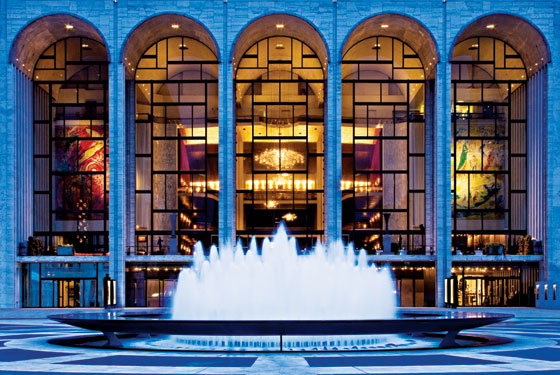
You can read the tug-of-war between monumentality and openness in the architecture. Philip Johnson turned the State Theater (now the David H. Koch Theater) inward, focusing attention on the ample promenade and the auditorium’s gilded ceiling, and fronting the avenue with a featureless slab. Max Abramowitz conceived of Philharmonic (now Avery Fisher) Hall as a luminous box inside a cage of slender columns. For the Met, Harrison was forced to tamp down his desire for an exotic arrangement of barrel vaults and sweeping forms, and instead produced a simpler structure with a spare arcade and a cramped lobby. The years have cloaked Lincoln Center’s disparate parts in the illusion of harmony, but beneath the patina is an enforced collision of aesthetics, glued together by budget cuts and compromise.
The task of rejuvenating the aging complex has fallen to the firm of Diller Scofidio + Renfro, who got the job because they weren’t itching to tear the whole thing down and start from scratch. Instead, they are treating the buildings with clarity, tenderness, and, when it’s needed, unsentimental rigor. West 65th Street is slowly donning a new identity as a livable thoroughfare, lined with marquees, theater lobbies, and a series of freestanding video screens parading down the newly generous sidewalk. The oppressive bridge is gone, to be replaced by a graceful glass-and-steel one. The route from city to box office will become a more festive procession. As for the plaza itself, the dancing jets of water in the sleeker round fountain have been choreographed by Wet Design, which built the aquatic spectacular at the Bellaggio in Las Vegas. (They’ve promised a more tasteful routine here.)
I am counting on these interventions to unmix my feelings about Lincoln Center. Eventually, I should want to arrive earlier and stick around after the final curtain. “I’m hoping there will be a shift toward a more social culture of theatergoing,” says the architect Elizabeth Diller. “And I hope that Lincoln Center’s public spaces become a destination, a scene.”
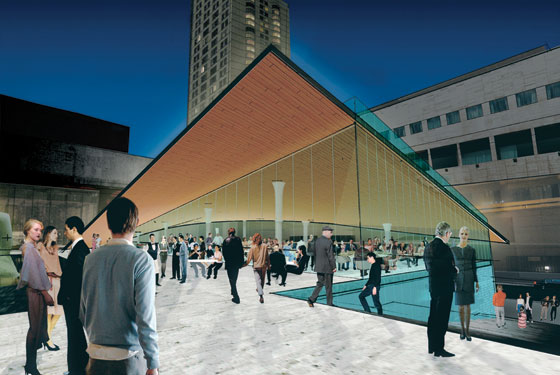
I tested that hope on a recent afternoon, pausing to join a lunchtime crowd on the bleachers in front of Alice Tully and hear an a cappella chorus. A couple of hours later, I stopped again to hear a brass band serenading Broadway. One day, I might even arrange to meet someone here for a meal, either in the restaurant that’s being inserted into the plaza in front of the Vivian Beaumont Theater or on the undulating lawn on top. The double-decker structure, designed as carefully for brown-bag lunches as for big dinners, is the renovation’s most aggressive act. The canopy dips to plaza level at one corner and rises to a peak at another, ravaging the minimalist symmetry of the old North Plaza. The sere garden that the restaurant replaces, by the landscape architect Dan Kiley, was a theoretical success and a practical failure—perfect, poised, empty.
In renderings, the new swooping green plane had a whimsical feel, like a fantasy of a flying meadow that would remain in the plans until some levelheaded administrator finally struck it. But there it is, cresting surreally above the construction fence. It reverses the relationship of enclosure to structure: This isn’t a restaurant with a green roof, it’s a rolling landscape enfolding a room. A stand of trees has been planted on the other shore of the reflecting pool, with a stone bench running along the corridor of shade. The new glade captures the mix of glamour and informality that the center always meant to foster.
Fifty is a tough age for a building: old enough for skin to slacken and innards to struggle, not yet venerable enough for immortality. But the anniversary coincides with a surge of Camelot chic, exemplified by the slick glamour of Mad Men, the stylish anomie of Revolutionary Road, and the fad for narrow-legged, thin-lapelled suits. At another time, the appetite for wholesale renewal might have proved irresistible, and we might have lost the chance to refresh rather than replace. Lincoln Center’s administrators might have voted to strip off the pitted travertine and replace it with more rugged limestone. They briefly considered draping the plaza in a rippled glass canopy like a permanent wedding tent. They could have followed the conductor George Szell’s advice when he first encountered Philharmonic Hall: “Tear it down and start over!” Instead, they decided to act radically at the margins.
The change is embodied, for me, by the new staircase that rises gently from Columbus Avenue. The old drop-off lane, a treacherous river of traffic that cut between stairs and plaza, has vanished, to reopen safely underground. The subtle alteration shows the care with which the architects are stitching the campus to the city and at the same time preserving its separateness. Now, once I cross the threshold, the pedestrian experience remains inviolate. I find myself slowing down. The rhythm of the stairs imposes a stateliness of pace. You can’t easily bound up them on the way to the box office, or thunder down to grab a cab. The staircase acts an anteroom, separating the fantastical realm of the stage from the reality lurking at the curb. When Lincoln Center opened, critics accused it of dowdy design, backward-looking values, and diluted modernism. Ah, but it was so much older then; it’s younger than that now.