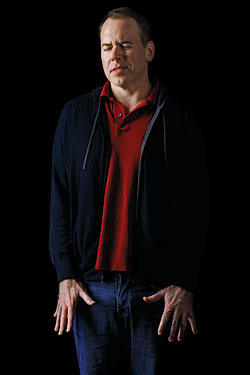
Coke for Bret Easton Ellis these days comes in those 7.5-ounce mini-cans—the new, vaguely European ones containing only 90 calories. This is what he offers me, taking one for himself, after inviting me into his apartment, which sits right on the edge of West Hollywood. The building is bland but the view is heady: a truly “epic view” that “reaches from the skyscrapers downtown, the dark forests of Beverly Hills, the towers of Century City and Westwood … ”
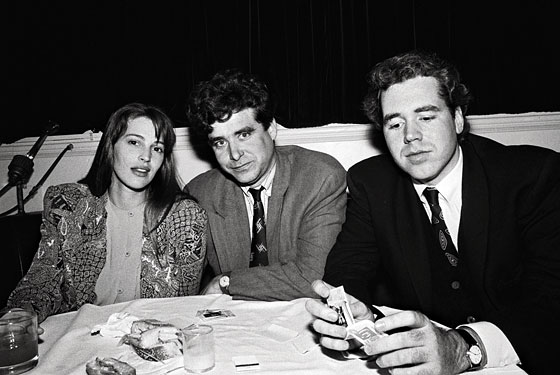
At least that’s how Clay, the narrator we first met in Ellis’s meticulously wrought 1985 novel of underparented anomie, Less Than Zero, describes the vista from his apartment in the author’s latest book, Imperial Bedrooms. The distinction between what the author lightly fictionalizes and what he invents entirely has always been beguilingly blurry. Zero, and the equally bleak and rambunctious follow-up Rules of Attraction, were sexy, and Ellis and his literary party pack (fellow young novelist Jay McInerney, editor Morgan Entrekin) were too; he gained the sort of celebrity few young writers ever manage (or, these days, seek: Can you imagine Jonathan Safran Foer zonked out from clubbing, blood gushing from his nose?). His last book, Lunar Park, is even narrated by “Bret Easton Ellis,” and includes a satirically nostalgic look back at boldface literary precocity: “It was always the A booth. It was always the front seat of the roller coaster. It was never ‘Let’s not get the bottle of Cristal’ … It was the beginning of a time when it was almost as if the novel itself didn’t matter anymore—publishing a shiny booklike object was simply an excuse for parties and glamour.”
Today, Ellis, who’s 46, refers to that era, with a touch of irony, as “Empire,” which is a reference to Gore Vidal’s definition of global American hegemony. Ellis dates this period from 1945 until 2005. “We’re in the post-Empire world now. Or we might even be going further than that to a dystopian world; I don’t know,” says the wary but gentle-looking Ellis, who is barefoot and wearing a blue hoodie. The question preoccupying the author now is what post-Empire Ellis means. On his Twitter feed, he defines it in terms of pop culture, as if it were a charticle in a magazine. Post-Empire is Shia LaBeouf, Lady Gaga, Twilight, Trader Joe’s, and Kick-Ass. Empire is Bruce Willis, R.E.M., New York, the Polo Lounge, Veuve Clicquot, “the U.S. reaction to Kick-Ass.” Which is where Imperial Bedrooms comes in. It’s set 25 years after Zero, and is advertised as a sequel. As Knopf puts it in the publicity materials, “The story continues …”
But it doesn’t, really. In the new book, Clay is also 25 years older and a screenwriter who has just returned to L.A. from exile in New York (yes, he lived where Ellis lived, too, in the Silk Building just south of Union Square). Here on the West Coast, Clay is confronted with the whole entangled, entitled gang from that first book, all grown up now but still without much of a sense of humor (or proportion) about anything. But beyond the two books’ shared tone of gothic nihilism, Imperial Bedrooms is in many ways the opposite of Less Than Zero, which famously began: “People are afraid to merge on freeways in Los Angeles.” Everyone in Imperial Bedrooms, especially Clay, who falls abusively in love with a woman who thinks he will make her famous, wants desperately to connect.
“Minimally decorated in soft beiges and grays with hardwood floors and recessed lighting,” is Ellis’s description of Clay’s apartment, or in fact his own. It looks very much like an extended-stay hotel room; Ellis bought it when he moved back four years ago, intending to stay only long enough to find the right house (he sublet the New York apartment). But the market dropped and he’s still here. When I arrive a bit after five in the afternoon, a slight, arty, twentysomething guy is slouched on the sectional sofa, watching a cartoon on the big TV, a guitar leaning next to him. We chat, but Ellis doesn’t introduce us. In 2004, nearing the end of the Empire era, Ellis’s longtime boyfriend, Michael Wade Kaplan, died of a drug-related heart attack, at 30. Ellis has always been squirrelly regarding what he calls “the gay thing,” and professes to me a certain sympathy for the pragmatic Hollywood closet. Or as he wrote in the semibiographical part of Lunar Park, “I was a mystery, an enigma, and that was what mattered—that’s what sold books.” In that novel, “Ellis” has a wife and kids; his characters are primarily straight, though decadently bisexual.
The apartment came decorated, and it hasn’t been touched since, right down to the still-empty floating shelf by the front door. It does, in fact, seem like a “good place to hide,” as Clay says in the book. After moving in, Ellis realized he could see the Century City penthouse where his father lived after splitting with Ellis’s mother. He points to the building from the living room window, then leads me, mini-Coke in hand, down the short hallway to his office, which is occupied mostly by a large glass-topped desk and two silvery Macs. Behind the desk, partly obscured by the computers, he leans back and steeples his fingers over his lips, as if interviewing me for a job. The bookshelf over my right shoulder is small and contains the very books you’d expect him to have read: Lost Illusions; The Man Without Qualities; Absalom, Absalom!; Play It As It Lays. There’s a pot pipe shaped like Homer Simpson’s head on the table to my left.
“I did not want to write a sequel to Less Than Zero, but I was interested in, well, where is Clay now and what is he doing?” says Ellis. “And it just sort of haunts you. The question doesn’t go away. You can tell yourself, Look, forget about it, concentrate on something else, but it just doesn’t happen. So then you start making notes, you start going, Well, I guess he’s a screenwriter. What does that mean? I guess he’s back in Los Angeles, right? And then you want to follow it through, regardless if it is for a reader or for an audience. Regardless of whether this is a betrayal of the text of the first book or not. It’s something that you as a writer really don’t have a whole lot of control over.” Besides, “I think Less Than Zero is something that really can’t be fucked with, in a way. It has its reputation. I don’t think the sequel is going to mess it up.”
Haunted is a good word for Ellis, who has a penchant for prelapsarian longing, not unlike his friend and literary inspiration Joan Didion (“I would rewrite paragraphs of hers just to see how she would do it”). Some notion of looking back was even in Less Than Zero—its italicized portions recalled Clay’s family and childhood—and that was published while Ellis was still a junior at Bennington. Of course, a great deal has happened to him since then. His bloody, and brand-dropping, third book, American Psycho—a novel that “came out of this kind of anger I had about … ‘Oh, this is the world of adults’ ”—turned into an object of widespread opprobrium. His first publisher, Simon & Schuster, killed the book after Spy and Time magazines trashed it; Vintage then picked it up. But to hear Ellis talk about the novel’s creation, it was all pretty innocent. He’d been hanging out with Wall Streeters, hoping to be inspired for his next book, “and it wasn’t interesting at all. Then there was one dinner with these guys that I had met through friends, and I realized, wait a minute, one of them is a serial killer, and then the book took off from there. And I thought, Okay, it’s going to be funny too, and maybe a little scary.” Of course, the scandal helped its sales, and, like Less Than Zero, it not only turned into a stylish movie, it came to define another era of extremes.
These days, Ellis makes much of his living writing for Hollywood—script polishing, for the most part, but he also has shows cooking for HBO and Starz, and a film with Gus van Sant, based on the lives and suicides of the artists Theresa Duncan and Jeremy Blake. Imperial Bedrooms was, in a way, a side project. But it’s also part of the processing of his past, and of his return to L.A., where his friends are “directors, actors, producers, people I’m involved with in various projects,” he says. Ellis has always been seduced by money and fame, and that hasn’t changed. “Maybe it’s a weird strain of anti-intellectualism,” he says, but if given a choice he’d rather “hang out with Rob Pattinson than Richard Ford.” Or maybe it’s simple insecurity. He leans over and opens a drawer and asks if I mind if he smokes. One of the things he likes about L.A. is that “it’s easier to drift around out here … if you don’t feel that you’re that smart.”
“Maybe it’s a weird strain of anti-intellectualism,” but “I’d rather hang out with Rob Pattinson than Richard Ford.”
Unlike Clay, “I’m not a ‘successful screenwriter,’ ” says Ellis. “I’m not being asked to write the reboot of Predator or whatever. Clay has the big studio gigs, he has all the right kinds of connections, and the right movies with titles like Adrenaline.” There’s a droll whiff of envy in Ellis’s voice. Right now, he and Van Sant are having a hard time getting their movie made. “You can imagine what trying to sell a movie about two people killing themselves was like. It was a highly comic movie in its own right. And everyone said, ‘Oh, we’d love to see this movie, we just don’t want to pay any money to see it through.’ ” (It’s in development.) Van Sant, meanwhile, was trying to get the gig to direct Twilight. “You can make a lot of money doing that,” Ellis whispers, so lightly that it doesn’t get picked up by my tape recorder.
When he was outlining Imperial Bedrooms, Ellis was reading Raymond Chandler. “I was thinking about the Hollywood novel, and the Hollywood myth of exploitation. People using each other.” As he sees it, the issue with Clay “has to do with narcissism. I was very interested in the question of what happens when a narcissist hits the wall? And what happens when all the tricks he’d been using, or all the things that were fulfilling, were feeding his narcissism, weren’t working?”
For all the hedonism in his novels, Ellis is a moralist. We talk about how people have misconstrued his satiric violence as gleeful wallowing, his bleakness as nihilism, rather than injury. “Not being able to find meaning can be just as powerful as finding meaning,” he says. “Numbness is a feeling. Being numbed by something is a feeling. That’s like people who argue against Minimalism, who reject Warhol, whatever. It’s something that a lot of people just don’t … grasp, or can’t emotionally connect to. If there’s a power to it, it’s … I don’t know. Well, it’s a cumulative sense of horror.” Then he stops. “I can’t talk about my books that way.”
He has another cigarette, and shifts around in his chair. The sun has started to go down, and the room, once awash in California light, is darkening; it’s almost eight. I ask him about the dead boy who haunts Clay’s apartment—this apartment—in Imperial Bedrooms. “It’s almost an essay question,” he responds. “For me to answer it would be like, Oh, is it his youth? Is it Clay’s youth haunting him? Blah blah blah.” He pauses. “To start talking about it, to me, is not productive.”