Here’s a timely operatic plot: When the mortgage on an oversize dream house proves unaffordable, the owner has no choice but to raise more cash by plundering little people, triggering a tsunami of greed that eventually results in global calamity. That synopsis, give or take a dozen subplots, helps explain why Richard Wagner’s fifteen-hour, four-part “Der Ring des Nibelungen” always feels current. Even with its cursed baubles, wrathful giants, and shape-shifting gods, Wagner’s “Ring” cycle remains a deeply modern work. Mesmerizing to many, horrifying to some, it is essential even to those who know it only from “The Ride of the Valkyries” in Apocalypse Now, or the Bugs Bunny version (“What’s Opera, Doc?”) that dispatches the whole story in under seven minutes.
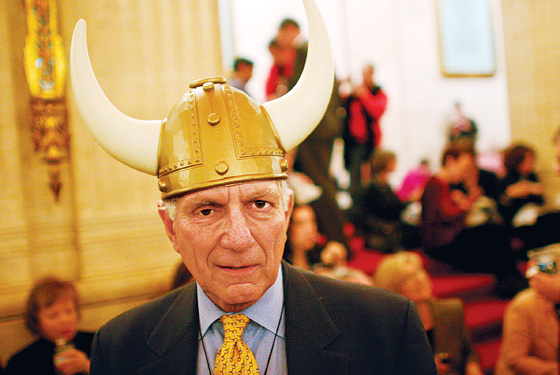
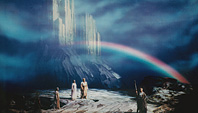
The four separate works—Das Rheingold, Die Walküre, Siegfried, and Götterdämmerung—return to the Metropolitan Opera over the next two months in the final outing of Otto Schenk’s production from the late eighties. (In 2010, the company will start rolling out a wizardly, high-tech version by Robert Lepage.) Schenk’s is one of the last of the old beard-and-breastplate extravaganzas, and zealots from across the planet are converging on Lincoln Center to mark its retirement. Some will attend in tuxedos and horned helmets, and perhaps take the Wagner Society of New York’s river cruise, “Rhine Journey on the Hudson.” This is the high-culture equivalent of a Star Trek marathon.
Chris Whitaker, a retired Australian port executive, is making the pilgrimage from Perth for the first of three “Ring” cycles he’ll attend this year: After New York comes Vienna, then Seattle. “The music is addictive,” he says, “but you can go beyond the music into the depths and layers of meaning. My wife’s been discovering the theme of Buddhism that runs through some of the later works. Just when you think you’ve got your brain around it, you listen again and you think, I’ve never been aware of that before. It’s like looking at a mountain from different sides.”
Wagner did his best to instigate a cult of himself, and was spectacularly successful at it. With the backing of his feverish—and addled—admirer King Ludwig II of Bavaria, he built himself a temple-cum-theater in the village of Bayreuth. He designed the Festspielhaus around the “Ring’s” extravagant theatrical demands, and founded a summer festival that is one of music’s meccas. Penelope Turing, an octogenarian British writer, has become mildly famous for having attended every Bayreuth Festival since the early fifties. (Asked by an interviewer from WagnerOpera.net about her first Die Walküre, she recalled that she went home “dead drunk with the music. I remember an hour sitting on the side of my bed.”) Devotion requires patience: The waiting list for single tickets runs to roughly a decade.
Within a few years of the composer’s death in 1883, the mania had spread so decisively that Wagner nights at Coney Island’s 3,000-seat Brighton Beach pavilion regularly sold out. Gilded Age audiences got a heavy diet of Wagner at the Met, which went so far as to present French and Italian composers’ works in German translation. Today, there are Wagner societies in New South Wales, Hawaii, South Africa, and Abu Dhabi, whose members organize their travels around productions of the “Ring.”
The wellspring of all this obsessive energy is a fog-shrouded landscape of Icelandic myths, populated by so many characters that a synopsis reads like gibberish. As in Greek tragedy, family dysfunction acquires epic grandeur. The god Wotan and his spouse Fricka play out their disputes on the destinies of two golden siblings, Siegmund and Sieglinde, who consummate an incestuous romance. The prolific Wotan’s offspring also includes a gaggle of ferocious sisters, the Valkyries (Walküre), who ride winged horses up to their peak-ringed perch. Wotan punishes his favorite, Brünnhilde, by imprisoning her in a ring of flame. The mix of mythology and pathology is so ripe for satire that the surest way to mock the entire art of opera is to invoke a spear-wielding shrieker from the “Ring.”
Wagner has always attracted scorn and rage as well as reverence, sometimes all from the same people. Friedrich Nietzsche swung from worship to late-life rejection. “Wagner is a great corrupter of music,” he wrote. “He has discovered in it a means to excite weary nerves—and in so doing has made music sick.” I have inherited this supercharged ambivalence. Each time I return to this vast work, I thread a path between fanaticism and disdain. I find it as seductive to mock the Ring’s grandiloquence as to abandon myself to its riptides. But to take the drama seriously and still hold on to my misgivings, to bathe in Wagner’s music without being pulled under—that’s an act I haven’t quite mastered.
Neither Star Wars nor The Lord of the Rings could have been conceived without Wagner’s precedent, and it’s no coincidence that all three attract a crazed allegiance. But the “Ring” cycle depicts a more complex and human world. Good men win the wrong battles, heroes follow misconceived advice, and leaders strike disastrous deals. We see Wotan first as a swaggering figure, but he is almost immediately entangled in his own arcane rules of destiny. His authority erodes and Wagner’s magical universe, like our own battered planet, experiences a crippling loss of confidence. Eventually Wotan, too, falls victim to an apocalypse he cannot prevent. The “Ring” is the most pessimistic of sagas, a fable of total annihilation.
This perpetually urgent tale is bundled with some toxic themes. Mystic nationalism rooted in hoary myth, purification through violence, and virtue based on bloodline all come together in the character of Siegfried. Like his creator, the fair-haired naïf has an unpleasant streak: arrogant, narcissistic, sneering, and given to unthinking rage. He first appears kicking around the craven, cringing blacksmith-dwarf who raised him: Mime, who tries vainly to forge a sword that the muscular boy can’t break. Eventually, Siegfried does the job himself by melting down the shards of his shattered ancestral weapon called Nothung and hammering it back into invincibility. Having reclaimed his heritage of lethal pride, he is ready to do some slaying.
I find myself simultaneously stirred and repelled by Siegfried. Who doesn’t crave a superhero—especially now? The score, heavy with purpose, propelled by an urgent bass line and sparking fanfares, galvanizes the scene of violent renewal. Yet we are also witnessing a terrible coming-of-age: the transformation of an innocent into a mighty man filled with ignorant righteousness. Siegfried embodies conviction without knowledge, courage without compassion, desire without empathy. He is deeply dangerous.
Wagner identified powerfully with Siegfried, calling him “The Man of the Future,” which is also how the composer thought of himself. (He gave the name Siegfried to his only son, whose arrival he explained to his not-yet-wife Cosima by saying, “The world spirit wanted me to have a son by you.”) Just as his young hero used his new sword to split the anvil on which it was forged, Wagner shattered customary operatic practice, dispensing with discrete arias followed by pauses for applause. Instead, he wrought a seamless fusion of all elements: To dramatize Norse myths, he created a pseudo-archaic form of German, whose cadences dictated the stately melodic lines, which in turn flowed together into endless scenes. The “Ring” was an assertion of revolutionary freedom germinating from ancient roots.
Having armed his hero and given him purpose and a destiny, Wagner led him to the dragon’s forest lair—and then put down his pen. The interruption lasted seven years. I like to think that Siegfried’s creator was troubled (as I am) by the shining pure-blooded killing machine he’d created. Another generation of German revolutionaries had no such qualms about the idea of a dazzling, final apotheosis. Adolf Hitler felt at home in Bayreuth. He loved Wagner’s town, his operas, his family. So strongly did he feel about Wagner’s vision of German national mythology that he conflated the composer’s cult of personality with his own, turning Bayreuth into a showcase of Nazi pride. Sometimes Hitler even tinkered with designs.
Wagner’s anti-Semitism generally gets the blame for the association between his work and the Nazis; it’s the principal reason that his work is still virtually banned in Israel. Certainly his hatred of Jews was real, lifelong, and central to his worldview. Refusing to see that hideous aspect of his operas is an act of willful self-delusion. But a far more central cause of Hitler’s adulation is what draws the rest of us in: the coercive rapture of the score. Wagner at his most fervent summons white-water rapids of music, bearing the listener along with its roiling energy.
He achieves this power to bypass the mind partly through his use of leitmotif, a melodic phrase or harmonic move associated with a narrative element. There are leitmotifs for individual characters, abstract concepts (like fate, a curse, or oblivion), props (sword, ring, helmet), and plot events, and they all recur and recombine. Committed Wagnerians study them with ornithological thoroughness, learning to recognize and catalogue the enormous array of musical shards.
The leitmotifs take on added potency when they float on what Wagner called a “sea of harmony,” a current of immense power and inexorable direction, with no apparent beginning and no clear end. It is the musical equivalent to pronouncing, slowly but with rising urgency, the phrase, “I want you TO …” and then waiting, leaving the ear primed for a verb, craving the relief of unambiguous meaning. Wagner keeps withholding the missing piece even as he multiplies desires, spinning out minute upon minute of music that rushes from one expectation to the next. Harmonic sequences, stretched from momentary passages into panoramic lengths, become at once epic and erotic.
The interaction of melodic strands suspended in liquid harmonies is calculated to bypass the brain and become a physical experience. The effect is dreamlike—a constant series of partially grasped memories. The eternal and the hectic overlap. This, I think, is why some people are so allergic to Wagner: They either are immune to its narcotic quality or they resist it with all their might.
The “Ring’s” ability to hot-wire the emotions has provoked suspicion since it was new. When it landed in America in 1889, the New York Tribune critic Henry Krehbiel pointed out that the critical mind was an impediment to full enjoyment. Instead, he advised the brave to plunge into Wagner’s world “with a fixed resolve to keep a tight check line on the rational faculty and give free rein to the imagination.” Yet even as he advocated letting go, the critic seemed discomfited by the implications of that advice. I’m just as torn. I adore the “Ring,” but immersing myself in it involves a battle between reason and impulse, and I’m never sure which side I’m rooting for.
Around the “Ring”: A History
1813
Richard Wagner wills himself into existence.
1853–1857
Steams through the composition of Das Rheingold, Die Walküre, and the first two acts of Siegfried before hitting a wall. It’ll be seven years before he picks it up again, and 25 years altogether before he’s done.
1876
Wagner opens the Festspielhaus in Bayreuth with the first complete “Ring.” Critic Eduard Hanslick writes: “Who could endure four consecutive evenings of this exaltation?”
1883
Wagner dies, and his wife, Cosima, takes over the Bayreuth Festival. Viking horns, paste-on beards, and ropy wigs become the standard getups.
1889
The “Ring” arrives at the Met, abridged to suit the American attention span.
1906
Cosima retires, and son Siegfried takes charge. His namesake kills freely, and falls for a Valkyrie; the real Siegfried avoids contradicting his mother and is gay (but marries anyway).
1930
Siegfried dies, leaving his wife, Winifred, to run Bayreuth. She happily Nazifies the festival and cultivates Hitler, whom her children call “Uncle Wolfie.”
1941
The tenor Max Lorenz is a great Siegfried—and is bisexual, with a Jewish wife. Given a choice of sending him to the death camps or letting him sing at Bayreuth, Hitler chooses the latter.
1945
Wagner’s legacy is tarnished, his theater ruined, and Winifred is in disgrace. Bayreuth falls silent …
1951
… until her son Wieland Wagner rebuilds, opening the house with a highly abstract production bathed in Rothko-esque colored light.
1966
Wieland dies. His younger brother Wolfgang will run Bayreuth for the next 42 years.
1976
In Bayreuth, the director Patrice Chéreau offers a “Ring” that opens not on the timeless Rhine but at a hydroelectric dam.
1989
Otto Schenk’s production at the Met, with prop rocks and Day-Glo rainbow set, is so visually hidebound that it’s practically avant-garde.
2008
Wolfgang Wagner retires, leaving the family legacy to relatives who never sat on Hitler’s lap.