
The China-red signboard in the mauve marble lobby of the Imperial Theater does not reveal, until shortly before the house opens for each performance of Billy Elliot the Musical, who will be playing Billy. Often enough, the three boys sharing the role will have only recently received the news themselves, as the schedule is constantly being rejiggered based on their health and readiness. However nervous this makes them—and just before curtain they are sometimes nearly hyperventilating—onstage they give startlingly confident, and different, performances: one suave and beamish; one brooding and heartbroken; one blisteringly angry, dancing as if his limbs were bats cracking baseballs out of the park.
But at the dinged-up stage door afterward, the scene is always the same. Actors emerging there face a kind of perp walk, penned in by barricades that keep fans, with their complicated emotions, at bay. Also kept at bay is a group with even more complicated emotions: the parents. Forbidden to enter the theater except in the usual way, with a ticket, they must await their little stars at a distance.
It is not because the production fears the intrusive wiles of stage mothers that it enforces this segregation; it is the sheer numbers. The 51-person cast includes 23 kids, 15 of whom appear in each show. No stage mother worth the name would waste her efforts on Broadway these days anyway; there’s too little reward. (Madame Rose herself would be off to California in search of a movie, or at least a reality show.) Rather, the mothers (and fathers) of the cast are mostly there at their children’s behest, having been turned by them into humble sherpas, lugging wheelies of dance gear to the theater and saying good-bye just shy of the mountaintop. It’s the show’s job to take the kids the rest of the way. Indeed, a significant part of the $20 million capitalization for Billy Elliot’s Broadway incarnation (the London production continues strong in its fourth year) pays for the huge in loco parentis apparatus that is responsible for training, educating, and minding its minors from the time they arrive for rehearsal in the morning to the time—as much as twelve hours later—they are returned to the real world outside.
After evening shows, that handover begins at 11 p.m., when seven child wranglers (technically called guardians so as not to suggest the use of cattle prods) start pairing their charges with the appropriate adults. On October 8, a week into previews—the official opening is November 13—the first to emerge was one of the youngest: 7-year-old Mitchell Michaliszyn, who plays the lollipop-sucking Small Boy at alternate performances. He was already wearing his SpongeBob pajamas, and jumped right into his father’s arms. A gaggle of so-called Ballet Girls came next, posing for cell-phone photos and slowly walking the gauntlet toward their folks. Soon a cheer went up, though if you weren’t in the front row, you wouldn’t have seen that it was because Trent Kowalik, who is four-foot-eleven, had stepped onto the sidewalk. A freckle-faced 13-year-old from Wantagh, Long Island, Trent had already played Billy for six months in London, but tonight was his Broadway debut. Joy wafted off him like an odor. When an older girl asked him to sign the T-shirt she was wearing, he threw his mother, behind the barricade, a thrilled, goofy look that seemed to say, “Can you believe it?”
Lauretta Kowalik, dressed in a tweedy jacket over a long brown linen dress, smiled briefly. For her, the whole experience was hard to believe. To begin with, she’d barely seen Trent in days; she and her husband had rented an apartment near the theater so he could catch a few extra hours of sleep (under the eye of an older sister, in college nearby) instead of racing to the Long Island Rail Road station each morning.
As a result, she and her only son lived in separate worlds. And Trent’s world was so extreme. He had always been a wonder, winning Irish-dance championships since he was 5, but now he had landed the title role (or one-third of it, anyway—he is the brooding, heartbroken Billy) in the biggest new musical of the season. More than that, it was a once-in-a-generation role for a boy, as Annie had been, 30 years ago, for a girl. Yes, there are lots of kids these days on Broadway: Gypsy has seven, Spring Awakening eighteen, and minors make up the entire company of 13. But the young actors in those shows share the burden of the storytelling with adults or with each other. In Billy Elliot, the drama is squarely on Billy’s narrow shoulders. He stands at the intersection of its two central questions: Will Maggie Thatcher crush a northern-English coal-mining community, circa 1984? Will that community’s philistinism crush the boy who, in the aftermath of his mother’s death, discovers his improbable love of ballet?

The drama demands so much of a young performer—emotionally, vocally, physically—that it hardly seems sane to have tried telling it onstage. Billy goes full tilt for all but two scenes. There have been many injuries, and it has often happened, including to Trent in London, that a boy finished Act I but could not go on for Act II. Even leaving the role can be traumatic. (All Billy contracts include a termination clause that can be triggered by a growth spurt or change of voice.) James Lomas, who after a year of training lasted only six months in the West End production before his voice dropped and he “got muscles,” found life back home in Sheffield a lonely nightmare. He later returned to the show part time as a stagehand. Lomas says he is happy now, with a girlfriend, a flat, and Elton John, the show’s composer, helping to finance his education.
In response to such cases, the producers hired a social worker who not only counsels the London Billys during their employment but also provides “aftercare” when they age out. She may help find an agent, a ballet school, or just a way to relinquish stardom. Still, all Billys dread the day their adolescence becomes undeniable, notwithstanding (or perhaps because of) the onstage ceremony in which they are handed back to their families, with parting gifts.
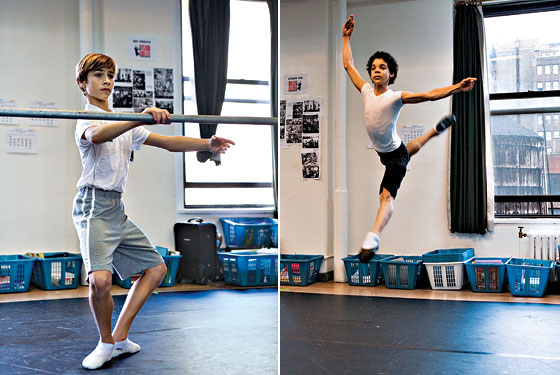
Boys are ordinarily eager to adolesce. Billy himself says, “I don’t want a childhood.” But Trent and his co-stars—Kiril Kulish and David Alvarez, both 14—emphatically do not want to grow up just now. Nevertheless, and despite their smooth skin and still-passable sopranos, they are shadowed by a premonition of their older selves. The show makes the point impossible to miss. During the climactic Swan Lake pas de deux, Billy is spun high in the air (in a flying harness) by a hunky danseur noble identified as Older Billy; it’s a Peter Pan fantasy of being suspended, blissfully if temporarily, above the sweaty world of adults. And yet to maintain that fantasy, as the show requires, a preadolescent is asked to perform as strongly and reliably as those sweaty adults. This creates some contradictory incentives. Wearing a tank top at acrobatics class one day, Trent glimpsed his strawlike arms in the mirror and, thinking more like a self-conscious teenager than an actor playing an 11-year-old, started banging out push-ups.
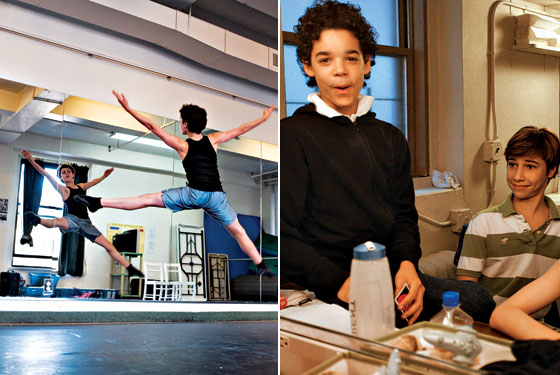
Puppyish in repose, the boys are nevertheless fierce workers. (“Usually, they have to be declared legally dead before they stay home,” says Robert Wilson, the head guardian.) Kiril and David, international prize winners in ballet, are honing their tap and acrobatics. Trent, superior in these, is upgrading his “horrible” pointe. Their different strengths (and the different ways the show deploys them) diffuse their competitiveness; they are endearingly gaga over each other’s abilities. (“David’s turns look really classical!” “Trent’s tap is amazingly fast!”) Yet they are all similarly inured to the ickiness of being constantly examined, touched, palpated, corrected, and even (by nondancing acquaintances) mocked. They power past all that as they power past exhaustion. The morning after his Broadway debut, Trent still had to rise from the air mattress on the floor of his new apartment for a full day of class and rehearsal.
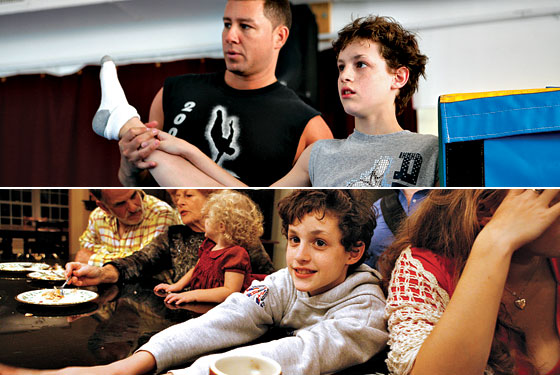
As he did so, the other two Billys would be preparing for the same kind of schedule. In a high-rise on 42nd Street, Kiril, the suave and beamish Billy who had moved from California with his mother when rehearsals began, would fold up the sofa bed, scarf down his egg whites, and squeeze in perhaps 30 minutes of piano. (The piano is about the only non-bed furniture in the apartment.) In the East Nineties, David, the blistering Billy with a mop of black curls, would wake up in the room he shares with his 10-year-old sister, Maria, and his G.I. Joe action figures. He would probably already have missed his father, who sometimes returns from work at night to find David sitting in front of the news in frog position, conked out but limber.
To some parents, this would no doubt be a terrible picture: overworked, overdriven kids living adult lives in an artificial world. But as the Billy parents see it, their sons are experiencing the pleasure and utility of their gifts to the fullest extent; they are never bored or idle but, rather, devoted and fulfilled. What’s odd is that the three families came to that conclusion (and thus to Manhattan) from enormously different premises. Their roots couldn’t be further removed: in cul-de-sac suburbia, in exilic post-Soviet Jewry, in Cuba by way of Montreal. They speak different languages, at least at home: English, Russian, Spanish. And yet, like Lauretta, they each seem awestruck by their son’s talent, if not by the sons themselves. It’s as if someone had handed them the Hope diamond and said, “Here, take care of this, would you? For a while?”
* * *
What would you like to do if you got a few days off?
David: I want to sleep! And then after fourteen hours I want to go out with my family.
Kiril: Anything but sleep. On a Sunday even now I wake up early and go out and play sports. Except I can’t play sports because I’m in the city.
What else do you miss from normal life?
Kiril: I have a totally normal life. This is what I like to do.
But like video games, TV, homework …
David: No video games. That’s a waste of time.
Kiril: I hate watching TV. I hate watching movies.
David: Oh, come on! You gotta start. Now.
Kiril: I do miss In-N-Out Burger!
David: Yeah. I want to sleep more and eat a lot of cheeseburgers.
Kiril: They’re scrumptious. There was one next to my ballet studio in San Diego. I’d go four times a week.
David: How are you ever in shape?
Kiril: Thanks a lot, David!
David: They have so much fries it isn’t funny! I would get fat if I ate that way.
Kiril: Me too.
Trent: I get so much exercise I’m not afraid to have five bowls of ice cream. Either cookies and cream or mint chocolate chip, but it has to be the green kind, because if it’s not green, your brain doesn’t know there’s flavor.
Kiril: I miss biking or running on the beach.
Trent: I miss playing basketball with my friends, but everyone’s scared of getting something injured. It’s crucial that everything is intact.
David: Yeah, I’m not allowed to bike. My mom is afraid I’ll break my leg. Or Rollerblade. She doesn’t let me do anything.
Does that bother you?
David: Huh? No. As long as I do what I love.
Kiril: Me too.
And where does that come from, “what you love”?
Kiril: It comes from me.
In the 29th-floor lounge of the glassy new building in which she and Kiril have rented an apartment, Raisa Kulish seems perturbed in a grandmotherly way (though she is only 54) that no one will eat the free schnecken. A concert pianist in Ukraine, she’d left everything behind when she emigrated, in 1989, along with her husband and two children—Victor, now 31, and Beata, 27. They settled in La Jolla, near San Diego, where Kiril was born five years later. Though he has the bright blond cheer of a surfer dude, there is still something Old World about him: a sense of high purpose and discipline.
Raisa herself seems to have been quarried from the Pale. When Kiril’s dance training, which started when he was 5, began to interfere with his schooling, she simply home-schooled him. By the time he was 10, their daily schedule involved leaving home at 4 a.m. to get to Los Angeles for his ballroom-dance class. After that he sometimes had auditions (he’s made several commercials) before heading back to San Diego for ballet from four to eight. Then home to bed. “Is okay,” Raisa explains. “He can eat and read and study during the car rides.”
Kiril didn’t mind—he never complains about anything—though it’s hard to see how it would have mattered if he did. “No, a child doesn’t always want to do it,” Raisa says, “but if you make it mandatory he will. This is the key. Brushing teeth isn’t optional! No one asks if math is optional! They are mandatory. It’s the same with music, with dance. American parents say, ‘Would you like to do this, honey?’ They don’t say, ‘Would you like to do math?’ But we take him to ballet class not because we think he will fall in love with ballet but because we love ballet. If he will love it, that is up to him, but at least he will be cultural. And we are lucky, he loved it right away.”
If Kiril was a Billy waiting to happen, the problem for the production was how to find him. Starting in October 2006, Nora Brennan, a casting director and former Broadway dancer, held auditions in eight major American cities, sending out 4,500 flyers to all the dance schools within a four-hour radius of each. Because of the skill requirements and the narrow parameters of age and height, they’d usually get just a few dozen boys per city, of whom only a handful made it to the end of the day. In June 2007, fifteen finalists from these auditions were invited to New York for a ten-day callback process the boys called an “intensive,” perhaps because there was reportedly one fistfight. It wasn’t until months later that Kiril and David got the good news. (Kiril’s family went to the Cheesecake Factory to celebrate; David’s to Pizzeria Uno.) But Trent was confused to learn they wanted him sooner—and in London. “My mom was thrilled,” he says.
The creative team, on the other hand, was dismayed by the choices it had to make, sometimes because a boy’s personality was too shellacked (“Like they were ready to open in Annie tomorrow,” says David Chase, the music director) and sometimes for no better reason than that he was clearly on the verge of puberty. Even Kiril, David, and Trent were a risk. Their voices were evaluated for signs of cracking. Their parents were subtly examined for clues to their eventual stature.
Stephen Daldry, the director of both the original film and the musical, has so far worked with 29 Billys, becoming quite attached to them all. “If you were of this mind,” he says, “which I’m not, you’d calculate frantically what you’re investing in each child—say, $100,000—and you may only get four months out of him. Because of that, you have to make sure that the process is life-enhancing in its own right, not show-dependent, which is why we give them one-on-one training with some of the leading professionals in their fields. It’s one long, extended theater-schooling program. The kids do understand the risk involved, but you have to keep telling them.”
Still, a Broadway show doesn’t take chances. The Billy on the logo is not Trent, David, or Kiril but a boy from the London cast. The Billy standby, Tommy Batchelor, is a young-looking 13, with a lime-green retainer case on a chain around his neck. And Nora Brennan has started another round of auditions, to keep the pipeline of Billys flowing. Amazingly, there are more to be found—a fact that parents of ordinary mortals find hard to believe. Haydn Gwynne, who has played the acidulous dance teacher of ten Billys so far, has sons of her own, ages 8 and 10. “Their greatest ambition right now,” she says, “would be to run a sweetie shop.” She remains astonished by her young co-stars’ drive and focus.
“Maybe it’s because no one makes them do it,” she adds; maybe it’s because no one stopped them either. “All I know is that they don’t seem fucked up. Of course, I’m not going home with them after the show.”
I’m sure my voice will break, but the more you start thinking about it, the more you might make it happen.
Those who do aren’t taking limousines. The Billys earn about $1,700 a week—a little more than Equity minimum. The Coogan Act (named for the child actor Jackie Coogan, whose millions were frittered away by his parents) requires that 15 percent of that salary be set aside in trust. With all the usual deductions then deducted, Kiril’s paycheck is barely enough to cover the rent on the one-bedroom apartment.
“He doesn’t think he sacrifices,” Raisa says, “but I had to totally give up my life. Quit my teaching, move my house, leave my students.” (She has also separated from her husband, who remains in California.) “But you love to sacrifice if only he will be happy. And he is happy. Every night, he come home so inspired. He has no strength to talk, but I see it. He is enriching his personality in an incredible circle that he admires. Stephen Daldry is just genius. He got Oscar!” (Actually, just two nominations.) “I give him in wonderful hands.”
Kiril has wonderful hands, too. Back in the apartment, he plays the Chopin “Fantaisie Impromptu” on the spinet in the corner. Although he negotiates its tricky runs quite well, he stops partway through, dissatisfied. “My suggestion, Kirusha,” Raisa says equably, “is play something slow until your fingers warm up.” But by then Kiril has suddenly switched gears, to the striding swagger of “Ain’t Misbehavin’. ”
* * *
How much allowance do you get?
Kiril: I get maybe $10 a day, but that’s for my food.
David: Zero. No allowance. I’m not like American kids.
Do you consider yourself American?
David: Yes!
Kiril: But for us, instead of football or Disneyland it’s more like you have to get an education, do art. That’s what our parents say.
David: It comes from their not being Americans.
Kiril: It’s very European. They grew up going to the ballet, concerts …
David: See, the arts grew up in Europe. America just started in the 1700s!
Kiril: A lot of kids would love to be good at the arts, but their parents never introduced them to it.
David: American kids don’t have enough to do. But for me, to get what I want I need to step back and see what it takes to get there.
Kiril: My mom says in order for kids not to go bad you should be doing something 24 hours a day.
Why don’t most kids have that drive?
David: They’re lazy maybe? Or they don’t like it?
Kiril: A lot don’t get a chance to try anything new so they don’t know.
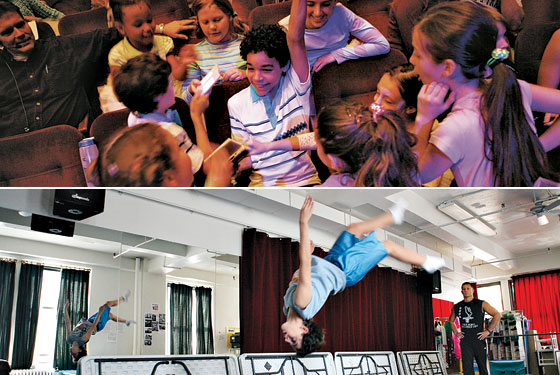
Trent: Some kids are going to do only what other kids are doing.
David: Also, maybe they’re not talented.
Trent: Everyone’s talented at something. My dad plays accordion. And if you work enough you can get what you want.
David: Maybe …
David’s parents met in Havana in 1991. Yanek, already a successful young actress there, was onstage when she spotted David Sr. in the audience. In one of their first conversations they confided their desire to leave Cuba, where his prospects as a young scientist seemed dim and hers as an actress limited; they couldn’t even read a Milan Kundera novel in public without wrapping it in a socialist magazine.
They developed a plan worthy of Lubitsch. Yanek would start a theater company whose sole, secret purpose was to get a foreign impresario to invite them abroad so they could defect upon arrival. For two years the troupe toured Cuban cities performing a play for Communist youth. David Sr., who appeared as “The Russian,” was terrible: “I was supposed to be funny but never got one laugh,” he says. Eventually, an invitation came from Montreal. Not until a day before their departure in July 1993 did they tell their parents the plan, which came with a terrible price. Though they could smuggle out their books as props in the play, they would have to leave everything else behind, including Yanek’s 4-year-old daughter from a previous relationship.
David Sr., 37, narrates this story in accented but very good English. He is small and adorable, like his son. Yanek, 40, only occasionally interjects, usually in Spanish. She cuts a more dramatic, voluptuous figure, dressed all in black, not like a New Yorker but like a character out of Chekhov or Lorca.
“It was four hours on the plane,” David Sr. continues. “We barely spoke; we just held hands. We didn’t know what would happen, or what to do once we got there. But the Canadians—we were shocked to hear them talking in French—processed us and took care of us. We were taken to a hotel on Ste.-Catherine Street, with lights and people and freedom everywhere. We had never seen a bank or a pay phone. In Cuba they say that in capitalist countries, people shoot each other in the street all the time. When we heard a car backfire, we thought it was a shooting. But we quickly realized that we were safe. Canada gave us welfare and sent us to school to learn English and French. I was so very happy! I was able to study and say and read what I wanted and move ahead in my work. But for Yanek … ”
Yanek looks away.
“It was not all happy. She could not really do her work in Canada, because of her accent. She had a … harder time integrating.”
Perhaps it was in some sort of sympathy that David, born a year after his parents’ arrival in Montreal, did not utter a word except mami or mima or meme until he was 5. They didn’t mind; he was very physical and communicated perfectly just using his body. That’s why they started him in ballet class, where he immediately flourished. When he did finally begin talking he had an accent that uncannily recapitulated his family history: French cadences overlaying Spanish consonants. He has been hard at work with the show’s vocal coach to remove it.
Used to starting over, the family—including Yanek’s daughter, retrieved from Cuba after two years—moved to San Diego in 2003, where David continued dancing. In 2006 he was offered a full scholarship to come to New York and further his studies at American Ballet Theatre. Soon after they arrived, Nora Brennan saw a picture of David on ABT’s Website and called to ask him to audition for Billy Elliot.
“At first we say no because it’s Broadway,” recalls David Sr., now an assistant professor of biotechnology at Kean University in New Jersey. “But Nora was insistent. ABT got in a panic because it would take his focus away. But Baryshnikov has done a Broadway show! So we said yes. It was a year of hard work. Sometimes he felt anxious because maybe they would say at the very end, ‘No thank you.’ Maybe because he was so quiet, or has an accent, or never studied tap. We comforted ourselves that even if he didn’t get it, it would have been worth it. But we really wanted it.”
When they finally got word, on March 1, Yanek turned to her son and said, “You look like Napoleon. Now you need to conquest.”
Their history has taught the Alvarezes that no gift is forever. Though they hope to spend some of David’s earnings on a bigger apartment, beyond that they do not make assumptions. David may be learning the same lesson. In accordance with industry standards, he spends fifteen hours a week getting what the tutoring company calls a “parallel education.” The ensemble kids are taught in a rehearsal studio ten blocks away; the seven principal kids in a grimy room above the Imperial’s lobby. During a recent giddy science class there, in which partially eaten atomic models (made from gumdrops) moldered in a corner, David was disappointed to find that the prize for winning a game of Elements Bingo was merely “a sense of achievement.” In English class, some of the boys were reading Flowers for Algernon, a book perhaps too on-the-nose, being the story of a childlike man with a gift that is immense, inexplicable, and fleeting.
“Even if he grows tomorrow,” David Sr. continues, “it will have been worth it because of what he’s learned from being pushed to his limits. But he doesn’t yet know that talent is not enough in life. There is also”—he pauses for a moment—“will.”
Yanek sighs and speaks in English for nearly the first time. “This I don’t have,” she says.
* * *
Do you worry about your voice breaking?
Trent: Yes. Right now I sound like shit.
Kiril: I don’t think about it. I’m sure my voice will break, but the more you start thinking about it, the more you might make it happen.
David: Half and half. If I can last a year I’ll be happy.
And what about your height?
Kiril: Until now I was always, “Grow, grow, grow,” because I want to partner and you can’t until you’re bigger than the girls and have strong arms and shoulders. Now I’m like, “Stop growing, stop growing, stop growing!”
David: My mom used to measure me up against the wall and put the pencil at an angle to make me look taller. Now she squishes my head down to make me smaller.
Trent: Yeah, we’re lucky that Haydn’s like seven feet tall.
Do you know what you want to be when you grow too old to play Billy?
Kiril: A professional ballet dancer and/or choreographer.
David: Me too. A dancer at ABT and then a choreographer when I retire in 30 years.
Trent: All my life I’ve been a dancer. I still love it, but now that I’m doing this I want to do more.
* * *
More? Having just turned 50, Lauretta Kowalik doesn’t seem very eager for that. The night of Trent’s debut she had a tired, tight expression in her eyes, the kind you might expect to see on an air-traffic controller after a double shift with two near collisions. The scheduling and ferrying and waiting behind one kind of barricade or another is a job that she and her husband, Michael, have performed for years. This on top of their paying jobs—he as a surveyor, she an organist—as well as the ordinary responsibility of raising Trent and his three older sisters: Carine and Siobhan in college, Daria in high school.
And the job had not gotten easier. If Billy Elliot was the culmination of all their effort, it was also an extreme example of it. Because of the complicated casting permutations, the Kowaliks were kept on their toes almost as much as Trent himself. Who would play the opening, or record the album (if there is one), or be reviewed by which critics on which press night was anyone’s guess. And while the boys didn’t have to deal with this sort of thing—the production kept them safely in a bubble of hard work—their parents did. Trent’s debut, for instance, had been rescheduled twice, most recently at three that afternoon; David was home sick and Kiril wasn’t feeling much better. After once again exchanging 30 tickets for family and friends, Lauretta scrambled to find a sub to cover the Yom Kippur Eve service at the Community Reform Temple of Westbury, which was, in terms of her own creative expression, always the best gig of the year.
More difficult was the problem of Daria, who was at cross-country practice—but whose cell phone wasn’t—when the news came in. Michael drove all over Wantagh, searching every field where the team sometimes ran. When he finally found her, at 5:20, she said she was too much of a sweaty mess to join them on the 5:59 train and was unwilling to go by herself on a later one. In the standoff, no one volunteered to wait for her, nor did she soften her position. It would fall to Lauretta to console her later, or possibly face her “spitting sparks,” not only about missing her brother’s big debut but also about the way his needs had for years taken priority in the family. After all, Daria had been a high-ranking Irish dancer, too, if not a world champion like Trent. It was in her huge tap shoes, while watching a video of Riverdance, that he had first tried to stamp the steps like Michael Flatley, on cutting boards snatched from the kitchen.
“If anyone tells you this is easy,” Lauretta says, “they should talk to her.”
But then there was the thrilling sight of her son bowing at the end of the show in front of a giant electrified sign that said billy. Was he indeed Billy? The boy whose dreams of dancing wrested him from his family? When Trent was asked to go to London, some friends questioned the Kowaliks’ decision, even though he would be living in a “Billy House” with castmates and a kindly chaperone couple. “They said, mostly behind our backs, ‘How could you let him go like that?’ ” Lauretta recalls. “But the question really was ‘How could we not?’
“It’s like when he was offered a newsboy role in Gypsy on the same day as his Billy callback. He had to choose right away between the definite and the possible. People said, ‘Don’t let him not take the part in Gypsy,’ but I said he has to choose for himself. I mean, if I pushed him to take it I’d be just like Mama Rose, right? So I told him it was up to him. He said, ‘I think I’d make them a good Billy Elliot.’ He has an uncanny perception of exactly where he stands.”
All three boys do; perhaps it comes from dancing. Or perhaps from their extraordinary relationships with their mothers. The talent is their own creation, but you don’t have to look too far to see how they learned that it comes with a sell-by date. Each his mother’s youngest son, they seem to know, in a way their peers rarely fathom, that time is always running out. Maybe the New York production will soon have reason to offer its own aftercare program, but until then what little is left of their childhood must be squeezed completely—not wantonly spilled. Either way, it will not come back.
So far their bodies have cooperated. And so has the production. Because Kiril’s voice is beginning to show signs of deepening, a new arrangement of the song “Electricity” has been prepared for him in a lower key. The orchestra parts are copied and ready to go at a moment’s notice. But Kiril has asked not to sing it that way—not yet. And if his voice cracks on a high note occasionally, who can say it’s not just emotion?