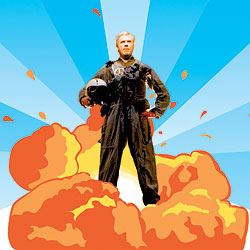
You’ll be relieved to hear that our 43rd president is holding up well in retirement. Appearing for six short weeks in what he calls the “faggy theater district,” he looks characteristically loose, impervious to all questions (except the ones he poses to himself), and far too comfortable in his own skin. Yes, he appears only as an impression performed by Will Ferrell, but You’re Welcome America. A Final Night With George W. Bush reflects all of Dubya’s key traits—it’s tacky, cocky, defensive, a little half-assed here and there, utterly full of itself … and bunker-bustingly funny.
On the face of it, Ferrell and director Adam McKay are after easy meat. An old-fashioned Bush-bashing, celebrating a thumping repudiation at the polls, and on a Broadway stage—this is the blue-state equivalent of unfurling a mission accomplished banner. But consider the known unknowns: First, there’s no guarantee that anyone, even America’s premier comic man-child, could top the self-parody that the real Bush furnished throughout his presidency, especially during those final, quasi-vaudevillean exit interviews. Second, your audience has been running its own Bush roast on infinite loop for nearly nine years. How do you compete with the late-night barbs, the endless caricatures and impersonations, to say nothing of the page-a-day calendars, fridge magnets, T-shirts, bumper stickers, buttons—the vast Bush Sucks industrial complex? How do you push your agenda in all that noise?
The answer is the same one Bush arrived at: Reiterate. Steadily. Ferrell gives us the greatest hits: My Pet Goat Day, Iraq and WMD, the Ranch, the extended family, Katrina, along with the signature moods—the pouty put-upon-ness, the fratty magnanimity, and, of course, the misspeaks. “You Paul Krug?” he asks one audience member. “Marino Dowd?” (He’s convinced that someone from “The New York Suck My Dick Times” has showed up to mock him.) He prays, at length, to a “blonde, almost Swiss-looking Jesus.” He disastrously mispronounces “Niger,” after a world-class windup. And he peers into “the anals of history.” “It comes down to this,” says Ferrell’s Dubya. “Am I the worst president of all time?” Whereupon the audience, unbidden and Pavlovian, responds, “Yes!” “Hold on now!” the prez retorts. “I didn’t know it was amateur-historian night here at the Cort Theater!” Well, of course it is. And it will be, forever. The real Bush, deplored by real and imagined “elites,” left his legacy to history. And here it is, already. Ferrell’s impression is this presidency’s death mask. Buffoonery and error are already the Horus and Osiris on its sarcophagus.
The real triumph of You’re Welcome is that it really isn’t about Bush. It’s about us. The man onstage represents Dubya, but also another institution, the Dubya Impression—our only real ownership over a remote, diffident, and frightening presidency. We’re saying good-bye to both. The experience is bittersweet, but Ferrell and McKay clearly lean toward the bitter. There’s detectable pity here, albeit pickled in years of disgust, but no sympathy—not for Bush, who’s more or less beside the point, anyway, and certainly not for the electorate that made him possible. “So I got the job. Cool!” is how Dubya sums up the 2000 Florida recount, and we’re reminded that all of us—even those who voted against, campaigned against, and spent countless hours aerobically loathing Bush—bear a measure of responsibility. After Ferrell reminds us of Katrina, then reminds us that he has to remind us of Katrina, he praises the American attention span (“It’s great ’cause you can half-ass shit and it doesn’t matter”), and it becomes clear that we, not George, are the butt of the joke. Bush is just the stick they beat us with. You won’t have this impression to kick around anymore, the comics are saying. You’re on your own.
In a remarkable improvised segment, Ferrell showcases Bush’s famous ability to bestow instant nicknames upon all he meets, with nothing but a first impression to go on. He calls on audience members, asks for a Christian name and occupation, and brands them, Texas-style. At the show I attended, one soul was bold (or foolish) enough to call out “Reviewer!” Ferrell, in character, cracked a huge grin, and didn’t miss a beat: “I’m gonna call you ‘Obsolete Profession.’ ” The house came down. It was more than a death-of-media inside joke. It was Dubya’s joke on all of his critics—amateurs all, in his estimation. What did they matter, in the end? He was president. He did what he did, and he left an impression. More of a crater, actually. But we’re welcome to play in it.
Downtown, Charles Busch is hard at work on his own legacy. The famously bewigged mainstay of a largely extinct downtown theater scene has built a career on making real plays out of fake women (The Tale of the Allergist’s Wife; Die, Mommie, Die!). His works are notably more than drag acts—they’re learned ruminations on social roles, illustrated but not drowned in camp, and crowned with a guy in a dress. But The Third Story, a messy excess that sets the stage for more messy excesses, features not one but two famous female impersonators: Busch himself and Kathleen Turner, nature’s drag queen.
Turner—sometimes listlessly hilarious, sometimes hilariously listless, but often just listless—plays Peg, a blacklisted golden-age screenwriter trying to pull her son and former writing partner Drew back into the game. Busch plays the outsize silver-screen avatars Peg creates, in a pageant of doubling that’s repeated, but never developed, over the course of two very long hours. Turns out Turner and Busch don’t double so much as crowd each other: Dame Kathleen’s sleepy-grumpy, kiss-my-ass irascibility clashes with Lady Charles’s fringe-y brio. In fact, there’s at least one too many of everything in The Third Story: too many stories, too many themes, too many declarations of purpose in this herniated interrogation of the writing process (and, Q.E.D., Busch’s failure to make that process work this time around).
In a two-page (!) author’s note, Busch ticks off the ingredients in this gumbo: gangster flicks, sci-fi B-pictures, clones, the forgotten female screenwriters of pre-Code Hollywood, mothers and sons, the huac era, the thrill of self-creation, and the true meaning of “fabulousness”—the penchant for storytelling, and for making oneself a story. “After two false starts,” Busch notes, “it’s often the third story that takes off.” Yes, but what if the third story is just another draft? The answer is playing right now at the Lortel.
See Also
A Roundup of Ferrell’s Nicknames for Audience Members
You’re Welcome America. A Final Night With George W. Bush
By Will Ferrell.
Cort Theatre.Through March 15.
The Third Story
By Charles Busch.
Lucille Lortel Theatre. Through February 28.