
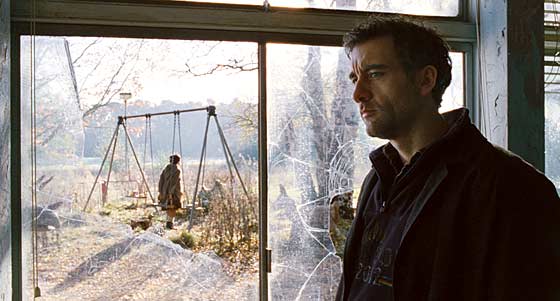
Alfonso Cuarón’s Children of Men is the latest cultural harbinger of the End of Days, of nature gone haywire and human nature following apace. Or maybe it’s the other way around. In any event, it’s 2027 and eighteen years have passed since the last baby was born on the planet. Humans have lost the capacity to reproduce, and no one knows why. It’s just something in the air. Or the water. Or the Zeitgeist. The point is: We’re a dying species, paying a terminal price for our arrogant sense of entitlement. The English have maintained a sort of order, but that order is (characteristically) pathological, the people in sheeplike denial, the ruling class progressively more violent. Into this vacuum of hope has rushed a Fascistic regime, which rounds up illegal immigrants—known as “fugees,” as in “refugees”—and imprisons the undesirables who aren’t shot on the spot in holding cages and emptied-out cities that make you think of downtown Baghdad. Children of Men is a bouillabaisse of up-to-the-minute terrors.
It’s a wow, though. The director and a battery of credited screenwriters have twisted P. D. James’s 1992 novel into a relentlessly dire chase picture with double crosses and an explosive final battle between the military and the fugees. The plot makes sense only if you don’t loiter over it. As the state has become more repressive, an underground resistance—known as the fishes—has emerged, first terroristic, now allegedly more constructive. Doing the alleging is a fish leader, Julian (Julianne Moore), who makes contact with her ex-husband, Theo (Clive Owen), because she needs cross-country transit papers for some precious human cargo and his cousin (Danny Huston) is a government honcho. Theo is a bitter cynic, very much in sync with a piece of graffiti he passes: THE LAST ONE TO DIE PLEASE TURN OUT THE LIGHTS. Children of Men centers on his moral and spiritual rebirth.
It also centers on a literal rebirth—on the advanced pregnancy of a black fugee, Kee (Claire-Hope Ashitey), whose best hope of survival rests with the fishes’ ability to deliver her to a supersecret international organization known as the Human Project. In James’s book, the mother-to-be is white, and the focus is on the tortured inner landscape of people with no faith in the future: She has a crack whodunit writer’s grasp of repression, of what it hides and what it liberates. Cuarón isn’t indifferent to that theme, but he doesn’t have the patience of a septuagenarian female former civil- service worker. He’s a youngish Mexican moviemaker with an FX budget; he’s burning to get to the horrific spectacle of authoritarianism and military occupation: to male and female refugees stripped of civil liberties, caged, blindfolded, shot down—to a world like our own, where evil flourishes because good men do nothing.
The cinematographer, Emmanuel Lubezki, has shot the whole film, including the cataclysmic skirmishes, with handheld cameras in long, long takes—takes that make you realize how merciful editing can be, since every cut reminds you, on some unconscious level, that you’re not really in that place at that precise instant, dodging (or getting torn up by) bullets and bombs. Here, there’s a shot from inside a car rolling down a hill as it’s chased by men with guns that’s like the last thing you see before you wake up screaming. The insistent soundtrack alternates between the mocking obeisance of King Crimson’s “The Court of the Crimson King” and John Taverner’s funereal hymns. The ubiquitous rubbish, the cold rain: The movie calls to mind an early description in Cormac McCarthy’s overwrought but gripping post-apocalypse novel The Road, of gray days “like the onset of some cold glaucoma dimming away the world.” Would Children of Men feel as momentous without the sensual bombardment? No, but the bombardment is central to the director’s message. Cuarón never wants to let you fall into the moviegoer’s trance—to stop feeling sickened by bloodshed or to become inured to a world without children’s voices.
Clive Owen makes a great dystopian action hero. I’ve seen him on talk shows so guarded (or nonverbal, or not-too-bright) that he can barely put two sentences together, but what comes across on the big screen is a potent mixture of irony and animal cunning. He’s like a rude-boy version of the young Michael Caine—and the genial old Caine shows up here as his surrogate dad, an aged hippie who uses a garden of ganja to keep despair (barely) at bay. Peter Mullan has an insanely funny bit as a policeman proud to be called a Fascist pig. But the laughter fades fast: For Cuarón, there’s nothing amusing about Fascist piggery.
He demonstrates this as a producer of his friend and countryman Guillermo del Toro’s Pan’s Labyrinth, the shockingly brutal fairy tale of a pensive young girl, Ofelia (Ivana Baquero), whose new stepfather (Sergi Lopez) is a sadistic captain in the Spain of 1944, just after Franco and his Fascists have won their civil war. As in Children of Men, this is a world of soldiers with too much authority and too little scruple, of freedom fighters bleeding out in dark forests, and of vulnerable children at the center of the carnage. But Pan’s Labyrinth has another world, an underlayer of fairies, slime-spewing monster toads, carnivorous demons, and, in the middle of a giant stone labyrinth, an orotund faun (Doug Jones) with huge horns and milky eyes—a creature that gives Ofelia a series of harrowing tests to prove that she is worthy of immortality.
The movie opens with a prone Ofelia, blood trickling down her face, thinking back over the past month, and it’s possible that what follows is a fantasy—the vision of a critically wounded girl searching for consolation in a myth of princesses, heroic self-sacrifice, and eternal life. But the supernatural has a place in all of Del Toro’s work. Weaned on horror pictures, he made ghosts a central element of his first stab at the Spanish Civil War, The Devil’s Backbone (2001)—another fairy tale in which children die horribly. The mixture of elements is jarring but somehow organic: In Del Toro’s universe, political outrage and realistic violence mingle with stop-motion creatures whose hambone voices evoke decades of el cheapo Mexican vampire movies. His palette here is deep-toned, with bottomless blacks and supersaturated oranges and blues—as if the Walt Disney of Pinocchio had collaborated with Goya. When the captain beats in the face of a guiltless peasant, it’s under a storybook crescent moon. Anti-Fascist directors can be awfully cruel.
Children of Men and Pan’s Labyrinth cap a deflating year at the movies, in which even an old Republican like Clint Eastwood exploded the heroic archetypes of the Greatest Generation, in which the birth of the CIA was presented (in Robert De Niro’s much-underrated The Good Shepherd) as the birth of moral relativism. If this isn’t the End of Days, it’s a wake-up call for Americans: the end of our daze.
The Painted Veil at least recalls a more optimistic era, in which white people journeyed to Third World countries and treated the sick and cared for orphans and discovered, in the midst of death, a higher purpose. The new film, directed by John Curran, is an adaptation of W. Somerset Maugham’s 1925 novel about a shallow, adulterous flapper type (played here by Naomi Watts) whose spirituality is awakened in the middle of a cholera epidemic in rural China—in a lush, verdant, mountainous hellhole to which she has been dragged by her buttoned-up but vengeful bacteriologist husband (Edward Norton). Maugham’s white-savior fantasy has been cut with a dose of 21st-century political awareness: The superstitious Chinese want to cut their saviors into tiny pieces. On the other hand, the heroine’s religious awakening has been romanticized—even, in a most un-Maugham-like way, sexualized. The movie makes for a good old-fashioned wide-screen wallow. Norton isn’t remotely credible, but Toby Jones is dandy as a sleazeball with a core of decency, and Watts is so open, so soulfully petulant, so transcendentally pretty, that even Maugham might reconsider the pleasures of the flesh.

BACKSTORY
In Children of Men, mankind is going extinct. Meanwhile, the suicide drug “quietus” is sold over the counter in England though “ganja” remains verboten. But what might 2027 really look like? World population is expected to increase by nearly 1.5 billion by then, says the U.N., and by 2030, China’s GDP will have surpassed the U.K.’s (as well as Germany’s, Japan’s, and France’s), according to the National Intelligence Council. As for life on this side of the Atlantic, possession of medical marijuana might well become decriminalized long before 2027—that is, if the bill ever gets through Congress. Assisted suicide is another matter.
Children of Men
Directed by Alfonso Cuarón. Universal. R.
Pan’s Labyrinth
Directed by Guillermo del Toro. Picturehouse. R.
The Painted Veil
Directed by John Curran. Warner Independent. PG-13.
E-mail: filmcritic@newyorkmag.com.