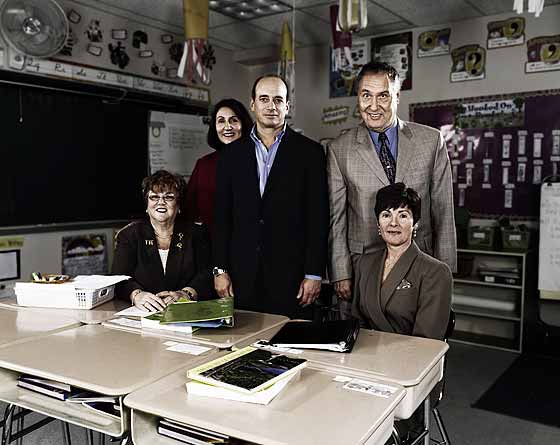
On a weekday morning in the spring of 2002, Joel Greenblatt took a radical detour from his usual commute. Instead of riding the Long Island Rail Road from his home on the North Shore to his office in midtown, the 44-year-old hedge-fund manager hired a car service to deliver him to P.S. 65Q, a small, struggling elementary school in working-class Ozone Park, Queens. Little about his past pointed to this visit. Over the previous two decades, Greenblatt had quietly built a reputation as one of Wall Street’s most successful stock-pickers: He had steered his fund, Gotham Capital, to a 40 percent average annual rate of return (it’s now worth about $1.6 billion), and as the author of investment manuals like You Can Be a Stock-Market Genius (Even If You’re Not Too Smart)—the predecessor to his current best seller, The Little Book That Beats the Market—he’d become something of a guru to a generation of elite fund managers. But that morning, Greenblatt was taking a break from Wall Street to focus on the less glamorous world of New York public schools.
P.S. 65Q had opened several years earlier to serve a growing population of extremely poor South American and South Asian immigrants. Housed in a former airplane-parts factory, the school sits on an industrial street with no homes in sight, in the shadow of the elevated A train. The vast majority of the school’s 540 students couldn’t read or do math at the proper grade level, and their parents were largely too beleaguered or disengaged to help.
At the time of Greenblatt’s visit, P.S. 65Q was staring down the loss of an important grant. Under Iris Nelson, the principal who had started at the school a year after it had opened, P.S. 65Q had secured government funds for a reading program called Success for All. The program had led to some promising gains in reading scores, but the grant was expiring at the end of the year. Greenblatt, who had developed an interest in public education only a few years earlier, had become a fan of Success for All and was looking for a school where he could introduce or broaden the program to boost overall achievement. The Success for All Foundation’s director, Bob Slavin, arranged a meeting between Greenblatt and Nelson to try and make a match.
The principal and her staff hadn’t been told much about Greenblatt—just that he was a wealthy banker interested in discussing a contribution. In Nelson’s office, Greenblatt didn’t let much time pass before making it clear his visit wasn’t about just a grant. “I want to keep spending money,” he said, “until everyone can read.”
Nelson struggled to contain her disbelief. Before long, she and Greenblatt were touring the school. About the only thing that didn’t get settled that day was how much money, exactly, Greenblatt would give. Before he left, he asked Nelson to put together a grant proposal.
For weeks, Nelson fretted over how much to request. Finally, she decided to take Greenblatt at his word: To keep everyone from falling behind, she calculated, it would take an incremental $1,000 per student per year for five years, or $2.5 million.
Greenblatt had clearly done his homework. “That,” he told her later, “is exactly what we thought you’d need.”
Today, thanks to Joel Greenblatt’s friendly takeover, P.S. 65Q is a turnaround story worthy of a Harvard B-school case study. Perhaps no school in New York City has ever bounded so swiftly from abject failure to unqualified success. From 2001 to 2005, the proportion of fourth-graders passing the state’s standardized reading test doubled, rising from 36 to 71 percent of the class—and since then, the students’ performance has only gotten better. Nearly every child who has been at the school for three years or more now reads and does math at their proper level or beyond—even the special-ed kids. Last spring, the school was one of fourteen statewide to win the public-school version of the Nobel Prize: a Pathfinder Award for improved performance. The city schools that usually win are in rapidly gentrifying neighborhoods like the Lower East Side or Fort Greene—what one P.S. 65Q administrator calls “God’s country.”
None of this would have happened, of course, without Greenblatt. It’s true that a certain breed of civic-minded capitalist has argued for years that the public schools should be run more like private businesses. Mike Bloomberg and his school chancellor, Joel Klein, have prayed mightily at the altar of management reform, pushing for top-down accountability and Jack Welch–inspired leadership training. It’s also true that writing fat checks to city schools has become fashionable. Caroline Kennedy has helped solicit more than $300 million in private and corporate donations. And outsiders like Teddy Forstmann have gone the voucher route, paying to airlift kids into private schools. But Greenblatt’s plan is more ambitious. He wants to create an effective and affordable public-school prototype that could be franchised citywide—and fast. “I’m an investor,” he says. “I spend my time trying to figure out whether a business model works or not. I wanted to find a model that worked and roll it out.”
P.S. 65Q is the first school off the line. There, Greenblatt has expanded the Success for All program, brought in sophisticated data-analysis tools to track each child’s progress, and hired a staff of outside tutors to step in quickly when kids need help. But what makes the success of P.S. 65Q especially remarkable is how little, relatively, it has cost. The extra $1,000 per child Greenblatt has invested amounts to less than a 10 percent increase over the approximately $12,500 that the city spends on average per child—and well below what some private schools pay for the same kind of results. “Given all the negative costs of not educating the kids—more crime, fewer taxpayers, less productive people—it was less than free,” Greenblatt says.
Education experts are quick to point out that Success for All, which depends heavily on scripted material, is at odds with the more flexible curriculum Bloomberg and Klein have instituted. Greenblatt himself concedes that some ingredients of school success, like the experience and talent of an Iris Nelson, are difficult to replicate. And Greenblatt may have skirted some union rules by using his own money to hire outside tutors. Still, there’s an argument to be made that he has done in four years what many public schools have proved institutionally incapable of doing, period. Which raises the question: Should all city schools be run like a hedge fund? And should the mayor and his chancellor be taking notes?
Scrutinizing business strategies is second nature to Joel Greenblatt. Given the chance, he’ll happily go on about how Wal-Mart went on to clobber Kmart because it waited to roll out stores until its distribution model made sense. It’s lessons like this, he says, that have informed his decisions with P.S. 65Q.
Born in Great Neck and educated at Wharton, Greenblatt started Gotham Capital in 1985 with $7 million from investors, much of it from junk-bond impresario Mike Milken. He also founded the New York Securities Auction Corporation, a junk-bond trading firm, and for a time he chaired the board of a Fortune 500 aerospace-and-defense company called Alliant Techsystems. Like many other investors in the nineties, Greenblatt fell under the spell of Warren Buffett. He strayed from his hedge-fund perch to preach the back-to-basics gospel, teaching at Columbia Business School and running the Value Investors Club, an online community for high-level investors searching for undervalued companies. In 1997, Greenblatt published You Can Be a Stock-Market Genius, which sold a reported 38,000 copies and went on to become something of a cult classic among a growing coterie of hedge-fund managers.
By the time Greenblatt was entering his forties, Gotham had returned all its outside capital, and he and his partners were running their own money. In his charity work, he became drawn to the schools. “I think capitalism is a great system, but that’s if everyone has a fair chance,” he says. “And education is the most unequal system of anything I can think of.” About eight years ago, he joined the board of a nonprofit that focused on middle-school and high-school reform. Watching teenagers struggle, he started to wonder if his approach to business could help find a way to produce a decent, affordable public education before it became too late for kids to catch up. His core question—what would it cost to get every kid to the right level?—is the one policy-makers have been asking about the city’s schools for years.
Greenblatt had long taken it as self-evident that public schools are a creaking monopoly desperately in need of innovation. The infrastructure is woefully undercapitalized, for example, and the teachers are protected by a 200-page contract that turns hiring and firing into a bureaucratic nightmare. And the peculiar widget that the schools are supposed to produce—a decent education for 1.1 million children from every conceivable background—stubbornly resists standardization. Greenblatt was especially bothered by the seemingly universal acceptance of unambiguously low standards. Why, for instance, does the city celebrate every time test scores drift upward a few percentage points—when half the students are still reading below grade level? Numbers like that in his world would end in bankruptcy or a stack of lawsuits. The closer Greenblatt looked at the situation, the more bleak it seemed. Take, for starters, the fact that only 53.3 percent of New York City high-school students end up graduating within four years. And that doesn’t even count students who reenroll elsewhere. This could mean that something like only one out of every three entering high-school students bothers to stick around to get a diploma—and in certain poorer neighborhoods that number could be a lot lower. The M.B.A. in him saw a productivity problem, and a tempting challenge.
Greenblatt set to work on a business plan. From the start, he wanted a budget big enough to get the job done, but not so big that it would be implausible to roll out at more schools. “Sure, you could throw a lot of money at it and turn everything into a private school,” he says, “but that’s not a solution for very many people.” He grew attached to the idea of spending $1,000 per child—not a lot, considering the spending gap between wealthy and poor school districts in New York State is said to be more than double that. In the city alone, $1,000 per child would add up to $1.1 billion, or just 2 percent of the city budget, and only one fifth of what a court panel has ordered the state to pay the city in its long-awaited settlement with the Campaign for Fiscal Equity—the group that has famously and successfully sued the state for shortchanging the city schools for decades (Albany, naturally, is still contesting the decision). “If you can teach all the kids in America to read and do math for $7 billion”—$1,000 per kid for the 7 million or so kids in need—“then that would be a bargain,” Greenblatt says. “In an over trillion-dollar federal budget, that’s just not a big deal.”
His next step was to find a reading-and-math program to use at one school as his pilot project. “I wanted a model that was replicable, that made sense, that was cost-effective, and that wouldn’t run out of steam,” he says. In The Little Book That Beats the Market, Greenblatt makes much of identifying the right criteria to discover the diamond in the rough—the company that’s undervalued—then buying into it with conviction. “There, I define a good business as a business with a good return on capital,” he says. “Here, what I was looking for was to make the most difference with the least amount of money.” A friend and former superintendent of the Memphis public schools told him about Success for All.
Created in the eighties by Bob Slavin, a Johns Hopkins professor, Success for All is a reading-and-math curriculum used at about 1,300 elementary schools around the country. In New York, Success for All is best known as the highly structured curriculum used in the Chancellor’s District—a group of deeply troubled schools corralled together for special attention in the nineties by then-chancellor Rudy Crew. The Chancellor’s District did see modest gains from Success for All: From 1999 to 2002, the percentage of students passing the standardized reading test increased from 14.3 to 22 percent. But when the Bloomberg administration instituted its new math-and-literacy curriculum, Success for All was dropped.
Success for All immediately appealed to Greenblatt’s private-sector sensibilities. It was modular and standardizable: Each school day has a detailed script for teachers to follow for both reading and math; each kid, therefore, is assured of getting the same education at the same time. “Immediately it hit me as something you could really roll out,” he says. If, as Greenblatt likes to say, half the employees anywhere are by definition below average, “you could take a below-average teacher and make them an excellent teacher, because they have years of research behind every lesson plan.” The program also has a special focus on reading: For nearly two hours each morning, the kids leave their classrooms and join groups of other kids at their same reading level. It seemed like common sense to Greenblatt that a teacher can more efficiently help 30 kids at one level than 30 reading at a dozen different levels.
Success for All also played to Greenblatt’s fetish for data. While most city schools test their kids’ progress only once a semester, Success for All tests these skills every eight weeks. As he would with a business’s earnings yield, Greenblatt would be able to see clearly what needed improvement not just in every grade or every class but with every last kid, practically in real time. Any child who fell behind could quickly be given help. And the program had a track record: Success for All schools had outperformed comparable schools in dozens of studies and comparisons. Even so, Success for All had never come close in twenty years to getting every student at a school reading and doing math at the right grade level.
When Greenblatt asked Success for All’s Bob Slavin about that fact, Slavin didn’t contest the point—but he noted that the program had never been implemented without a school district watering it down or draining it of funds.
“Is the problem just money?” Greenblatt asked.
“Yes,” the professor said. “It’s just money.”
Greenblatt and Slavin agreed to create an amped-up version of Success for All at one school, with Greenblatt’s extra money going toward tutoring every struggling student. All that was left was to find the school.
The Success for All Foundation only allows its program to be used in a school where at least 80 percent of the teaching staff agrees to go along with it, so they had to find a school with a staff that was willing to dive into the deep end with Slavin’s program. After Greenblatt hit a few dead ends—a Long Island school system simply wasn’t interested, and a principal at a Brooklyn school seemed too harried to discuss the offer—Slavin thought of P.S. 65Q. Nelson and her staff had already bought into Success for All and had begun using it in the years before the city introduced the mandatory reading curriculum. Slavin knew Nelson could use more help and thought she might want someone to pay for the math program.
“I’m an investor,” Greenblatt says. “I spend my time trying to figure out whether a business model works or not. I wanted to find a school model that worked and roll it out.”
Greenblatt’s grant was given through the Success For All Foundation, and not directly to the city, leaving the school room to maneuver around education-department rules. “We provided the grant to Success for All, and they provided all services, including tutors, for free,” Greenblatt says. “You can’t argue with free.”
It was time for Nelson to start spending. Starting with the 2002–2003 school year, P.S. 65Q began receiving $500,000 extra for its budget for five years—or roughly $1,000 for each of the 540 students. Nelson could do anything, Greenblatt said, “if it was reasonable and fit within our budget.”
Nearly half the $500,000 annual budget would be needed to pay for Greenblatt’s plan to supplement Success for All with a dozen part-time tutors, enough to keep as many students as possible from falling behind (working 24 weeks at $22 an hour, each tutor cost Nelson $17,600, or a total of $211,200). That left Nelson with less than $300,000, and she still had to purchase the materials for the new Success for All math program and supplements for the reading program. Those cost about $100,000, bringing the Greenblatt kitty down to less than $200,000.
Next, Nelson hired two new full-time staffers: a facilitator to get the math program going and a tutor coordinator to track every student’s progress, at $50,000 a year each. The $100,000 in salaries, plus the associated benefits, left Nelson with a bit more than $50,000. With that money, she sent fifteen teachers and other staff to Success for All training conferences around the country (at $1,500 per teacher, or $22,500 total) and replenished the school’s empty library ($10,000). She used some of the remaining $25,000 or so on extra Success for All materials, like phonics DVDs and the equipment to play them. The additional manpower Greenblatt’s grant bought also made it possible for Nelson to repurpose staff members paid for by the city to become floating tutors in test-taking skills, helping make the children comfortable with the pacing and format of standardized tests. This cost her nothing.
Nelson and her staff began expanding Success for All immediately. (The school received a waiver from the standard city curriculum; waivers aren’t easy to come by, but Greenblatt’s $2.5 million was hard to overlook.) On a recent stroll through the halls, the teachers in three different reading classes were all using the exact same jargon with their kids. “Sound it out!” “Be a finger detective!” “Ask your partner!” “You got it right? Yeah! Kiss your brain!” Not every education expert believes in such rigid regimentation, and not every teacher would want to teach this way, but the P.S. 65Q teachers say Success for All provides important continuity from grade to grade. “Most of our upper-grade teachers use literature, they use novels, and there’s a lot of creativity involved,” says Beth Longo, Nelson’s former assistant principal, who succeeded her in the job last year. “Yes, SFA is more scripted in the roots, but if we want kids to be good readers, they need to know what the letters sound like, and that has to be taught the same way to everybody, because next year they’re going to be in a different class.”
The new tutoring program was more problematic. For the first year of Greenblatt’s grant, the school continued with a previously existing arrangement to have NYU graduate education students come and tutor during their available hours. But the NYU students never seemed to be available at times that were convenient for the kids. In the pre-Greenblatt world, Nelson would have had to tough it out and take what she could get from NYU—she couldn’t afford to fill the tutoring positions with salaried city employees, and bringing in freelance tutors during the school day might violate the teachers’ contract. But at the end of the year, Greenblatt persuaded Nelson to cut NYU loose and instead put ads in the paper for tutors. “You can’t fire teachers, but this is my money, and you can fire the tutors,” Greenblatt told her. “Let’s find some local people who we can train.”
Nelson was concerned about quality, but she wound up pleased. One of the tutors turned out to be a retired teacher who had previously worked for Nelson who answered an ad in the New York Times. “You have all of these people with years of experience,” Nelson says, “and we were able to get them at a price that we would not be able to get them for through the Department of Education.” When some tutors didn’t work out, Nelson could simply fire them and hire others. “We were no longer this New York City school,” she says. “We had the ability to do things that other people could only dream about.” Still, the first-year tutoring was limited, and although the school’s fourth-graders took an astonishing leap on their state math tests—from 63 to 81 percent performing at grade level or above—the state literacy-test results were sticky, staying level at 48 percent.
In year two, with Greenblatt’s encouragement, Nelson added to the tutor ranks by enlisting ten of the school’s full-time teachers to help students for 45 minutes every morning before the start of school. Much of this tutoring would take place in the cafeteria, before kids came in to get their subsidized breakfast. Those teachers would get $25 an hour, four days a week—they could earn an extra $4,000 over a 40-week school year. For ten teachers, Greenblatt was spending another $40,000, but without some of the year-one start-up costs, he was within his $500,000 annual budget. Once this tutoring was up and running, as many as 200 of the school’s 540 kids could be flagged for extra help at any time.
The tutoring became so plentiful that it was used preventively. Even a child who was reading at the right level but was having a tiny problem understanding, say, what an inference is, would qualify for extra help. “The twenty minutes of tutoring they get is scheduled minute by minute based on what level they’re at and what they’re doing in class,” Greenblatt says. By the end of year two, Greenblatt’s goal of tutoring on demand had been reached. The percentage of passing fourth-grade readers vaulted from 48 percent to 71 percent.
Greenblatt wanted to go further. How would he really know if what he was doing at P.S. 65Q was working if the kids who had been at the school for two weeks were lumped together in the same data with the kids who had been there two years? How could he achieve success for all if he couldn’t identify which kids weren’t succeeding? He decided to give P.S. 65Q the same sort of sophisticated data-management capability he used in his business. He compares the setup he has now to his Value Investors Club, the online community he runs. “We know the background of every member,” he says. “We have a little grid on the site for each member. We know every rating they ever made and how well their investment write-ups did. I didn’t think it was that hard to have something like that for each child.”
The new tutoring coordinator had already been outfitted with a spreadsheet program to track every student. Greenblatt had a software designer from Gotham Capital find ways of breaking down not just the state standardized-test data, but all the assessment information that Success for All coughed up. Acting on the eight-week testing data and information from the classroom teachers, Nelson and her staff could target the tutoring with remarkable efficiency. “We have listed under every child what their reading level is, how long they’ve been in the building, whether they are mainstream or special ed, whether they are English-language learners or whether they came from an English-speaking household,” says Nelson. “We could take information and say, ‘Our ESL children have made good progress, but they started behind in April.’ ” They also could examine the growth of a particular group. “Let’s say teacher A has this group, and we see at the end of the eight-week cycle that half of those kids didn’t go up what we expected them to. Then we need to look at what the teacher’s doing.”
With the new data, Greenblatt was also able to come up with a benchmark for overall success that made sense. “I said, ‘Listen, if a child has been in this school for three years and they’re not at grade level, that’s our fault,’ ” he says. “It doesn’t matter how they came in or what their family situation is. If they’ve been here three years, we should be as close to 100 percent as possible with those kids. That’s our goal, and that’s a fair way to be judged.”
By the spring of 2004, those “long enrollers,” as they’re called, were closer than ever to being considered entirely successful. Though the fourth-grade reading-test results showed 71 percent at grade level, the long enrollers were 84 percent. The math scores were through the roof—89 percent of all the kids, not just long enrollers, passed the state test. By spring 2005, the numbers inched up: Fourth-graders were up to 95 percent in math and holding steady in reading. Greenblatt had all but met his goal, a year early. Every year an influx of new kids threatens the school’s ability to keep up momentum, but the best sign of long-term progress is that, according to the school’s data, last year’s kindergarten had 99 percent of the kids at their proper reading level.
Last spring, Greenblatt and Nelson were recognized with a Pathfinder Award. Nelson arranged an assembly to celebrate in the school’s tiny auditorium. She invited all the local officials, the superintendent, the local paper. The fifth-graders, she decided, would perform for the parents, since it was their fourth-grade test scores that helped to win the award.
“They sang,” she says. “To know that you are getting an award based on your performance measured up against 3,000 schools in New York State—and that you were one of fourteen schools, not just for reading but for math too? That was like adrenaline pumped into everyone.”
The question, of course, is, can P.S. 65Q’s success be replicated citywide? Dissenters say that some of Greenblatt’s ideas simply aren’t workable on a large scale. The extra $1,000 per student may not be theoretically prohibitive, but barring a windfall from the CFE lawsuit, it’s difficult to imagine a mayor waking up one day and deciding to increase the $14.8 billion school budget by 10 percent. Greenblatt caught a break when the union didn’t complain about his placing ads in the Times for tutors instead of hiring union employees. “I constantly want things that work to stay in place,” says Randi Weingarten, the union chief, who adds that she admires what Greenblatt’s school has accomplished. Yet it’s hard to see her tolerating a similar maneuver in all 1,400 schools. Greenblatt was also able to cherry-pick talent. In Iris Nelson, he found an educator with a rare combination of experience and a willingness to try an unconventional curriculum. But what happens at a school where the management and staff simply aren’t as capable or adaptive?
Then there’s realpolitik. Joel Klein visited the school last fall with Greenblatt and praised his efforts; he, too, has worked to bring extra tutoring time into city schools, starting last week with a mandated 37.5 minutes for struggling students. But Klein is hardly ready to embrace Greenblatt’s plan as a blueprint for systemwide success. “I would be careful to generalize, when there are so many different variables, as to what the magic in the process is,” the chancellor says. “One school is always great. But it’s not a pattern of practice.” (If the chancellor were ever in a position to spend an extra $1,000 on every child, he says he’d spend it on providing prekindergarten for every child in New York. So, in a rare case of agreement, would Randi Weingarten.)
Even if the Greenblatt model could be replicated, should it be? Success for All, some educators argue, is too scripted. Although evidence shows that the program’s emphasis on basic skills does help kids learn to read, a generation of New York educators remains committed to a more inquiry-based, or “whole language,” approach, in which kids learn from context and read actual books earlier, developing an enthusiasm for reading that “drill and kill” strategies don’t foster, and picking up the technical skills of reading along the way. Klein has taken unprecedented steps to bring skills-based learning into the New York schools, but he remains unwilling to ditch his entire curriculum for something as rote as Success for All.
Soon enough, we’ll see if Greenblatt can crank out his next franchise. Next year, he and one of his Gotham Capital partners, John Petry, are planning to open the Harlem Success Academy, a charter school approved by the state in December. Early plans are for a school day that runs from 8:20 a.m. to 5 p.m. and includes an infusion of the arts—even yoga and karate classes. Success for All will be the curriculum, and the same sort of supplementary tutoring and data management will be used. Bob Slavin will be on the board. Iris Nelson has been hired as a consultant both at the charter school and at P.S. 65Q (her bonus from the Pathfinder Award bumped up her pensionable salary to the point where it made more sense for her to retire than stay working at the school). And the executive director of the charter school is Eva Moskowitz, the former City Council member who chaired the education committee and often proved a tenacious foil to the mayor, the chancellor, and the teachers union.
What makes the Harlem project especially interesting is that its budget is the same amount the city spends at its schools (the city gives charter schools 75 cents on the dollar; Greenblatt and Petry will make up the rest out of their own pockets). “P.S. 65 spends $12,500 per child without my $1,000,” he says. “What I’m trying to prove is that for the same money they’re spending in the city—not a $1,000 more—you can do what we’re doing at P.S. 65Q.”
Even if the Harlem school is as successful as P.S. 65Q, Greenblatt says that he doesn’t intend for every school in the city to do things his way overnight. But just as the mayor and other charter-school proponents aim to foster innovation that could be duplicated elsewhere (Bloomberg aims to add 75 charter schools in the next four years), Greenblatt hopes his experiments in education will act as a wedge. If he can produce excellence at one school—and another and another—with the same money the city uses to produce mediocrity, the public, he believes, will realize that there is a better way and begin insisting on it.
“If it can be replicated enough, people won’t be able to say this can’t be done,” he says. “The public schools will have to get better or public monies will have to be spent on other choices for students in failing school districts.” Then, he says, he’ll have leveraged the education marketplace. “They’ll either have to come up with another excuse, or they’ll have to fix the problem, too.”