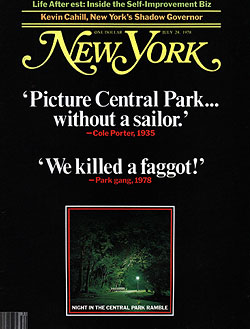
From the July 24, 1978 issue of New York Magazine.
Picture Central Park—without a sailor, Picture Mister Lord, minus Mister Taylor.
—Cole Porter’s “A Picture of Me Without You,” 1935.
The west side of that 30-acre section of Central Park known as the Ramble had a reputation as a homosexual meeting ground long before Cole teased his friends at private parties with this suggestive lyric. But though Central Park at night—any part of the park—is dangerous, the gay ghetto that is the Ramble is perhaps the section most fear-ridden. Gangs of toughs—teenagers and the macho middle-aged, usually drunk, occasionally including a couple of off-duty cops—roam the Ramble at night, engaging in an old American pastime: fag bashing.
You don’t have to be gay. You don’t have to be exposing yourself. You don’t have to be doing anything except walking through the tangled darkness to be abused, shoved, threatened at knifepoint, kicked, and beaten.
But these shadowy dangers are in sharp contrast to the serenity of the sun-flecked arboreal mecca the Ramble becomes for thousands of gay men throughout each day. The sun, the strolling, even the solitude, and the natural beauty of the park’s most bucolic copse—more than the opportunity for a casual sexual encounter in the bushes—are the magnets that for much of this century have made the Ramble the city’s best-known outdoor gathering place for gays.
The Ramble has been in the public eye ever since the assault July 5 by a gang of anti-gay toughs who, at 9:30, just a little after dusk that Wednesday, went wading in with baseball bats, bashing any men they thought were gay. The dull thwack of bats hitting flesh and bone accompanied shouts of “faggot” from the all-white band of defenders of decency. Five men were hospitalized with serious injuries—including Dick Button, a former ice-skating star and now sportscaster.
Just two nights after this latest act of human vandalism, I made my way into the Ramble at midnight. Much to my surprise, there were actually people there. Not many, perhaps twenty men, but still, there they were. I found, too, that the isolation from city street life which gives the Ramble its idyllic quality by day transforms it into a labyrinth of nameless terrors by night.
Without a moon, the unaccustomed eye turns every figure in those blackened byways into a potential assassin. Without police protection, those shadowy fears can transform themselves into cold, clinical words that march across the admissions records of hospital emergency rooms.
Most of the men I encountered that night wouldn’t talk. Of course, one doesn’t go to the Ramble at midnight for conversation. At that hour on that night most of the men appeared to be over 35, but what disturbed me was the smell of fear on these men. It was not fear of being beaten. These men are there looking not for danger but for a point of contact, a moment of warmth and touching and comfort. Theirs is a more terrible fear—fear of discovery.
It was in the Ramble one night last week that I encountered Paul, a man of 56, successful in his Seventh Avenue garment business (he’s the owner, not the designer), who occupies a lovely duplex apartment on Central Park West with his wife of twenty years and their two sons. Yet, several times a month, Paul goes out into the dark of night, walks a few blocks from his home to the 81st Street entrance to Central Park. Just a few feet beyond the stone wall that separates park from street, there is a break in the iron fence that seals off the bushes and trees from the roadway into the park. The iron bars have been bent back to allow easy access to a well-worn; narrow dirt path among the bushes. Paul follows that path until he comes to a series of turnings. Choosing one, he enters a grotto within a grotto. There, around a large, gnarled old tree—the “orgy tree”—there are little confessional-like spaces created by the untrimmed flora. There, in the darkness of the night, Paul finds a few moments of release with his own kind. Then he returns to his home, his wife, his children.
Except one night, about six months ago. That night, Paul left the park and went instead to Bellevue’s emergency room to have sixteen stitches taken in his head. “I fell down an embankment,” he told his wife.
“They jumped me, three kids,” he told me. “Twenty, twenty-five, maybe, not older. I couldn’t tell, they jumped me as I was just stepping out on the Bridle Path. I offered money. Just don’t hurt me, I said. ‘Man, we don’t want your money, you faggot,’ they said. ‘It’s probably just as queer as you are.’ Then they started kicking me. I passed out for a minute. When I came to, they were prancing arm in arm down the road, singing: ‘We killed a faggot, we killed a faggot.’ They were laughing.”
Why didn’t Paul go to the police? “My business, my reputation. My family. God, are you crazy?” Paul ran away, tears streaming down his face. The terrors of leaving his closet were more real to him than the terrors of the night.
The Ramble is a beautiful setting for such horrors. The invitingly open lawn at the northern end of the Ramble— noted for its magnificent tupelo tree (Nyssa sylvatica)—was called “the Fruited Plain” back in the twenties by those who frequented it and by those who lived near it.
Just south of the famous tupelo is an intimate, secluded maze defined by other unusual trees—the ginkgo, the ailanthus, the rare cork—grown tall now with age, their intermingled branches shielding those who wander there from the view of even the highest buildings along Central Park West. Around these sheltering trees, around the asphalt walkways that wind through the Ramble, are man-tall thickets of bushes. And leading into those verdurous tangles are man-made trails—cleared not by the Parks Department but by the feet of decades of men, seeking to meet other men in a gay cloister away from the city’s disdainful eyes. There have always been parts of our city that have served as gay cruising areas: Washington Square Park in the 1940s, Third Avenue near the Queensboro Bridge in the 1950s, the Soldiers and Sailors Monument at 89th Street and Riverside Drive in the sixties, piers at the end of Christopher Street in Greenwich Village in the seventies. But Central Park West, and particularly the Ramble, has retained its popularity for 50 years.
The afternoon after I talked to Paul, I met Jerry, an attractive man of medium build in his mid-thirties, sitting on top of a large outcropping of rock in the middle of the Ramble. His T-shirt hanging out of his back pocket and his tanned runner’s legs dangling his Adidas over the edge of the rock, Jerry tells of the first time he heard about the Ramble. “It was when I read John Rechy’s novel City of Night,” Jerry recalls. “I was living abroad with a woman at that time, but I had begun to figure out that I was gay. It was the only place I had heard of where I could find someone who was like me. So, the second night after I got back to New York, in 1970, I went there in the early evening, right after work. My God, I never knew there were so many gay people! For the first time I didn’t feel like a freak. I was shy but people were so open I soon got over that.”
The Tunnel is the most active group-sex scene in that area of the park. Some nights it will be crowded wall to wall with men until four in the morning.
From his rock perch, Jerry has a clear view below of the Ramble’s main “meat rack”—a cruising area for men who are there for sex. As we chat, two men—a blond, athletic, bearded young fellow and a dark and handsome forty-ish man—emerge from an almost unnoticed indentation in the tent of bushes. It is nearly 6:30 on a Friday night, and both men are carrying their suit jackets and briefcases. Their shirts open to the waist, their ties loose around their necks, they grin, shake hands, and stroll lazily off in opposite directions.
Other businessmen on their way home mingle with hundreds of balding cyclists, long-haired students, tight-clothed young Hispanics wearing gold crosses, clean-cut preppies, middle-aged dog walkers, and the most ordinary-looking of men as they wander, quietly, stopping occasionally to chat, to greet old friends, to make new ones, or to sit contemplatively with a book or a joint. Some take a partner home. Others find a niche in the bushes.
As the light fades, the after-work crowd vanishes. Much later, usually around midnight on a weekday, the Ramble’s nighttime regulars begin to trickle into the park. The daytime socializing is casual, friendly, chat-filled. The nighttime sex scene in the Ramble is conducted in silence, lest the voice dissipate the mutual fantasy evoked by the look, the pose, the costume, the attitude. Body language is the only language needed for success here. Some night people prefer a particular quiet corner, for one-on-one encounters. Others gravitate toward the Tunnel, that part of the Bridle Path which runs under the 77th Street overpass. The Tunnel is the most active group-sex scene in that area of the park. Some nights it will be crowded wall to wall with men until four in the morning. Some nights, too, the cops decide to come full speed down the Bridle Path in their squad cars, headlights and spotlights blazing, barely giving the preoccupants in those close encounters time to pick up their pants and run—before being run over. “For their own protection,” say the cops.
But outdoor sex is not the only thing that draws gay people to that part of the park. Kenneth Sherrill is a Hunter College political-science professor, author of a widely used college poli-sci textbook, and a Democratic-party district leader. He and his lover, Gerald Otte, dance captain of the Alwin Nikolais Dance Theatre, live in their own brownstone, which they are renovating themselves on West 81st Street, an integrated block. (Ken was president of his block association for two years.) “I met Gerald in the Ramble,” Ken remembers. “I always went there to relax, meet other gay people, talk. To have sex? Not me. Anyway, I met Gerald as he was walking back from Sunday services—his brother is a Baptist minister, and Gerald still tithes, you know. It may sound corny, but it was love at first sight. We’ve been together for twelve years.”
Over on the north lawn—the Fruited Plain of the twenties—where scores of men are reclining, chatting, catching the day’s last rays of the summer sun, there is a spirited softball game in progress. Eight men, four women, and three children take turns dividing into five-person teams.
Leah, one of the women waiting for her turn at bat, is a 26-year-old computer operator who is there with her lover, Janice, a 35-year-old schoolteacher. One of the kids—a seven-year-old boy—is Janice’s, and the three live together as a family on West 82nd Street near the entrance to the Ramble. “Frank and Norman are lovers, and so are Bill and Tom,” says Leah, pointing out the players. “Those other two guys in the outfield are married to the other two women, and those two girls are their kids. The two infielders we just met—they were playing Frisbee, so we invited them to join us,” smiles Leah, sitting on a large plaid blanket spread under the tupelo tree, as she starts unwrapping sandwiches from a wicker hamper. “We all live near here. Sure, it’s mostly gay guys, but they love the kids, and the straights who live around here get along with the gays fine. Matter of fact, Bill met Tom at one of our kids’ ball games, and they’ve been living together for six months!” Tom strolls up. “Yeah, it’s like a big outdoor living room here,” he says, “a family of people even though you don’t always know their names. I feel free here.”
All that is indicative of a kind of traffic Frederick Law Olmsted and Calvert Vaux never envisioned when they designed the Ramble a hundred years ago as a horticultural display, planned with detail to show off unique plants in an intimate setting. In Olmstead’s day, you could see clear from Bethesda Fountain to the Belvedere Castle. Now, those trees Olmstead never lived to see grow up—more than half of them wild pin-cherry trees—have obscured the view, creating those secluded spots used by gays for trysting and socializing, and by birds for nesting. The bird watchers are the Ramble’s other main constituency, but their tenancy is primarily confined to two months—April and October—when migratory birds flock to the sanctuary. Those are also the only two months when there is much police protection in evidence.
“My god, I never knew there were so many gay people! For the first time I didn’t feel like a freak. I was shy but people were so open I got over that.”
In the wake of the most recent gay beatings, there was much bitterness voiced against the police by gays—and straights—who frequent the Ramble. “They said only five gays were attacked, and that’s bullshit,” said Don, a young, straight doctor with a large gay practice in the neighborhood. “I’ve already heard about three other guys—one of them came to me—who were beaten by that same bunch. But at least they could walk.” Why don’t they go to the cops? “For what?” snorts Dr. Don. “If it happened on Central Park West, okay. The guys at the 20th Precinct are pretty good. But the cops in the park have seldom given gays anything but harassment. Go to them and you, the victim, are made to feel like a criminal.”
“We’re always caught between the mob and the cops,” complained Jerry, the United Nations translator. “In 1970, when the Knapp Commission raided all those gay bars that had back rooms where you could have sex, there was a tremendous increase in the amount of outdoor sex in and near the Ramble.”
Morty Manford recalls that in 1974, when he was president of the Gay Activists Alliance, “there were 45 guys arrested along the Bridle Path and in the Ramble for sodomy, all in one month. Dick Kuh was the D.A. then. We went to him and said how can you do this to people who are hurting no one? After threatening some demonstrations—he wanted to run for something, we knew—we got the charges reduced to disorderly conduct for everybody. But the basic attitude hasn’t changed.”
You get a different view from Captain Peter F. Lamb, commander of the Central Park precinct. “We haven’t had any arrests for sexual activity in the park in the thirteen months I’ve had this command,” he says flatly. What about heterosexuals? “Fornication isn’t illegal, sodomy is—but we haven’t made that type of collar in years.” Haven’t there been gay complaints of harassment by police? “Not to my knowledge,” says Lamb. “Unless somebody is really out in the open, out in front of the public, we don’t worry about it. But that kind of stuff is so isolated, so rare here.” Lamb sees little tension between gays and the straights who inhabit the borders of the park.
The Ramble is a beautiful setting for such horrors. The invitingly open lawn at the northern end was called the “Fruited Plain” back in the twenties.
Manford, who now directs a Comprehensive Employment and Training Act training program employing 500 youths, for the New York City Department of General Services, recalls: “I first went to the Ramble on a double date with a friend of mine and two girls. I was in my senior year in high school and,” grins Manford shyly, “I was still in the closet then. We went into the park, sat on a rock for a smoke. There was this good-looking guy who came and sat next to us for a while. After we left, my friend Louis said, ‘Morty, that guy winked at me,’ ” Morty smiles. “I went back often trying to re-create that experience.”
“When I first started going to the Ramble seven years ago,” says Neal, a 26-year-old broadcast executive, “I’d meet doctors, lawyers, West Side professional types. But then, there was only one gay bar on the West Side. Now there are six in three blocks in the West Seventies, plus gay and mixed restaurants where you can socialize and meet people. Besides, when I first started going to gay bars, they would not let you in unless you were 21.
“I was eighteen. Where else could I go but the park?”
“It’s a reflection of what we call the ‘heterosexual presumption,’ ” says Chuck Ortleb, the bright-eyed young editor of the gay literary magazine Christopher Street. “If I’m straight and I come on to some girl that I’ve met casually, say, at work, I might get a turndown, possibly a slap in the face if I’m crude about it. But gay men can’t approach other men they encounter in their day-to-day lives without risking a serious beating, their jobs, even death.
“The discrimination, the fear and hatred of homosexuals ingrained in the culture eliminate most of the opportunities for socialization that exist in the straight world. The bars are an extremely limited form of interaction. And if you don’t drink—or even if you do—a gay bar can be a very tension-filled, oppressive atmosphere. The openness of the park encourages openness among people,” says Ortleb. “It’s one of the few places in which this society allows us to meet each other.”
There seems universal agreement that the park gay scene has changed considerably in the last two years. For more and more middle-class gays who find themselves wooed by a proliferation of bars, discos, bath houses (mostly straight-owned), and the open (if expensive) atmosphere of Fire Island, there is less need for the park. For the poor, working-class gays—who can’t afford the bars or the baths—the park is not just free, it is necessary.
Tony is nineteen, an Italian kid who lives with his large family in Bensonhurst, where he works in his father’s hardware store. “I can’t bring my boyfriend home—it would kill my ma. So we have sex in the park. It’s beautiful smelling the grass and not even feeling like you’re in the city. But I can’t wait to get my own pad. Still, my brother’s straight, and he brings his girl friend to the park to get laid. What’s so wrong?”
What’s so wrong, indeed? Yet the harassment of gays by marauding, homophobic toughs continues. “I’m aware of only seven incidents this year,” says Parks Commissioner Gordon Davis. “I’m aware of seven this week,” says Dr. Don, “and six the week before that.”
“There’s a lot to be done to improve the problems here,” says Bruce Kelly, a dedicated young landscape planner who heads a committee to rehabilitate the Ramble for the Central Park Task Force, a private group. Kelly’s studies have been financed by a $35,000 public and private grant, but he estimates the restoration job will take “about a million dollars.” “Look, gays are going to continue to use this area of the park, just like the bird watchers. Neither group bothers anybody. They’re citizens too.”
“We can design the Ramble to be better, safer for all, gays and everybody. Open up some spaces, thicken others. We could re-enforce certain trails so that people can have a better sense of direction and not get lost. Certainly we could put police call boxes on each of the lampposts in the Ramble. Did you know half of those lights don’t even work?”
As for the police, they did post hard-to-read photocopied notices (signed by Deputy Chief Martin Duffy) on trees throughout the Ramble, asking witnesses to telephone a special police number if they had information concerning the beatings on “the night of June 7.” The only problem was, Dick Button and the other new victims of the gay-bashers were assaulted on July 5.
Though Parks Commissioner Davis and Police Commissioner Robert McGuire last week announced a 22-member “special force” of undercover cops to be assigned to Central Park as a whole, these few police will have a lot of turf to cover. But 22 cops are nearly equal to the total number of police now on patrol in the entire 840 acres of the park at any one time. Sector Charlie, which covers the Ramble’s winding paths from 74th to 79th Street, has only two patrolmen to cover that 30-acre maze. On the three nights I was there, I saw none.
Captain Lamb says that “less than 10 percent” of the violent crime in the park takes place after midnight. He had no figures on the Ramble. Yet one wonders how many—like Paul, the garment manufacturer—were afraid to report their attacks.
One is impressed by the dedicated work of policemen like detectives James O’Neill and Gerald Smith, who directed the swift arrest of six young suspects in these latest beatings. But one wonders: Would there have been such swift, massive action on, and careful attention to, this case had there been one lone victim, not the five whom police were able to identify? Or if one of the victims—Dick Button—had not been a celebrity? Or had not the press, because of celebrity and the number of victims, given such publicity to this case? Or if there had been an administration in City Hall less committed than Mayor Koch’s to the rights of our city’s million gay people?
Finally, one wonders how many more incidents there have been to match one I heard from a young executive I met on the Bridle Path: “I was attacked by two kids while walking alone in the Ramble last month. Miraculously, I found a patrolman and told him what had happened, as blood streamed down my cheek from a cut over my left eye. You know what he said? ‘Serves you right, faggot.’ “
Gay-Bashers: The Exorcist Syndrome
The behavior of those East Side street toughs arrested in the July 5 episode of park violence gives possible clues to the social circumstances that fostered these beatings.
“I talked to those kids through the barred windows of their cells as they were being held in the Central Park precinct,” recalls photographer Allen Tannenbaum. “They seemed proud and unrepentant about what they’d done. As they were being transferred for booking, one of the young men—his T-shirt hiding his head—clowned for the media and cops as he was led away. Lewdly grabbing his crotch and exposing himself, he sneered: ‘You wanna have some of this? C’mon an’ get it.’ The whole atmosphere was not just repulsive, it was frightening.”
“They knew exactly what they were looking for—’queers,’ ” says sex researcher Dr. John Money of those responsible for the Ramble gay bashing. “In every case of this type I’ve seen in 30 years of work in this field, I have found such young men, on the one hand, attracted to homosexuality and acting it out. On the other, they try to destroy it. I call this the ‘exorcist syndrome.’ “
“I had a patient with a history of queer baiting. After each assault he’d go home and puton his mom’s clothes. He’s the type you’re dealing with.”
Dr. Money, a pediatrician and past president of the Society for the Scientific Study of Sex, is professor of medical psychology at Johns Hopkins University, chief of its Gender Identity Clinic, and co-editor of the five-volume Handbook of Sexology.
“The folkways of our culture fill our young people with images of homosexuals as sick, evil, less than human. There are so many signals from the home, the school, the church—and from the media—which make homosexuality the daily butt of television humor and have given such publicity to Anita Bryant and her gays-are-child-molesters campaign as to legitimize her views in the eyes of our youth,” says Money, recalling the gang-stabbing murder of a San Francisco gay not long ago by youths who shouted, “This is for Anita!” “At the same time, the law itself epitomizes this attitude. The very fact that our laws make homosexuality a crime validates the idea that ‘queers’ are animals.
“So,” says the doctor, “when teenagers see something evil about themselves, one way to get rid of the evil is to destroy it. It’s an old story, isn’t it?”
Dr. Money recounts a case he encountered in Boston, at the beginning of his sex research, when a gang of youths were involved in a series of attacks on lone gay men. “These kids had already had sex with the men, but those who serviced them were objects, not people. By the way, I have stayed in touch with those kids, now men, for a quarter of a century. They are married with children, and their families do not know to this day that these men still seek out and engage in homosexual activity.”
Money believes the assumption that homosexuality can be “taught” or is contagious is “part of the pernicious myth that makes gays sick in the eyes of our kids. It’s a silly, simpleminded idea—monkey see, monkey do. If this theory of learning were true, children would come home from Sunday school and crucify their dolls.” Or, as comedian George Carlin puts it, “If my teacher could have influenced my sexuality I would have turned out to be a nun.”
“Look,” sighs Money, “it’s like a farm kid who proves his manhood and gets rid of his hostility by going out and shooting a deer. There are no wild animals in New York or any other city; however, the society’s values make the ‘faggot’ easy prey, an urban animal.
“I am presently treating a married man who is a transvestite. Macho by day, a cross-dresser at night. He had a history as a young man of queer-baiting and -beating. And after each beating, he’d go home and put on his mother’s clothes. That’s the type of person you’re dealing with in the beatings in Central Park.”
—D.I.
Doug Ireland is a frequent contributor to New York. Certain details in this article have been changed to protect the identities of some people quoted.