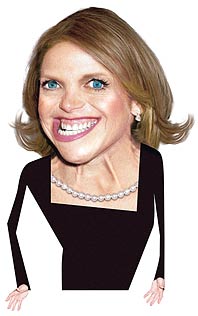
Last week, with a brand-new set freshly loaded into its studio, CBS News started doing daily run-throughs with Katie Couric in the anchor chair—a “shadow show,” as news division president Sean McManus described it to me, that will continue until they go live September 5. Finally. It was way back in 2004, more than half-an-Iraq-war ago, that Dan Rather admitted he was leaving the CBS Evening News, and Les Moonves, the CBS chairman, started sniffing around Couric.
But the extended interregnum (a function of Couric’s NBC contract, which expired only three months ago) was undoubtedly worth it for CBS. Making Couric the anchor and de facto face of CBS News is a very smart, potentially even visionary choice. Not because she’s the first woman to anchor a network newscast alone—although since the news “evening” is really late afternoon, a daypart dominated by female viewers, the CBS Evening News With Katie Couric will surely attract women who don’t currently watch any nightly news show. No, the real brilliance—in this age of The Daily Show— is that she’s the first network anchor to have a quick, smart, mischievous sense of humor as a major part of her public persona. She has all the serious-news experience the job requires, but it’s her lack of old-fashioned TV-news “gravitas”—that perpetual default to careful, po-faced grown-up solemnity that any moron can fake—which makes her special.
If it’s possible to rejuvenate TV news, Couric is among the last best hopes. “The format,” she said to me one morning last week, “has gotten pretty formulaic over the past 40 years.”
At the beginning of his post–Dan Rather R&D period, Moonves said, “Those days are over when you have that guy sitting behind the desk who everyone believes to the nth degree.” That’s not quite right. People still want to believe in news anchors. That nth degree of credibility, however, is achieved these days not by some quasi hottie’s stilted channeling of Chet Huntley or Walter Cronkite, but by a smart person who comes across as more or less normal on the air. Another of the early notions Moonves encouraged was making Jon Stewart an anchor—wrong person, right direction. Stewart’s jokes and ironic sensibility may not be transferable to a straight-ahead news program, but Moonves and McManus seem to have spent the past year studying the subtler lessons of The Daily Show.
First of all, it’s a truism—as well as true (or at least truthy)—that people are hungry for authenticity in their public figures. And a good sense of humor is the most reliable contemporary signifier of authenticity. Humor combined with menschiness and a degree of convincing moral engagement—why Stewart is a hero for our times, and The Daily Show starring Craig Kilborn never quite worked—is unbeatable.
For the past fifteen years, Couric has had a great venue to show off all those virtues—and this summer, dealing with the press, she’s worked the comedy like a pro. On her physical appearance as the CBS anchor: “I’m going to pretty much look the same way, unfortunately, that I have always looked. I have no plans to get a crew cut or shop at Brooks Brothers … Hopefully, I’ll have good hygiene.” Will she adopt a signature sign-off like Cronkite’s And that’s the way it is or Rather’s Courage? “I contemplated ‘Peace out, homies.’ That just didn’t feel completely right.” And at the Aspen Ideas Festival, alluding to her colonoscopy on Today, she said she planned to get an on-air Pap smear her first night as anchor.
She won’t have many opportunities to crack wise on the Evening News, of course. But if you strip away the jokes from Stewart’s Daily Show performances, what remains is an intelligent, charming, clued-in, puckish, apparently unpretentious, occasionally self-deprecating fortysomething whose responses to news stories seem recognizably, appealingly human. In other words: Katie Couric.
Then there’s the critique embodied by the Daily Show correspondent shtick: that a lot of real TV news consists of brazen superficiality delivered in a strenuous, stylized performance of authority and seriousness. As much as competition from cable news and the Internet, it’s the deep-seated disingenuousness that’s made people give up the network news habit. Couric and McManus and Rome Hartman, the show’s new executive producer, seem to get this. If they have the steadfastness to act on the understanding, to slough off the phoniest TV conventions and devote more air time to (relatively) in-depth explanations—as Couric puts it very hopefully, “a perspective The Economist might have a week later”—they could actually start to make a distinct, next-generation network news show.
“I don’t think,” Couric told me, “that just because I’m moving to the Evening News I have to take on an entirely different persona and be Ted Baxterish.” At the CBS affiliates’ convention in June, she predicted the end of the “pretentious era” of anchordom. Her colleagues won’t quite go so far as to affirm the implicit idea that Dan Rather and the old-school CBS News hauteur were pretentious. “I think,” Hartman says, “that was just another way of her saying she is who she is [on TV]. She’s confident enough to be herself. That sense of genuineness is a tremendous strength. This informality.”
The difficult trick is manifesting much of that within a very tight, mostly serious half-hour each evening. Reading a script while sitting alone at a desk doesn’t easily allow for the expression of a broad range of one’s personality. But Couric is game to try. She plans to bring in people like Tom Friedman and interview them live. She’ll go into the actual newsroom and talk to producers on the air. She aims to make the Evening News “appropriately casual, less what I call Newzak, the kind of droney thing that has no relation to normal conversation.” As she said to McManus recently, “if we have a day in Iraq that’s particularly bloody, I’d like to come on air and say, ‘This is a really, really lousy day in Iraq.’ ”
An anchor can show off more brains and charisma by getting out and reporting— although as a practical matter that often amounts to reading a script while standing in front of an exotic skyline (a might-as-well-be-fake photo op that’s expertly satirized by the ridiculous blue-screen stand-ups on The Daily Show). Couric suggests she won’t play along, Gunga Dan style, and appear in war zones just because Brian and Charlie are flying in. “It’s a bit of a show when the anchor parachutes in and bigfoots a correspondent who’s been working on a story. It’s window dressing sometimes.”
Being less pompous and fake than her competitors is one thing. But how, on the Evening News, will she manage to be assertively, accessibly witty? It’s hard. Brian Williams is actually very funny and loose in person and when he appears on comedy shows. But as an anchor—when his viewers’ median age is 60 instead of 51 (Letterman, Leno) or 35 (The Daily Show)—he’s still entirely invested in a hyperearnest premodern version of gravitas, which just doesn’t suit a 47-year-old very well. As one senior TV news executive said to me, he comes across “at times as a parody of an anchorman.”
On the new CBS Evening News, “there will be some nights,” McManus says, “perhaps the first night, where there will be some humor.” The regular container for that will be what Hartman calls “the opinion section,” a nightly 90-second commentary by civilians as well as famous people—“the Nora Ephrons of the world,” Couric says, or Carl Hiaasen. How about Stewart? “I love Jon,” she says. “He and I have talked about it. Early on it might be too much, but down the line.” And please, God, not Andy Rooney? She laughs. “He’s got a perch already.” And she adds: “I’d love Ali G to do one.”
Reading a script alone at a desk doesn’t easily allow for the expression of a broad range of one’s personality.
What about impertinent lines or amused inflections and smiles from Couric herself? “We have to figure out how to titrate it appropriately,” she says. “I think probably less is more in this format.”
Until now, daily TV about current events has tended to be one or the other, either dry and sober (at its finest, PBS’s NewsHour) or a pure frolic (The Colbert Report). In print, however, hybrids of seriousness and humor are nothing new, and have propagated through daily journalism for the past quarter century, as forever-young baby-boomers came of age. Today a majority of the Times’s op-ed columnists write “funny” at least some of the time. And elsewhere the most celebrated political commentators of the left (Michael Moore, Al Franken, Arianna Huffington) and right (Ann Coulter, Rush Limbaugh) are now humorists.
If successful political journalists and pundits are practically obliged to demonstrate a sense of humor in this Daily Show age, then so, naturally, are successful politicians. People who dislike George Bush find his chuckles and smirks repellent, but it was nevertheless the regular-guy jolliness, frat-boyish though it may be, that helped elect him. His performance alongside a Bush impersonator at the White House Correspondents’ dinner last spring killed, because it was funny and surprising and self-deprecating—and thus preemptively spoiled Stephen Colbert’s mock-right-wing act. And if Bush’s Democratic opponent in 2000 had been as loose and funny as a candidate as he is now as a climate-change Jeremiah (“I’m Al Gore. I used to be the next president of the United States”), he almost certainly would have been president. Which is also another way of explaining why (puckish) John McCain will trounce (earnest) Hillary Clinton in 2008.
A sense of humor is powerful stuff in an era of rampant phoniness and PC dissembling. But if you’re clumsy at it—and if you’re kind of a dick—it can blow up in your face. It was Senator George Allen’s Bushian predisposition for barbed ad-libs that wrecked his presidential candidacy in one stroke two weeks ago, when he turned to the Indian-American videotaping him at a campaign rally and, grinning, encouraged the (white) Virginia audience to laugh at “Macaca, or whatever his name is.” That was the same news cycle in which Bryant Gumbel, Couric’s former Today co-anchor, got into trouble for joking on TV that the outgoing NFL commissioner has had the leader of the players union on a leash. Thus all spontaneous displays of humor, even when they backfire, are glimpses of authenticity—authentic churlishness as well as authentic charm.
The breakthrough that Couric’s ascension represents is not about women being “taken seriously” in the old-fashioned, male-defined sense. Broadcast journalists from Nancy Dickerson to Jane Pauley to Christiane Amanpour have won those battles. Couric belongs on a newer, more complicated end of the social-progress spectrum, along with Oprah Winfrey and Tina Fey: female TV personalities who have become big stars by being a certain kind of smart and confident and tough and funny—and uniquely female. Their gender, at this social and historical moment, permits them to be more interesting and entertaining and beloved than men with the same job descriptions. (Viewers could care less if Couric was less-than-beloved by some of her colleagues at NBC—and if she were a man, such reports of diva behavior would’ve had no traction.) One simply can’t imagine a male Oprah, or a male Katie. In a man, their most effective attributes, the ones that engender appeal and trust, would seem … so gay. No male news anchor, especially one suspected of a gravitas deficiency, would dare say to a reporter, as Couric recently did, “It’s been an out-of-body experience to watch these major news events unfold in my pajamas.”
She’s out of her pajamas now, and ready to go—even though the shrinking audience for the nightly news shows is only half as big as when she got into the game. “The challenge,” she said, “is to make the evening news a go-to place again.” Which is a huge, maybe impossible task, no matter how new and improved her version turns out to be. I asked about her excitement-to-terror ratio on the eve of showtime. “About 20:80,” she said, apparently in all seriousness.
Email: emailandersen@aol.com.