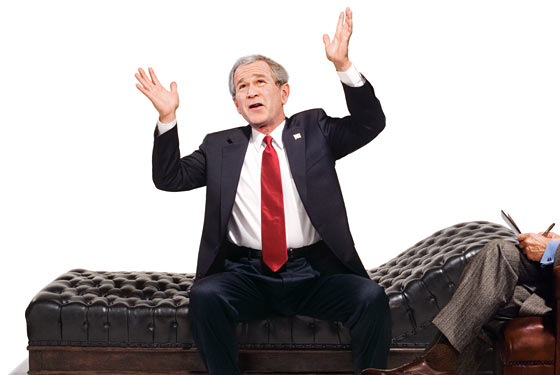
The Man With No Shadow
By Robert Stone, author of Prime Green: Remembering the Sixties
I think Bush has come to believe he’s on a lonely, noble mission—doing the right thing in spite of the ravings and denunciation by pygmies—and that to some degree he thinks people outside the Oval Office have to be lied to. But he is very mysterious—he doesn’t reveal much in the way of personal qualities. There’s an actor quality to what he does; he’s not very good at it. It’s as though somebody gave him a “nice young man” lesson.
I think he’s probably become suspicious of Cheney and Rove. They’re certainly isolating him as much as they can in order to protect him. He does seem less confident and steady. He must feel that he’s being abandoned.
He’s trying for a do-over. It’s the last throw of the dice. He’s casually ruthless enough to sacrifice that many lives. Maybe this is brutal, but I think some of those tears over dead soldiers are really self-pitying. It may be just a superficial sentimentality, which is better than sarcasm.
Bush is unimaginative, to a slightly pathological degree. He doesn’t cast a shadow; he’s just this paper construction.
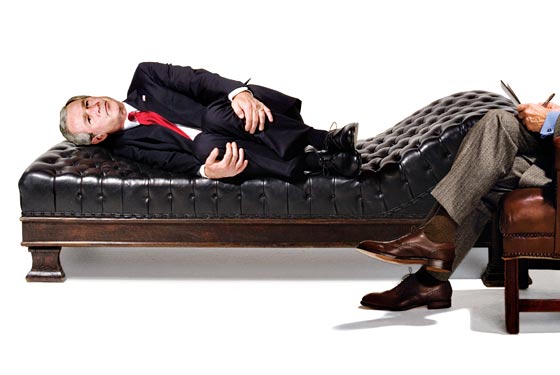
Dad, the Bottle, Vietnam
By Jonathan Alter, Newsweek columnist
I see Bush’s behavior as the result of three major forces: the dad, the bottle, and the Vietnam War. For most of his life, Bush tried and failed to follow in his absent father’s footsteps. His father was a war hero; Bush a no-show Guardsman dodging Vietnam. His father did well in the oil business; Bush struck dry holes. His father got elected to Congress; Bush was defeated in 1978. A collection of Bush Sr.’s letters contains far more to Jeb than George W. Finally, in 1994, Bush was elected governor of Texas, but George and Bar were so upset that their anointed son, Jeb, lost the election that night for the governorship of Florida that they barely seemed to notice. You don’t have to be Freud to see that Bush has snubbed his father’s closest advisers (who turned out to be right) and hired men who held his father in contempt, like Don Rumsfeld (who turned out to be wrong). It was no big surprise that he rejected the Baker-Hamilton report. As with many former substance abusers, he became fanatically disciplined—maybe the most disciplined man to hold the office. But with discipline came rigidity. Former drunks sometimes fear that if they change their lives too abruptly after straightening out, they’ll pull a thread on their recovery and sink back into chaos. They never admit their helplessness, so when they succeed in staying sober anyway, it helps their confidence. It’s a reflection of their will to stay the course. This is too simple an explanation for Bush’s failures as president, but it helps illuminate his mind-set. Finally, Bush is a baby-boomer, but with a twist. He was rebelling against the reigning liberal orthodoxy of the sixties. He and other Vietnam War hawks believe that we lost simply because we quit. To give in to the Establishment view of his father and the Democrats now would be to repudiate his whole political sense of self. One thing has changed: Now he meets the families of the dead. It has wiped the smirk off his face—but it’s actually reinforced his determination that they must not die in vain.
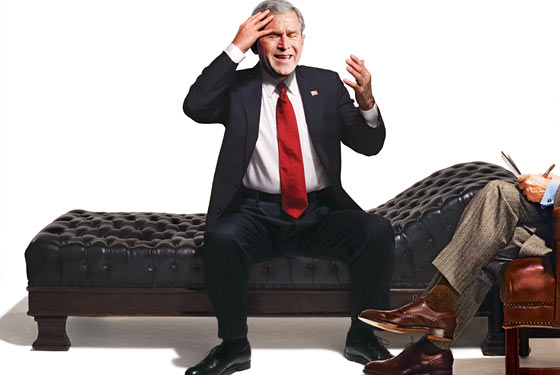
The Real Agenda
By Dahlia Lithwick, senior editor, Slate
It sounds counterintuitive, but I think the president is thinking that he may have lost the battle but he’s won the war. The battle being the short-term fight in Iraq and maybe some political capital. The war being the endgame: enshrining a radical new vision of the scope of executive power. The president may be unpopular. His war may be a disaster. But in pursuing that war, he’s expanded presidential authority almost beyond recognition. The prison at Guantánamo may be futile, but he’s won the right to operate it. Abusive interrogation may yield no useful information, but he’s seized the right to do it. Warrantless eavesdropping may not catch terrorists, but he’s staked out the power to order it. If securing such power was always the endgame of this administration, the war in Iraq is nothing but a speed bump. And putting two justices on the Supreme Court who appear willing to sign off on an imperial presidency is the cherry on top.
He Is Not a Crook
By Melvin Laird, counselor to President Nixon
There are those who want to draw parallels between George W. Bush and Richard Nixon. But for those of us who were in the White House with Nixon, the differences could not be starker. I resigned as Defense secretary at the beginning of the second Nixon term in 1973. My intent was to fade quietly into private life, but I began hearing reports the White House was paralyzed by Watergate and Nixon had withdrawn into a cocoon. So I accepted his offer to become a senior adviser and member of his Cabinet. But especially after I confronted Nixon with the truth I soon discovered about Watergate, I rarely saw the president. There were many presidential documents in the files from those months that were signed but barely noticed by Nixon, as he was too occupied with Watergate. George Bush has problems of his own, but he is not down, nor is he out. Bush is an inveterate optimist with a strong sense of self. He wants Congress and Americans to give him the time, resources, and freedom of action to get the job done in Iraq as he sees fit. But the result is that the public and Congress are left out of the thinking process.
Listening to Himself
By Peter D. Kramer, author of Listening to Prozac and Freud: Inventor of the Modern Mind
People are hard to gauge from even a short distance; I may imagine I have a good read on someone, only to discover a different person when he shows up for a consultation. That said, I’m not inclined to give Bush the benefit of the doubt. If you or I failed in this catastrophic fashion, we would be crushed to the point of—who knows? It’s nearly unimaginable.
But Bush may not be devastated. Frustrated, rather, by new limitations to his power or harm to his image. Or self-satisfied, at having achieved power in the first place. Or vengeful, and distracted by petty slights. Or simply able to live with confusion, to tread water, to continue to find reasons to pat himself on the back. I don’t doubt his intelligence, but it’s possible to be, say, adept or cunning without being insightful.
I suppose that I’m speaking out of fear and anger as much as anything. My concern is precisely that Bush is not undone by the current state of the nation and that he’s not going to prove thoughtful in the service of seeking change. Then again, a contrasting possibility—that Bush is more self-aware than I imagine, and more panicked and overwhelmed—might be more humanly attractive but no more reassuring.
Once More, With Feeling
By Mark Green, former NYC public advocate
Dear Diary:
I want to end my term at the 60 percent favorables of Ike, Reagan, and Clinton. My poll numbers have always been under 50 percent, except when they jumped to 80 percent after 9/11, to 70 percent after I invaded Iraq, to 60 percent after I found Saddam. Could it be that, beyond the 25 percent of Evangelicals who believe more in the Bible than the Constitution, I can only get over 50 percent by doing something militarily? Doesn’t Iran sound like Iraq? Isn’t it also run by a Hitler-like guy, don’t they foment terrorism, might they go nuclear sooner rather than later?
Gotta go…
He Misunderstands History
By Alan Brinkley, Allan Nevins Professor of History, Columbia University
Despite the tepid signs of conciliation in the State of the Union, what is striking about Bush today is how little impact his problems appear to have had on him. To all appearances, he seems still to believe that he is a great world leader engaged in the historic task of leading a reluctant nation into a necessary new relationship with the world. (“I must tell you,” he said in a recent press conference, “I’m sleeping a lot better than people would assume.”) In some perverse way, it appears, the very fact of his unpopularity is evidence to him of his own strength. Other presidents have demonstrated a similar rigidity. Andrew Jackson was famously stubborn and ran tremendous political (and financial) risks in taking on powerful opponents like the National Bank. Woodrow Wilson refused to compromise with his adversaries on the League of Nations. Ronald Reagan could not bring himself to acknowledge error or responsibility in the aftermath of Iran/contra. But none of these examples is really comparable to Bush’s current situation. Jackson took on the bank from a position of enormous political strength and, for better or worse, won. Wilson dug in his heels on the League only after suffering a debilitating stroke. Reagan was, many believe, already impaired by the time of Iran/contra and apparently unable to understand the controversies swirling around him. Bush, by contrast, is relatively young, in apparently good health, and surrounded by capable people sympathetic to him—among them his own father—who are willing and able to help him rescue his presidency from its present self-defeating course. He has a modest prepresidential reputation of having the ability to work effectively across party and ideological lines. But as those who believe that he is following a wise course shrink to an almost insignificant remnant, as the very architects of the policies he now defends repudiate their own work, as the political cost of his current path becomes increasingly apparent to almost any sentient person, Bush—who may still have time to redeem at least some part of his legacy—still appears to be oblivious both to the downward spiral of his presidency and to his own likely place in history.
What Would Jesus Do?
By Scott Dikkers, editor-in-chief of The Onion
I think anyone who’s ever read the New Testament knows that there’s very little upon which George W. Bush and Jesus would agree, but in his mind they’re in total consort and he’s his favorite political philosopher. I would say he talks to God the same amount now as ever. The only poll he cares about is the one that comes from Jesus. And he’s got 100 percent approval from Jesus.
The Pathological Optimist
By Joshua Wolf Shenk, author of Lincoln’s Melancholy
Bush is rather the opposite of Lemony Snicket. He never anticipates an unfortunate event. And about those that come to pass, he makes not a peep. No matter the external reality, Bush maintains a confident—even aggressive—stance.
This isn’t merely an attitude; it’s a fixed belief that confidence is right and skepticism wrong. In this sense, he is the apotheosis of an ideology that afflicts the culture at large—that an optimist is a good person. He is the optimist-in-chief. But another phrase applies in his case: “pathological optimism.” Refusing to engage reality only works as long as reality is kept at bay.
Lincoln showed another path. His insistence on grappling with the worst conceivable scenarios—and candidly assessing errors—was crucial to his strength, not least because it drew his allies closer to him at times of trial. Perhaps Bush’s presidency faces a crisis not just because times are hard but also because he won’t see the hard times for what they are.
Mr. Subliminal
By Christopher Buckley, author of Thank You for Smoking
Top Secret/Really Really Top Secret
National Security Agency
subj: Brainwave Intercept of President During State of the Union
Done this, what, six times? Seven times? What’s 2007 minus 2001? Five?
Here we go, “Madame Speaker, the president of the United States.” Madame Speaker. Well, she’s a whole lot easier on the eyes than Denny Hastert. Someone said he looked like a shoplifter in a novelty store.
They’re applaudin’. On both sides of the aisle. Buncha hypocrites. An hour from now they’ll be tellin’ MSNBC, “Actually, Keith, I was applauding the office, not the man.”
Keep smilin’. Like Mother says, Never let the c********rs see you cry.
Hello, Barack. Barack Hussein Obama. Hello, Senator Warner. Thanks for comin’ out against the surge today. That was so f***ing helpful.
What the hell’s that sound behind me? Is Cheney eating? Jesus Christ, Dick, could you wait till I’m finished here?
Let’s get some applause lines goin’ here. Okay, listen up. We’re gonna launch a manned mission to Jupiter in 2008! You excited? I’m thrilled! Wanted to put that in, but Bolten said it’d blow out the budget and no one gives a rat’s ass about Jupiter.
Polls. Times said today I’m about where Harry Truman was during Korea and where Nixon was during Watergate. Wonderful. What was the name of that book everyone was reading at Yale … Been Down So Long It Looks Like Up to Me. That’s about right.
Smile. Hit ’em with the 20 percent reduction in gas idea. That’s right. Twenty percent. Keep a straight face. Do not laugh.
All right, now the Iraq stuff. Deep breath. Look statesmanlike. Don’t grin.
All right you m**********rs, listen up: You may not like where we are, but we are in it together. Uh-huh. That’s t-o-o-g-e-t-h-e-r. You got a better idea? Fine. Write it on a postcard and send it in.
Now the fun part. Lookit all them heroes in the balcony. My God, where else you got heroes like that? In Canada? China? There’s whatsisname, passed up the chance to play basketball so’s he could go back to the Congo and open a hospital. Jesus, lookit the size of you. What do they feed you in the Congo? Thought everyone there was undernourished. And there’s whatsisname, jumped on the subway platform and saved the guy. How about jumpin’ on top of me? Could use some help here.
Almost done. Okay, hit ’em with the state of the union is strooong. Then bolt.
Whew. They’re clappin’. Listen to ’em. Laura, darlin’, they’re clappin’. For the man.
Quick. Outta here before Keith can say, “Well, Chris, well, Tom, they’re really clappin’ for the office, not for that sorry-ass loser.”
Autographs. They want autographs. Would they be askin’ for autographs if they didn’t like me?
You’re doin’ a heckuva job, Bushie.
His Smile
By Deepak Chopra, president, Alliance for a New Humanity
One of the most unnerving things about George Bush is his smile. As the situation in Iraq has grown more calamitous, the smile hasn’t disappeared. It’s become markedly patronizing, saying, “I’m right on this. The rest of you just don’t understand.” A pitying smile. On the night of the State of the Union, the president kept his smirking to a minimum—a surprise. It’s been pointed out that until he became president, Bush didn’t smirk. It’s grown into a disturbing tic, expressing a mixture of contradictory traits: smugness, disdain, self-consciousness, doubt. It’s not the easiest smirk to read. People who read contempt in it are rightfully offended. They think of Bush’s most unpleasant attribute: his sense of entitlement. Having accomplished little in his life, he nevertheless expected the highest rewards. He wanted victory to come easily, as his birthright. When it did come in 2000—to the astonishment even of his family—the smirk said, “I told you so.” His smile turns into a go-to-hell smirk whenever Bush hears a hostile question. He’s shielding himself from impudence while reining in his own simmering anger. He’s smirking to put you on warning. In a moment he might blow his top. Bush’s smile also tells us, almost guilelessly, that he isn’t suffering inside. This fact maddens his critics the most. Lincoln suffered terribly during the Civil War, as Churchill did in World War II. Bush has to remind himself to put on a sad face when he talks about his war. The black dog, as Churchill called his depression, doesn’t nip at this president’s heels. Have we seen a more inappropriate smile from any politician since Nixon? I doubt it.
Deep Down He Knows
By Ted Sorensen, speechwriter for President Kennedy
I have enough sympathy for anybody in that position that I wouldn’t say he’s mentally deranged: I feel sorry for him. I think he must know that he’s going to go down in history as the most incompetent president since Buchanan. He came to the White House knowing nothing about national and international policy and consequently relied on Washington veterans—who proved to be incompetent ideologues who got him, and the country, into very deep trouble. Now he’s in a hole, and I’m sure he doesn’t know what to do and has that hopeless, helpless feeling.
The Vessel
By Gary Hart, Wirth Chair Professor at the University of Colorado at Denver and former U.S. senator
I think Bush didn’t have a view of America’s role in the world until after 9/11, and then it was provided to him by those around him in power. They had two big ideas: One was to depose Saddam and use Iraq as a base to pacify, in an imperial way, the Middle East, and to control its oil. The second big idea, carried over by the vice-president and the secretary of Defense, was that of the unitary presidency. It also fits in with a kind of messianic belief on the part of the president that he did have a great purpose in life even though he had up until that time not discovered that, and his great purpose was to destroy international terrorism and overthrow dictators and spread democracy.
I think he’s not totally delusional. The escalation is the last gasp. He had to give it, in his own mind, one more try. The most interesting thing he said was about a year and a half ago: “This war will not be solved in my presidency.” And that was his exit strategy, I think. He had concluded that he did not expect to achieve success.
He clings to a thought that in 20 or 25 years, history will maybe prove him right, and people will say he really knew what he was doing. But throughout all of this, he has seemed so blithe and casual about death and destruction. It would have kept me awake at night. I don’t know how he does it. He must just turn it off.
Simplicity Himself
By Franklin Foer, editor of The New Republic
Where Nixon was a barrel of laughs, the Bush presidency simply isn’t very funny. There are no masterful Bush impersonators. Nixon’s comedic appeal resided in his dark interior life. When he spoke in public, you knew that you weren’t getting the full Nixon. Back in the private quarters of the White House, he was famously brooding over his enemies, sipping scotch, and talking to the portraits on the wall. The fact that the leader of the Free World was neurotic, paranoid, and palpably creepy made him a genuinely excellent premise for jokes. Bush has none of these qualities. Even as his entire presidency has tanked, he shows no signs of acquiring psychological complexities. He remains the “simple,” “resolute” man that his hagiographers once venerated. If you put Bush on the couch, I’m afraid he’d still take a nap.
A Decadent Aristocrat
By Andrew Solomon, author of The Noonday Demon: An Atlas of Depression
Bush, like his mother, has an almost inhuman ability to identify his own advantage without the slightest regard to its cost to others. One reads in Lincoln’s diaries of how his heart bled for every soldier who died in the war he felt obliged to wage; one reads in Bush’s face and in his speeches an inability to conceive of other people as fully human, including the soldiers who die at his behest, a quality that renders him less than fully human himself. This heartlessness, unlike his achievement of the presidency, is the very hallmark of decadent aristocracy. It is worth noting, however, that most aristocracy is not so far decayed; the queen of England, despite her less cuddly manner, is clearly more compassionate than W. But in the great popularity contest of electoral politics, he has been a winner, and in his mind he is one still. With a few nods to the disagreeable fact of the Democratic Congress, he continued, in the State of the Union, to declare the truth rather than to reflect it, narcissistically unable to grasp that he is not the world.
The Clinical Diagnosis
By Susan Andersen, professor of psychology, NYU
As haunting as events in Iraq have been, debate in the White House remains in perpetual lockdown. This may in fact mirror what goes on inside the president’s mind. This same lockdown may exert a chokehold on inconsistent thought, complexity, and contradiction, sequestering such things away in quarantine to enable an unsullied inner confidence and a fixed worldview impervious to external facts. When people are under threat, they tend to hold ever more tightly to their pre-existing beliefs. Self-esteem can be inflated as well, leaving one emboldened against criticism. This pattern is all the more profound among people who show signs of “narcissistic personality.” These individuals are especially reactive to dips in adoration and yet they regularly fail to take others into account. They are prone to manipulative, domineering behavior, even though they can also be smooth and alluring. Anecdotal evidence would suggest that Bush has these tendencies. He shows signs of an “authoritarian personality” as well, which involves a special vulnerability to stature and power, to demonstrations of force, and also a profound personal need for power, order, and control. This helps account for how deeply enthralled he apparently is by the powerful and elusive vice-president.