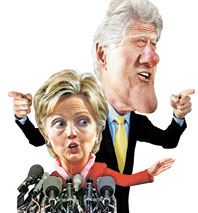
The Clinton dyad made its campaign-trail debut last week in Iowa, with the second leg of the traveling show scheduled for this week in New Hampshire. As tends to be the case with matters Clinton, the reviews so far have been mixed: Bill has overshadowed Hillary; no, he has let her shine; no, he has looked “downright bored” (per Newsweek) as he absorbs her numbing stump speech. And yet the rolling Clinton psychodrama has produced at least one riff that seems likely to have legs. “I know some people sort of say, ‘Well, you know, look at them, they’re old. They’re sort of yesterday’s news,’ ” Bill intoned at the University of Iowa, jabbing pointedly at Barack Obama’s trademark call for generational change. “Well, yesterday’s news was pretty good, that’s the first thing I want to say!”
As Clinton proceeded to rattle off a selective litany of that news, much of it turned out to be of the economic variety. Of course. In many areas, after all, from foreign policy to personal comportment, Clinton’s record looks from the vantage of today the same as it did at the time: mixed. But when it comes to Clintonomics, the benefit of hindsight has only burnished the administration’s achievements: the job creation, the robust growth, the fiscal surplus, the wage and productivity increases, the general-purpose prosperity. Certainly, there isn’t a plausible Democratic presidential candidate who isn’t trafficking, at least implicitly, in nostalgia for the Clinton boom.
Here’s the curious thing, however. One of the central tenets of Clintonomics was its embrace of globalization; indeed, a convincing argument can be made that Clinton did as much to advance the cause of free trade as any president of either party in the past 50 years. Yet as far as I can see, none of the top-tier Democratic runners has come close to offering a full-throated endorsement of this aspect of Clintonism. And although that may come as no surprise with regard to Obama or John Edwards, the distance between Hillary and her husband on the topic is both noteworthy and telling—not just about the brass-tacks electoral calculations behind her policy positions, but about the shifts now under way in Democratic economic orthodoxy.
Just how far apart are Mr. and Mrs. Clinton on the question of global economic integration? The gap is yawning. For the former president, three sweeping and historic trade agreements did much to cement his reputation as bone-deep internationalist: the passage of NAFTA, the ratification of the Uruguay Round of the gatt, and the extension of permanent normal trading status to China and its inclusion in the WTO.
But for the current senator, much of this apparently seems dubious, at least as a road map to the future. “We just can’t keep doing what we did in the twentieth century,” she told a reporter from Bloomberg, adding that we may need “a little time-out” before the enactment of any further trade deals. Accordingly, in 2005, she voted against the Central American Free Trade Agreement. Last month, she announced her opposition to the South Korean Free Trade Agreement. She has backed legislation that would impose trade sanctions on Chinese goods unless Beijing stops holding down the value of the yuan. She has even repeatedly spouted skepticism about the wisdom of NAFTA—while stopping short of blaming her husband for its deficiencies. “NAFTA was inherited by the Clinton administration,” she informed Time magazine. “I believe in the general principles it represented, but what we have learned is that we have to drive a tougher bargain.”
It’s tempting to mock this last point as a nakedly disingenuous reading of history, but … no, actually, it’s irresistible. Though Clinton did, in fact, inherit NAFTA from the Bush 41 régime, he campaigned for its passage as if his life depended on it, taking on the out-front protectionist bloc in the Democratic party at a time when his standing was far from solid—an act of considerable political courage and even greater political skill. After pushing through the deal, Clinton described it as representing a seminal decision by the country not to retreat from a world in which “change is the only constant.”
The pace of change being driven by globalization has only accelerated in the fourteen years since NAFTA’s passage. And the political backlash against that change has only grown more bellicose, potent, and mainstream. In 2006, a raft of Democratic Senate candidates—Ohio’s Sherrod Brown, Virginia’s Jim Webb, Montana’s Jon Tester—were elected in part because of their appeals to economic nationalism and their opposition to trade deals that reputedly sent countless jobs overseas. And the anti-globalization tenor of many House Democratic campaigns was even more pronounced. “In all my time in Washington,” says Rob Shapiro, chairman of the New Democrat Network Globalization Initiative and a key adviser to Bill Clinton’s 1992 campaign, “I’ve never seen less support for open trade across this town than today.”
This new political context helps explain why Hillary is charting a course on trade so different from her husband’s. And Washington is only part of the story—and for her, the less important part. In crucial Democratic primary states, the anti-globalization fever is running even higher. “She’s lurching left on economics, and it’s all about Iowa,” says one Democratic insider with no affiliation to any presidential campaign. “They know she is badly positioned on Iraq, especially out there, where the antiwar feeling is strong. So she has to compensate somehow, and this is her way of doing it.”
Another unaligned Democratic operative, who believes that Clinton has been on a roll of late, suggests that another factor besides Iraq is at work in shaping her views on trade. “There really are three overlapping issues, all of which reflect on the face America shows the world: trade, immigration, and Iraq,” says this operative, who worked in the Clinton White House. “It’s hard to be on the unpopular side of all three of those issues. So if Hillary is going to be liberal on immigration, she has to be where she is on trade.” (This calculus, he adds in passing, is why John McCain is so completely hosed.)
To be fair, politics may not be the only thing behind Hillary’s skepticism about the unalloyed virtues of liberalizing trade. In the years since NAFTA was signed into law, even some of its most prominent boosters have come to acknowledge that the promised benefits, especially for the Mexican economy, have been painfully slow to arrive—and to question the assumptions on which they based their advocacy. “I was a true believer in NAFTA,” Berkeley economist and former Clinton administration official Brad DeLong proclaimed last year. “Now my faith is not gone, but shaken.”
More broadly, the consensus among top-tier economists that underpinned the support for free trade has lately been rattled by a spate of revisionism. Alan Blinder of Princeton, a former vice-chair of the Federal Reserve and a staunch Democrat, has taken to arguing that the downsides of unfettered globalization may be far greater than standard doctrine has assumed—in particular, that offshoring and outsourcing may put as many as 40 million American jobs at risk in the next two decades. The Nobel laureate Paul Samuelson has joined the chorus, as has former Clinton Treasury secretary Larry Summers, who wrote recently that pledges to retrain workers displaced in the globalized economy are “pretty thin gruel” when it comes to allaying the fears of the middle class.
The rethinking going on among such economists is salutary, to be sure. There can hardly be any doubt any longer that globalization (fueled by rapid technological change) is, as Shapiro has written, “weakening the long-standing connection between increases in the productivity of workers and the wages they earn.” But what makes the responses to this new reality among the Blinders and Summerses of the world welcome is that their arguments tend to be complex, careful, and nuanced. What none of them is advocating is any form of protectionism—even though that is precisely what many of the politicians and union leaders now seizing on the rethinking have in mind. Instead, the economists favor grand-scale education reform, worker training, R&D spending, and changes in the tax code to promote the creation of high value-added U.S. based jobs, and, not least, universal health care reform to bring down costs for domestic businesses.
“The next administration has a responsibility to create a new bargain on trade,” says Shapiro. “The bargain is, we will continue to expand open trade and we will make the significant investments required to enable American workers to benefit from it.”
Given Shapiro’s roots, it’s not surprising that his new bargain embodies the spirit of Clintonism (Bill Clintonism, that is). What’s often forgotten about Clintonomics, in its original incarnation, is that its theme was “putting people first.” Yes, there was always a commitment to fiscal discipline. Yes, there was the embrace of internationalism. But there was also a promise to sink massive sums into the formation and enhancement of human capital. But Clinton’s human-capital agenda was sacrificed on the altar of budget balancing, a sacrifice that was arguably unnecessary had the president and his people been willing to take on corporate welfare, congressional pork, and entitlement spending.
Now comes a golden opportunity for a presidential candidate prepared to do just that. Ready, that is, to make good on Bill Clinton’s unfinished agenda. Without question, the candidate most suitable to taking up the task, for reasons of both temperament and historical-cum-marital continuity, would be Hillary Clinton. Doing so would require her, however, to drop the cheap posturing as a trade hawk and adopt instead a stance of, I dunno, a genuine third-way leader. Those of us who care about getting globalization right will be watching and egging her on. And so, one hopes, will be her husband, who happens to understand all of this as well as anyone alive.
E-mail: jheilemann@gmail.com.