Harold Hayes, the late and deservedly fabled editor of Esquire when it was great, was a boyish-looking Southerner whose morning arrival at work was signaled by the metal taps on the heels of his suede oxfords. A young peon under his sway, I could measure Hayes’s mood by those taps. On days he anticipated a battle—when the business side was harrumphing about too many words and not enough fashion spreads—his taps went heavy-metal as he made his way from the elevator. On brighter days, when the magazine’s aging proprietor was off sunning in Palm Springs or, better yet, when Hayes was looking forward to a new piece by a writer he admired, the taps rang out with up-tempo joy, the sound a drummer makes riding a hi-hat.
There were happy tapsters all over town back then, not just at Esquire. Willie Morris was bringing fresh life to Harper’s, going so far as to run Norman Mailer’s “The Steps of the Pentagon”—all 90,000 words of it, the equivalent of a 300-page book—in a single issue. Clay Felker, having lost the top spot at Esquire to Hayes, moved on to hoist New York Magazine from the ashes of the Herald Tribune, filling its pages with Jimmy Breslin, Gloria Steinem, and a long list of other talented contributors. Felker—who’d give writers a New York second to pitch an idea, then turn his attention to the next—was renowned for going from party to party, scrawling article ideas onto cocktail napkins, stuffing the scraps into his pockets, assigning the pieces the following day.
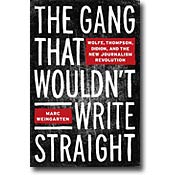
Those were the days, all right. Magazines were important enough to make people mad. Just after I arrived in New York—a baby editor, a kid—Norman Mailer threatened to punch me in the face at a party at Westbeth, simply because Esquire had done something to piss him off a few years prior. Magazines weren’t just billboards that sucked up to pretty faces with new movies coming out. Magazines were, at least a few of them were, springboards for the journalism of Mailer, Capote, Wolfe, Ephron, and a bunch of wild-eyed kids you never heard of until one of their pieces knocked your socks off. It was a time that magazine junkies celebrate to death, and now there’s yet another commemoration: a conscientious if hagiographic history by Marc Weingarten, The Gang That Wouldn’t Write Straight: Wolfe, Thompson, Didion, and the New Journalism Revolution.
The term “New Journalism” has always been a baffler, ambiguously defined, unevenly applied. It was first used to describe this brand of magazine writing by … well, nobody really knows. The label is generally applied to a work of nonfiction wherein the writer plants his or her persona, ego, or even the occasional private part into the story line. It gained currency in 1973, when Tom Wolfe dispatched it as a spitball aimed at the collective face of contemporary fiction. Wolfe’s rant argued that the American novel had been driven into a “begonia patch” of irrelevance by effetely literary diddlers who had turned their backs on realism. Neo-Fabulists, sneered the man in the white suit. It was now the reporter who had the literary skills, and the balls, to capture the mood and meaning of the times. The spitball stuck. New Journalism was, and remains, apparently, the state of the art. I don’t know what Clay Felker or Willie Morris thought of the term. But Harold Hayes dismissed it as little more than a packaging handle that could help an attention-hungry magazine writer achieve what everybody else was after in the sixties: proof of self-importance. But despite his disdain for the label, it was Hayes who left behind the genre’s bible, a 981-page anthology titled Smiling Through the Apocalypse. The 1969 collection is now out of print, but, as of this morning, you could order a used edition online for 72 cents. A better-crafted, more provocative doorstop you won’t find at Restoration Hardware. Within its bright-orange covers are 60 of the sixties’ greatest journalistic hits: Mailer on the coming of JFK; Wolfe on the geographical affliction otherwise known as Las Vegas; Talese on Sinatra, suffering the sniffles; Michael Herr on the horrors and delusions of Vietnam.
Curiously, this priceless collection is absent from Weingarten’s bibliography, which is a miss. There’s no better sampler with which to light or relight a reader’s fire for sixties journalism, and thereby demonstrate how a smart magazine could career through Vietnam, race relations, the women’s movement, the sexual revolution, the incipient cult of celebrity—“America’s collective confusion,” as Hayes put it. Apocalypse is all show and no tell, which is its strength. Weingarten’s Gang, on the other hand, is the reverse: It tells, but doesn’t much show. So if you want to get a grip on what the fuss was about, the two books make solid companions. Apocalypse delivers the goods; Gang explains how the goods were assembled and staged, relying on anecdotes and interviews with many who were present at the creation.
Though it doesn’t exactly tap-dance, The Gang That Wouldn’t Write Straight puts most of the important pieces in their place. It traces the rise of writers (Talese, Wolfe) who’d made names for themselves in daily newspapers, then opted to break their chains—first in magazines, later in best-selling books. It recounts how certain members of the gang (Mailer, Didion) brought A-list literary credentials to the party. And how others still (Michael Herr, Timothy Crouse) simply showed up uninvited, bright-eyed and hungry, with fresh and subversive takes on the American way of war and politics. Predictably, the author also throws a bushel or two of poppy petals at the feet of the late, great, self-branded king of gonzo, Hunter S. Thompson, who made an art out of running amok. See a pattern? Personally, I never did. But, as I say, the spitball stuck.
Anyway, it’s nice to keep the flame flickering, and one is reluctant to be too hard on The Gang That Wouldn’t Write Straight. However, Weingarten is so intent on glorifying New Journalism that he loses perspective. His dismissal of The New Yorker (borrring!) is near total, no matter that the magazine under William Shawn, while often long-winded and snoozy, was home to much lively and innovative work. After dissing Capote for In Cold Blood’s inaccuracies, Weingarten goes radio silent on The New Yorker, wasting not so much as a footnote on John McPhee, who, while less of a preener than Tom Wolfe, has arguably been a more potent influence on literary journalism over the past four decades.
What we’re left with is a heavy sigh: Journalism-will-never-be-the-same. The fact is, despite the magazine industry’s depressing state, good journalism does survive out there. Weingarten gives cursory credit to Ted Conover, Jon Krakauer, and Barbara Ehrenreich, who are now parsed in J-schools as the New New Journalists. But it wouldn’t have hurt to go further, noting the accomplishments of many others—William Langewiesche and Michael Lewis, to name two—who reliably give their forebears a run for their money, in terms of both reporting and writing. But to bestow too much credit on today’s gifted gang would have only contradicted Weingarten’s basic premise: that Breslin, the Gonz, Wolfe, and the rest of the disparate cast were “our master explainers, our town criers, even our moral conscience,” the greatest of whom, Weingarten says, “burned with a Promethean flame.” I’d say that’s a bit overreaching—and I suspect that Hayes, Felker, or Morris would have advised the author to tone things down, and might have taken a sharp pencil, if not an ax, to those sentences.

It’s not clear who first applied the words “New Journalism” to the writing of Tom Wolfe, Joan Didion, et al. But the term first appeared in 1887 in an essay by the English conservative Mathew Arnold describing the sensationalist human-interest stories churned out by the London tabs. His praise was measured at best: “Full of ability, novelty, variety, sensation, sympathy, generous instincts; its one great fault is that it is feather-brained.” Then again, he said the same thing about democracy.
The Gang That Wouldn’t Write Straight: Wolfe, Thompson, Didion, and The New
Journalism Revolution
Marc Weingarten.
Crown. 336 pages. $25.
Lee Eisenberg is a former editor of Esquire. His book The Number: A Completely Different Way to Think About the Rest of Your Life will be published in early January by Free Press.