

How to Cook & Eat Fish Telling Good Fish from Bad

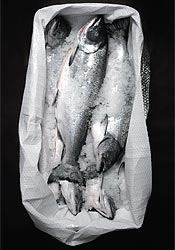
David Samuels swings a six-inch-long metal hook down into a box of fish and stabs a blackfish just below its eye. He lifts it up, plucks it off the hook, and holds it at arm’s length: It’s stiff. “Rigor mortis,” he says with an approving nod. “Rigor mortis is very good. The salt structure hasn’t broken down yet. This is a very good fish.”
He drops it into the box with a moist thwack. It’s 4:30 A.M. at the Fulton Fish Market, and grimy men dressed in overalls flecked with oil and fish guts whip by with stacks of boxes on handcarts. Samuels’s employees scoop shovelfuls of shaved ice into aluminum pans, and Korean restaurateurs wander by, peering into wax boxes of scrabbling crabs. Samuels is the owner of the Blue Ribbon fish wholesaler. His clients include stores citywide and elite restaurants like Esca and Le Bernardin; it’s his job to find the best stuff from the load that arrives every day from fishing companies. He deals with up to 100 fishermen in a day. “I buy from guys who have 100-foot boats, and I buy from guys who literally have a hook and line. There are a million ways to catch fish,” he says.
Samuels has a Zenlike calm, but he is a wickedly fast judge of fish—and indeed, everyone this morning is in a hurry. “Got any striped bass?” asks one restaurant buyer who darts up. “None that are good enough,” Samuels says with a shrug, and the man vanishes. Samuels saunters over to examine the most remarkable fish he has bought today: a glistening pink heap of unusually huge, twenty-pound red snappers from Florida, each nearly three feet in length. “Unbelievable. Beautiful. To see fish this fresh, you’d have to go to an aquarium,” he says almost breathlessly. “Feel the texture. You can feel the musculature beneath it.” At 6 A.M., Sandy Ingber, head chef for the Oyster Bar at Grand Central Station, turns up, dressed in a white butcher coat. “What do we got?” he asks Samuels, and the two bow heads and confer. Barely a few minutes later, the transaction is done, and Ingber has his day’s menu: some halibut, fluke, monkfish, arctic char, and soft-shell crab.
“I’m down here every morning,” Ingber tells me afterward. When it comes to fish, he trusts only his eyes. “I need to see it, if I want to have confidence in the fish I’m selling.”
Perhaps even more important, he comes down every morning because he’s developing a relationship with Samuels. Personal service from Samuels is both a badge of honor for a chef and, crucially, a guarantee of getting a product that will nudge a seafood restaurant out of the minor leagues and into multi-star territory. “Anyone can buy from me, but it’s very hard to get David Samuels’s personal attention,” Samuels says. If a chef isn’t in that inner circle, well, maybe he’ll get fish that’s good. But it won’t be great—not superb, not remarkable, not the sort of fish that glistens on a plate like a dewy ingot and makes diners drop big money.
Top restaurants have always siphoned off the best goods available in the city, from dry-aged sirloin to the ripest strawberries. But fish is unique food because the single most critical element is freshness. The top seafood chefs are not selling their delicate sauces, their unique recipes, or their food presentation so much as their ability to acquire fish that was alive and swimming yesterday. They’re selling the fact that Samuels picks up the phone when they call. They are not, ultimately, selling food: They’re selling access.
“The cooking part is easy,” jokes Ed Brown, executive chef of the Sea Grill in Rockefeller Center. “What sets us apart is getting the absolute freshest fish. And it’s not an easy thing to do.” The competition for the top fish has become stiffer in recent years, since fish itself has become an increasingly in-demand item. American per capita fish consumption has risen by 35 percent in the past twenty years, and in fashion-and-health-conscious New York, demand has recently spiked—such that one in every five restaurant dollars in the city is now spent on fish.
To make matters more difficult, fish is the last truly wild food. True, fish farming— raising fish in watery offshore pens—has become increasingly common in the past ten years, flooding the market with cheap salmon, tilapia, and (more recently) a bit of tuna. But the top chefs generally swear by wild fish, since its flesh is leaner and doesn’t taste of artificial feed: “Ninety-nine percent of our fish is wild—99.99, actually,” says Eric Ripert, chef at Le Bernardin. This means the supply of elite fish is inherently unpredictable: If the fishermen in British Columbia have terrific weather and luck, there’s plenty of excellent sockeye salmon to go around; if they don’t, there’ll be a scramble, and that’s when a chef needs his network.
“Sometimes there’s a lot of superior merchandise, and everyone can get it. But sometimes there’s a limited amount, and I have to protect my chefs,” Samuels says. “I’ll say to everyone else, ‘Hey, there’s no jumbo sea bass for you’—because I know my chefs are going to need it.” In the hypercompetitive world of New York food, fish is the trickiest catch of all. For an example of just how volatile the fish business can be, consider piballes, a delicacy favored by Cornelius Gallagher, the chef at Oceana. Piballes, otherwise known as baby glass eels, are available only three weeks of the year, which means they normally cost a hefty $80 a pound—more than ten times the price of, say, high-quality halibut, cod, or flounder. Gallagher has a $75 prix fixe menu, and he tries to keep the price of a fish no more than 35 percent of the overall cost of his dish, so piballes just barely squeaks into the realm of the affordable. But it’s worth it, he figures, merely for the cachet: “My customers are pretty educated, so when they see it, they go, Okay, he’s got piballes on the menu—we’ll try it.”
This year, though, Gallagher got shut out. The Japanese market—awash in money from a hot economy—went completely berserk for piballes and bid the price up to a punishing $350 a pound. “That’s insane,” Gallagher says. “That’s more than caviar! More than foie gras.”
Piballes is an extreme case, with extreme prices. Yet it’s a useful snapshot of the fish business, where the price and availability of a fish can zip up and down from day to day, wreaking havoc with chefs’ plans.
The problem isn’t merely demand. It’s that the supply chain for fish is affected by such a bewildering array of forces. Consider the case of Chilean sea bass, which rose to popularity about ten years ago. It was originally known as “Patagonian toothfish,” a name so unsavory that chefs had trouble persuading anyone to try it. But in the mid-nineties, a major stock of the fish was discovered off the coast of Chile, and some enterprising businessmen rebranded it as “Chilean sea bass” and sold it for about $2 a pound to chefs, a price so low it instantly showed up on every menu. Its high fat content meant it survived shipping well and was difficult to overcook. Soon, the enormous demand eroded fish stocks, and environmentalists lobbied Chile and adjacent nations to impose quotas to save the fish. With the quotas in place, the supply of Chilean sea bass shrank drastically, and the price soared to $9 or $10 a pound, where it resides today. Now days can go by without a supplier’s seeing Chilean sea bass at all, and many chefs never feature it because of its endangered status.
Many other previously dirt-cheap fish have been rising in price, as more and more quotas are imposed. Most quotas began fifteen years ago, when North Atlantic stocks suddenly dried up and the U.S. government began carefully regulating how much fish could be caught—and when. The result is a tangled forest of rules determining who can catch fish when and where.
“Cod used to be the lowest common denominator in the fish industry. It was less than $1 a pound. It was what you put in fish and chips,” Samuels recalls. Now scarcity has turned it into more of a luxury fish, particularly when it’s caught not in a net—which causes damage to the fish—but on a hook and line, which ensures that every fish is individually handled. “Now it’s $4 and $5 a pound, and Le Bernardin wants it.”
“The cooking part is easy,” says one chef. “What sets us apart is getting the absolute freshest fish.” And the competition for that has gotten very stiff indeed.
Snapper is another New York fish-of-the-moment, and its availability varies on a week-by-week basis—it’s only legal to catch it in Florida ten days out of every month, when easy availability can drop the price to about $4 a pound. When Florida boats are dry-docked, chefs are forced to get their snapper from New Zealand or other countries, and boom, the cost of travel boosts the price to $5.25 a pound. For many fish, the threat of overfishing continually looms: When Samuels was a kid, his family could barely give monkfish away for 50 cents a pound. Now it’s up to $3 or $4 a pound, and some fish experts worry it will soon be as endangered as Chilean sea bass.
“I think you should eat all the good fish you can right now, because the demand for fish is so high, it doesn’t seem good for the future,” says Mitchell Davis, publications director of the James Beard Foundation.
Mind you, not everyone agrees that we’re on the verge of a piscine apocalypse. Quotas, some argue, do work: They brought striped bass back from the brink. And when competing for scarce resources, New York is blessed by geography; Montauk is a world-class fishery that is a mere ten-minute boating trip from a deep coastal shelf that plunges into the Gulf Stream. Better yet, New York has excellent and cheap air shipping, offering increasingly easy access to international markets. Many foreign fishermen have become expert at key packing techniques—surrounding the fish with ice, carefully bleeding them, and sometimes even managing to leave them coated in their protective slime from the ocean. “Sometimes I get better fish from South America than I get from Montauk,” Samuels says during my visit with him, using his hook to open up a box of yellowtail snapper that glisten so brightly it’s as if they’d just been plucked from the Hudson River. “See? It’s packaged beautifully.”
Wherever they’re buying fish from, the suppliers and chefs have one thing in common: speed. With a food that spoils this quickly, nobody can sit around dithering; decisions to buy thousands of dollars’ worth of fish are made in the blink of an eye.
One morning, I visit Pierless Fish, another top-rated local wholesaler, in the Brooklyn Navy Yard, and find owner Robert DeMasco barking buy-and-sell orders into a phone while frantically clicking away on his computer. At a nearby desk, his partner haggles with a Maine fisherman over an order of striped bass. “How much does he want?” DeMasco asks.
“He wants $4.50.”
“Fuck him! Tell him $4.”
His partner shrugs. This fisherman’s a good source, so the partner doesn’t want to piss him off and risk losing the guy’s support if they need striped bass later in the month. DeMasco gives in and agrees to $4.50. “There’s a lot of deal-making,” he tells me.
The sheer value of an individual purchase can be astonishing. We wander over to a six-foot-long box, and DeMasco heaves off the cover. Inside is a massive bluefin tuna, as thick as a tree trunk. He’ll cut it up into some fish fillets and block-pieces of sushi. Bluefin costs $9 a pound, and this one weighs almost 500 pounds. It’s a $4,000 fish.
For a new chef, cracking into the elite fish network is not easy. “What makes the Fulton Fish Market unique,” says Dan Kim, partner of Alaskan Feast, a Fulton wholesaler, “is that you come to us—we think about it.” (The market is set to move to the Bronx any day now, but its social structure surely will remain intact.)
Rick Moonen, the chef who cooked at Oceana and ran Restaurant RM in New York (before decamping last year for Vegas), recalls how difficult it was, when he first started in the business, to get Samuels to give him access to the top-tier fish. Moonen was buying from Louis Rozzo, a competing Fulton wholesaler, so Samuels wouldn’t have anything to do with him. “The first couple of times I tried to get him to sell to me, he was like, ‘Nah,’ ” Moonen says. But Moonen kept on visiting Samuels’s operation and talking to his staff. He promised to pay cash up front for all his purchases. “After a while, I was down around the fish market often enough, it showed I was serious. So finally we went into the back room for a talk and he agreed to work with me.”
Once a chef has a trusted supplier, he tends to stick with him. That’s because a good supplier isn’t merely a source of fish; he’s a source of information about what’s fresh, what to go for, and what to avoid. Indeed, suppliers practically dictate the menu at the top restaurants. Eric Ripert uses Samuels exclusively; Daniel Boulud relies heavily on Rod Mitchell of Browne Trading Company up in Portland, Maine, who is renowned for having the best New England fish. Over at Sea Grill, Ed Brown also uses Browne Trading for about 30 percent of his fish; 60 percent comes from Rozzo, who, as Brown avers, gets the best snapper from Florida.
“He puts his hands on guys with day boats, and he’ll say, ‘I’ll take the entire boat. Pack it up, and fly it up to Newark.’ He’s got that kind of power,” Brown says. “And he’ll pick out the golden pieces and send them to me, the best three pounds he’s got. Whereas if you’re Joe Smith the chef, he’s like, ‘Yeah, I’ll get you three pounds—from the bottom of the box.’ ”
Another big player in fish networks is, improbably, FedEx. It has transformed the industry, giving chefs instant global access to individual fishermen worldwide, thus allowing the chefs to opt out of local machinations. At Esca, chef David Pasternack gets his top sockeye salmon by ordering directly from boats in British Columbia and Alaska. “I call ’em in the morning, see what they got, and if it’s good enough, they overnight it to me. It’s literally right off the boat,” Pasternack says. (Other fish he buys from Samuels.) Over at Oceana, Gallagher buys his fish exclusively from a FedExed network of twenty handpicked fishing companies worldwide. One of them, Scottish Wild Harvest, in western Scotland, sends him ten-pound boxes of langoustines, packed in a remarkable fashion: They’re in a dark tank for a few days to recover from the stress of being caught, then shipped to New York in temperature-controlled boxes.
“They’re literally still alive when I open the box here,” Gallagher marvels. “Out of 100, maybe one is dead. Whereas years ago when they shipped them, about half would be dead.”
Yet while FedEx brings in ever-more-elite fish, it also brings in ever-more-elite prices. Ed Brown often spends $100 to ship a 50-pound box of wild king salmon from Alaska, or sea trout from Tasmania. That’s another $2 per pound on the price, a hefty spike when you consider that local merchants nearly come to blows over 25-cent price differences. FedExing is thus an extra gamble for a chef, another way of eating into the already thin margins of the fish business. “If I don’t sell three portions,” he adds, “that could be my entire profit for that order.”
Sushi can be even more expensive. The best fatty tuna from Tokyo can regularly cost up to $50 a pound, so great is the Japanese demand for elite cuts. Over at Jewel Bako, owner Jack Lamb recently paid $42 a pound for big thin reef squid, coveted for its creamy taste. “At first I was like, ‘$42? This is crazy,’ ” he says. “But they said it’s the greatest squid in Japan, and when I tasted it, it was true.” Sushi has one major advantage: It is regularly “flash frozen”—a method of super-quick freezing that sometimes begins on the boat when the fish is still alive. Since sushi is frozen, a chef can stock up on excellent fish and hold it for weeks or even months, without needing to sell it instantly. It is a little jarring to learn that virtually all sushi arrives at restaurants in a cold brick that’s sawed into portions using wood-shop tools. But FDA rules require that all sushi be frozen, to kill parasites. (The exception is tuna, a naturally parasite-free fish.)
When it comes to suppliers, secrecy reigns. Many chefs won’t discuss whom they buy from, to prevent another restaurant from dipping into the same source. Gallagher was eating superb tuna at Sushi Seki, the Upper East Side sushi restaurant, and asked the chef where it came from. “He said, ‘Spain.’ I said, ‘Who’s your supplier?’ He just started laughing. And I realized I’ll never find out. Chefs’ sources are a pretty highly guarded secret. I don’t mind talking, but some of the old guard, they won’t say anything.”
What happens if a supplier screws a chef and sends him sub-par fish? With the long-term relationships, this doesn’t happen often: If Samuels and his ilk can’t find good enough halibut or monkfish for Eric Ripert or Pasternack, they’ll simply say none are available rather than foist mediocre fish on them. But sometimes a new supplier will “haze” a chef, checking to see how seriously he takes his quality. “Everybody’s gonna try to throw a couple of fish in there that aren’t very good,” says Daniel Angerer, a former co-owner of restaurants Fresh and Coast. Gallagher tells me that a supplier recently tried to “up” his order, shipping him 850-gram loup de mer when Gallagher had ordered only 800-gram fish. Gallagher sent them back, with an angry phone call. “I’m a gentleman, but I’m a ballbuster too. They’ll try to send you stuff and it’s not great, to test you. Then they find out you’re a ballbuster, and they treat you better.”
“There are companies I don’t like, but you couldn’t pay me all the money in the world to badmouth them,” Ed Brown says, laughing. “Relationships are everything, and you don’t want to break them.”
Indeed, those in the fish network are in a curiously co-dependent relationship. In a strictly economic sense, the top Fulton suppliers, like Samuels or Dan Kim of Alaskan Feast, probably don’t need the big chefs: Fancy restaurants don’t account, in fact, for much more than 10 or 20 percent of their business. Most of the business goes to mid-market restaurants and supermarkets that are willing to buy fish that’s a rung or two down the ladder, is a few days older, or has been damaged in transit. But having an elite chef as a client gives a fish seller prestige. “I know guys who get screwed on bills by big restaurants, but they don’t cut them off, because they all want to be the one saying, ‘I’m supplying so-and-so,’ ” says one supplier who asked to remain nameless. Indeed, serving a top chef can sometimes be less than profitable, as Dan Kim notes. “When I buy a fish for $10 a pound, I just look at myself and I go, ‘What am I doing?’ Handling these really expensive fish is almost more of a courtesy. You don’t make your money on it.”
Of course, chefs being chefs, outsize egos can sometimes rub suppliers the wrong way—particularly if someone is being a stickler about price. Few elite chefs will admit to serious haggling; if the fish is truly good, they claim they’ll pay almost whatever price necessary, since their wealthy customers can afford it. But suppliers tell a different story. “I remember one top guy, literally one of the top chefs in New York, was looking at some of my monkfish,” one supplier told me. “It was just amazing stuff. Line-caught, perfectly handled—it was so fresh it was still flopping around when we got our hands on it.” He asked for $5.50 a pound, but the chef refused to pay more than $4.50. “We couldn’t believe it. We’re like, ‘This is the best monkfish we’ve ever seen.’ And he’s like, ‘I don’t care. I can get monkfish elsewhere for $4.50.’ Yeah, but not as good as this. And this guy’s supposed to be running one of the best restaurants in New York?”
Another supplier complained that chefs are becoming timid, sticking only to well-known and mild-tasting fish like halibut, sole, and flounder, because they don’t want to do the experimentation necessary to discover new fish. “Slam the chefs,” he says. “They’re not going far enough afield. Even they’re bored by what they serve. They spend all their time just making new sauces instead of trying to find really good new fish.” David Samuels looks at it a slightly different way: “The really great chefs, they’re like a pastry chef—they just need basic ingredients, like great chocolate, great flour, great sugar. They’re not out there looking for weird new fish.”
The owner of Jewel Bako paid an astounding $42 a pound forbig thin reef squid. “They said it’s the greatest squid in Japan, and when I tasted it, it was true.”
Given how tightly knit the fish network is, how, precisely, does a new chef penetrate it and launch a restaurant that offers top-flight fish? It’s certainly possible to get great fish: As Moonen points out, almost anyone can call up a place like Browne Trading and order very good stuff. “It’s just that it’ll cost you an arm and a leg,” he adds. And since you’re the new guy on the block, you won’t be able to charge prices as high as Ripert or Ingber at the Oyster Bar, so your margins will be tighter. You could hunt down your own small boats worldwide that catch superb fish and have them FedEx it to you, but again, the expenses will pound you.
If you can survive long enough, you’ll have a chance to get in tight with the likes of DeMasco, Samuels, Kim, or Wild Edibles, another top wholesaler, though you’ll also have to convince them that you won’t go under in a few months. Having a client whose restaurant abruptly closes is the great risk for all suppliers, because the stakes can be serious: DeMasco has restaurants that can run up a $35,000 tab in a single month. In 2001, chef David Bouley reneged on $10,000 he owed DeMasco; DeMasco sued and won.
“Is it the cost of doing business?” DeMasco says. “Yes. Is it fun? No.” So to survive as a seafood chef, you either have to become so elite that suppliers crave your business, or so economically savvy that you never screw a supplier. “Because every day, I’ve got everyone asking for 100 pounds of cod, and I’ll only have like 20 pounds. So who are you going to give it to? The guys who pay their bills. Money talks! It always talks.”
Even Ripert says he’s careful to keep his suppliers happy: “You pay your bills, and you don’t bargain too much. Because if we did that every day, they’d be like, ‘Fuck you and go somewhere else!’ So we pay the price, we pay on time. The best fish goes to the one who pays the most.”
If the chefs of New York gobble up the truly outstanding fish every day, what’s left for consumers? Are we doomed to get only their scraps, the second-tier fish? Many experts say that’s the case. “You can’t get fish as good as a chef. There’s very few channels for that to come to you,” says Davis of the Beard Foundation.
The exceptions, however, are the fish stores that are also distributors, such as Wild Edibles or Citarella. These organizations buy fish for restaurants, so they have direct access to the fish markets and hunt the top cuts for elite chefs. But they also have stores serving high-end customers who are willing to pay extreme amounts, as much as or even more than a top chef. They’ve got dual loyalties you can exploit.
“In New York, you got a $5 million apartment on top of a $10 million apartment with a $20 million penthouse on top of that. Where else are you going to find that density of affluent people? So the stores have a fighting chance in Manhattan to offer great fish,” says Jonathan Meyer, an owner of Wild Edibles, when I visit him at his Bleecker Street store, where enormous wolf fish and snappers lie glistening on a bed of ice in the window.
Granted, the economics of fish still favor the chefs: They’re buying in bulk and they’re buying regularly, so they’re the first in mind when a superb Coho salmon comes into the store. Walk-in customers who wish to get their hands on the good stuff, Meyer says, are advised to cultivate their own relationships. Shop regularly, and instead of demanding a particular cut of fish—which may or may not be in season—do what the chefs do: Simply ask, “What’s fresh?” and go with that. Indeed, fighting the seasons can doom you to paying far too much for merchandise. “Customers say, ‘I have a dinner planned for next Thursday, and I’ll need a dozen soft-shell crabs,’ ” says Meyer. “And it’s the middle of the winter and soft-shell crabs are like $8 apiece. So it’s $100 for Mrs. Simpson just for her appetizer, and it’s a problem at the cash register.”
Another time-tested method is to always buy a fish with its head on. “That way, you can see the eyes—they gotta be clear and bulging,” says Pasternack of Esca. “And the gills should be red, because if it’s all purple in there, it means the fish is older.” What’s more, looking at the whole fish allows you to see if all the scales are intact, a sign that it’s been well handled. If you gently poke the side of the fish, it ought to spring back firmly. A spectacularly fresh fish may still have a coating of protective slime (almost like wet snot, says Pasternack). There’s the old smell test: Technically, a fish shouldn’t smell fishy at all; it should smell like the ocean. (Some chefs even claim the cleaned belly of a good fish smells faintly of cucumber or watermelon.)
FedEx can also work for you. Browne Trading runs a phone-in ordering service for everyday consumers that even top chefs agree carries superbly fresh fish, since the company has direct access to the fish auctions in Portland, Maine, where local fishermen sell their catch. “We really want to keep people out of the supermarkets,” says Mitchell. Prices are not excessively steep—a fillet of lemon sole is $12.95 per pound, and a whole tail of monkfish is $6.95 per pound—though overnight shipping can start to make your home-cooked dinner as expensive as eating out. For those who don’t like the idea of receiving unseen fish by mail, there are also the stalls at Union Square Greenmarket, where local fishermen like Blue Moon and PE & DD bring yesterday’s catch directly to the streets.
One way or another, says Meyer of Wild Edibles, “there’s always something fresh.” He leans into his window display, grabs a wolf fish with both hands, and thrusts it at me, holding the mouth open so I can see its rows of enormous jagged teeth. “See, that’s so vibrant!” he crows. “The eyes, they’re totally clear! Those teeth eat crabs and clams, crushing them up, and that’s why the meat on this fish is very sweet.” He holds it to his face and stares it in the eye. “The wolf fish looks very sharp today.”
See Also
Telling Good Fish From Bad