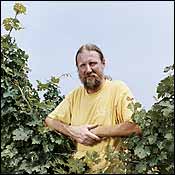
Eric Fry spends much of his year poring over bundles of stiff orange sheets known in the wine trade as chromatograms. The bottom of each sheet carries a row of wine spots, one smear for each wine in Fry’s cellars at the Lenz Winery near Cutchogue. Holding a sheet up to his mouth, he raises an open bottle of Parsons’ all-purpose cleaner and blows across its top like a man making bubbles. The ammonia from the solution hits the sheets and reacts with acids in the wine, smearing them upward in green-blue blobs and streaks. Fry points at the streaks with massive, soil-stained fingers—the three acids contained in wine, malic, tartaric, and lactic, all streak at different speeds, so the acid content of each wine is immediately revealed.
“I’m like a jeweler endlessly fussing over tiny details,” he says, as if resigned to his own fanaticism. “I’m watching that malic acid decline. Acid balance is everything.”
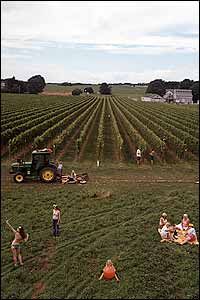
In his graying ponytail, beard, and blue overalls, Fry looks more hippie farmer than jeweler, but the intensity in the eye is the same. We move into the cellars, pipettes in hand, ready to sample from barrels. Lenz is one of the top wineries in the North Fork, and Fry has long been considered one of Long Island’s star winemakers, a prized consultant to thirteen estates. We taste some of his old-vines Merlot—still foamy and tartly young in barrel—and he explains that Long Island is at something of a crossroads these days. It is no longer an obscure region in the shadow of the metropolis, but neither has it made its way onto the city’s greatest wine lists. New York’s indigenous wine is a mass of contradictions: Bordeaux varietals made in Burgundian styles, artisanal methods jostling with industrial production, Jeffersonian agricultural idealism merging with an influx of millionaires. The wines are getting notice; the crowds are getting thicker. In ten years, the transformations have been radical. Is the North Fork, then, becoming New York City’s very own Napa Valley, a wine-tourist theme park?
“Well,” muses Fry, a little perturbed by the familiar comparison to Napa. “I suppose something like that is happening. The voracious reach of the Big Apple is bound to touch us. But most wine economies around the world are tourist economies now. Look at Bordeaux. Look at Chianti.”
Inevitably, Long Island faces the dilemmas Napa faced 30 years ago. Back then, Napa was unrecognized in the world, its wines often crude and technically unsophisticated. In the eighties, all that changed. Technology, a growing interaction with elite French estates, and ruthless marketing turned Napa into a wine superpower, as well as a potent tourist draw. It’s doubtful that Long Island can reproduce the same spectacular success story. And given that Napa today is almost a byword for “supermodel” wines lacking character and intimacy, many North Fork producers are acutely wary of following closely in its footsteps, even while envying much of what Napa has accomplished.
Long Island has been a wine region only since two young pioneers named Louisa and Alex Hargrave planted grapes in 1973. Thirty years on, 60-odd vineyards spread over 3,000 acres produce 1.2 million gallons of wine a year, fueling a $65 million annual business. Such success has sucked in a new generation of entrepreneurs seeking what Californians call “the Vine Life”: a heady pastoral lifestyle based on vineyard ownership.
But somehow a stigma remains. In his thick, global-minded Wine Buyer’s Guide, critic Robert Parker barely mentions New York State. Manhattan restaurants offer more wines from New Zealand than they do from the far end of Long Island. True, the days are long gone when snobs purported to detect a whiff of potatoes in the glass, and Lenz runs ads boasting of how a $55 bottle of its 1997 Estate Merlot beat a $650 Château Petrus in a blind tasting. But the rankling sense of being ignored by the metropolis persists.
Some of this can be chalked up to the idiocy of fashion, which governs the wine trade like almost no other. That evening, Fry took me to a winemakers’ blind-tasting dinner at Starr Boggs restaurant in Westhampton Beach. Eleven winemakers brought unmarked bottles to sample, the only condition being that none of them should be from Long Island (I brought a Bisson Prosecco from Liguria). After a few rounds of blind tasting, the vintners got into heated oenological debates. I was seated next to Charles Massoud, owner of Paumanok winery, one of the most rigorously artisanal on the North Fork. Of Lebanese descent, Massoud was once an IBM executive. Today, he is the archetypal family-wine patriarch presiding over a very personal estate. His German wife is from the Pfalz winegrowing region and has helped steer him away from the California model, with its emphasis on specialization—in California, vineyard managers and winemakers tend to be distinct professions. Massoud prefers to be both farmer and winemaker, like his French and German counterparts.
“A regional picture has not yet emerged here,” Massoud said, as we listened to the in-house entertainer belt out Paul McCartney songs on a sad electric piano. “There are just a handful of wineries that have made a serious commitment to quality.” He then leaned over and murmured softly, as if spies might be about: “Not like some operations I could mention. The region is going to have to decide where it’s going.”
We then opened the Bisson Prosecco, and the table drank it. It was deliciously unusual, with a faint scent of yeast—a perfect Prosecco, I thought, though naturally quite unlike any Long Island wine.
“It’s corked,” a voice piped up, using a term to describe wine that’s spoiled in the bottle. I decided not to argue. The comment struck me as either an example of extreme technical obsessiveness or else of a kind of inferiority complex. As it happens, the latter sentiment is the more ironic, for Long Island is at last on the threshold of being known, and rightly celebrated, for its serious wines. No reason to feel so inferior anymore.
Intermingled among the charming old clapboards with their apple trees and slow-moving Hyster tractors are the spiffy, novel signs of the wine economy: creative environmental design, landscape gardeners, wine tasting here. Route 25 looks like a plush suburban gated community studded with wineries like Raphael, an imposing faux Tuscan monastery—are we really in Cutchogue? Other operations have a slicker, chic-er look. Take Bedell Cellars, founded in 1980 and perhaps Long Island’s most famous winery.
It was the Merlots made by winemaker Kip Bedell in the early nineties that put the region on the map, and his creations have remained among the North Fork’s most prestigious wines (he was “Mr. Merlot” on the cover of The Wine Spectator). A former retail fuel-oil dealer, Bedell bought the declining potato farm as a hobby and planted some Zinfandel there for fun. Learning as he went along, he turned himself into a winemaker—though his ruddy, no-nonsense face somehow still reminds one of a successful petroleum retailer.
“Our original capital wasn’t enough,” he says, sitting in the newly renovated Bedell guest cottage, wearing a neat Bedell Cellars T-shirt. “We set the winery up, but it was Michael Lynne who saved us for the longer haul.”
Related Stories
The Long Island Top Ten
A personal (and sure to be hotly contested) selection of the East End’s finest wines. A Weekend Cruise Through The Wine Country
The Long Island wine country starts, appropriately, where the Long Island Expressway ends.
Lynne, the oenophile co-CEO of New Line Cinema, bought Bedell in 2000 for a cool $5 million, along with another landmark North Fork winery, Corey Creek, for which he paid $2 million in 1999. Peggy Lauber, the original owner of Corey Creek, recalls that it was Lynne who enabled both Corey Creek and Bedell to buy modern equipment: “We never had a proper winery until Michael put in the money. He wasn’t out to make a cash killing on these domains.”
Others, however, have been very interested in the cash. In the same year, 1999, Peconic Bay Winery was sold to Manhattan UBS investment consultant Paul Lowerre for $2 million, and a consortium of Chilean investors snapped up Laurel Lake Vineyards for $2.7 million, the first foreign capital to enter the scene. In 2000, telecommunications tycoon Vincent Galluccio bought Gristina Vineyards for $5.2 million and hired French guru Michel Rolland to make more “international” wines. The Entenmann cake empire now owns Martha Clara Vineyards—a $4 million tasting room is being completed—while Leslie Alexander, owner of the Houston Rockets, has laid out $1.5 million for a new venture in Cutchogue. Raphael, with its ostentatious $6 million, 15,000-square-foot facility, is owned by Long Island’s Petrocelli Construction. Such lavish public facilities are a lesson learned from Napa—this is where easy money can be made. For many wineries, 60 percent of their revenue comes from their tasting rooms.
Nineteen-ninety-three was the annus mirabilis for the North Fork, the first great Long Island vintage. As wine critic Gerald Asher noted, “The unique character of North Fork wines came together in 1993 in ways that will be of lasting consequence for this newest of American wine regions.” A ’93 Bedell I tasted is opulent and aromatic, perhaps reflecting the technical influence of Bordeaux winemakers like Paul Pontallier of Châteaux Margaux and May de Lencquesaing of Château Pichon-Longueville, who first visited Long Island in the late eighties (Pontallier is now a consultant at Raphael).
In many ways, however, the rejuvena-ted Bedell is Lynne’s creation, the incarnation of a sensitive outsider’s money. The potato farm–cum–winery is now a hip tourist installation, with a formidable tasting room accented in black and finished in minimal style; Arte Italica culinary wares are for sale, along with Riedel stems with the Bedell logo and Martha Stewart–y oddities like Corey Creek chocolate-Merlot sauce. The walls boast Wine Spectator awards and plaques from the New York Wine Experience. Both here and in the guesthouse, one stumbles across items from Lynne’s superb collection of modern art, pieces by Cindy Sherman, Kiki Smith, and Sarah Morris (Lynne is on the board of MoMA). The cottage itself has a huge Barbara Kruger photo adorning the kitchen—a woman laughing (or is it screaming?).
“I looked everywhere for a vineyard,” Lynne said on his way to Cannes in May, “Italy, California, France. But I’m a New Yorker and I wanted something close to the city. A friend took me out to the North Fork, and I was amazed by what I saw. And the wines we’re making are trying to gravitate towards France, not California.”
But aren’t new owners like him transforming the North Fork in very Californian, new-money ways? I asked. “Not necessarily,” he said. “There’s been a lot of change of ownership over the last seven years or so, it’s true. But what that’s meant is the inflow of investments, which the original owners simply couldn’t afford. A lot less wine, but higher in quality. For the first time, Long Island is set to be a global wine power, if you’ll forgive the phrase.”
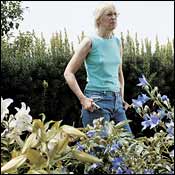
Louisa Hargrave lives today in a pretty farmhouse near Jamesport. Now divorced and somewhat removed from the wine business, she still quivers with its rarefied passions. With her slender frame and short blonde hair, she emanates a regal glamour and an acid intelligence.
Back in the seventies, Hargrave was splendidly countercultural—the newsletters she put out were dated from the winery’s founding like documents of the French Revolution, so that 1981, for example, was “Year Nine of the Noble Vine on Long Island.” A whiff of Utopia was in the air. “At first,” Louisa wrote in her 2003 memoir The Vineyard, “we thought of ourselves more as poets than as pioneers.” They thought of themselves, too, as a farming frontier resisting the juggernaut of suburban development.
“People say that Long Island has finally figured out how to make wine,” she says now. “Well, that’s crap. The wines were always good here. Aging is the critical issue—these wines have to age like any others—but the economics now make aging impossible. We’re living in an instant-gratification economy. Long Island is judged, wrongly, on the basis of these really young wines.” (Louisa gave me an interesting parting gift—some rare old wines of hers from the eighties, which I later drank with friends in the city. A 1980 Cabernet was one of the best American wines I have ever drunk. Nobody at the party I brought it to could guess where it was from, though all thought it was French.)
In 1999, the Hargraves sold out to an Italian prince, one Marco Borghese. The original Hargrave Vineyard in Cutchogue, imposingly renamed Castello di Borghese, cost the prince a handsome $4 million. The wines now made there have little to do with those made by Hargrave. “Wine is like cheese, namely a kind of game with bacteria,” she says. “It’s a tight-rope between complexity and disaster. In wine, you’re provoking bacteria to eat acids. But you’re playing with fire. It’s like sex, too: You accept the rancid, sweating human body in all its mystery.” Such wines, in other words, are sometimes flawed but always alive.
Industrial winemaking has a horror of all this. Its financial models abhor any suggestion of uncertainty, unpredictability, or—gasp!—the occasional corked bottle. So obsessed with technical perfection have Napa wineries become that they seem to be breeding strange fermented drinks for consumption at trade shows and competitions rather than wines destined for the mouths of mere mortals.
Although wine writers often describe these dueling models as New World and Old World (opposing, say, California and France), Fry refers to them as the Bordeaux and Burgundy models. Put simply, they represent differing approaches to fermentation. In Bordeaux, the estates are huge and production is on a large scale. Efficiency, therefore, is a prime consideration. Grapes are hurried through a first alcoholic fermentation for about three days. During this period, the juice is often moved from tank to tank and racked—that is, purified. It’s then put into steel tanks for a second fermentation, known as malolactic. In this fermentation, bitter malic acid (like that found in green apples) is split up by bacteria into softer lactic acids (like those found in yogurt). This will last about three to four days. The proto-wine is then barreled for aging.
This Bordeaux method ensures both a clean wine and a quick fermentation turnaround, ideal for wineries with thousands of barrels to process. But in Burgundy, it is very different. There, estates are small and production limited. A winemaker can supervise a smattering of barrels in his cellar with a personal care impossible in a larger winery. Fermentation can be much longer, more nuanced. A Burgundy malolactic fermentation can last months—traditionally from autumn until the following spring—during which time the winemaker tinkers, nudges, cajoles his wines. It’s the method that Fry has adopted at Lenz because, as he sees it, it gives his wine more detail, more authenticity. It’s called “reductive winemaking.”
“Smaller quantities, more complex fermentation,” says Fry. “What’s weird in Long Island is that we’re applying a Burgundian method to Bordeaux grape varietals like Merlot. But it gives our wines that distinctly complex, mushroomy funkiness that the French call sous-bois.”
When I visit Charles Massoud the following day at Paumanok, he confirms that his methods are also Burgundian. As we drink a glass of his excellent dry Riesling, which has appeared on the list at Alain Ducasse, Massoud admits that making this kind of wine is not a good business model. “It’s the fanatic’s route, if you will,” he says. “A way of life that is beyond money.”
This costly method does, however, enable Massoud to price his wines as elite products. His top Todd Hills Lane Cabernet rose from an initial $22 a bottle to a staggering $109 because of furious demand. A magnum of it has reputedly sold for $380. “It’s a question of supply,” explains Massoud. “I can sell 50 cases at any price I want. But 500 cases … I cannot be so cavalier. The market is much more difficult now for expensive wines.”
’We’re not at the point where we can ask $100 a bottle. That day may come—if the Big Apple starts drinking it seriously. But we’re cheap compared to Mondavi!’
Price is a vexing issue for every winemaker. At Lenz, Fry let me taste his top Merlots, which retail for $55 a bottle—relatively cheap by global standards, but in some perverse way perhaps not expensive enough for the New York power-restaurant scene. Wine is a fetish commodity, and its prices have little to do with objective notions of quality. “This is a great wine, in my opinion,” Fry says, raising one of his pipettes and looking at the ruby liquid trapped within. “But we’re not at the point where we can ask $100 a bottle. That day may come—if the Big Apple starts drinking it seriously. But we’re cheap compared to Mondavi!”
Working the other side of the street from Paumanok and Lenz are mass-production wineries like Pindar, Duck Walk (one of three vineyards on the South Fork), and Martha Clara, whose technically clean industrial wines are huge commercial successes. Pindar reportedly imports tankers of Californian wine to supplement its production and thrusts thousands of $7.99 bottles with names like Spring Splendor and Summer Blush onto a market infatuated with gimmicks like California’s Two Buck Chuck. Pindar’s owner, Herodotus “Dan” Damianos, a doctor who made his fortune in nursing homes, may well be Long Island’s most successful wine entrepreneur, his tasting room packed with bargain-hunting tourists.
A good deal of Long Island wine comes from a single place, the Premium Wine Group’s custom crush facility in Mattituck. With almost 100 fermentation tanks processing hundreds of tons of grapes per harvest, the plant can be used by any winemaker who doesn’t have the facilities himself or the capacity to mass-produce. It’s used by Martha Clara, Lieb Family Cellars, and Sherwood House Vineyards, among others.
Wines like this used to define Long Island in many people’s minds, and while they are now being somewhat eclipsed by the more serious artisanal producers, they’re still a far better business.
The vine life attracts a good share of idiosyncratic dreamers, and among them on the North Fork is Joe Macari Jr. A Queens native, he has grown up to be a fierce advocate of radical organic agriculture and its applications in winemaking.
The Macari family, which owes its fortune to the real-estate and construction business in Jackson Heights, has been on the North Fork since Joe’s father bought land there in the sixties. Their first idea was a golf resort, but that was blocked, and years later, when the bankrupt Mattituck Hills Winery was put up for sale, the Macaris bought it.
Today, the Macari estate is both huge and magnificent, gracefully abutting Long Island Sound. It is there that Joe Jr. lovingly practices “biodynamics,” a mystical form of organic farming that uses astrology, dousing, and other alternative techniques to supplement a pesticide-free method of creating harmonious ecosystems. In the wine world, it has been made glamorous by star producers in France like the Loire’s Nicolas Joly, but Macari has struggled to pull it off on such a grand scale.
Cruising around his property in a truck, we careered around the system of dirt tracks that connects the various plots of vineyard with the internal farms that breed longhorn cows or manufacture organic fertilizer and compost. We stopped near a strange-looking tower.
“That’s an Irish energy tower over there,” he explained. “It brings in cosmic energy to nourish the soil.”
A little farther on, we stopped by some beehives, for “bringing back the bees to the land.” Macari also grows nettles, from which he makes tea, and imports dead fish from the Brooklyn Navy Yard to make his stupendous compost heaps.
Joe beamed with pride when he opened one of his wines, a $65 bottle of Merlot called Alexandra. The biodynamic wine tasted, well, biodynamic—clean, potent, and energetic. “I think wine should be kinda visionary,” he said. “It should come out of a total environment. Most winemakers can’t be this thorough. But we’re determined to break the destructive cycle of exploitative chemical agriculture!” Thenhe added, ruefully, “We hope to break even in about four years.”
A few weeks later, I would learn that the Macari vineyard is up for sale. Its wine has been widely praised and featured in top restaurants such as Craft, but the rigors of biodynamic farming, not to mention the scarcity of profits, had worn the Macaris out. While Joe hopes to run a smaller operation, they’re looking for someone to cash them out of the main business—at a reported asking price of $9.5 million, which would mark an all-time high for the area.
One afternoon, I found myself wandering through the fields of the Shinn vineyards in Mattituck. The potato farmers in their tractors on the neighboring lots drew a sarcastic roll of the eyes from David Page, the New York chef who runs this small-scale vineyard with his wife, Barbara Shinn. “I think,” he said, “they would sell out to the developers in two minutes. Good money for them.”
Shinn and Page are also owners of the West Village restaurant Home, which is the only New York restaurant devoted wholly to Long Island wines. Page is clearly a man of the sixties, with his ponytail and carefully acquired rural erudition. As we strolled down rows of Bordeaux varietals, he named flowers and plants with a lyrical ease. Yet the trellises are also organized with a fanatical attention to detail. Page and Shinn are ambitious: They are not out merely to ferment a bit of plonk for Saturday nights: They want to put their wine on the Manhattan gastronomic map.
“We can make great wine here; it’ll just take a bit of time,” said Page. “When people criticize so-called new money here, they forget that wine regions always depend on such investments.”
Shinn and Page are virtual expatriates from Manhattan, comfortably ensconced in a low, modern house on top of the cliffs that look over to Connecticut. While they made dinner—always a celebration of Long Island produce, as at Home—I wandered past the gazebo and peered down at the milky waters of the empty beach. It was difficult to imagine what such real estate must already cost. “The rise in property prices,” Page later confirmed, “has been astronomical. The North Fork has become New York’s wine country. Shame, though, that so few New Yorkers actually drink our wines. I’m assuming, though, that the more they come here for weekends, the more they’ll drink.”
And indeed, I couldn’t help feeling that David and Barbara, the lovely house on the bluffs, the gazebo, the organic asparagus, were all part of a new metropolitan American middle-class paradigm: urban money aspiring to rural gentility, a canny convergence of skillful careerism, civilized domestic reclusion, and what could be called ecological hedonism—the pursuit of high-minded Jeffersonian pleasures, especially those of the table. The urban farmer is no longer an oddity, because for the first time people can flee the city and make a living, so to speak, cultivating their vines. For the time being, anyway.
“We’ll see if anyone can do it twenty years from now,” Shinn said a little gloomily.
What Shinn and Page wish is that Long Island becomes to the city what the Loire is to Paris or Napa is to San Francisco: a wine hinterland molded by a food-driven touristic hedonism. Metropolitan wealth, in other words, looking for a pleasurable outlet.
Later, back in the city, I opened a bottle of a wine called Home which the Shinns make on the side—a straightforward unblended Cabernet Franc. It’s the kind of simple, exquisitely rustic wine that California used to make out of its Zinfandel. Will it win any medals? Certainly not. But I thought that if Long Island is going to take the high road to acquiring local soul, this is the kind of wine it ought to make. With a little support from Manhattan’s sippers, it may well happen.