James Goodrich is showing me his fetuses. His conjoined-twin fetuses, to be precise, two sets of inch-long, perfectly formed bodies (except for a bit of tissue joining them at their chests), each pair floating in its own baby-food-size jar. They were given to him by Eastern European pathologists who knew about his interest in all creatures conjoined, and he seems as unself-conscious about this show-and-tell as he did about greeting me at his front door barefoot, wearing sweat pants and a T-shirt.
Goodrich is the pediatric neurosurgeon who last August led the celebrated team that separated Filipino head-joined twins Carl and Clarence Aguirre at Montefiore Medical Center in the Bronx, and I’ve invited myself to see his study—the place where he says he spends most of his time when he’s not at work and the subject of murmured awe around the hospital. The first time I’d met him was in February, in his office at Montefiore. A handsome 59-year-old, with a perpetual tan and silky white hair and a beard, Goodrich had just removed a brain tumor the size of an orange from a Korean child. In his green scrubs, with his surgical mask still hanging around his neck, he reminded me of how Ian McEwan, who shadowed a neurosurgeon for his recent novel Saturday, jokes about the specialists’ macho élan: “The trick I’ve noticed with neurosurgeons is that they have a deep V-cut to the neck, and what you have to do is angle it so chest hair just pokes through.”
This late spring afternoon, Goodrich seems a little more mortal, if not exactly ordinary. His house is modern and very white, with views of the Hudson. I catch only a glimpse of the river—it’s too foggy to see much—before Goodrich leads me to the place in question, his large cherrywood study. The room looks like it was lifted from another house, a nineteenth-century manor, though Goodrich’s music, Bob Seger and the Silver Bullet Band, doesn’t quite fit. The walls are lined floor-to-ceiling with some 10,000 rare medical books (Goodrich runs a mail-order antiquarian-book business in addition to practicing medicine), and every available surface is packed with medically themed artifacts. There are rows of shrunken heads from Ecuador; skulls from Peru, a few of them bored with holes where Goodrich guesses surgery might have been attempted; a wood sculpture of an African shaman; dozens of tiny white ivory netsukes from China; and assorted pre-Columbian figures of poor souls with humped backs, cleft palates, and other deformities. Goodrich’s desk too is an artifact—it once belonged to the founding father of American neurosurgery, Yale’s Harvey Cushing.
“Every three or four years I pick a goal, to learn something new,” Goodrich says of his obsessive curiosity. “I started out with wine, then it was books, then it was bonsai trees, then it became the didgeridoo. It’s the way I approached the twins. I sit down and learn everything possible.” He shows me an original newspaper article from 1874 announcing the deaths of the most famous conjoined twins, Chang and Eng Bunker (attached at the chest and from whom sprang the now discredited term “Siamese twins”), and circus brochures from the nineteenth century to the sixties telling the stories of various sets of conjoined twins. I pick up a saber-tooth tiger’s skull, actually two tigers joined at the head like Carl and Clarence. On top of a cabinet are the fetuses—he can see them when he’s working at his desk.
We eventually move to the kitchen and Goodrich pours me a glass of wine from his vast cellar. For a few minutes, he is his usual smooth self, but when the conversation turns to the Aguirres, particularly to questions about his work, he turns defensive and blunt.For almost a year now, Goodrich and his colleagues have maintained that they were the first team ever to separate so-called craniopagus twins without causing brain damage to the children, and I ask him what he makes of the fact that Johns Hopkins surgeon Ben Carson, the dean of craniopagus surgeons in the U.S., says that he achieved that feat back in 1997, when he separated Zambian boys in South Africa.
“Bullshit,” Goodrich says, batting at a shock of hair that’s slipped into his eyes. “He has twins that nobody has ever known or seen, which I find amazing. If I was in his situation, I’d be having photographers all over the place.”
I tell him that I’ve heard that Egyptian craniopagus twins Mohamed and Ahmed Ibrahim—whose separation by Dallas doctors two years ago was accompanied by fanfare similar to that surrounding the Aguirres’—are doing about as well as Carl and Clarence. “The few pictures that have been shown of [Mohamed and Ahmed], you can see they have what I call that ‘la-la look,’ ” Goodrich says. “La-la look” is Goodrich shorthand for the vacant stare of brain-damaged children. “Carl and Clarence look at you and smile, interact with you. Neither of these kids do that, other than when you rub them the right way.”

Goodrich pioneered a yearlong, four-stage method for separating head-joined twins. The standard practice has been to rely on a single, up-to-50-hour operation. I ask Goodrich what he thinks about that technique. His response, again, is over the top: “Why anyone would want to go through with a buzz saw … ”
James Goodrich and his colleagues completed the last of the four surgeries to separate Carl and Clarence Aguirre on August 5, 2004. The brothers weren’t the first craniopagus twins to be separated, but the sheer oddity of their condition, the sympathetic figure they and their single mother, Arlene, cut, and the dizzying degree of difficulty involved in the process made the boys a global sensation and turned Goodrich and his medical team into media heroes. The Montefiore public-relations staff estimates the Aguirres’ story has made 3.6 billion “impressions” in the United States alone, meaning people have encountered it 3.6 billion times.
The procedures, in the most critical sense, were successful. The boys are alive and separate (they’re currently undergoing physical, occupational, and speech therapy at Blythedale Children’s Hospital in Valhalla). Many of us don’t want to know much more. Conjoined twins are frightening to contemplate, downright stomach-turning to a lot of people. “The public is horrified at conjoined twins,” says Cassy Aspinall, a social worker at a Seattle children’s hospital that has separated twins, “and relieved at their separation.” But a year after the Aguirres’ final surgery, there are soft spots in their tale. Was the twins’ separation the singularly spectacular achievement Goodrich and the hospital have repeatedly claimed? Have he and his colleagues really proved that a series of surgeries, not one operation, is the best method? And perhaps the most surprising question: Should head-joined twins always be separated in the first place?
Within the field of pediatric neurosurgery, doctors who perform craniopagus-twin separations are an elite clique. The condition is exceedingly rare, occurring in an estimated one in 10 million births. No more than 40 surgical separations of head-joined twins have been attempted worldwide.
Goodrich joined this rarefied group by a wayward route. Raised by a Catholic adman and Christian Scientist mother in Portland, Oregon, he barely graduated high school (GPA: 1.62), then escaped to the California coast. It was the late sixties. His four sisters were always in trouble: “Total chaos,” Goodrich says. “The generation gap was enormous; my parents didn’t know how to handle it.” Living a few blocks from the beach, Goodrich painted houses and surfed. To avoid going to Vietnam, he signed up for the Marine reserves but was sent into combat anyway. During the Tet Offensive, he saw a Vietnamese surgeon in a medical tent opening up a soldier’s head. “Cool,” he thought. “I want to do that.”
When he returned to the United States, Goodrich couldn’t get into a four-year university, so he attended Orange Coast community college and parlayed the first good grades of his life into admission to the University of California, Irvine, and from there, Columbia Medical School. He didn’t set out to specialize in pediatrics, but when he finished his residency in 1986, there were two neurosurgery positions open: pediatric neurosurgery at Montefiore and adult neurosurgery in Oklahoma. His wife, a dental hygienist who had already moved across the country so Goodrich could attend medical school, wasn’t about to move to Oklahoma.
Over the years, Goodrich says he’s grown fond of interacting with children on the job, but he doesn’t have any himself and says he’s never wanted them. “When I come home at night, I enjoy my meal with my wife, my glass of wine. Then I go to my study, turn on my music, do what I’m going to do. If a little kid came in, three years of age, scampering across the room, I would have been annoyed.”
At Montefiore, Goodrich established a reputation as a gifted surgeon and helped build the hospital’s craniofacial-surgery unit into one of the best of its kind. But before the Aguirres, he says, the only case he handled that attracted any media interest was when he put a shunt into the child of a senior surgeon in the Soviet Politburo.
Goodrich first heard about the Aguirre twins in the winter of 2003 from Dorita Urrata, a wealthy Connecticut woman who wrangles free medical care for Third World children. She’d called on him before: Charitable organizations regularly tap Goodrich and his colleagues to treat poor children from around the world. Sometimes the kids are brought to the Bronx; other times the Montefiore doctors set up shop in locations like the former Soviet Union, Peru, and the Czech Republic and perform a roster of surgeries there. Though Goodrich had never separated twins, Urrata says he was her first choice because of both his personal skill and Montefiore’s excellent craniofacial-surgery program.
Before Goodrich would take on the Aguirres, however, he needed to know that he had a realistic chance of successfully separating them. For six months, MRIs and X-rays of their unusual anatomy flowed between Manila and New York. Goodrich, meanwhile, pored over the available medical literature, queried fellow neurosurgeons, and consulted with his plastic-surgery partner David Staffenberg. One factor that might have deterred them, Goodrich says, was if the brothers’ brains were connected, not merely abutting. On the MRIs, everything looked clear.
By the time 31-year-old nurse Arlene Aguirre got off the airplane with her sons at Westchester County Airport in September 2003, Goodrich thought he knew how to proceed. But as Carl and Clarence were carried down the plane’s steps, the two surgeons could tell the boys were “sick puppies,” Goodrich says—in far worse shape than their colleagues in the Philippines had led them to believe.
Arlene had learned of her twins’ condition from an ultrasound, but as a Catholic, she refused to consider abortion. She’d given birth alone in Manila (the boys’ father had long since left the scene) but moved home to her rural village, an overnight boat ride from the country’s capital, so her mother could help care for the boys. At 18 months, both Carl and Clarence were malnourished; Arlene hadn’t been able to feed them much more than milk. Clarence was the tinier of the two, as much from exhaustion as from lack of food. He was the twins’ “engine,” Goodrich soon discovered. His blood pressure was three times the normal level, while Carl’s was just 60 over 40. Somehow, none of this had been mentioned by the Filipino doctors, but what was Goodrich going to do now? Put the boys back on a plane? Return them to their “dirt-floor hut, no running water, no electricity,” as Goodrich likes to describe Arlene’s family home? No, that couldn’t happen.
The overwhelming message Goodrich says he took from his research was that most craniopagus separations had been disastrous. Neurosurgeons had managed to “take two children into an operating room and bring them out alive,” he says, but all the survivors had been “basically devastated” neurologically. The next step was “not to just bring out ‘ga-ga’ survivors” but “two kids that go in and come out the same way.” The secret, Goodrich believed, was to separate Carl and Clarence in several small operations rather than one epic one.
Goodrich was inspired to break up the operation by his friend Jack Walker, a Salt Lake City neurosurgeon who had used the staging approach in three craniopagus separations in the eighties and nineties and lost none of his patients. His innovation—to draw out the surgery, to be patient, essentially—wasn’t exotic, but it challenged brain-surgeon culture. “When I was in training, you went into the operating room and you stayed until the case was completed,” Goodrich says. “That was considered virtuous, that I could stand there for 27 hours and continue to work on a tumor. Absolute bullshit.”
Walker’s patients had suffered some neurological harm, but Walker now believes that may have been because he did the surgeries over a couple of months. There was no textbook to say how far to space the procedures, and the fact is that separations are extremely expensive for hospitals. “I was always getting the nudge: ‘Can you hurry this up?’ ” Walker says. With Montefiore’s blessing, Goodrich decided to conduct the Aguirres’ surgeries over a year.
The theory behind multiple operations is that when you try to split conjoined twins’ byzantinely entwined cranial vessels all at once, the blood can’t find its way out of the brain fast enough—strokes, hemorrhaging, or catastrophic swelling can be the result. Staffenberg compares the circulatory backup in one-shot surgeries to the gridlock that would ensue if a bunch of Manhattan streets were closed all at once. Instead, with the Montefiore plan, “let’s say we block off West End Avenue, what will drivers do?” he asks. “Initially, it’s a problem, but within a few hours, the drivers realize they can go around the block or say, ‘You know, I’m not going downtown today.’ So traffic still flows, even with the roadblocks. That’s what we wanted Carl’s and Clarence’s veins to do.” In other words, the hope was that Carl would begin to drain his own brain, rather than rely on Clarence to do the work. Carl had the venous infrastructure to do it, the doctors believed—he just wasn’t using it.
By the time the fourth and final surgery began on August 4, 2004, Goodrich had worked his way around about 80 percent of the boys’ heads, dividing up their shared blood vessels in what he calls a “rotisserie” approach. The first three procedures had helped control Clarence’s blood pressure, so much so that he was down from four hypertension medications to one. Meanwhile, MRIs showed Carl was pumping much of the blood out of his own brain.
The final surgery began smoothly, as Goodrich finished cutting and tying off the remaining veins, but as he peered into the last reaches of the boys’ skulls, he was stunned by what he saw. “The MRIs lied,” Goodrich says. “We got to a [two-centimeter-by-two-centimeter] area where Carl’s and Clarence’s brains were fused together.” Somehow this “tongue” of shared tissue had remained undetected on the imaging studies and in previous surgeries.
For the next two hours, Goodrich and his team anxiously pondered what to do. They eventually found a spot that looked sensible “embryologically”—a place where the twins’ brains might have divided properly had their fetal development been normal—and Goodrich carefully sliced through it. Just like that, the boys had two brains. Applause broke out in the operating room, and Staffenberg briefly left to inform Arlene. “You are now the mother of two separate boys,” he said, clasping her hands. And weeks later, Goodrich and Staffenberg were telling reporters that they’d cleared the high bar they set for themselves: separating craniopagus twins without damaging their brains.
At the 3rd-birthday party for Carl and Clarence, in April, the Elmo cake and Elmo hats and Elmo balloons are in place, a dozen of the boys’ fellow patients at Blythedale are on hand for the festivities, and a clutch of photographers and television cameramen are clustered beside the kiddie table, recording the event for posterity.
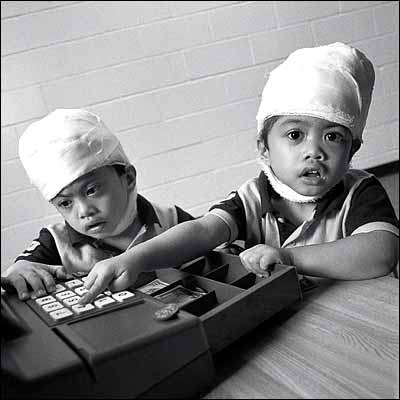
The only obvious sign that Carl and Clarence were attached at the top of their heads nine months earlier is their mummy-style bandages (their skulls still need to be reconstructed, a procedure expected to be done this fall). The boys’ curly brown hair spills out around the edges of their gauze head-coverings, and their dark eyes are lively. One of the mundanely exquisite pleasures the Aguirres now get to experience is the joy of looking at each other. After their baths one evening, I watched them clown around. Clarence started it—he shook the metal bars of his crib, then, giggling, shook them again, as if to say, “Hey, bro, get with it.” Carl got on his knees, glanced over at his twin, and gave his crib a good rattle, cracking them both up.
Of doctors who separate twins in a single marathon procedure, Goodrichsays, “Why anyone would want to go through with a buzz saw … ”
These are the kinds of playful, the-kids-are-all-right details that will be reflected in the next day’s papers. But other realities of the boys’ lives won’t make the news. Arlene is smudging icing on Carl’s and Clarence’s lips, trying to entice them to eat the two fat slices of cake sitting in front of them. The twins didn’t eat well before their separation—being on their backs often made them vomit—and feeding the two of them is still an arduous task for Arlene and the Blythedale staff. Sometimes they manage to feed the boys only a few bites of chicken nuggets or Cheetos or a special pureé. The twins get the vast majority of their calories via portals surgeons placed in their bellies—having Mom hook up the feeding tubes is part of the boys’ nightly bedtime ritual.
Clarence also isn’t responding to Arlene’s efforts to get him to talk for the reporters. “Say ‘hi,’ Clarence. ‘Hi,’ ” she implores. (Carl’s a lost cause; soon, he’s fast asleep, seemingly overwhelmed by the hoopla.) In the months since their final surgery, the boys have made great strides physically, but their speech has barely budged.
Each child has his own speech therapist, his own occupational therapist, and his own physical therapist—most of whom are here, waving and clowning. But as delighted as they are by the boys’ progress, they’re not sure what to make of the speech delay. “Of course I’m concerned they’re not talking more—they’re 3,” speech therapist Rita Erlbaum Kotorac told me earlier. “The more time goes by, the more concerns I have about whether or not they will achieve the same spoken skills as another child.”
Erlbaum Kotorac and everybody else at Blythedale is more reticent than the Montefiore doctors about declaring the boys neurologically unscathed. At the same time, they’re nervous about contradicting the doctors’ upbeat assessment. “It was overwhelming to us that the information being released was that the boys are perfectly normal,” Erlbaum Kotorac says. “At some point, it might look like they’d gotten incompetent therapy: If they had a normal brain, why weren’t we able to help them develop these skills?”
Goodrich says he isn’t worried about the lag. Because he and the other Montefiore doctors suspect the boys’ language deficits might be related to hearing blocks, they put tubes in their ears to relieve pressure and fluid buildup. Plus, he says, “you take eighteen months of social isolation [Carl and Clarence were virtually confined to home in the Philippines], another year to go through surgeries, two different languages—there’s been a lot thrown at these kids.”
This April in New Orleans, Goodrich gets the chance to present the crowning accomplishment of his career to his peers, the more than 4,000 members of the American Association of Neurological Surgeons. It’s the organization’s annual meeting, and after Goodrich gives a short lecture, Dale Swift, one of the neurosurgeons who separated the Egyptian twins in Dallas, rises to comment as the predesignated “discussant.” Swift trained under Goodrich twenty years ago, and now the student is critiquing the teacher. “It’s very hard to argue with success,” Swift begins, and staging surgery to redirect blood flow definitely “makes sense.” But then he proceeds to tick off reasons why it’s not always such a hot idea, the main one being the risk of infection incurred by performing multiple operations.
Goodrich can only smile tightly during the meeting—there’s no chance for debate—but later, he doesn’t hold back. “Did we have an infection?” he demands. “To me, if it takes four operations to get a good neurological outcome, that’s what you do. Infection can be treated. Brain can’t be regenerated.” Look at the Guatemalan girls, Goodrich says, referring to María Teresa and María de Jesús Quiej Alvarez, whose 2002 operation in Los Angeles is the other recent marquee separation of craniopagus twins in the U.S. They were taken apart in one stage, and look what happened to them: At age 4, María Teresa is severely retarded, deaf, and can’t move her arms and legs, likely owing to meningitis contracted through the head wound left by the separation; María de Jesús has adequate mental function but is badly physically disabled.
Back to the Egyptians, who are now almost 41ž2. Goodrich is emphatic that they suffered brain damage and his kids didn’t. The Dallas doctors concede this—sort of, Swift more so than the leader of the team, plastic surgeon Kenneth Salyer. “The boys are walking, speaking Arabic, English, and a little Spanish, and are absolutely delightful and fantastic,” Salyer says. I note that Goodrich says he’s performed the only craniopagus separation without causing brain damage. “Each of our children has a hemiparesis [partial paralysis],” Salyer says, “but that was anticipated as part of the operation. It wasn’t a complication.”
Goodrich can hardly stand it. “Ken Salyer is the ultimate showman. He’s been on Oprah Winfrey, twice. The time he brought the two boys, they sat in the laps of both parents, laid there. Neither kid got up. Neither kid did anything.” (This is basically an accurate description of the show, though it was aired in October 2004, six months before I asked about Mohamed’s and Ahmed’s progress.)
What about Ben Carson’s twins? Carson, who’s African-American, has an even better backstory than Goodrich: He went from the Detroit ghetto to Yale to med school at the University of Michigan, and today he writes books, gives inspirational speeches, and runs a foundation that grants scholarships to high-achieving needy kids. When he comes to New York to accept an award for his charitable work, I inquire about the Zambian boys. “They’re in third grade, walking, talking, neurologically intact, not having seizures,” he says. Cognitively, he says, “they’re at grade level.” Has he heard what Goodrich is claiming? I ask. “That doesn’t bother me,” he says. “When things are done in Third World countries, it doesn’t get the same attention.”
Carson hasn’t published his case in a medical journal, he says, because his fellow surgeon in South Africa, Sam Mokgokong, wanted to do it but hasn’t. “I’m seriously thinking about just going ahead and doing it myself,” he says. I tried to reach Mokgokong several times, and while I got one response from his assistant indicating he’d be willing to comment, I never heard from him.
Because of the devastating outcomes of many separations, there are people who believe surgery is too automatic. One of them is Northwestern University bioethicist Alice Dreger. In her 2004 book, One of Us: Conjoined Twins and the Future of Normal, she argues that the glory separations bestow on surgeons and hospitals can make it hard for doctors to resist the cases. She writes about one doctor who, “envious of a longtime rival’s sudden fame,” went “shopping” for a set of twins to separate.
Goodrich’s response is simple: Without separation, the Aguirres would’ve died. What he means, exactly, is that had the Aguirres never left the Philippines, had they never received medical care at Montefiore and Blythedale, including the first few stages of separation that helped take the strain off Clarence’s heart, they probably would have died. But he acknowledges that “by the time they got to the fourth stage, their physiological health was superb.” He also says that according to the data he gathered, craniopagus twins who survive to age 2 have a 50-50 chance of making it to age 10. Those aren’t exactly terrific odds, but they do cast a different light on the risk-benefit ratio of such a dangerous surgery.
When I ask Goodrich if Arlene Aguirre could have halted the proceedings once her boys began to thrive, he doesn’t reply directly. “Every time we sat down to do a surgical consent with Arlene, death, paralysis, and infection were part of the discussion. That’s a decision the parent has to make.” (Arlene tells me she never truly considered not separating her sons. “As a mother, it’s so hard to see your children like that,” she says.)
Dreger doesn’t accuse Goodrich or any other reputable surgeon of hiding the risks of surgery from parents. Rather, she believes medical professionals don’t inform parents fully about what their children’s lives might be like if they were to stay together. They don’t bring up the possibility of aggressive physical therapy and psychological support in lieu of separation, she says. (Practically speaking, this wasn’t an option for Arlene and isn’t for any poor parent. Who would’ve paid for the rehabilitative treatment without the glamorous operation?) “Surgeons tend to be naïve in understanding that there actually have been people who’ve looked like this who’ve done okay,” Dreger says.
Goodrich knows that there are a few sets of twins, head-joined even, who might be said to fit this description. At a Saturday speech and slide show for his colleagues at Montefiore, he showed one pair from his collection, the McCarther twins, born in Los Angeles in the fifties and joined exactly like the Aguirres. “This is their christening photograph,” he says, as a black-and-white picture of two girls in frilly white dresses appears on the screen. “I just bought it off of eBay, so you’re getting the first look.”
“Of course I’m concerned they’re not talking more,” says one of the Aguirres’ speech therapists. “They’re 3.”
Like almost all surgeons who perform craniopagus separations, Goodrich proceeds from the premise that living conjoined is simply untenable. “I just can’t imagine a parent with two kids like that,” he says, breaking off mid-sentence, as if the idea of not separating is too imponderable to utter. The McCarthers learned to walk, like a bridge, and were enrolled in nursing school when they died in their forties, but if Goodrich knows these facts, he isn’t sharing them with the crowd at Montefiore. “This is the way they went through life,” he says, turning to look at the little girls in their white dresses. “What kind of quality of life do you have walking through a mall tilted side by side?”
The country’s—or perhaps the world’s—oldest living craniopagus twins, Lori and Reba Schappell, have an answer for Goodrich—well, more Lori than Reba, because when I call to ask to visit them, Lori informs me that her twin “doesn’t do conjoined stuff.” Reba’s in show business, Lori says, as I imagine her sister listening in. The two are joined at the side of the forehead facing in opposite directions, such that they can’t see each other, and I hear what sounds like Reba whispering. “You know how show-business people are,” Lori picks up. “They can’t do things for free.”
Lori would prefer not to talk for free, either; she asks if I can compensate her for the interview. Jerry Springer and Sally Jesse Raphael, documentaries, magazine interviews—“All this googlie-gah every time a conjoined twin is born or separated,” as Reba later says—this is the modern circus for conjoined twins. I tell Lori that the most I can do is spring for lunch, but she still agrees to meet with me. For the past seventeen years, the sisters have lived, without assistance, in high-rise apartments for the elderly in Reading, Pennsylvania. The 24 years before that they spent in an institution for the mentally retarded, put there by their frightened and confused parents; they were released only after the wife of former Pennsylvania governor Richard Thornburgh helped prove to state officials that they were of normal intelligence. They’re among the conjoined twins who even if born today would likely not be separated because they share a significant portion of brain.
“I’ll be down in a minute,” Lori says when I arrive and call up on my cell phone. Although her sister is definitely coming along, Lori never says “we.”
They appear, Lori’s head crooked down toward Reba, whom she’s pushing on a chair that resembles a rolling bar stool. (Spina bifida has stunted Reba’s growth and left her unable to walk.) I’m nervous, bumbling as we get in the car for the ride to the restaurant. I can’t look both in the eye at the same time, and though they want me to confine my questions to Lori, I can hear Reba’s “Pssst … pssst.” When I open the back door, Lori says pleasantly, “I prefer the front.” Oh my, have I insulted them? But how will they fit?
They fit, though not neatly, like a woman holding a too-large child in her lap, and I’m mortified each time I have to ask Reba to move so I can reach the gearshift. The lack of freedom, of privacy, the sharing of the most intimate bodily functions, these facts of conjoined life for some reason had never repelled me, but so much for my enlightened state. Squished in the car with the Schappells, I’m suffused with … what? Embarrassment? Shame? Disgust? Something more than the early spring sun is making me sweat.
“Hey, girls, how ya doing? I seen you on TV,” a smiling woman calls out when we finally arrive at the restaurant they’d chosen (Lori’s directions were vague, to Reba’s annoyance). And that’s about the most attention they get during lunch at the Old Country Buffet. It’s not always that way; strangers sometimes follow them or start snapping their picture. “I always say, ‘If you want to follow us, fine, but if you have something to do, go do it,’ ” Lori says. “If people talk to us, I answer them, if the questions aren’t too stupid.”
Over macaroni and cheese and fried fish, with Lori standing and facing me across the table and Reba looking out into the restaurant, her plate in her lap, the sisters have the kind of exchange I witness many times: Reba bossily correcting something Lori says, and Lori cheerfully conceding the point. “If I mess up something, she does come in and save me, because she’s better with the words—analogies and stuff.”
Perhaps because they’re so irrevocably together, their likes and dislikes, their habits, their demeanors are that much more polarized. Or maybe it’s that being so irrevocably one, they fetishize being two. Over the course of the day, I learn that Reba’s book smart, Lori’s street smart; Reba’s butch, Lori’s fem; Lori’s the homemaker, Reba’s the career woman; Reba’s the tightwad, Lori’s the spendthrift (who likes nothing better than walking through a mall).
Both are adamant that being conjoined does not limit them in any way, doesn’t define their existence. I believe it, and I don’t. One moment I’m thinking, Hey, this is just another disability to be overcome, and the next, I’m crushed. Their apartment smells faintly of urine, because Reba’s Chihuahua is trained to pee on pads by the bathroom—it’s too much of an effort for the Schappells to get down the elevator to take him out. But then when Lori shows me pictures of a man she dated in community college and says, “Oh, gross,” and is talking about her eighties hair, I’m with her. Being conjoined is who she is, like my being a woman, perhaps; it’s not something she can conceive of changing or even wanting to change. What she can change is that odious feathered hair.
Lori says that while at least one of the men she’s dated was interested in her merely as spectacle—“He calls his friends and goes, ‘We’re gonna be here and we’re gonna be there’ ”—most can get beyond Reba (who’s indifferent to romance). “When I’m out on a date, it’s just me and him,” Lori says, absently picking a piece of lint off Reba’s shirt. “She doesn’t butt in. We start talking, and he totally forgets she’s there.” And when I get up the guts to ask about it, she says, “Making out is no problem. The other stuff he doesn’t get till I’m married.”
Later, Lori smiles when I spot a copy of The Ultimate Wedding Planning Guide on one of the many stacks of papers in their living room. In the past, she’s expressed sadness that she hasn’t found anyone to settle down with, but all she’ll say now is that she has a boyfriend she met at one of Reba’s gigs.
What gets Reba going is her career. She tells me she sang at the Knitting Factory in Manhattan a few months ago, that she spends her days listening to “demos,” that she’s in negotiations to record the country tune she sang in a 1999 A&E documentary (“Fear of Being Alone,” which she did not choose because of the allusion to conjoinedness in the title—didn’t I know the song’s about a man and a woman?), that she’s considering two acting roles but has to check the scripts first (“I don’t do nudity”), and so on. I know they’d had a part as conjoined twins considering separation in the TV series Nip/Tuck, and that Reba had sung “Fear of Being Alone” over the credits of the conjoined-twins spoof Stuck on You, but to hear them tell it, the career is Reba’s and Reba’s alone and has nothing at all to do with their distinctive bodies.
When I later learn that the Knitting Factory appearance was held at four o’clock on a Sunday afternoon and arranged by a producer doing a documentary on conjoined twins, my heart sinks. I feel worse when I discover that Chuck Harris, the agent whose name Reba had given me, has a thriving career representing, according to the L.A. Times, “freaks, geeks, and assorted other oddities.” But Harris, of all people, spins me around. He’s a true Hollywood character—voluble, funny, and irrepressibly enthusiastic about “the girls.” Yeah, Reba’s grandiose about her prospects, but who isn’t, he says. “I’ve got this guy—ears pointed, implanted whiskers, split lip, cat eyes, looks like a tiger,” Harris says. “He’s always complaining that I don’t get him enough work. He wants to do Shakespeare.” What Harris loves about the Schappells is how each of them is so implacably her own woman, he says, how excited they are about every bit of work they get. So, Reba’s living a little fantasy, a dream. “What I don’t do is stand in judgment of that,” Harris says. “I say, ‘Sweetie, you keep hoping. Ya never know.’ ”
These days, James Goodrich sees Carl and Clarence every month or so, when he goes out to Blythedale for the regular spina bifida clinic or for Aguirre-related media events. The twins’ days are long. Carl and Clarence spend their time going from physical therapy to occupational therapy to preschool—three hours in the morning, three more after lunch. The boys are night owls, and Arlene doesn’t have the heart to just turn out the light and close the door, so Carl and Clarence stay up till ten, eleven, even two in the morning, the singsong of Barney or Elmo or the Wiggles droning in the background.
Arlene doesn’t know when the family will be able to go home. Their departure date depends partly on the boys’ skull reconstructions and partly on when Blythedale thinks they’ll no longer need inpatient rehabilitation. When the boys do return to the Philippines, they’ll find a much-improved place to live. Embarrassed by the specter of the country’s tiniest celebrities returning to such backward surroundings, the owner of the land on which the Aguirres’ small village is located finally agreed to electrify it.
Carl and Clarence continue to improve physically—Clarence is on the cusp of giving up his toy grocery cart and walking unassisted, and Carl isn’t far behind. They’re still struggling to talk, though both boys are babbling more and using sign language. At the end of June, Clarence had what his speech therapist calls “a long-awaited language spurt.” He’s saying a few words, “Mama” and “Carl” among them.
Although Goodrich muses about the prospects for Carl and Clarence “to grow up and be just like any other kid on the block” and Staffenberg has explained many times how he preserved the boys’ hairlines so they’ll be “better off in school, with their friends,” the staff at Blythedale remain cautious about the boys’ prognosis. Blythedale neurologist Joelle Mast says, “Are they continuing to make progress? Yes. Will they be normal? I really don’t know.” The twins are testing at about only 16 months cognitively, though who knows if the surgery is the cause, she says. “Just by the nature of having your brain joined, you’re at the risk of development and learning disabilities.” Yet Mast also mentions two facts about the impact of the separation on Carl that Goodrich doesn’t tend to talk about: He had some weakness on his left side and suffered seizures (now controlled by medication)—both signs of neurologic dysfunction, however slight.
Goodrich, for his part, is unabashedly proud of the attention he and the hospital have received for the Aguirres. Citing what he calls the “twin-halo effect,” he says Montefiore’s occupancy is now at an all-time high, that the emergency room is the seventh busiest in the nation, that the boys have been a magnet for attracting high-caliber young doctors, and that the hospital has by now “more than made back” the money it laid out on the case. (Montefiore senior vice-president Steven Safyer dismisses the notion that the expense, which he puts at close to $3 million, has been recovered. “Where I put the return is in the pride of people here,” he says.)
Goodrich hasn’t experienced any financial windfall from the case—he’s paid a straight salary by Montefiore—but his professional profile has risen dramatically. He’s given 60 medical lectures already this year, where his annual total used to be about 25. His caseload is up by a third, his waiting list stretches to two months, and nearly every day he hears from a desperate parent of a deformed or neurologically impaired child seeking a second opinion, calling to see if Goodrich can make a miracle happen for them too.
Goodrich insists he’s not frustrated that staged separations haven’t been universally embraced. The hardest surgeons to convince, he says, are the ones who’ve already done separations, which one can interpret two ways: Their skepticism is wisdom born of experience, or they don’t want to admit that someone else might have a better method.
Goodrich offers the obvious answer when I ask him what the Aguirres have taught him professionally: Staged separations are far superior to the old technique.
When I ask him what he’s learned personally, there’s a pause. “Nothing stands out,” he says. Then, “it’s certainly, obviously kind of the ultimate case for a neurosurgical team.”
I try another tack: What do you hope the Aguirres will say about you one day?
Goodrich laughs a little. “Well, hope they like me, you know.”
He’d laughed the same way when I asked him a couple of months earlier whether it bothered him that Staffenberg was the doctor on Arlene Aguirre’s speed dial, the one she wanted to show up for her boys’ 3rd-birthday party at Blythedale, the one who a Montefiore nurse tells me has a “special heart for those boys.” Neither time did Goodrich seem flustered or embarrassed—the laugh was one of cheerful self-recognition. “What am I going to become, a mensch?” he asked. “I am what I am.”