
On a late August morning, Wall Street Journal managing editor Paul Steiger arrived at his downtown office confident that his paper had navigated a tricky turn. In three weeks, the broadsheet would kick off its wingtips and launch a more lighthearted Saturday paper, dubbed “Weekend Edition,” with recipes, fashion tips, and sports. For all the talk of a “casual” Journal, however, the birth of the new paper was three hard years in the making. Focus groups had guided its design. New circulation schemes had been devised to reroute paperboys away from empty offices so the Saturday paper could land on readers’ home doormats. Steiger recruited about 80 employees to staff the Saturday paper. The reporting and editing of live stories was well under way.
The venture is so expensive and complex that Journal management considers it the most important gamble in the company’s recent history. Which is why Steiger had entrusted it to his loyal protégée, Joanne Lipman. The 44-year-old editor had already created the paper’s most financially successful innovation of the past decade: the advertising-packed Friday “Weekend Journal.” This success elevated her to the highest editorial post ever occupied by a woman at the Journal and made her likely to rise higher.
So, when Lipman closed the door to Steiger’s office and told him that she was quitting the Journal for a formless, nameless Condé Nast business magazine, he hadn’t seen it coming. “He’s not very happy, to say the least,” one of his friends told me. The news was bad, the timing worse. Steiger hoped to avert a PR debacle by delaying Lipman’s announcement until after the September 17 launch of “Weekend Edition,” but Condé Nast, worried about the project’s leaking to the media, insisted on a press release the day after Steiger learned of Lipman’s plans.
At that point, there wasn’t much Steiger could do to entice Lipman to stay. Condé Nast offered her a salary close to his own, then piled on bonuses and the vaunted Si Newhouse–funded expense account.Steiger and the paper were badly stung. From the start, three editors had shepherded the Saturday edition. There was Larry Ingrassia, who left the Journal to run the Times’ business section, and Steve Adler, who abandoned the paper to take over as editor of BusinessWeek. With Lipman headed uptown, Steiger had lost all of “Weekend Edition” ’s primary editors—and it hadn’t even launched yet.
These are apocalyptic times for the newspaper business, especially for the Journal, with its historic dependence on advertising from financial services and tech companies. No major media company has suffered a string of bad luck and management missteps that quite compares to the recent bum run of Dow Jones, the company that owns the Journal. Over the past five years, its stock has plummeted 45 percent—trailing the New York Times Company and the S&P average by 25 percentage points. Where it once aspired to conquer the global market, this spring it shrunk its European and Asian editions into tabloids, a step many consider a prelude to their euthanizing. The domestic situation is less grim, but only a bit. With ads scarce, it often publishes waiflike editions of the Journal. In five years, there have been four heads of ad sales.
It is an obvious irony: that the great chronicler and champion of capitalism has become a poor example of it. Reporters at the Wall Street Journal seem personally offended by this condition and disdainful of their management. “We write stories about shareholder culture and corporate abuses. And then they seem to go make all the same mistakes we describe,” one reporter complains. In part, they gripe because they have been victims of the company’s austerity program. Last year, their union suffered through bitter contract negotiations, a dispute that caused even the fustiest stock-market reporters to participate in work slowdowns and denounce the “greedy bastards” in the boardroom.
But there’s another reason for the griping. Covering companies like Google and Yahoo and the Washington Post, they see other media outfits that have found ways to grow in these lean years. Of course, you don’t need to look at annual reports to know this. You could just look at the skyline. On Lexington, there’s the freshly constructed Bloomberg Tower, and the stack of steel triangles that Sir Norman Foster designed for Hearst. Renzo Piano’s New York Times building will soon stare crosstown at Condé Nast and up toward the Time Warner Center. Dow Jones has, humiliatingly, experienced the reverse of this media building boom. For two decades, Dow Jones has resided in Cesar Pelli’s World Financial Center, where brass letters at the entrance modestly announced it as the building’s marquee tenant. But earlier this spring, reporters and editors arrived to find that workers had removed Dow Jones’s name and replaced it with that of a law firm.
By attracting a whole new set of advertisers, “Weekend Edition” could put this bad patch behind Dow Jones. But there are many in the media world who seriously doubt if the current ownership and management are up to the task. Mark Boyar, a substantial Dow Jones shareholder, told me, “It is so broken that the only choice is to give a new owner a chance to fix it.” If “Weekend Edition” fails to deliver, then the name on the door to the Journal offices might soon change again—to something like, say, News Corp.
When Peter Kann, the Dow Jones CEO, makes his company’s case to Wall Street analysts, they note that he hardly looks the part of a media mogul. His thinning hair is often due for a trim, and he stumbles through remarks, occasionally mumbling inaudibly. “He’s not as articulate with the spoken word as he’s eloquent with the written word,” says Bob Merry, a former Journal reporter who’s now president of Congressional Quarterly. During the presentations, Kann tends to add charmingly self-effacing quips that may reveal more than is prudent. “I’m a troglodyte with technology,” he announced a few years ago when explaining Web strategy.
Kann, the son of Austrian émigrés, arrived at the company’s executive floor in 1979, seven years after winning a Pulitzer Prize. The newsroom cheered loudly for his promotion because his comrades there worshiped him. His Vietnam dispatches had captured the war’s futility, showing, for instance, how Mekong villagers feared a water snake with nine nostrils more than the Vietcong. “[Kann’s] Pulitzer was one of the most popular with colleagues in my lifetime,” says former Washington Post managing editor Bob Kaiser, a friend of Kann’s from Vietnam. Among other things, he was admired for his cheeky, unyielding independence. During sojourns across Asia, he famously ignored cables from his editors. “Message unreceived,” he wired New York, flouting an order to quit covering the skirmishes in Dhaka.
Ever since the thirties, Dow Jones has appointed journalists, and only journalists, to run the company—a practice that no other media company follows. It’s a tradition with an obvious upside. The scribblers-cum-CEOs make for superb editorial stewards who understand the inherent inefficiency of news gathering. But for all of Kann’s charms, empathy, and smarts, his tenure has raised doubts about the Dow Jones system: Should the company put journalists in charge?
The most obvious managerial idiosyncrasy of the Kann era can be discerned from a quick glance down the executive floor. After the death of his first wife, Kann beat out Charlie Rose for the hand of the Journal’s star diplomatic correspondent, Karen Elliott House. Since then, he has promoted her continually, all the way to publisher of the Wall Street Journal. High-profile husband-wife partnerships hardly ever exist in corporate America, for obvious reasons. As one former Journal executive puts it, “Who would have the cojones to criticize the boss’s wife? With Karen, it doesn’t ever happen.”
“Peter accused him of disloyalty,” says one of Barney Calame’s friends, describing Kann’s reaction to Calame’s new job at the Times. “He really tore into him.”
Kann’s biggest failures, though, have been his attempts to diversify the company away from the shrinking newspaper business. When Michael Bloomberg’s upstart computer terminals began to trounce Dow Jones’s Telerate boxes in the mid-nineties, Kann announced that he would sink $650 million into the reinvigoration of his product. Operation Rolling Thunder, the company called it, a name that harked back to Vietnam. The metaphor fit. Like General Westmoreland, Kann had escalated his involvement in a war he couldn’t win. In 1998, he sold Telerate for $510 million, a third of what Dow Jones had initially paid. Three years earlier, he had sunk another sizable chunk of change into the purchase of WBIS, an analog television station in New York, perhaps as atonement for the last-minute failure of nerve that prevented him from snapping up the Financial News Network (bought by CNBC) in 1991. Two years after buying WBIS and investing millions it, Dow Jones’s partner in the deal, ITT, began suffering its own internal crisis, and Kann sold the station for a tablespoon more than the company paid for it.
After the company unloaded Telerate and WBIS, it didn’t have much left outside of the Journal—just the news wires, Barron’s, SmartMoney magazine (owned in partnership with Hearst), and a chain of regional papers. So Dow Jones depended heavily on the Journal and its main source of income, B2B advertising—that is, businesses hawking wares to other businesses. Dow Jones had no defense from the crippling 2000 recession, when business spending dried up. The tech sector and financial-service companies stopped buying ads. “Without a major turn in the economy, there was nothing they could do,” says newspaper-industry analyst John Morton. “Except try and land other kinds of ads.” The Saturday edition intends to compensate for the absence of Sun Microsystems and Fidelity ads by chasing after a species of company that hasn’t tended to buy much space in the Journal: Ralph Lauren and Best Buy, importers of Ligurian olive oil and Pinot Noir, as well as Lexus and Mercedes-Benz. These companies are in hot pursuit of an archetypal consumer who bears little resemblance to Paul Steiger. The paper’s rumpled, gravelly voiced managing editor wears a faded tie and a yellow shirt that looks as if it slid off a Brooks Brothers shelf twenty years ago.

Most Dow Jones executives pitch “Weekend Edition” with evangelical fervor. This isn’t a mode that comes naturally to Steiger. Of course, he can tick off plenty of journalistic reasons for the paper to get into the Saturday market. Hot scoops harvested on Friday might not stay ripe until Monday, and the Friday markets often provide dramatic narratives. But Steiger describes Saturday with a slight defensive twinge. “It’s not that the ad sales had to drag us to the weekend; as journalists, we’ve wanted to be there for a while,” he says.
That’s technically true. In the eighties, Steiger’s predecessor, Norman Pearlstine, had toyed with the idea of a weekend paper. But the revived interest in the Saturday edition clearly originated outside the newsroom. More specifically, it can be traced back to COO Richard Zannino. Before editors sat down to kick around ideas for “Weekend Edition” (internal code name: Project Propel), Zannino supplied them with a sheaf of research compiled from focus groups and reader studies. Though the Friday weekend section is filled with real-estate ads, it still has failed to attract the most lucrative department-store and consumer-electronics accounts. And the “Personal Journal” section has even less luck with these groups. “One of the knocks is that [readers spend time with] the Journal at work or on the way to work, when they aren’t in a consumption frame of mind,” Zannino told me. “Now we’re going to give advertisers the chance to reach our readers at home.”
Despite all the preassembled research, Project Propel didn’t. For starters, the company assigned veteran editor Larry Ingrassia to devise a prototype, but also installed deputy managing editors Joanne Lipman and Steve Adler to supervise him. Both Adler and Lipman aspired to replace Steiger, who faces mandatory retirement when he turns 65 in 2007, and they used brainstorming sessions to score points with him and Karen House, according to a person close to the process. Then the Dow Jones board dragged its feet. Although focus-group tests of Ingrassia’s prototype finished in the fall of 2003, the project sat on a shelf for another year. “They kept asking for more market research,” says one editor. During the long intermission, Ingrassia left to edit the Times’ business section—a loss that badly stung the paper. (When I asked Steiger about the string of recent departures, he told me, “There hasn’t been an increase in the number of people we’ve lost who we haven’t been just as happy to lose.”)
Ingrassia and Lipman rarely agreed on editorial matters. Two years ago, at a regular gathering of bureau chiefs, Ingrassia provocatively asked the group if the paper ran too many specious stories trumpeting new trends. It was a not-so-subtle shot at Lipman’s “Weekend Journal” section, which once notoriously reported on the rising number of home chefs using dishwashers to cook fish. Lipman rushed to return the volley, claiming that her sections applied precisely the same standards and editorial rigor as the rest of the paper.
During the development of the first “Weekend Edition” prototype, these competing editorial instincts created a salutary balance. Ingrassia’s higher-brow tendencies tempered Lipman’s commercial ones, especially in the “Pursuits” section of the paper, crammed with lifestyle and entertainment coverage. While Ingrassia accepted the need for fashion and food coverage, he insisted on long magazine-style profiles. The sports page, for instance, contained a piece on the basketball player Mateen Cleaves, describing the life of a benchwarmer. On page one of the main section, there would be a big, non-newsy feature that functioned like a cover story. But after Ingrassia left, Lipman began reworking the prototype. Though she retained the page-one story, reporters jokingly referred to her working version of “Pursuits” as “Lucky,” after Condé Nast’s shopping glossy, because it spilled over with editors’ picks, often presented in charts. Reading “Pursuits,” you might learn which airlines serve gourmet meals or how to procure couture on the cheap.
But even more than stretching the paper editorially, the “Weekend Edition” poses a massive challenge for its business side. The Journal had always shied away from publishing a weekend paper because of the technical challenge of redirecting the half- million copies of the paper delivered to offices. Technological advances have solved part of the problem, but it’s still an expensive proposition, and at least for the early going, the Journal isn’t charging subscribers for the extra day. Executives, including Karen House, have sometimes wondered whether the money wouldn’t be better spent further developing Dow Jones’s Websites or diversifying the company’s portfolio. After all, since every newspaper, including the Journal, is inexorably losing its readership, is it wise to be doing more on paper, especially on Saturday when newspapers don’t usually draw huge audiences? Finally, to score coveted advertisers like department stores, the Journal will need to show that it can garner more female readers than it has in the past.
Until now, Dow Jones’s corporate problems have never impinged on the Wall Street Journal’s editorial content. Even though Peter Kann may not have run the business perfectly, he receives near-universal credit for preserving the quality of the paper. This is a big reason that the Bancroft family, the majority holders of Dow Jones stock, claim to have stood behind him through his troubled tenure. As their family lawyer, Roy Hammer, says, “I suppose it’s hard to conceptualize this accomplishment, but the Journal has avoided the pitfalls so many other publications have not avoided the last decade. It’s not luck. It’s based on high standards and adherence to those standards.” But now, with ad sales driving content, the fear (rational or not) is that the editorial side might follow the business side and allow its high standards to slip.
Reporters have some evidence to justify their concern. While resources have been funneled into coverage of what the Journal calls the “business of life”—that is, lifestyle journalism—core areas haven’t received the same lavish treatment. Management, for instance, has obsessively campaigned to keep “Money and Investing” stories under eighteen column inches. To reporters on complicated financial beats, this seems stingy, especially since “Personal Journal” stories often run at 24 inches. And while Lipman built “Pursuits” into a robust little empire, hiring dozens of reporters and staff, the rest of the paper has seen no similar bump in hiring, even though their workload will increase when there’s one more newspaper to fill up every week.
Reporters are also raising a spiritual objection about the turn toward consumerist coverage. It is fitting, therefore, that the plainest critique of this turn came from Barney Calame, the son of a fundamentalist preacher and an ecclesiastical figure in his own right. As the Journal’s deputy managing editor, he served as the paper’s unofficial moral arbiter, the embodiment of the old Wall Street Journal run by earnest Midwesterners. Last winter, after nearly 40 years at the paper, Calame headed into retirement. Colleagues memorialized the loss by hanging a slogan on a conference-room wall, WHAT WOULD BARNEY DO? Calame stayed true to his reputation up until one of the final parties celebrating his career, when he issued a subtle reprimand of Lipmanism. “Please be mindful of ordinary people in our society,” he intoned. “I fear we know a lot more about nannies and second homes than we do about day-care cooperatives and secondhand cars.”
Three months later, the Times called to offer Calame the chance to succeed Dan Okrent as the paper’s public editor, a post prestigious enough to draw any newspaperman out of retirement. When Peter Kann called, Calame expected a round of kudos. Instead, he received the opposite. “Peter accused him of disloyalty,” one of Calame’s close friends told me. “He really tore into him in a very personal and nasty way. He basically declared him persona non grata at the paper.” The great defender of old traditions had been excommunicated.
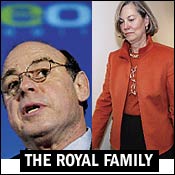
Weekend Edition” ’s debut coincides with a precarious moment for the company. Just more than two years from now, Peter Kann will join Steiger in retirement. As it ponders a new CEO, the Dow Jones board must ask: Can it afford to maintain the tradition of handing over the company to journalists? How it answers this question will decide between the two leading internal contenders, House and Zannino.
One board member participating in this discussion is Vernon Jordan, the venerable consigliere. Presidents and corporations turn to Jordan to perform delicate chores because the man knows how to keep a secret. But in his role at Dow Jones, he has complained with uncharacteristic bluntness. Jordan has told friends and acquaintances that he can’t believe the sluggishness and sloppiness of Dow Jones’s succession plans. “He’s grown quite disillusioned with Peter Kann,” says one Jordan friend. Where most companies like to anoint an heir apparent far in advance, Dow Jones is poised for a battle royal. “Vernon would rather avoid the whole mess.”
Kann bears most of the blame for the muddle. When he presents to the board, he doesn’t lay out a clear plan. Instead, he offers options and leaves it to his audience to discern his preferences. Several sources close to the board say that his preference is obvious. “He very much wants Karen to replace him,” says one.
Did Karen House deserve to rise up the corporate ranks, and if so, does she merit one more boost? She’ll never get a fair answer to that question. Her every promotion—from reporter to deputy foreign editor to foreign editor to head of international operations to publisher—has occurred on Peter Kann’s watch. Reporters joke about “The House That Kann Built” and “Karen Elliott Spouse.” And that’s the rub; the unmistakable whiff of nepotism hangs over her career at Dow Jones.
Her blunt style is also a problem. As a reporter, this brusqueness and determination yielded incredible access and important stories. “She was a phenomenal scoop artist,” says Seth Lipsky, who edited her Pulitzer Prize–winning interviews with King Hussein. “She actually co-piloted his plane going around India with him—the king is in the pilot seat, she’s in the co-pilot seat.” In management, this temperament didn’t serve her nearly as well. A 1997 Vanity Fair profile was rife with anecdotes exposing her shrewish side. During her stint as foreign editor, House once visited a bureau, gathered the staff, and brutally ripped apart articles written by reporters in the room. At a 1986 wedding reception, while still a reporter, she famously hurled a glass of wine at managing editor Norman Pearlstine after he forbade her from appearing on The McLaughlin Group.
When the Wall Street Journal newsroom returned to its refurbished building after the September 11 attacks blew out its windows and covered it in ash, House didn’t make an appearance there for nearly three weeks. “There was so much anxiety about the return,” says Gardiner Harris, a Journal reporter who recently migrated to the Times. “We could have used some leadership.” When she finally turned up, an editor led her around the room, introducing her to reporters and explaining the layout of the reoccupied floor. “She didn’t seem to know people—it was as if a Japanese tourist were visiting,” Harris recalls. “I can’t tell you how angry we were.”
House gets pilloried so often that she has become a cartoon. Her nasty image, however, belies what Phil Revzin, a former Dow Jones executive and editor, calls a “deep emotional connection to—and pride in—the Journal as the best newspaper in the world.” When addressing orientation meetings for new reporters, she invariably chokes up. “She gets teary when talking about the mission of the Journal,” Washington reporter Tom Hamburger, now with the Los Angeles Times, recalls. The tears also flowed during two interviews with The New Yorker’s Ken Auletta in 2003—nine times, in fact. But when she rehashed her performance with colleagues, she claimed not to remember the crying. “You’re not dealing with a callous person,” one of her friends says, “just someone lacking self-awareness.”
Her battle to become CEO will require overcoming that reputation. Already, concerns have been raised about her age. She will be 59 when her husband retires. Kann, however, has every reason to think that he can persuade the board and the Bancroft family of the wisdom of tapping House. Not only did Kann select many of the company’s directors, he has effectively bought the family’s support. During the nineties, his board gradually raised the quarterly dividend—from 19 cents per share to 25 cents—despite an often stagnant stock price. This consumed an enormous portion of the company’s cash. In 2002, Dow Jones paid $82 million in dividends, while it brought in a net income of only $100 million. Earlier this year, when the Bancrofts clamored to sell more of their stock, Kann and his board rewrote the corporate rules to ensure the family’s continued control of the company, though they no longer owned anywhere near a majority of shares. This careful preservation of family privilege helps explain how Kann has kept his job for fifteen years.
If the board continues to harbor doubts about House, the company could pluck its next CEO from outside, a break from custom. Or it could choose a dark horse, like Gordon Crovitz, the widely admired Rhodes scholar who ran the Far Eastern Economic Review and now heads the company’s successful digital-publishing arm. In perhaps a sign of his rising prospects, reporters and editors note that House has treated him with increasing hostility in meetings and attempted to bring more of WSJ.com within her ambit.
But House’s most likely rival is Richard Zannino. In the building, some refer to him as “The Garmento.” That’s a dig alluding to his prior career as an executive at Liz Claiborne and Saks Fifth Avenue, and to his supposed ignorance of the values of journalism. “They think I’m a digit-head,” Zannino says. “People have a misconception of me.” When I met him in the Dow Jones conference room, he looked every part the Saks veteran, down to his silver cuff links. This alone sets him apart from his fellow executives. Steven Goldstein, a former head of Dow Jones corporate communications, says, “When I was there, he was the person most likely to shop at Bergdorf.”
I asked Zannino to describe the differences between Liz Claiborne and Dow Jones. “There are far more similarities than differences,” he began. “They are all about serving readers, which are customers, understanding those wants and needs and doing it with a purpose in mind, doing it consistent with enhancing earnings and producing shareholder value.” He paused a beat, realizing that he had skipped the all-important caveat. “The biggest difference is the impact publishing has on the world.”
If Zannino doesn’t play well with the Journal rank and file, that’s because he hasn’t tried very hard. As he presided over hundreds of firings, he preserved his own big raise, a $350,000 bonus, and a $1.4 million grant in stock options. Zannino gets tagged for all kinds of other cutbacks, like killing the full-service company cafeteria.
In recent years, Dow Jones management has tended to blame shortcomings on economic forces beyond its control. Zannino expends a fair deal of energy cheerleading, but he will occasionally eschew this style and betray a sense of honest urgency. When I mentioned Telerate, he replied, “That was then; this is now.” He could have left it there, but he continued. “By and large, the strategy was right, and we could have executed better.” An implicit shot at Peter Kann, his boss, the man in charge of execution.
“You’re not dealing with a callous person,” says one of Karen House’s friends, “just someone lacking self-awareness.”
House and Zannino regard one another with what some of their fellow executives describe as mutual contempt. While House shares the newsroom critique of Zannino—that he doesn’t read and doesn’t understand journalism—Zannino considers House an abominable manager. This animosity doesn’t often spill over into the public realm, but it did once. Two years ago, Peter Kann invited retired IBM chair Lou Gerstner, an Ur–corporate guru, to dinner with his top managers. According to two accounts of the evening, a substantive disagreement between the two aspirants escalated into a startlingly heated argument. After the incident, Kann demanded they never repeat that night’s performance.
In the race for Steiger’s job, a similar dynamic prevails. Global-news editor Marcus Brauchli, who has served in Europe and Asia, positioned himself as the anti–Joanne Lipman, not so diplomatically decrying her superficiality to reporters. A three-way race, also including Adler, had featured aggressive campaigning, with contenders jockeying for office space close to Steiger and attempting to prove their superior bona fides through unusually copious comments on articles in the story queue.
But the field has thinned considerably in the past several months. Since Karen House hasn’t held candid discussions about succession with any of the candidates, Adler and Lipman have fled the paper for other jobs, preferring known opportunities to a drawn-out battle. “The only certainty at Dow Jones is uncertainty,” one editor quips. The cutbacks of the past five years have eroded the strong loyalty that once kept the paper’s stars from entertaining outside offers. Compared with Dow Jones’s tight-fistedness, other media companies suddenly seem like editorial wonderlands, places where editors don’t need to constantly worry about how much lunch costs. So when Condé Nast comes offering approximately $100 million to develop a new magazine, the decision to go isn’t very torturous.
According to conventional wisdom, the departures of Lipman and Adler have cleared Brauchli’s route to the grand prize. Only dark-horse contenders, like former Washington bureau chief Alan Murray and Barron’s editor Ed Finn, remain. On the other hand, it’s also possible that Lipman or one of the émigrés could make a triumphant return to Liberty Street after proving themselves in the wider world. Ron Suskind, a former Pulitzer Prize–winning reporter for the paper, raises the possibility that Ingrassia, for instance, could return. “The subject of who Larry will steal next is a subject of regular conversation at the Journal,” says Suskind. “Those conversations raise your profile and bring you into the race.”
Karen House will have more say than anyone in choosing the ultimate winner, and her close colleagues say that she doesn’t like having her options narrowed for her. So the more the chattering classes fixate on one candidate or another, the likelier it is she could make a truly unexpected choice.
Even if the “Weekend Edition” succeeds, if ads from Coach and Williams Sonoma come rolling in, it still might not compensate for continued slack weekday sales. As newspaper analyst John Morton warns, the weekend paper might even cannibalize weekday advertising. “There’s some danger that the current stable of consumer advertising will just spread their advertising out over another day rather than add to it,” he says. If the Saturday paper doesn’t make the Journal more profitable, then what?
Ever since 1997, when investor Michael Price tried to entice Dow Jones and the Washington Post into a merger, rumors have proliferated about the company’s imminent sale. But until recently, the Bancrofts never gave any indication that they intended to part with the company. “Overtures [to purchase the company] have been politely rebuffed,” says Hammer, the family lawyer who once sat on the Dow Jones board. They view the paper as “a family trust” and a source of prestige, as well as a dividend factory.
In the past few months, however, the Bancrofts’ sentiment may have changed. Hammer told Fortune in May that a substantial offer could spur a sale. For all its troubles, the Journal remains quite a prize, and there are many potential suitors who could fire up a bidding war. Michael Bloomberg has salivated over Dow Jones in the past, although his company likely won’t make a major move as long as he’s ruling in absentia. Arthur Sulzberger Jr. doesn’t have such restraints. Two years ago, The New Yorker reported that he sent the Bancrofts a letter, via Hammer, announcing the New York Times Company’s interest in a deal. Hammer and Kann rebuffed Sulzberger without even asking the Bancrofts first. But nobody really quibbled with the logic of the rejection. “The Bancrofts worry that the Wall Street Journal and the Times are natural competitors,” says a source close to the family. They would never abide the two Gray Ladies shacking up together, because they can’t see the Journal receiving the attention it deserves within the Times company.
Don Graham and the Washington Post are far more natural buyers. Although the Post and Journal editorial pages reside on opposite sides of the political aisle, they run complementary businesses. The Post has no interest in selling papers much beyond the Beltway. The two organizations also have chemistry. Kann and Graham go back to the Harvard Crimson, and this summer they were spotted at dinner in Manhattan. In 2003, the old chums hammered out a deal for Post stories to appear in the Journal’s international editions. Len Downie, the Post’s executive editor, told one of his reporters recently, “We would love to buy the Journal, if we could ever get the family to sell.”
Graham, however, would need the blessing of Warren Buffett, the Post’s influential board member. According to the rumor mill, the “Oracle of Omaha” might even buy the Journal with his own cash. Buffettologists, however, reject this scenario. They note his animus toward the paper, which he recently slapped in the face by recommending its competitor the Financial Times in his annual letter to investors. And it’s no secret that Buffett has little patience for the staunch conservatism of the Journal’s editorial page. Nor would Buffett’s assent guarantee a Post bid. Don Graham lacks his mother’s flamboyant ownership style. His aides-de-camp say he fears igniting a bidding war for the Journal that might drive yet another family-owned paper into corporate arms—a scenario he fears because he assumes his chief rival would be Rupert Murdoch.
Graham has good reason to fear Murdoch, who first floated the idea of purchasing Dow Jones to Kann in 1997, at the height of the Telerate debacle. And earlier this summer, according to one eyewitness, he told top News Corp. execs that “there’s no other property in the world I would love to acquire more.” Apparently, he covets it so much that he says he would want to personally run the Journal. “He has begun to justify to himself how he can pay $60 a share for the company,” says one source who has discussed the Journal with him. Sixty dollars happens to be the price point at which, according to last May’s Fortune article, the Bancrofts would sell. Dow Jones shareholder Mark Boyar says, “Murdoch is the most obvious buyer.”
There’s no denying the Journal would fit snugly into his empire. They share the same politics. So much so that at the height of last year’s election, Karen House big-footed editors in Washington and published a note retracting an article’s description of Fox News Channel as “a network sympathetic to the Bush cause and popular with Republicans.” (One reporter from the Washington bureau told me her boss, Gerry Seib, “didn’t know about the correction until it was a done deal.”) More important, the Journal also jibes with Murdoch’s wish to launch a Fox business channel.
Wall Street Journal reporters, the world’s leading archaeologists of corporate machinations, understand that Murdoch is the most likely alternative to Bancroft ownership. Time and again in our conversations they privately fretted about the possibility of working for News Corp. Their fear creates an odd dynamic. Over the past five years, the newsroom has viciously turned against Peter Kann, its onetime hero. They consider his layoffs and cost-cutting acts of betrayal. Outside last year’s annual shareholders meeting, a union-organized gathering of reporters shouted, “Peter, Peter, benefits eater.” Inside, the stock-market columnist E. S. Browning read a blunt statement: “The feeling among Dow Jones employees is that management has gotten greedy—greedy in what it wants to pay itself, and greedy in its effort to take our health benefits and wages based on such a flimsy justification.” But as the company’s advertising crisis continues, with few signs of abating, these reporters have found themselves with no choice other than to root hard for Kann to pull off an eleventh-hour victory with the “Weekend Edition,” to ensure that the company retains its independence. After one reporter angrily itemized his grievances against Kann, he took a deep breath and sighed. “On the other hand, he’s all that separates us from ‘Page Six’ and Bill O’Reilly. May God bless him and keep him safe.”