We can’t live here and have Nana there,” I told my wife, Kathy, meaning her 89-year-old grandmother who lived in Los Angeles. “It’s a disaster waiting to happen.”
We were walking through our leafy brownstone neighborhood in Brooklyn after dinner, trying to figure out what to do with Nana, who was making our lives increasingly difficult. Voice cracking with fear, some of it ginned up for dramatic effect, Nana called my wife whenever she had a problem, which was every day: She couldn’t get beef heart at the butcher shop to grind up for “the girls,” her Persian cats, or the garden tools were disappearing from her garage, or, more ominously, she had scraped the pump in the gas station with her Mercury Grand Marquis.
Earlier that day, Kathy had received a frantic phone call in her office in Manhattan when Nana had stumbled to the floor in her kitchen in California. Kathy had sat in her office listening to her grandmother crawl back and forth across the floor alternately wailing for help as if she were going down in the Titanic and muttering to herself about needing to feed “the girls.” Eventually Nana had pulled her diminutive self up on a chair and returned to the phone, but by then my wife was a wreck, tearful with worry and frustration.
“We can’t move to L.A.,” I said, just in case anyone might think such a thing were possible.
“That’d kill me,” Kathy agreed.
We had moved to Brooklyn in our mid-twenties, and the problem of Nana was a dilemma we’d conveniently subordinated to the excitement of getting married, starting new jobs, and forging an existence in New York. Kathy’s mother, an only child long divorced, was dead, as was my wife’s grandfather, and thus Kathy was Nana’s only living relative but for a couple of cousins twice removed. They could not be the “responsible party,” nor could any of Nana’s friends, who ranged from the aging hairdresser who gave her a rinse each week to the kindly and yet increasingly ineffectual housekeeper, herself no spring chicken, to the various doctors Nana saw, including the “toe man,” a wizard with the arthritic knobs and bunions of Nana’s feet. To put it plainly, the people Nana communed with on a regular basis usually expected a check for their services.
Moreover, Nana was by any measure difficult, by virtue of her age, her temperament, and her upbringing. She had lived long enough that the circumstances of her birth were of another era. She was born in Shanghai in 1899, the second daughter of a wealthy Jewish family who lived in the British Concession; their mansion was so large as to require the assistance of 40 Chinese servants. And this was just the beginning: She’d ridden the Orient Express across Russia before the Russian Revolution; she’d seen death, suffering, and pestilence as a girl in pre-Communist China; she had rebuffed some of the richest young men in Asia (“I could not possibly marry a man who calculated sums on the cuff of his shirt! Can you imagine?”); she’d driven huge motorcars and conducted love affairs in Nice in the twenties and thirties; and then, aware that the Nazis were coming, she’d moved to London. For reasons that remain mysterious, she left London for Southern California, of all places, and found herself a strapping widower who had no money but was a gentleman in every respect, and then had her first and only child at the age of 42.
Nana had been wealthy and intrepid on three continents, and no small measure of her sense of entitlement remained, even a generation after the money was mostly gone. She was still razor-tongued, never hesitating to tell anyone of her mistreatment at the hands of fate. She felt sorry for herself, having outlived her husband and only child. I’d met her just a few times. She fascinated me, but I didn’t exactly like her.
“There’s no sort of assisted-living situation … ?” I began again, euphemistically.
“Nana won’t go into a nursing home.” My wife shook her head at the horror of the idea. “And I don’t want to put her into one.”
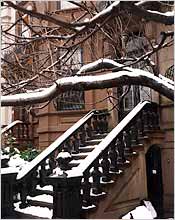
We walked farther, passing one grand four-story Victorian home after the next. Brooklyn’s brownstone neighborhoods had appreciated nicely during the boom, and it would be many years, if ever, before we could afford to buy one. Around us, we saw people coming home late from work, couples with babies, folks going out to dinner.
“Suppose we moved Nana here?” I said, scarcely believing what I was saying.
“You must be insane,” my wife sputtered.
“It will only get worse out there,” I told her. “You’ll be flying to L.A. constantly. She’s going to blow up the gas station one of these days.”
“Oh, fuck,” she said. “I spent years getting free of her!”
This was certainly true. My wife’s mother had become accidentally pregnant at 17, submitted to a quickie marriage and divorce, and then more or less deposited her newborn baby into Nana’s hands as the price for her release. She’d moved away, always residing at some temporary and sometimes unknown address. As Kathy grew up, the three of them—grandmother, mother, and daughter—had engaged in an ornate yet ferocious battle for autonomy, control, and identity. In this struggle, which did not end when my wife’s mother died of breast cancer at the age of 43, money was a weapon, love always provisional, and screaming a constant. As far as Kathy was concerned, her real life had begun when she escaped her grandmother’s house.
“Where could she live?” Kathy asked.
I stared at her.
“No,” she said. “We’re newlyweds. This is our first year. I don’t want to take care of my 89-year-old grandmother.”
“Just an idea,” I said.
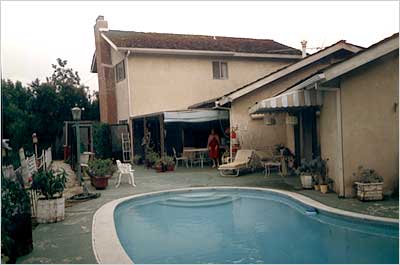
An idea I’d been quietly studying. As the Brooklyn real-estate market steadily floated upward, the L.A. market had become an insane speculators’ bazaar. The upward rise was bound to crash sooner or later, but until then, Nana’s ranch house, even with its earthquake damage, cracked swimming pool, and walls stained by cat mucus, had appreciated dramatically.
“Did you know,” I ventured, “that the value of your grandmother’s house would probably cover a good chunk of a house here?”
My wife looked at me, aware that my motivations were decidedly mixed. “You would think of that.”
“Hey, maybe we could do a good thing, but maybe that could be good for us too,” I said. We were going to have to take action, one way or another. We’d either initiate change or have it forced upon us.
“I can’t live with her,” Kathy said. “She’ll drive me crazy.”
I didn’t especially want to live with an 89-year-old woman myself. I was 28, for Christ’s sake, and running out to dinner parties with my beautiful young wife, and working hard, and playing in a basketball league at night, and generally having the time of my life. The idea of living with Nana was insane. What had gotten into me?
But now my wife was thinking about it. “Nana has no one else,” Kathy said. “She’s frightened. That’s a big house to go to sleep in by yourself each night.”
“She’d be happy if you moved there.”
“But she knows I won’t.”
“So why is she calling so often? I mean, the reason under the reason?”
We stopped walking. No matter how difficult her upbringing, my wife had said many times that the bottom line was that her grandmother had always taken care of her, sheltered her, paid for school, college, everything.
“Nana is asking me to fix it,” she said slowly.
Within a week, my wife had proposed to Nana that she move to Brooklyn. She would sell her house and help us buy a brownstone, where we all would live, Nana in her own ground-floor apartment, the two of us above her. The plan now excited Kathy, and I could see why: It offered a way for the two of them to be together in a setting other than the one where so much familial destruction had occurred. Maybe a little redemption might be possible. The plan possessed a certain theoretical elegance, but its enormity scared me. Executing the two transactions would be entirely my responsibility; not only were the sums involved considerable, but I would have to sell real estate in Los Angeles while buying it in New York almost simultaneously. If one part of the plan failed, the whole thing failed.
“I’m not moving,” Nana said.
“What will you do?”
“Someone will take care of me.”
“Who?”
That was when the crying began. “Nana, I am absolutely not moving to Los Angeles,” Kathy said. “I’m young. I have my life here.”
Nana wouldn’t budge.
“Tell her that’s the best we can think of,” I said.
“Nana, this is the best we can think of.”
“Tell her nursing homes are $6,000 a month.”
Kathy put her hand over the phone. “I’m not going to tell her that.”
“Tell her—hell, I don’t know what to tell her.”
A month later, my wife and I flew to Los Angeles, having made no headway with Nana, even though there had been more incidents. Something about the car and a large bush. Another time, Nana had become lost while driving on the freeways, finally needing a police escort home. She had dropped one of her $800 hearing aids in the kitchen disposal. And so on. Meanwhile, the L.A. real-estate market was teetering at wild heights, ripe for a crash, and the Brooklyn market was still rising. If our plan was to work, it needed to work soon, before the markets went in opposite directions.
“This is it,” my wife said when we arrived, pointing to an uninspiring two-story house with stucco siding built into a sliver of hillside. The place had fallen into a kind of sun-baked suburban shabbiness. Nana’s enormous car sat half-parked in the garage, and a quick glance upward showed that the roof was losing its thick cedar shingles at a precarious rate.
Nana met us at the door looking even smaller than when I’d last seen her, at our wedding.
“Oh, at last! At last!” she cried. Stooped and so thin her vertebrae lifted her sweater, she was no more than five feet tall in her heels. Her relief was immediate, and she clung tearfully to Kathy.
There was a deep female logic to this. My home for yours, your baby for me. The equilibrium was complicated, but it made sense.
Inside, my wife showed me the earthquake damage, the wall-to-wall carpeting streaked with dried beef-heart drippings, the nooks and crannies jammed with bills, canceled checks, newspaper coupons, supermarket receipts, and hearing-aid advertisements.
“If I go, we must take my darlings!” Nana announced, and I assumed she meant her three Persians, who now inhabited what had been my wife’s old bedroom, their enormous exercise furniture draped with sub-sanitary clouds of cat hair. But I was wrong. Nana led us out to the kidney-shape swimming pool and pointed at some handmade elfin headstones arrayed in a weedy bed.
“My darlings!” she repeated, and my wife explained that this was the graveyard of innumerable cremated Persians, each tiny tin of ashes carefully labeled and dated before burial. Each tin would have to be disinterred and brought to Brooklyn.
My wife had already said that I didn’t have to go through with it, that I could change my mind. But that was no longer possible, I knew. Kathy was Nana’s blood. I was married to Kathy. The thing was knotted up; it was what it was.
That night, we discussed the plan with Nana.
“I might do it,” she said.
Kathy had brought pictures of the Brooklyn brownstones we were looking at.
Nana held them in her bony hand. “Like London,” she noted.
The next morning, I called a real-estate agency and asked that they send over a representative to talk to us about selling the property. At precisely the appointed hour, a white Mercedes convertible pulled in, and out jumped a statuesque and totally stacked blonde in a white miniskirt and white pumps. She was a perfect L.A. goddess. She offered me her hand, itself a small piece of artwork, draped with diamonds and featuring creamy long nails. Every man has his weaknesses; I could feel stupidity flood my circulatory system.
“My partner will be here in a minute and then we’ll get started,” she breathed.
“Partner?” I said.
A moment later, an identical white Mercedes convertible pulled in behind the first and an identical woman jumped out.
“No, we’re not twins!” they announced brightly. “We just like the way we both look!”
Suddenly I understood that in a pretty hot real-estate market, there was competition among agents for houses and that it didn’t hurt to be pretty hot yourself.
As the two women tottered in their heels over the cracked sidewalk around the pool, I reminded myself that I might be handed the grave responsibility of selling Nana’s house. I couldn’t let these cantilevered buxotics mess with my head. After they left, I called the real-estate office back. “I want someone I can deal with,” I said. “Send over a potbellied middle-aged man.”
Which they did. He arrived that same afternoon. His car was nice, his watch expensive. But I looked into his face and saw a tired guy who’d been beaten around a bit, probably survived a few down markets. “Listen,” I said after he’d met Nana and politely inspected the cat cemetery. “We’re not going to fix this house up. If we sell, it’s as is.”
“Got it,” he said.
“I don’t want super-top dollar. I want superfast dollar.”
He nodded. “I can get you super-top dollar, though.”
“You can? Look at this place.”
He smiled. “It’s perfect.”
“Why?”
“Teardown. Everyone wants one.”
I nodded slowly. Nana had not quite made up her mind. The idea that her house would be demolished by bulldozers the day after she left might spook her, underline the impermanence of things.
“We would, of course, not need to mention this to Mrs. Jacobs,” said the real-estate agent.
That night, perched on the edge of her antique chair, Nana said she had been thinking about the idea of moving to Brooklyn and leaving her “lovely California.”
“I’ll do it on one condition,” she told us. “Only one.”
Kathy and I looked at each other. We thought we had covered all the angles. “What?” she asked.
“That you have a baby.”
“What?”
Nana’s expression was defiant. “If you promise to have a baby as soon as possible, then I will move. That’s my offer.”
We were taken aback. But we could see that Nana was serious. We’d barely discussed having children, and her request was enormously self-indulgent. Still, I grudgingly admired her willingness to deal in the most ultimate of terms. A baby would send her own family’s flesh forward in time, and in the face of her advancing years, it was a consolation. I felt that there was a deep female logic to all this. My home for yours, your baby for me. Warm new life before cold, certain death. The equilibrium was complicated, but it made sense. Besides, if a baby could help to tear apart a family, might not a baby also help put one back together?
“Yes,” my wife said.
“What about him?” Nana asked. “He might not like living with a baby and an old hag at the same time.”
“I can handle it,” I said. Brave words, to be sure, but cheap, too. I didn’t know enough about babies to be properly scared by what it meant to agree to have one. What did scare me was what we’d already seen in our brief visit. Nana was barely functioning as an independent adult. If she slipped 5 or 10 percent further, there might be a fire, a car accident, a bad fall. We’d arrived just in time, and I would have said just about anything to get this problem fixed now.
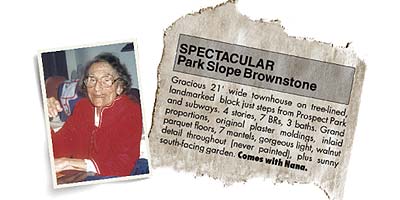
The broker held an open house for Nana’s property, and it sold, for full price, in eighteen minutes. We moved into our Brooklyn house, a big creaking brownstone in Park Slope. Four floors. Seven bedrooms, three baths. Seven mantels. Walnut detail throughout, never painted. Sure, it needed a little work: They all do. We were deliriously excited. This was our house now? In the hours just after the closing, my wife and I lay on the dusty parquet floor of the empty living room gazing up at the impossibly high ceilings. How would we fill this big house? How would we populate it? What life would we live that otherwise would never occur?
Meanwhile, Nana had to be moved 3,000 miles east. As promised, I dug up the cat cemetery and brought the encrusted little urns back to Brooklyn. I toted boxes filled with decades-old canceled checks, shopping flyers, and Christmas cards. These boxes often contained cat hair of unknown vintage, important documents such as birth certificates, and a fine yet unidentifiable granular matter, perhaps Nixon-era kitty litter. Nana followed a few weeks later. Her cats were flown by personal courier, at a cost that made me want to bang my head against the wall.
We settled in. My wife catered to Nana’s every need, which delighted Nana. Once a week, she was bustled off to a local hair salon, which she quite liked, sitting under a giant hair dryer among the ancient widows of Italian longshoremen who’d worked the docks of Brooklyn in days gone by. Despite their disparate backgrounds, they shared the same osteoporotic stoop and shameless application of rouge. “The hags!” Nana exclaimed when she returned, her hair a blue cloud. “You have no idea!”
After living alone for the better part of a decade, Nana’s anxieties now eased considerably. We had dinner parties, and she conversed brightly with people almost 60 years younger. She pretended to clutch her stomach and complain in French about her liver. While sitting in a lawn chair next to the front stoop, she engaged the mailman in small talk and charmed whoever happened to go by. She called everyone she knew in California and bragged about the marvelous house she lived in with her “most beautiful and smart granddaughter.” It was, for her, a genuine adventure, as if she had departed on a very long cruise on an ocean liner as big as Brooklyn, with a stateroom the size and configuration of a brownstone.
Nana spent innumerable hours each day examining her mail, tidying up the kitchen, making tea for herself, and writing small checks to the large number of animal charities that had already discovered her new address. Her cats ran amok in her apartment. She complained about my wife’s cooking but begged for more of it. She insisted that we inspect the inside of her nose by flashlight each night before she went to sleep. She demanded a variety of goopy cat food so obscure and expensive that it was not sold anywhere in the borough, and some of this molten beef sauce ended up on her glasses each day. She consumed box after box of English cookies. She tended to fall asleep on the sofa after dinner, her swollen ankles set together. She complained that I was “a lout,” and when my wife got angry at that, she cried for forgiveness and kissed her hand and said her life had been saved. But this was minor. Mostly, the whole thing felt easy and domestic. My wife and I wondered if something a little bit fantastic had happened. Nana was happy. And my wife was happy.
Maybe that’s why she got pregnant so quickly.
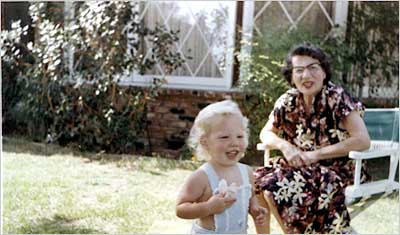
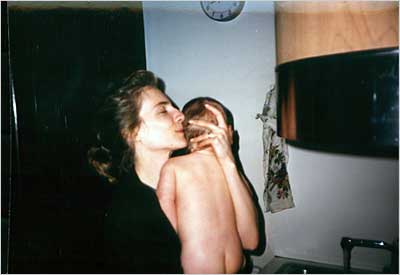
Almost exactly nine months after we had moved in, my wife had a baby, a daughter we named Sarah. Nana beheld this newborn creature in her lap a few days later, too nervous to lift her. “My hands are no good,” she cried happily. Not only was the baby precious, but the meaning of the baby was precious, too. Two generations removed, this flesh was her flesh.
From there, Kathy and I fell into the difficult time of being new parents. Working, taking care of a newborn and a 90-year-old, the days went past in a blur of sleep-deprivation. My wife worked herself to a deep exhaustion, losing weight, running the baby to the doctor’s office, shopping, cooking, cleaning. Sarah was fat and cackling, and we loved her more than life itself. The deal we had made with Nana seemed completely logical in retrospect, preordained even. Each piece had fallen into place.
Except the last one, the most obvious piece. Our baby girl was not 10 months old when it became clear that Nana had started to fail. She was tired, she was weak, she was irritable. Getting her to and from the hairdresser became more difficult. She didn’t want to go out to shop anymore. She wobbled alarmingly upon standing. Her skin was now so thin that it tore easily if she lurched against a piece of furniture.
Her mood deteriorated as well. Now she said that we spent most of our time and energy on the baby. If we wanted to take Sarah for a walk, she cried piteously on the sofa and wouldn’t look at us. “Nana, we’re just walking around the block,” my wife would say soothingly.
“Just go and leave me!”
As the weeks tumbled by, my wife and I sliding along, dumbed by exhaustion, Nana required ever more care. Now I carried Nana up the stairs for dinner and then down again. Sometimes she urinated in my arms. I didn’t much mind. She had given me my house, and in a way, she had given me my daughter. But we were never free from her. My wife bathed her every day or so, changed the sheets. I would check her nose with the flashlight, adjust the blinds, the heat, the blanket.
We lay on the floor gazing up at the impossibly high ceilings. What life would we live here that otherwise would never occur?
Nothing we did could address her looming terror. She began to scream at night, a kind of frightened wailing that rose and fell. Two floors above, my wife would lift her head.
“Oh, fuck,” she’d say. “I can’t take this anymore.”
I, the fool who had suggested the whole arrangement in the first place, would stumble down the stairs and stroke Nana’s forehead and promise her that if anything happened, I was there. In the darkness, Nana would cry a little and then passionately thank me, and then maybe she would fall asleep and maybe I would, too, or not. This went on for months—how many I can no longer remember.
Then came the next-hardest part, when we had to stop kidding ourselves. We had promised Nana we would take care of her to the end, but now she was losing blood from her rectum and losing consciousness. My wife took her to one doctor after another, but soon the doctor’s visits became hospital stays. She was dying, her doctor told us. Her heart was failing, and she might live another six months. This meant that she would either die at home, or she would not. Either option was bad, but one of them was worse, given the circumstances. I began to look into what a nursing home might cost.
Meanwhile, my parents visited us and were shocked by how exhausted we appeared. “You are caring for two human beings in diapers,” my mother said. “You think you’re managing this, but you’re not.” She was right. The moment of clarity came when Nana fell badly, cutting her chin, and while attending to her we neglected to check on Sarah, who was by then crawling. We found our daughter eating cat food out of the bowl on the floor in Nana’s living room.
Finally, we did it, wringing our hands, anxious, guilty, sad, trying our best to explain to Nana. She went to the hospital one more time and never came home. We placed her in the nearest nursing home we could find, a hulking institution about a mile from our house in a bad neighborhood. It was the only place even remotely close that had an open bed, and we tried to look on the bright side: We could take her out in a wheelchair onto the roof garden when the weather turned warm . . .
My wife was able to visit Nana nearly every day, and I stopped by at night on my way home from work. Panting weakly most of the time, Nana had lapsed into an uneven delirium, in which she complained about the food and then said that she’d seen red roses growing out of the wall. If she wasn’t in bed, then I would find her in the dayroom, slumped over in her wheelchair, tied up in order that she not fall out, with a dozen other women, many with urine bags under their seats, all asleep or staring at the wall-mounted television. Her eyes would be half-open and she would slowly lift her head at my touch, the corner of her mouth caked with gummy white stuff.
Had we done this to Nana? Were we—was I—to blame for this suffering? I was not sure. Had she never moved from Los Angeles, Nana would still have suffered heart failure. But somehow this was no consolation. She was here, now, in human torment. I looked around. They all were in torment, strapped into their wheelchairs, being spoon-fed soft food by the attendants.
There was absolutely nothing noble or redeeming or virtuous about my visiting Nana. It changed nothing, except that I could tell myself and my wife that I had visited. I did not go with a glad heart. I often resented it, I sometimes resented Nana, I resented myself, and most of all I wanted it to end. I wanted my suffering to end. Perhaps in later years I would have undertaken this duty with more charity and perspective and patience. But that wasn’t the case then. I was tired, working all the time, fed up, sick of trudging from the subway each night. I wanted Nana to die, yes, I did.
Then came the last hospital stay, when the nursing home called an ambulance. My wife and I arrived at the hospital and I noted the lack of urgency in the manner of the nurses. They had seen this moment many, many times. My wife and I made the decisions, we signed the forms. Do not resuscitate, do not tube-feed.
Always we would remember the way Nana looked in the bed at the end, chin high, mouth open, eyes half-shut. Life leaving her. Her emaciated chest barely rising. Born in Shanghai in the nineteenth century, dying in Brooklyn 91 years later on a hot August afternoon, a mercy.
In the end, I consoled myself, all the parts of the deal were upheld, if imperfectly. Nana died with her great-granddaughter delivered into the world. And we had a big, warm house that was made, we realized now, for a family.
Copyright 2005 Colin Harrison. From the anthology I Married My Mother-in-Law, edited by Ilena Silverman, to be published by Riverhead Books in January.