It’s unheard of for people waving their wallets to be turned away from a political fund-raiser, but that was the chaotic scene outside psychologist Gail Furman’s Greenwich Village townhouse on a recent Monday night, as crowds of well-dressed thirtyish lawyers and Wall Streeters tried to talk their way in to see Wesley Clark.
Inside, nearly 400 people were jammed into the living room, perched on a stairway, hanging out second-floor windows. At 9:30 p.m., the retired four-star general made a triumphant, rock-star entrance via a back garden. The townhouse erupted in screams and chants of “We want Clark!” “You’ve got him,” Clark hollered back, adding, “Who says there’s no draft in America today?”
This was the cheap-seat event of Clark’s evening, a minimum $50 donation versus the $1,000-to-$2,000 price tag at two earlier, exclusive house parties. Introduced by financier Alan Patricof, Clark clambered onto a makeshift podium, high on the adrenaline of campaign fever, and began by dismissing the critical press he’s received. “As the political reporters have said, ‘General, you ain’t got much of a campaign,’ ” declared Clark. “I said, ‘You’re right, I don’t have a campaign, I have a movement!’ ” The audience roared.
Emphasizing his 34 years in the military, Clark thundered his opposition to the war (“How dare the leaders of this administration send our sons and daughters and brothers and sisters to fight in Iraq in a cause that wasn’t necessary”), joked when interrupted by the ringing of a cell phone (“If that’s President Putin calling, tell him I’ll be right there”), and stressed his belief in the United Nations (“We need our allies; I happen to like bratwurst and French wine”). Then he rallied his new troops with a call to wield their most potent weapon: “We want you to get your friends to give … You’re voting with your checkbook, and with politics, that’s important.”
Small wonder that Clark has spent more time in New York City since announcing his candidacy than in Iowa or New Hampshire—there’s more money per square mile in these greed-locked streets than anywhere else in the country. Sure, the Spielberg-Streisand outpost of L.A. boasts many deep-pocketed Democrats, but in less time than it takes to drive from Malibu to Studio City, Clark dropped by three homes here and scooped up more than $300,000—not bad for a night’s work.
With the Democratic race accelerating, the candidates have been hustling for cash here with the intensity of door-to-door insurance salesmen trying to reach their quota to win a color TV. “Everybody’s tripping over each other,” says Kati Marton, the author of a book about presidential marriages and wife of Democratic secretary-of-State-in-waiting Richard Holbrooke; she was spotted at a breakfast for John Kerry at the Grand Hyatt.
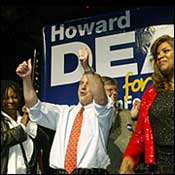
Indeed, even as Clark was continuing his fund-raising fandango for a second day with a top-dollar lunch at Hillary pal Jill Iscol’s Fifth Avenue apartment, native son Howard Dean was sweeping into town for a four-event marathon, ending that Tuesday with a late-night $250 dessert reception for an SRO crowd at Opia. The exuberant Dean went on so long that an aide, mindful of his upcoming 5:30 a.m. wake-up call for Good Morning America, enlisted the candidate’s mother to pry him away. (“Howard,” Andree Dean called out in a no-nonsense tone. “Your mother wants you. It’s time to go.”) Stopping on the 57th Street sidewalk moments later, Dean insisted to me that he’s not worried that Clark will siphon away money. “Clark is taking institutional support away from the other candidates; I have a different base of supporters,” said Dean, the fund-raising front-runner. He raised an astonishing $14.8 million in the just-ended third quarter, far outstripping next-in-line Kerry, who brought in an estimated $4.5 million to $5 million; Lieberman, aiming for $4 million; Edwards, an estimated $2.5 million to $3 million; and Clark, expected to bring in more than $2 million when final numbers are posted October 15.
Given the sheer volume of checks written in one week, it’s hard to believe there’s a recession in New York. The night after Dean’s event, it was Florida senator Bob Graham’s turn to shake the money tree down on the Bowery, that area long notorious for down-and-out denizens demanding handouts. Even though he’s lagging in the polls and there are rumors that he might drop out, this courtly silver-haired smooth-talker managed to reel in 250 well-heeled backers who paid up to $2,000 to sip apple martinis and eat roast chicken at Capitale, the handsome, ornate converted Bowery Savings Bank. There were murmurs in the pragmatic crowd about what a great vice-presidential candidate he would be, but Graham put on an upbeat face as he worked the tables. “You know what Willie Sutton said when he was asked, ‘Why do you rob banks?’ ” quipped Graham. “He said, ‘That’s where the money is.’ And that’s why people come to New York.”
Not since 1976, when ten Democrats vied for the presidential nomination, has there been such a crowded field. For those wealthy New York contributors with fond memories of nights spent in the Lincoln Bedroom during the Clinton years, choosing a candidate to back this time around involves a complicated series of calculations. Four years ago, the New York Democratic-money primary resembled a Hatfields-versus-McCoys showdown between institutional party loyalists, fantasizing about jobs in an Al Gore administration, and insurgent true-believer backers of Bill Bradley.
But this fall, the emotions and loyalties are even more fractured, pitting friends against each other and even dividing families. Clark’s guides to New York’s moneyed rooms are Alan and Susan Patricof, who have raised millions for Democrats and were early backers of the Clintons but who don’t see eye-to-eye with their own children on this race. Investment-banker son Jonathan, 30, raised a good chunk of change at his Soho loft this summer for John Kerry, while his brother Mark, 39, president of David Rockwell’s architectural firm, organized a lunch for Howard Dean. “We decided to go in different ways,” says Jon, explaining that he hasn’t tried to lobby his brother. “You can’t guide someone.” His father adds, “Everyone in the family has been quite restrained. Nobody’s attacked each other yet.” Jokes Susan, “Our youngest son, Jamie, hasn’t chosen anyone, and we hope we can get him on our side for Clark.”
Meanwhile, Jane Rosenthal, who runs Tribeca Films (and is married to Susan’s brother, Craig Hatkoff), also dabbles in Democratic politics and recently gave a meet-and-greet event, with co-host Whoopi Goldberg, for Dick Gephardt. “I’m backing whoever can win,” says Rosenthal, adding that she’s given money to Gephardt, Kerry, and Clark. “Our family is all over the place, and we have e-mail debates that are hilarious. We all show up at each other’s events. Jon came to my Gephardt event.”
The divisions in the Patricof clan mirror those in the Manhattan Democratic-money tribe—which is not much bigger. There are roughly 300 people in New York who are each capable of raising $100,000. The big money raisers know each other from past campaigns and keep in touch on the same cocktail-party and charity circuit. The small-world nature of Democratic politics here is epitomized by the fact that three key supporters of rival candidates—Roy Furman (Dean), Laura Ross (Senator John Edwards), and Hassan Nemazee (Kerry)—all have apartments in the same building, 770 Park Avenue, and have held events there. And Jill Straus, who co-runs Edwards’s New York fund-raising office, crows about her incursion into enemy territory: “One of our most successful events for Edwards was in Howard Dean’s mother’s building on Park Avenue.”
After the disastrous 2000 election followed by the midterm debacle for Democrats last November, the city’s major fund-raisers have been brainstorming about how to beat Bush and how best to make their financial muscle count.
During the past year, four Manhattan Democratic moneymen set themselves up as power brokers, each organizing informal groups to vet the candidates: Patricof (whose group included Gail Furman and Sarah and Victor Kovner); Philip Murphy, a Goldman Sachs managing director; Paul Beirne, a principal with Bernstein Investment Research and Management; and attorney Melvyn Weiss (whose group includes Carl Spielvogel). Their breakfasts and dinners weren’t fund-raisers but rather free meet-and-greets, which most of the major candidates dutifully attended in hopes of scoring supporters. “I organized this group about eight months ago because I didn’t want to throw money away,” says Weiss, explaining that he’d hoped that he and his friends would all agree to back one candidate, anointing an early front-runner and avoiding an expensive Democratic-primary fight. “When you have primaries, the money is just wasted. There were 25 of us, although some have fallen by the wayside or have now endorsed a candidate,” says Weiss, who recently hosted Clark and admits that his group remains divided. “We may not be able to come to a consensus.”
To put it mildly. Each candidate has committed partisan supporters, such as John Catsimatidis, the CEO of Red Apple supermarkets, who will happily talk your ear off about Kerry’s merits: “He has what it takes to defeat George Bush—he’s not too far to the right, not too far to the left, and he’s a war hero.” Investment banker Roy Furman is wild about Dean: “He’s pragmatic and smart, and people love what they hear.” The Kovners have fallen for Clark’s epaulets; as Victor says, “With his outstanding record of service and sacrifice for his country and knowledge of foreign policy, I think General Clark would be the strongest candidate.” Park Avenue fund-raiser Laura Ross is talking up John Edwards; rap-music mogul Russell Simmons is singing Al Sharpton’s praises: “He’s a voice for change. I’m interested in hearing him inspire all Americans to be more compassionate to poor people.” Lynn Forester de Rothschild is backing son-of-a-milkman Dick Gephardt: “Dick can beat Bush on foreign policy, and he’s a human being people can relate to.”
But most of the money tribe isn’t playing favorites yet. Make the rounds of presidential fund-raisers, and the same faces appear: Rabbi Solomon Horowitz turned up at both the Clark and Dean events, opining afterward, “Dean talked more about the issues, and he’s down-to-earth. I like that he talked to everybody. Clark was too high-and-mighty.” Writer Sarah Crichton (who ghosted Joe and Hadassah Lieberman’s book) came to a Kerry breakfast as a guest of a friend and four days later joined her mother at Dean’s Opia event, saying with a smile, “I’m curious.” Mom Judith Crichton, confiding that she had donated $100 to the draft-Clark movement, enthused after hearing Dean, “He’s the best speaker I’ve heard since Adlai Stevenson.” Philanthropist Anne Hess is on the circuit because she wants to make a first-person judgment. “I’m trying to meet as many of them as possible, and sometimes it costs me, sometimes it doesn’t,” says Hess, who’s attended events for Kerry, Dean, and Edwards. “I want to hear them answer questions.” And her choice? “At the moment, I’m underwhelmed by them all.”
It would be logical to think that people who take the more time-consuming and significant step of putting their names on invites and hosting fund-raisers have committed their hearts to a sole candidate, but even that’s often not the case. With four senators in the race, New York’s political junkies have preexisting relationships with several candidates and conflicted loyalties. “It’s been a tricky thing for me,” says Adam Epstein, a producer of Hairspray who organized a $130,000 theater-and-drinks event for Edwards earlier this year, but then switched to longtime family friend Graham, explaining, “I worked for him as an intern, and I love him.” Patricia Duff co-hosted a Dean fund-raiser earlier this year but later showed up for a $100-a-person Kerry lunch at the Yale Club. “I’ve known Kerry for so long that I feel guilty for not backing him all the way,” she said. “But I find Dean the real leader in this group. And he’s really created a revolution in the way he’s been able to bring in so many small donors.” Her ex-husband, Revlon mogul Ron Perelman, also has divided allegiances: He opened his townhouse to Kerry and his supporters in June, raising more than $60,000, but has also promised to help Joe Lieberman. An aide explains, “Ron has two friends in this race.”
The Manhatan A-list Scorecard
Who’s giving to whom? A guide to the fundraisers.
Lieberman insists that it doesn’t bother him if his supporters contribute to his rivals. “I don’t discourage it,” he says. “My first choice is that they only write checks to me. But people will say to me, ‘I hope you’ll understand that I’ve given to another candidate. A friend asked me.’ People have a lot of friends involved in this race.” He is telling me this at—what else?—a Veuve Clicquot–and–dessert fund-raiser in his honor at the spectacular Central Park South aerie of money manager Boykin Curry, held after the recent Thursday-night Manhattan Democratic debate. Although Lieberman has stellar name recognition, he’s largely ignored by the media since he lacks the buzz of Dean or Clark. After Lieberman’s campaign manager Craig Smith spelled out the election strategy—to de-emphasize the January Iowa and New Hampshire slug-outs and concentrate on the seven primaries and caucuses below the Mason-Dixon line that will held on February 3—the Connecticut senator then quipped to the 85 guests, “You’re all invited to the Lincoln Bedroom.” He paused, then added with a grin, “Probably not together.”
Thanks to the McCain-Feingold campaign-reform legislation, candidates can now rake in double the pleasure, double the fun, from such 90-minute festivities, since the maximum legal individual contribution has been raised from $1,000 to $2,000. But the ban on so-called soft-money contributions means that moguls can no longer curry favor from the eventual Democratic nominee by writing $100,000 checks to the Democratic Party for use in the general election against the Republican nominee. Anyone who wants to be important to a candidate these days has to do some heavy lifting—pick up the phone and arm-twist friends and business acquaintances to cough it up now.
Just as wealthy New Yorkers swap favors on the charity circuit—I’ll buy a ticket to your cancer benefit if you’ll buy a table at my New York City Ballet fund-raiser—many people are writing checks to candidates whom they do not necessarily support, at the behest of friends. Lisa Kent, a Westport, Connecticut, lawyer who supports Edwards, said she recently sent a check to Lieberman, explaining, “My girlfriend called and asked me for a donation.” When Lynn Forester de Rothschild co-hosted a Gephardt fund-raiser at her palatial River House apartment in June, she called on her social circle, including Harvey Weinstein, who didn’t attend but sent a check for $1,000. “Harvey hasn’t chosen a candidate,” insists his spokesman Matthew Hiltzik, saying that Weinstein had agreed to write the check as a favor. “Harvey supports his friends.”
All the top-tier candidates have been traipsing through New York for more than a year, wooing those masters of the universe and Upper East Side activists with a fund-raising track record. “New Yorkers like southern accents,” insists North Carolina’s Edwards, at a Madison Avenue fund-raiser last Wednesday night, just four hours before the end of the third quarter. “Bill Clinton did make it easier; people got used to the accent.” Moments later, my cell phone rang; it was John Kerry, responding to an interview request—he was startled to hear he’d caught me at an Edwards event. Twelve days earlier, I had watched Kerry, at a late-night $75 event on the Intrepid where he whipped off his Hermès tie and accompanied Moby on guitar. “I want to reach out to a cross-section of people,” he said. “I’m not going to leave any stone unturned.”
The Kerry campaign is now housed in office space on Park Avenue South that may not have the best karmic vibe; the previous tenant was the ill-fated Carl McCall gubernatorial campaign. Decorated in campaign posters and cartoons of Kerry on a surfboard, the place is bustling with paid staffers and volunteers. Jamie Whitehead, a handsome 31-year-old in jeans and a T-shirt, has fine-tuned his pitch after a year of meeting Manhattan’s movers and shakers. “People have different motivations for getting involved in politics,” he says. “They want to make a difference and care about the issues, or they like the sexiness of the events and like seeing their name in lights, or it’s about business. Part of my job as a salesperson is finding out what the motivation is.”
Landing the big donors is a time-consuming and emotionally fraught task. “The relationship between the candidates and the donors is psychopathic,” says one jaded fund-raiser. “Some donors make the candidates jump through hoops. They insist on dragging the candidates to meet their friends, they want a private lunch or a dinner. Other donors really want to be loved, and they think if they raise enough money, the candidates will love them. What they don’t realize when they get a call from a candidate is that it’s like a boiler room, the guy has a dozen staffers in a room dialing numbers, and he’s just going from call to call.”
“Everyone wants you to sign on to their team. A day doesn’t go by when one of the candidates doesn’t call.”
Early loyalty is much prized. As the once obscure and now sizzling-hot Howard Dean says, “I know who was there.” Prep-school classmate Jim Torrey was an important early backer, as was moneyman Roy Furman. Arriving at a VIP reception in late August at an Irving Plaza fund-raiser, Dean made a beeline for Diane Straus Tucker, the well-connected publisher of Manhattan Media and a fellow Yale alum who took him around a year ago to meet pals like George Soros. “How’s the bat?” Dean asked her, referring to his Internet fund-raising symbol. Tucker beamed, replying, “You’re going to hit a million tonight,” and he hugged her in response.
Gregg Hymowitz, the founder of EnTrust Capital, said he went searching for a candidate to back last year, meeting with Edwards and Kerry and talking by phone to Dean before deciding to sign on with Dick Gephardt as national co-chair. “If you want to have any kind of impact on a campaign, you’ve got to get involved early,” says Hymowitz, who is running the congressman’s New York fund-raising. “A lot of people don’t want to do anything. The risk is, you bet wrong. But if you do bet wrong, come April, when the primaries are over, you can always do fund-raising for the nominee.” At Gephardt’s fund-raiser last Monday night, at the Comedy Cellar in Greenwich Village, comedian Colin Quinn couldn’t resist teasing the Missouri congressman about his straight-arrow image, urging him to get a tattoo on his neck and joking, “You’ve got to get a sex scandal. Clinton was more popular afterward. You go out there, you’ve got lipstick on your collar.” Gephardt, laughing through it all, took the microphone next and replied, “You did very well. You can be my secretary of State.”
Celebrity-wrangling is a vital element in every campaign. “Celebrities are a draw,” says Dean fund-raiser Emily Wurgaft. “In the beginning, when no one knew who Howard was, they’d come to an event because it was given by Paul Newman and Joanne Woodward. Now people come because they want to meet Howard.”
Clark has been a stealth candidate for a year, meeting all the major players but coyly refusing to reveal his intentions until last month. For those New Yorkers who remained uncommitted, joining the Clark bandwagon offers a late-breaking opportunity to be at the center of the action. “He is catching on like wildfire,” says Jill Iscol, whose husband Kenneth is an entrepreneur. “This is getting in on the ground floor of a campaign.”
It was relatively easy for Clark to sweep through New York and pick up cash because he’s a fresh face (and because he’s picked what fund-raisers call the low-hanging fruit), but his problem in the weeks ahead is that most people want to see him if they’re going to write a check. With a mere four months until voters go to the polls, it will be hard for Clark to show face at fund-raisers and simultaneously sweet-talk the skeptics in Iowa and New Hampshire.
But that time-travel problem is hardly daunting for his new recruits. “I know he’s starting late, but I hope he can be Seabiscuit,” says Susan Patricof. Gail Furman is amazed at the hordes who descended on her townhouse, noting that 200 were turned away at the door. “I haven’t seen anything like this excitement since the sixties.”
Playing hard-to-get can make you very popular, as Paul Beirne has learned. “Everyone wants you to sign on to their team,” says Beirne, who hasn’t taken the plunge yet. “A day doesn’t go by when one of the candidates doesn’t call.” Suffice it to say there’s a high suck-up quotient to these calls. “It’s just awful, this frenzy to raise money,” laments Felix Rohatyn, the longtime chair of Lazard Frères and ambassador to France during the Clinton administration, who is also getting personal calls from the presidential wannabes. “They have to go through this ritual. People call you and pretend they want your view on taxes, when all they want to know is how much money you can send.”
Rohatyn is playing the field; he’s co-hosted fund-raisers for Gephardt and Kerry, and has donated $2,000 to Dean. “I’ll probably help Wesley Clark too,” he says. “I would like a Democrat to win, and they’re all acceptable to me.” In this goodwill-toward-all mood, will he also help Al Sharpton, Carol Moseley-Braun, or Dennis Kucinich? “Now that you’ve mentioned it, you’ve inspired me,” he says, chuckling. “I think I will give money to Al Sharpton. I think he’s handled himself quite well.”
While Sharpton’s rivals have been invading his home turf on a money quest, the Rev has spent very little time cold-calling for cash, raising a mere $130,000 in the first six months of this year. “Our plan was always that I was going to do people-raising through September,” said Sharpton in a phone call, referring to his campaign-speaking travels and voter-registration drive, “and then raise money in October and November.” His goal is to bring in $750,000 by the end of the year—pocket change to Dean and Kerry—so that with matching federal funds, he’ll have $1.5 million to pay for cable-TV and campaign ads. Def Jam Recordings founder Russell Simmons is giving Sharpton a $500-a-person birthday bash and fund-raiser on October 14, with co-hosts P. Diddy and Jay-Z. “I’ve received donations from a Who’s Who of black business leaders,” Sharpton says. “Earl Graves of Black Enterprise, Bob Johnson of BET, Kathy Hughes of Radio One, Percy Sutton. You’d be surprised by some of the people who contribute—Barbra Streisand sent me $1,000.”
As Sharpton watches the other candidates try to take Manhattan, he professes skepticism that money will buy them love. “I’ve been in favor of public funding of elections because fund-raising takes too much time from connecting with people,” he says. “I’m No. 3 in the Marist poll, and I haven’t spent a lot of money. If I were one of these other candidates, I’d be asking for a refund.”
Champagne Party Politics
A Manhatan A-list fund-raising scorecard
WESLEY CLARK
Alan and Susan Patricof
Victor and Sarah Kovner
Gail Furman
Kathy Lacey
Jill and Ken Iscol
Barbara Layton
**Jane Rosenthal
HOWARD DEAN
Roy Furman
Paul Newman
Joanne Woodward
David Rockwell
Mark Patricof
Jim Torrey
**George Soros
**Anne Hess
**Russell Simmons
**Jane Rosenthal
DICK GEPHARDT
Lynn Forester de Rothschild
Skip Stein
Leo Hindery
Gregg Hymowitz
Vincent Mai
Jim Chanos
**Jane Rosenthal
**Felix Rohatyn
**Bob Kerrey
**Russell Simmons
JOHN EDWARDS
Laura Ross
Woody Young
Strauss Zelnick
Charles Phillips
John Hall and May Lee
Ron Feldman
Richard Thaler
**Bob Kerrey
**Anne Hess
**Russell Simmons
**Adam Epstein
JOHN KERRY
Orin Kramer
Roger Altman
John Catsimatidis
Toni Goodale
Jon Patricof
Robin Duke
Fred Hochberg
**Jane Rosenthal
**Bob Kerrey
**Felix Rohatyn
**Russell Simmons
JOE LIEBERMAN
Alan Hevesi
Sheldon Silver
Michael and Judy Steinhardt
Boykin Curry
Peter Joseph
John Tishman
**Bob Kerrey
BOB GRAHAM
Marvin Rosen
Steve and Cathy Graham
Richard and Danielle Gardner
David Boies
AL SHARPTON
**Russell Simmons
Percy Sutton
Kathy Hughes
Robert Johnson
Earl Graves
P. Diddy
Jay-Z
**Indicates an undecided contributor to multiple candidates.