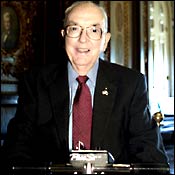
Photo: AP/Wide World Photo
It’s Washington in late September, and most senators are up to their hair plugs in Iraq. Under different circumstances, a debate about America’s sovereignty would have sent Jesse Helms cartwheeling to the center of the Senate floor, but with a weak heart, numb feet, and an unreliable sense of balance, the North Carolina senator no longer has the strength. Instead, he sits in a room off the main chamber, nestled in his motorized scooter, and entertains 55 middle-schoolers from Raleigh.
“I understand you got a mean lady for a principal,” he says. The kids smile, because the lady in question is Helms’s daughter. “You tell me about her. I’ll spank her.” He looks around the room. “Where is Jane?”
An apple-cheeked woman with gray hair raises her hand. Helms points.
“I changed her diapers.”
The kids think that’s pretty funny.
“Anyone have any questions for my daddy?” she asks.
They do, but Helms, 81, has a hard time hearing them; a blonde aide in a bright-pink sweater has to repeat each one loudly into the senator’s left ear. A Capitol Hill photographer comes along, and Helms insists, as he generally does, on getting out of his scooter for the shot. One of his aides gingerly reaches under his arms and hoists him up. Another picks away bits of lint from his collar.
Slowly, on pelican’s feet, Helms makes his way over to the huddle of seventh- and eighth-graders, leaning uncertainly on his four-legged cane. It is only when he reaches the group, unsteady but triumphant, that he finally shows a hint of the man who led the crusade against Robert Mapplethorpe, thumbed his nose at Gerald Ford, proposed at least ten constitutional amendments to ban abortion, denounced Martin Luther King Jr.’s “action-oriented Marxism,” called a Clinton appointee a “militant-activist-mean lesbian,” and held up eighteen ambassadorial nominations and two treaties in order to force a reorganization of the State Department.
“I want everyone,” he instructs the kids, “to grin like a jackass chewin’ briars.”
Helms’s daughter moves to his side. He tries to put his arm around her. And for one terrifying moment, he teeters violently backward. “Whoa,” the senator cries.
His daughter reaches out to steady him.
Perhaps no one in american public life has made the liberal liver work harder than Jesse Helms. The mere mention of his name provokes hostility, fund-raising, bravura acts of guerrilla protest. In 1991, AIDS activists scaled the roof of his home in Arlington, Virginia, and inflated a fifteen-foot replica of a condom. (HELMS IS DEADLIER THAN A VIRUS, IT READ.) The Internet has a site where you can make him explode. During his first term, the Raleigh News & Observer gave him a nickname, and it stuck for the rest of his career: Senator No.
Apart from Ted Kennedy, Jesse Helms may be the one out-of-state senator that New Yorkers can readily identify, because he is the champion of values so many of us loathe: pro-life, anti-gay, U.S. first, U.N. last. Alan Simpson, the retired Wyoming Republican with a coyote’s tongue and sailor’s flair for metaphor, thinks we’re destined not to understand him. “It’s the natural elitism of geography,” he muses. “New Yorkers are a great and wonderful people, but if you stop and ask ‘em if they’ve ever been to North Carolina, they’ll stop and blink at you like a frog in a hailstorm.”
With Helms retiring in January, the great temptation is to deem his departure the end of an era. And in some respects, it is: When Helms first entered politics as a staffer to a North Carolina senator 50 years ago, the South was still fighting tooth-and-nail to preserve segregation, the Red Menace was alive and well, and Roe v. Wade sounded, as the old quip goes, like two options for crossing a stream.
The truth, however, is that Helms is more responsible for defining our current political era than prolonging a bygone one, and he leaves a Senate fashioned largely, if not entirely, in his own image. To understand his legacy is to understand how Congress has evolved in recent years – in ways that increasingly tilt away from New York’s interests.
When Helms was first elected to Congress in 1972, there were 42 Republicans in the Senate, many of them quite liberal, and only 6 were from the South. Today, Helms exits as one of at least 51 Republicans, almost all of whom are deeply conservative, and 13 of whom, including the party leader, come from the South – 17 if you include Texas and Oklahoma.
When Helms entered the Senate, he railed against mothers on welfare, railed against big government, railed against the disappearance of God from public discourse. Today, religion and morality are regular staples of Washington discussion, the welfare state is fading, and when it comes to the size of government, most politicians agree that less is more.
“Jesse Helms was conservative before conservative was cool,” declared Phil Gramm, another retiring Republican lion, at the Senate’s two-and-a-half-hour, two-hankie lollapalooza of Helms tributes on October 2. “Before Jesse Helms came to the Senate, there was a guilt about America, this doubt about our purpose and our policy. Jesse Helms, as a young member of the Foreign Relations Committee, started the process of changing that debate.”
As the Greatest Generation starts to fade from the Senate and finds itself replaced, as Dave Barry likes to say, by the Largest, boomer Republicans are getting misty about Jesse Helms. (“The Rambo of the Geritol generation” is how Bob Dole once fondly described him, before he himself became the Rambo of the Viagra generation.) Younger Republicans may not always have agreed with him – he was, after all, one of only six senators to vote against the Clean Water Act, one of five to oppose the reauthorization of the Civil Rights Act, and one of two to reject the arms-control agreement with the Soviets in 1987 – but it was precisely this fearless, uncompromising radicalism that made their lives possible.
“He really set out markers in terms of how far conservatives could go and how aggressive they could be,” explains Republican Judd Gregg, the senior senator from New Hampshire, who was 25 when Helms first got elected. “We’re perceived as less hard-edged because of him,” adds Pennsylvania’s Rick Santorum, who was 14.
“Jesse was an inspiration,” says Trent Lott, the impressively high-haired Republican Senate leader. “When I was still in the House as a junior officer, I watched him from afar.”
Lott is leaving the Senate floor as he says this, having just kicked off the marathon of Helms encomiums. His voice catches. “Sorry,” he says. “I’m a little teary. This is very nostalgic. A lot of the fights Jesse fought in the seventies, eighties, and nineties, we won. He pulled us all this way.”
Unlike the front offices of most senators, Jesse Helms’s reception room in 413 Dirksen is not a garish shrine of self-congratulation or a shadowbox of state-related kitsch. The only interesting celebrity photo on the wall is from an admirer of a certain age: HOW CAN YOU LEAVE US TO THESE LIBERALS? WELL BLESSINGS ANYWAY!!! JANE RUSSELL.
In North Carolina, the constituent service provided by the Helms operation is legendary. It is run with seamless efficiency by bob-cut blondes and Brooks Brothers men whose smiling, lacquered professionalism makes New Yorkers acutely aware of their unruliness – we’re all loud voices and dark clothes. Helms’s aides respond quickly to letters, take handwritten messages (the senator refuses to install voice mail), and, most inconveniently, barricade their boss against journalists; it’s something they’ve learned from years of unbecoming press.
But as Helms’s days in the Senate dwindle to double digits, a more expansive mood seems to have filled the room. After a few minutes, his chief of staff appears, and he guides me to an antechamber outside the senator’s private office. Helms is busy receiving an award from the North Carolina Farm Bureau. When that’s over, he beckons us inside, offers me a seat, and quickly establishes that he is not exactly a stranger to New York. He and his wife came to New York on their honeymoon.
“This was World War II,” he says, in his lilting, trademark slur. (When he speaks, he shpeaks, as if he had a wad of tobacco in his mouth.) “And I was a serviceman, see. They wouldn’t let me pay for my meals or anything else. Dot and I went to see the kids kick up their heels at – what’s that place called?”
Radio City?
“Yes! And … and, um, then, Frank Sinatra, when he was juuuuust comin’ along. I forgot who he was singing with. A Roxy gal.” He sighs. “We saw so many things. But New York ain’t that way anymore. I like the old New York better.”
Helms began his political career in 1951, working as chief of staff for Willis Smith, a North Carolina Democrat who got elected on a baldly segregationist platform. (A typical campaign ad: WHITE PEOPLE, WAKE UP BEFORE IT IS TOO LATE.) After a brief stint in Washington, he returned to North Carolina, worked his way up the ladder of the state banker’s association, and eventually wrote a column for its in-house newsletter. His piquant commentary landed him a job as a conservative on-air editorialist for WRAL in Raleigh, and that, in turn, transformed him into a local celebrity, positioning him well for his Senate bid in 1972. When he won, Helms discovered that most of his fellow southern senators were still Democrats. “The Republicans in those days, they were nice gentleman,” he says, “but they were sort of, sort of … stodgy. I mean, we were coming along. We were trying to spread our wings and learn how to fly!”
In those days, the Republicans also considered themselves a hopeless, permanent minority. In order to get legislation through, they had to master the arcane rules of the Senate, and Helms took on this formidable task with gusto. It drove his opponents, and even his allies, nuts.
He forced votes on bills that members didn’t want to weigh in on, and stood in the way of bills they did. He put secret holds on ambassadorial nominations, amended other people’s amendments, filibustered with abandon. In December 1982, when every member of the Senate had a ticket in his pocket to fly home for Christmas, Helms kept the Senate in session for an extra week because he opposed Reagan’s nickel-per-gallon gas tax. (Simpson later declared he’d “seldom seen a more obdurate and obnoxious performance.”)
Perhaps because he blocked as many bills as he authored, Helms refuses today to say what legislation he’s most proud of, though he certainly has a few plump contributions to choose from – including the Helms-Burton law, which penalizes foreign companies that do business with Cuba, and his forced reorganization of the U.N., which many Republicans say vastly increased their respect for the institution. “But I’m not a boastful man,” he says. “And a lot of battles, I’ve lost.”
Then he looks me right in the eye. “I shall go to my grave a strong pro-lifer. I’m married to one of the finest ladies I ever knew, and we have two daughters and all that, but when it comes to the taking of the life of a child, I don’t think anybody has that right.”
Regardless of where one stands in the cultural wars, though, Helms didn’t win them. I point out that Roe v. Wade has withstood major challenges in the past 30 years, the National Endowment for the Arts perseveres, Will & Grace is in its fifth season . . .
“Well, I never view it as a win-lose proposition,” he says. “I never consider that I lost a battle if I did the best I could.”
And that’s just it: Helms’s objective was seldom to win; it was to force the Senate to go on record on polarizing, hot-button issues he’d shrewdly isolated as important to his conservative base – like banning government funding of pedophilic art, for example. (Sure, it’s unconstitutional, but who wants to vote in favor of such a thing?) As a former media man, he understood that controversy was the surest way to stimulate the interest of the press, and as a southern traditionalist, he knew that the best way to excite his supporters was to exploit the giant backlash generated by the sexual revolution, affirmative action, and gay rights.
He leans in confidentially: “If you promise not to regard me as holier-than-thou, I’m gonna tell you a secret.”
I nod.
“I’ve got a little office that’s down on the first floor of the Capitol” – a private, stately little space, one of the real old-fashioned Senate perks extended to the body’s senior members – “and I’ve gone down there many a time and said, ‘Lord, I don’t know how to handle this. Please, if you will, help me.’ And every time, His hand would go on my shoulder and say, ‘Get out there and try again.’ And I … I still lost, but my faith in the Lord has grown immeasurably since I’ve been here. Because I know who’s in charge. He is.” Helms rolls his watery eyes toward Heaven and points up.
Faith is central to understanding Jesse Helms. He is a devout Baptist from a state of devout Baptists, and while the things he does in the Lord’s name may give a lot of us the chills, it’s this sense of devotion that informs much of his rhetoric and deeds. It explains why he’s an ardent pro-lifer; it explains why he’s a mean-activist-militant heterosexual. (At a campaign rally in 1990, he lamented: “Think about it. Homosexuals and lesbians, disgusting people marching in our streets, demanding all sorts of things, including the right to marry each other. How do you like them apples?”) It probably also explains why, many Christmases ago, Helms adopted a child with cerebral palsy after reading a newspaper story about unadoptable children, and why, years later, he served as director of United Cerebral Palsy North Carolina.
Helms also has one of the few real marriages in the Senate. Everyone in that floor Jessepalooza mentioned Dot Helms. Sixty years later, and even in a scooter, he still opens doors for her.
It’s a sense of Christian duty, too, that friends say accounts for Helms’s recent embrace of two unlikely causes: AIDS funding in Africa and Third World–debt relief. In what has now become a shiny pearl of Senate folklore, the senator openly wept two years ago when Bono, the lead singer of U2, used the biblical principle of Jubilee to persuade the Committee on Foreign Relations to forgive the world’s poorest nations their loans. And this past February, at an AIDS conference thrown by an international Christian relief organization, Helms stunned everyone by confessing how “ashamed” he was not to have done more to fight the world’s AIDS pandemic, especially in Africa. His Senate swan song became a $500 million appropriations bill to USAID for HIV-positive pregnant women.
“I have come to a conclusion that the positions Jesse Helms took really weren’t political positions,” says Warren Rudman, the retired New Hampshire Republican and one of the Senate’s last great moderates. “They were things he truly believed in.”
It also often surprises people that in person, Helms is almost the exact opposite of the dragon the media and his foes make him out to be. He joshes with Senate pages, herds tourists into SENATORS ONLY elevators to spare them long waits, and greets most of the Capitol Hill employees by name. (Unlike, say, Barbara Mikulski, the liberal Maryland senator, who might routinely vote in their interests but whose stare could freeze a bottle of vodka.) In The Washingtonian’s biennial, bipartisan survey of top Capitol Hill staff, Helms was voted the nicest member of Congress – this is out of 535 people, mind you – in both 2000 and 2002.
How do you like them apples?
“It’s the reverse of the proverb: He’s the velvet hand in the iron glove,” says Danielle Pletka, who worked for the Foreign Relations Committee for ten years. “Often to the immense frustration of his staff. Because you’d want him to be the man people think he is: a superhawk, a tough guy. Instead, he’s genuinely, relentlessly nice.”
“He has been extremely cordial and kind to me personally,” admits Hillary Clinton, who once accused Helms on national television of being the steward of a vast right-wing conspiracy. “He was the first of my colleagues to stop me and ask me how my mother was doing after she had surgery for colon cancer.” She abruptly stops walking – a risk if you’re Hillary, because the press and tourists will crowd. “I mean, we still disagree on practically evvverything,” she says. “But … uh … well. I think both of us have been surprised at how cordial a relationship we’ve developed.”
“You could approach him about any issue,” adds Russ Feingold, the liberal senator from Wisconsin. “You’d be foolish to approach him about some, but I was surprised to discover that he’s rather easy to work with.” He, too, pauses. “As long as you’re not rude to him.”
“Arrrrghhhh! that is the most ridiculous, hackneyed point,” says Barney Frank, one of three openly gay members in the House, as he sits in the gilded Speaker’s Lobby and munches irritably on a cigar. “People were nice to their slaves!”
In the same biennial Washingtonian survey that rated Helms the nicest member of Congress, Frank was deemed Brainiest and Funniest for the past ten years.
“People also used to say, ‘Oh, I met Khrushchev, and he was nice!’ ” Frank continues. “There’s no correlation whatsoever between someone’s public policy stance and their personality. None. Few people get elected to office unless they’re prepared to be nice to other people. Grumpy people rarely win elections … “
I stare at him. Frank is one of my favorite members of Congress, but he is exceptionally grumpy. His staff has learned to ignore it, but he can still make the occasional rookie reporter cry.
“Okay, I’m an exception,” says Frank. “Thank you for pointing that out. It saves me a lot of time.” He stabs out his cigar. “But the fact is, people rarely get far in public life without having the ability to make other people like them. There’s nothing inconsistent with being charming and a racist bigot. Particularly in the South.”
“Helms’s contradictions are not hard at all to reconcile,” agrees Mel Watt, a black Democratic congressman from Charlotte, North Carolina. “People who are patronizing and unsympathetic in their public postures but friendly on a personal level – historically, that’s almost the stereotype of the older southern gentleman.”
Before running for Congress, Watt managed the first Senate campaign of Harvey Gantt, who challenged Helms both in 1990 and 1996. During the race, Helms aired one of the most shameless television ads he’d ever run: a pair of white hands crumpling an employment-rejection notice while a narrator intoned, “You needed that job, and you were the best-qualified, but they gave it to a minority.”
Harvey Gantt, by the way, is black.
“He chose to resurrect a bill that even Strom Thurmond had abandoned!” says Illinois Democrat Carol Moseley-Braun, who was the first African-American woman elected to the Senate. She’s referring to the failed measure Helms sponsored in 1993 to renew a design patent for the United Daughters of the Confederacy that just happened to use the Confederate flag as its emblem. “What I’ve seen,” the former senator grimly declares, “is someone who has no understanding or appreciation for the humanity of people who disagree with him.”
In Helms’s office, I ask whether he’d revise any of the civil-rights positions he had as an editorialist, when he excoriated black activists for being uppity and defended luncheonette owners who refused to serve.
“I still think forced integration was a mistake,” he says. “As a government action, I think it was detrimental to whites and blacks. And left alone, it’d have come along – if you look at the football teams in North Carolina, I tell you, there’s scarcely any room for a white boy on ‘em!”
He’s utterly silent for a moment.
“I came along at a different time, an earlier time, far earlier than you,” he finally says. “And I remember very distinctly one of my little friends, when I was 4 or 5, was a little colored boy. And he got mad at me – I think we were playing jack rocks – and he called me a white cracker.”
He pauses, looks at me intently. “And I called him a you-know-what,” he continues. “And it just happened that my father was passin’ by, and he heard me do that. He came and took me by the hand and said, ‘I’m not gonna paddle you, but don’t ever let me hear you use that word again.’ And I never used that word again.
“I wish somebody would go among the, uh, colored people, as we called ‘em, who work in the Senate, and ask what they think of Dot Helms,” he concludes. “And what they think of me. Many people here who work in the Senate, they are my buddies. I do the high-five with ‘em. No kiddin’. They stick out those hands and … ” He swats the air, demonstrating.
The following afternoon, the senator invites me into his personal office for a brief second interview. I’m delighted, because I still have other questions to ask: about George W., about W.’s father, about the U.N. and Madeleine Albright and the Foreign Relations Committee and Saddam and Osama. Yet I find myself distracted by a large photograph on the wall above his couch. I try not to look at it. And yet . . .
“Look at you! The lady’s lookin’ at me and Bono!”
It’s the strangest shot: Bono, making a V-sign in his wraparound shades, and the senator, grinning like a jackal in his suit.
“I’d never heard of Bono,” he says. “So I said, ‘Well, why is he comin’ here?’ It turns out that he is a deeply religious fellow. A family man. And a very charming individual.”
He looks back at the photograph, then at me. “Now, I don’t understand his music. All I know is loud. But he invited Dot and me to one of his concerts, and to use his – what do you call it?”
“Skybox,” says Jimmy Broughton, his chief of staff.
“Yes! Skybox. They had 27,000 people, I think. Sold out.” He starts drawing an invisible diagram in the air. “The suite had a glass window on this side. And it had refreshments and so forth. Thick glass so the noise wouldn’t bother you. And then, if you wanted, you could go outside.
“So my grandchildren and I and Dot, we sat outside, and it was … earsplitting! And there was my friend Bono down there, dancin’ around a heart-shaped thing, yellin’ and carryin’ on! He’d wave his hand, and a whole sea of people would do the same thing, just like seaweed blowin’ in the wind!”
He smiles that big Ichabod Crane grin of his. “They were havin’ a screamin’ willy!”
Lazy taxonomists usually lump strom Thurmond and Jesse Helms into the same generation of carbon-dated electoral relics, but almost nineteen years separates the two Carolinians, and time has been much kinder to Strom than to Jesse. As recently as the mid-nineties, when Strom was almost in his mid-nineties, he was still walking around the Senate unaided, adhering to a rigorous regime of sit-ups and prunes and swimming furious laps at the gym. (“He takes up a lot of lane,” his trainer once observed.) It is only today, just a few days shy of his 100th birthday, that Strom, wide-eyed and open-mouthed, is finally somewhere else, lost in a mist of recidivist contentment, smiling gauzily every now and then at pretty ladies and the people he knows.
Helms, on the other hand, has been in fragile health for some time, and the press has been whispering for years about his imminent demise. Between 1991 and 1998, he was treated for prostate cancer and had two kneecaps replaced, plus a heart valve. Back in December 2000, the senator’s spokesman on the Foreign Relations Committee got so fed up with press inquiries that he sent out a blast-fax: To our friends in the media – Senator Helms is not sick. He is not in the hospital. He is not on life support. He does not have terminal prostate cancer. He does not have pancreatic cancer. He is absolutely fine and will (God willing) be around to torment you for a long time to come. Relax and accept it.
But apparently, Helms wasn’t absolutely fine. Eight months later, he announced his retirement, citing his health. Seven months ago, he had another heart valve replaced, and he continues to suffer from a peripheral neuropathy that wreaks havoc with his strength, balance, and nerve endings.
Moseley-Braun sees a connection between Helms’s recent interest in AIDS and his aging. “I think that whenever someone is facing their maker,” she says, “they try to straighten up and fly right.”
What’s strange, though, is that Helms’s dearest friends say the exact same thing.
“I think what you’ve seen is a stripping-away or a peeling-away of the shell, and it’s really shining the light on the true Jesse Helms,” says Senator Bill Frist, a Tennessee Republican who happens to have been a heart surgeon in his previous life. “Amidst this fading energy, I’ve seen this AIDS issue take off to the sky.”
During Senate breaks, Frist frequently does medical mission work in Africa. Three years ago, he asked permission to do a global-health bill out of the Foreign Relations Committee, of which Helms was the chairman, telling the senator that AIDS was destroying sub-Saharan Africa.
“And Jesse said, ‘You gotta be kidding me,’ ” recalls Frist. ” ‘There are 10 million orphans from parents who’ve died of AIDS in Africa?’ And I said, ‘Yes. It’s the same little virus that, over the years, you haven’t been too sympathetic to.’ So we wrote a global-health bill. And it passed.”
Franklin Graham, Billy’s son and the chairman of Samaritan’s Purse, an international Christian relief organization based in North Carolina, was also instrumental in persuading Helms. “I told him that we have to be consistent as Christians,” he says. “We can’t be for saving the unborn and then turn our backs on children dying of AIDS.”
Back in his office, I ask Helms if his interest in Third World–debt relief and AIDS means his priorities have, in fact, changed.
“Not one iota.”
Didn’t he mention being “ashamed”?
“Well, I did say it, and I am ashamed,” he says. “But we’re not going to stop the spread of AIDS if we don’t all get busy workin’ in every possible way. We got to make morality in America popular again.”
He looks at me defiantly. “Because a lot of people who have AIDS and other diseases,” he says, “delight, I am told, in spreadin’ ‘em. Which is awful, if you think about it.”
Today, it is hard not to think about Helms in terms of his ideological opposite, the late Paul Wellstone, who also was a principled populist and the lonely senator on the slim side of 99-1 votes. Before he died, I happened to ask Wellstone what he made of his North Carolina colleague. I confessed to being charmed by him – in spite of the homophobia, in spite of the appalling record on civil rights, in spite of the utter monstrousness of his public rhetoric.
Wellstone was sympathetic. Shortly after he got elected in 1990 (but before he got to Congress), he told the Chicago Tribune that he “despised” Helms. “I still don’t understand what I would consider his real … harshness, to tell you the truth,” he told me. “But I’ll tell you: We once went on a plane together coming back from Rabin’s service, and we had a lot of time to talk. I remember saying, ‘We didn’t start out on such good footing.’ But then he talked about his children and grandchildren, and I talked about our children. And since then, we’ve come to really appreciate each other. Whenever he’s been in the hospital, I’ve always called him and wished him and Dot well … So it’s been nice. And surprising. But you know, I’m glad. I would rather it be this way.”
He stepped into the elevator to go vote. “I guess the key distinction,” he said, “is between a person and a person’s viewpoint.” The doors closed.
It was then I realized: Helms inspires Democrats to do just what he says his own daddy preached.
Love the sinner.
Hate the sin.
And pray that one day, our way wins.