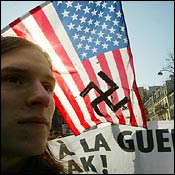
On the second floor of the plaza hotel, in a gaudy meeting room with lots of gold-painted wall filigree and faux-Baroque details, about 400 representatives of the Anti-Defamation League from around the country gathered one recent morning for the group’s 90th-anniversary conference.
As they settled in for a sober two-day program reflecting the grim situation Jews find themselves in (speakers included John Ashcroft, Thomas Friedman, and Israel’s ambassador to the U.N.), ADL national director Abraham Foxman rose to give the opening address.
Foxman, a professional noodge who has been sounding the alarm for more than three decades whenever he senses the slightest whiff of anti-Semitism—his new book is Never Again? The Threat of the New Anti-Semitism—began slowly, talking in an almost melancholy tone about his grandchildren and the uncertain future they face as Jews. But Foxman, who was sheltered during the Holocaust by his Christian nanny, quickly gained momentum and urgency, cataloguing stark examples of what he called “the world’s growing crescendo of irrationality.”
He invoked the shattered glass of Kristallnacht and mentioned Hitler several times, allusions that surely found their target with the mostly middle-aged-and-older crowd. As he has been doing for more than a year now, he described the threat to the safety and security of the Jewish people as being “as great, if not greater, than what we faced in the thirties.”
It was Foxman at his best: passionate, indignant, and connecting naturally with other Jews. His fears are their fears. His hopes for the future are their hopes. The speech clearly resonated with the audience.
But there was one small problem. The centerpiece of the speech, its theme, was misleading. There’s no question these are troubled times. But the notion that Jews in 2003 ought to use the Holocaust as a kind of lens to help them see their current predicament more clearly is, to say the least, problematic. The analogy no longer holds.
“Comparing what’s going on today to the thirties is both wrong and dangerous,” says Alan Dershowitz, who also has a new book, The Case for Israel, which is practically a point-by-point guide for responding to the Jewish state’s critics. “The old labels don’t apply, and the old diagnoses don’t address the problem. They substitute emotion for reason, and we can’t win this war with emotion. We need to look forward. We need to start thinking about the 2030s, not the 1930s.”
The war to which Dershowitz is referring is the global explosion of hate and hostility directed at Israel and at Jews themselves. For the past eighteen months or so, members of the Jewish community—intellectuals, activists, heads of various organizations, and laypeople—have been struggling desperately to find an effective strategy to address the new reality.
It’s been slow going. “The organized Jewish community has just not reacted strongly enough,” says Morton Klein, head of the Zionist Organization of America.
Part of the reason for this is that they are facing a new problem, an enemy they haven’t seen before. The stunning result of the burgeoning anti-Israel, anti-Zionist emotion is a kind of politically correct anti-Semitism. Foxman’s analogy to the thirties is right in this respect: It is once again acceptable in polite society, particularly among people with left-of-center political views, to freely express anti-Jewish feelings. What only two or three years ago would have been considered hateful, naked bigotry is now a legitimate political position.
The new p.c. anti-Semitism mixes traditional blame-the-Jews boilerplate with a fevered opposition to Israel. In this worldview, the “Zionist entity” has no legitimacy and as a result no right to do what other nations do, like protect itself and its citizens. It is true that immediately labeling someone anti-Semitic because he criticizes Israel is a long-standing, often bogus tactic that has been used by Jews to stymie debate. The new anti-Semitism, however, is in some sense the inverse problem, with criticism of Israel being a kind of Trojan horse in which age-old anti-Semitic feelings are concealed.
“Israel has become the Jew among nations,” says Mort Zuckerman, who in addition to his media holdings is the former chairman of the Council of Presidents of Major American Jewish Organizations. “It is both the surrogate—the respectable way of expressing anti-Semitism—and the collective Jew.”
The irony here is that Israel, which was supposed to be the solution to centuries of anti-Semitism, is providing a flash point and a kind of cover for p.c. anti-Semitism. Recently, The Forward, the savvy weekly newspaper that focuses on Jewish life here and abroad, published its annual list of the 50 most influential American Jews. In its introduction, in a dramatic public expression of the thing that’s on every Jew’s mind, the paper explained that this year’s list is dominated by people shaping the debate over the most critical question of the day: “Why has the world turned against us, and what is to be done about it?”
For most Jews, certainly those tied to the common-sense-based, moderate political middle, the momentum change is disorienting. How could this have happened when they believed so strongly in all the right things, like ending the occupation and dismantling the settlements? Fair-minded and compassionate, they regularly expressed concern for Palestinian suffering, and they cheered when Ehud Barak made an offer that appeared to finally clinch a peaceful two-state solution.
But when Yasser Arafat walked away from the peace talks and triggered the incomprehensible wave of suicide bombings, events took a very strange turn. First, the violence guaranteed the election of Ariel Sharon. I was in Jerusalem during election week in 2001, and the city was covered with bumper stickers and signs that read ONLY SHARON WILL KEEP US SAFE. The intifada also decimated Israel’s left. Jews everywhere wanted something done. Enough was enough. They wanted a show of force, and they got it.
American Jews felt adrift at first, then angry, as if they’d been betrayed. If their hearts were in the right place, why hadn’t the results been better?
But after a little more than three years, it’s clear the use of force hasn’t worked either. Palestinian violence hasn’t stopped. And the Sharon government’s hard line has generated runaway sympathy for the Palestinians and at least an equal amount of hostility toward the Israelis. Suddenly, Jews find themselves less and less able to claim the moral high ground as they are now cast as the villains in the conflict. No matter what Israel does—negotiate, fight, put up a fence—it only seems to make things worse.
“I feel sick to my stomach,” says writer and activist Leonard Fein. “I go to meetings where despondence is thick on the table. I also feel scared because Israel is rudderless.”
In the classic, angst-laden, self-absorbed, you-shouldn’t-know-from-it comedic tradition of everyone from Lenny Bruce to Larry David, it is a difficult time to be Jewish. Only now it isn’t funny. “Many people in the Jewish community, especially liberals, don’t know what to think,” says J. J. Goldberg, editor-in-chief of The Forward. “They feel powerless. They see their hopes and dreams, indeed their world, in flames, and they don’t have any idea what to do about it.”
One critical issue is how much of the resurgent anti-Semitism is the result of Israel’s treatment of the Palestinians.
Billionaire George Soros infuriated many in the Jewish community a couple of weeks ago when he was quoted by the Jewish Telegraphic Agency blaming the policies of George Bush and Ariel Sharon for the rise in anti-Semitism. But he is certainly not alone in this view, even among Jews.
“I have no doubt that the occupation and our policies in dealing with the Palestinians are an integral part of the return of anti-Semitism,” says Zeev Sternhell, a political-science professor at Hebrew University in Jerusalem who specializes in anti-Semitism.
Most Jewish leaders, however, instinctively respond that blaming Israel is blaming the victim. “It’s not about this or that Israeli policy,” says Malcolm Hoenlein, head of the Conference of Presidents of Major American Jewish Organizations, a mix of anger and exasperation in his voice. “It’s about Israel’s right to exist.”
Indeed, public opinion has swung so far to the Palestinian side that for the first time in decades, the very legitimacy of a Jewish state has been widely called into question. Columnists in mainstream European newspapers like the Guardian in England and Le Monde in France regularly challenge the validity of Israel and of Zionism.
Even here, serious (albeit leftist) publications like The New York Review of Books have published pieces attempting to revive the notion of a one-state solution. In this scenario, all of Israel, the West Bank, and Gaza would become a binational Jewish and Palestinian state, which would, by virtue of the population figures, become a Palestinian state with a Jewish minority in a very short time.
The language of the debate has become so polarized, so grotesquely distorted—words like genocide, apartheid, and fascism are used regularly—that legitimate criticism of Israel is near-impossible to hear.
This is unfortunate, because within Israel and in the diaspora there continues to be disagreement over policy. Sharon remains a divisive figure even at home, where Israelis have begun to tire of his hard line with the Palestinians. Recently, for example, Moshe Ya’alon, the Israeli Army’s chief of staff, said that the continuing military pressure on the Palestinians was fueling hatred of Israel. He called for gestures to ease Palestinian hardship and for Israeli leadership to do a better job of trying to work with Palestinian prime minister Ahmed Qureia than it did with his predecessor.
In a piece written for the Israeli newspaper Yediot Aharonot and reprinted in The Forward, Avraham Burg, former speaker of Israel’s Knesset and currently a Labor Party Knesset member, lamented, “We were supposed to be a light unto the nations. In this we have failed.”
Even more strikingly, Burg writes later in the piece: “Israel, having ceased to care about the children of the Palestinians, should not be surprised when they come washed in hatred and blow themselves up in the centers of Israeli escapism. They consign themselves to Allah in our places of recreation, because their own lives are torture. They spill their own blood in our restaurants in order to ruin our appetites, because they have children and parents at home who are hungry.” In the churning swirl of anti-Israel hostility, some of the most powerful World War II imagery has been excruciatingly (for anyone who suffered during the war) co-opted: Israelis have become Nazis committing genocide against the Palestinians. Ariel Sharon is the modern incarnation of Hitler, the Israeli army is the Wehrmacht, or, worse, the SS, and Ramallah and Jenin are Auschwitz and Buchenwald.
The Israelis are racists, imperialists, colonialists. And the suicide bombers, the murderers who pack bombs with nails and razor blades to cause the maximum civilian carnage, are freedom fighters, objects of sympathy and (in some quarters) even admiration, as long as the innocent people they’re killing are Jewish. (Even Avraham Burg’s emotional plea runs the risk of sounding like an apologia for the murderers.)
Israel, the democracy with a freely elected government; Arab representatives in the Knesset; a thriving, often hysterical free press; and a citizenry that is still, after all that’s happened, overwhelmingly in favor of a negotiated two-state solution (two thirds of Israelis are believed to support a two-state solution), is the object of hate, scorn, and revulsion among the left everywhere in the world.
Even in America. At a crisis center called San Francisco Women Against Rape, volunteers are asked to fill out a three-page application. Most of it is what you’d expect, a request for basic personal information and an introduction that says the center is seeking compassionate women who want to support survivors of sexual assault.
But on the last page, the application states that the center believes “it is important to be informed and take action on other social justice struggles.” One of these struggles is “supporting the Palestinian liberation and taking a stance against Zionism. Can you commit to this?” Since the implosion of peace talks about three years ago, France, England, Germany, Italy, Poland, Greece, and the rest of Europe have all seen a bone-chilling rise in expressions of anti-Semitism. European synagogues are bombed, Jewish schools are torched, and physical attacks on individuals readily identifiable as Jews have become shockingly routine.
In a recent European Union poll, 60 percent of the respondents chose Israel as the country that poses the greatest threat to world peace. In the Netherlands, of all places, where Jewish citizens were steadfastly protected during World War II, 74 percent of the Dutch fingered Israel.
Belgium wanted to try Ariel Sharon for war crimes committed at the Sabra and Shatila refugee camps in Lebanon. An Oxford professor would not allow an Israeli student in his class because the man had served in the Israeli Army. In Italy, La Stampa ran a front-page cartoon depicting an Israeli tank with its huge gun pointed right at the baby Jesus. The caption read, “Surely they don’t want to kill me again.”
“The Jewish communities of Europe are seen by the public,” says David Harris, head of the American Jewish Committee, “as extensions of and advocates for a regime in Israel that is rapidly losing its legitimacy in the eyes of the intelligentsia, the media, the left, and the anti-globalization crowd. So the question really becomes, how do you fight anti-Semitism in France or Belgium if the image of their Jewish citizens is inextricably linked to Israel? You either change the image or break the link. And there’s no easy answer for doing either.”
Two key factors in the virulent outbreak of anti-Zionism and anti-Semitism in Europe may be fatigue and fear. People are tired of the Middle East conflict. They’re burned out on the suffering, the killing, and the blood-soaked barrage of bad news. They are also worried about terrorism. Most Western European countries have growing, restive Muslim populations that are having trouble assimilating. Yet they are gaining political power. France has more than 6 million Muslims, and it is no accident that President Jacques Chirac began to crack down on anti-Semitism only after national elections last summer.
Feelings of fatigue and fear were candidly expressed by Daniel Bernard, the French ambassador to England, when he thought he was speaking off the record at a London dinner party in December 2001. He remarked that the world’s current troubles are all because of “that shitty little country Israel.” Undoubtedly expressing the view of many, he asked, “Why should we be in danger of World War III because of these people?”
The problem in Europe seems destined only to get worse over the next several years. “Europe has both an aging population and a low birthrate,” says Mort Zuckerman. “So they need immigration, and Muslims are the primary group coming in.”
In the Muslim world, where anti-Israel and anti-Jewish extremism are hardly news, the speech by outgoing Malaysian prime minister Mahathir Mohamad broke new ground. Not since Hitler has a head of state had the gall to take off the rhetorical gloves with such zeal. Addressing the 57 member nations of the Organization of the Islamic Conference—a group where the sole membership requirement is religion—he called on the world’s 1.3 billion Muslims to defeat the Jews.
“The Europeans killed 6 million Jews out of 12 million, but today the Jews rule the world by proxy. They get others to fight and die for them,” he said. The Jews, he continued, “invented socialism, communism, human rights, and democracy so that persecuting them would appear to be wrong, so that they can enjoy equal rights with others.”
“Israel,” says Zuckerman, “is not allowed to live like other members of the family of nations.”
It is one thing that the leaders of all 57 states gave Mahathir a standing ovation—including those from supposedly moderate states like Egypt and Jordan—but their reactions later, after they had had time to consider what he said, were stunning.
The Egyptian foreign minister said the speech was “a very, very wise assessment.” After making it clear he agreed with everything Mahathir said, Yemen’s foreign minister decided to pile on: “Israelis and Jews control most of the economy and the media in the world.”
This fifteenth-century-like hatred and prejudice is infuriating and frustrating for Jewish leadership. It is also endless. Egyptian television just finished airing a 41-part series based on the decades-old screed called Protocols of the Elders of Zion. “It was as anti-Semitic as anything you’ve ever seen,” says Zuckerman.
Making and airing a series like the Protocols is, of course, part of an orchestrated strategy by Arab dictators determined to stay in power. “Mubarak and the others try to distract their populations with hostility towards Israel and the Jews,” says Zuckerman. “You simply can’t believe the things they write in the Arab press. We confront them, but what can you do about that?”
Similarly, the outrageous, flamboyantly anti-Israel behavior of the United Nations has routinely dumbfounded Jewish leaders. In recent weeks, the U.N. has condemned Israel for building a fence to keep out suicide bombers and for destroying three empty buildings in Gaza.
“Israel is held to a different standard,” says Zuckerman. “It is not allowed to live like other members of the family of nations any more than individual Jews were allowed to live like everyone else in their individual countries.”
Aside from the occasional specious accusation from the likes of Pat Buchanan, the Jean-Marie Le Pen of America, that Jews are responsible for the war in Iraq, the battle here is being fought mostly on college campuses.
Natan Sharansky, the former Soviet dissident who is Israel’s minister for Jerusalem and diaspora affairs, completed a thirteen-college speaking tour here several weeks ago. He wrote an account of his extraordinary road trip for an Israeli newspaper in which he described being welcomed by robust anti-Israel demonstrations, bomb threats, and pro-Palestinian protesters with signs reading RACIST ISRAEL and WAR CRIMINALS. He was even hit in the face with a pie thrown by a Jewish student screaming, “End the occupation.” But the most discouraging moments were surely those he spent talking to some Jewish grad students at Harvard. They told Sharansky the atmosphere on campus is so overwhelmingly anti-Israel that they’re afraid to speak out in support of the Jewish state. They don’t want to be identified as pro-Israel because they fear being ostracized and having their grades affected.
Alan Dershowitz, who is a professor at Harvard Law School, argues that Sharansky overstated the problem. But listen carefully to how he characterizes it: “We are not losing so badly on the campuses today.”
But he believes it is critical that students know all the facts of the Israeli-Palestinian conflict—not just the version put out by the left. “Remember,” he says, “the goal of the campus divestiture movement is not divestiture but to miseducate an entire generation of students so that in fifteen or twenty years, the leaders of America will be like the leaders of France.” One thing is clear. The traditional means of battling anti-Semitism are as dated as the rules of conflict that once protected humanitarian organizations like the Red Cross and the United Nations from attack. “The old bag of tricks may work for your donors and for your own self-image as tough guys fighting back,” says David Harris. “But if the bottom line is, are you changing attitudes? Are you reversing images and stereotypes in Europe and the Muslim world? If that’s the measuring stick, then it’s very hard to say any of the organizations have been particularly effective.”
Part of the problem was the element of surprise. Everyone was caught totally off guard by the wave of hostility that spread across Europe. Foxman argues that the ADL never let down its guard either in America or in Europe, but there was a complacency that had settled over Jews. Perhaps it was what some call the golden age of the nineties, when the Israelis and Palestinians, guided by the Oslo accords, appeared headed toward an agreement.
Whatever it was, Foxman says he regularly got into arguments with people telling him it was time for the ADL to close its doors. “ ‘Stop counting swastikas in bathrooms,’ ” he says people told him. “ ‘The threat is assimilation, not anti-Semitism. We should be spending the money on Jewish education.’ ”
The miasma of anti-Semitism and anti-Zionism that has settled over much of the world had its genesis at the Camp David–Taba peace talks almost three and a half years ago. Never had the two sides been so close to making a deal on a two-state solution. The deal, which many on both sides never thought they would see, was there for the signing.
Israeli prime minister Ehud Barak offered Yasser Arafat and the Palestinians a state on 97 percent of the occupied territories with most of East Jerusalem as its capital. The offer included Palestinian sovereignty over the Temple Mount and $30 billion in compensation for the refugees. Short of removing the state of Israel from the Middle East entirely, the offer was everything the Palestinians had been asking for.
In an interview with reporter Elsa Walsh, Saudi Arabia’s Prince Bandar said he told Arafat that if he didn’t make the deal, it would be a “crime against the Palestinians.” Of course, Arafat not only didn’t make the deal, he walked out of the meeting, got on a plane, and left. No negotiating, no stalling, no attempts to massage the offer. Nothing. He never even made a counterproposal.
Initially, Arafat’s recalcitrance looked like not only a crime against the Palestinian people but a huge public-relations blunder as well. In the U.S., in Europe, and even behind closed doors in the Muslim world, people were quickly turning against him. Slowly, however, a revisionist movement began. A second story line, pushed by people like Clinton aide Robert Malley, emerged. This narrative, prominently promoted in a controversial front-page New York Times article, said the offer wasn’t all it appeared to be. And in any event, there were many reasons Arafat simply could not make the deal: It robbed him of his dignity as a Muslim man because peace was offered not won; it required signing an end-of-conflict clause, which meant the Palestinians would have to give up their dream of all the land.
In addition, the revisionists claimed, negotiations went too fast, Arafat was surprised by the offer, he needed more time, he needed more assurances of cover from the other Arab leaders, and on it went. As chief American negotiator Dennis Ross said, in the final analysis, Arafat couldn’t sign any agreement because “to end the conflict is to end himself.”
“Arafat may have believed the moment had come when he could break Israel,” says Leonard Fein. “And it’s not clear he was wrong. After he walked out at Camp David, he was offered a much better deal at Taba.”
Fein is shocked that after all that has happened since then, a third of Israelis say they approve of the Geneva Accords, the peace agreement worked out by Yossi Beilin and Yasser Abed Rabbo. Since neither man holds an official position, the deal, which appears to be even sweeter than the one offered by Ehud Barak at Taba, is theoretical.
“But if I were Arafat,” Fein says, “I’d be breaking out the champagne.”
Shockingly, after Arafat walked out of the negotiations three years ago, he was able to turn world opinion 180 degrees almost overnight by restarting the violence. He revved up the second intifada, and the savagery continues on both sides. But strategically it was a very clever move. He knew he could provoke the Israelis to overreact, and that’s exactly what happened.
Now there were horrific visuals of Israeli soldiers bulldozing houses, shooting at crowds, and generally manhandling and mistreating Palestinians, broadcast round the clock on television all over the Arab world. Prince Bandar said that even though he and Crown Prince Abdullah knew intellectually that the violence was Arafat’s fault, they couldn’t ignore the television images.
The American Jewish Committee’s David Harris was living in Europe at the time, and he remembers how the Palestinian narrative began to take hold. “A kind of quick collective amnesia set in among the Europeans, and at times I felt like I was having an out-of-body experience. The people I discussed the issue with largely dismissed, ignored, or relativized the Israeli side of the story.”
Harris believes that embracing the Palestinian story line enabled the Europeans to avoiding facing some difficult questions. Had it been a mistake to support Arafat all along? Why had they been funding Palestinian Authority institutions, including schools that continue to dehumanize Jews and continue to use textbooks and maps that picture a world with no Israel?
Many believe that taking the Palestinian side after Arafat blew up the peace process even provided the Europeans a kind of expiation of their collective Holocaust guilt. According to this view, Israeli violence enabled the Europeans to say, “Look, you are an occupying, colonialist state engaging in war crimes. You no longer have the moral high ground.”
Finally, bashing the Israelis enabled the various governments to try to curry favor with their alienated Muslim populations. “The whole thing just kept spiraling,” Harris says. “And very quickly the story line was this: Israeli violence was unjustified, and therefore they were actually responsible for the Palestinian violence unleashed on them.”
The overarching question is, what to do now? What is the best strategy to deal with the groundswell of hate? Can things be turned around? Paraphrasing Jonathan Swift, Zuckerman says, “You cannot reason people out of what they have not been reasoned into.”
In the Muslim world, the traditional model used by Jewish organizations to fight anti-Semitism is useless. It requires working from the inside by finding sympathetic, like-minded leaders willing to form an alliance for the greater good.
“There are a few ecumenically minded Islamic leaders,” says Harris. “But they’re in the minority, and with only a very few exceptions they tend to be afraid of becoming too public. So without a critical mass of Muslim partners, the best we can do is blow the whistle, shine the spotlight, and urge Western governments to raise the issue.”
In Europe, there are, as bleak as the landscape appears, a few bright spots. French president Jacques Chirac did finally come to the U.S. in September to meet with the leadership of America’s Jewish community; four of his country’s most prominent Jews—David de Rothschild, Ady Steg, Simone Veil, and Roger Cukierman—came with him. Leaders here seem to have mixed emotions about this. I talked to Abe Foxman about the meeting several times, and in our first discussion, he focused on the positive. “He came because he got the message and he cares about what was being said here,” Foxman offered, adding, however, that Chirac waited until long after the national elections in France were over.
“He also came because he believes we have power and influence. It’s the same at the U.N. Even when they’re censuring Israel, leaders of most of the countries are eager to meet with us because they believe in the mythology. They believe the road to Washington is paved through the Jewish community.”
Later, however, Foxman said he was embarrassed for the Jewish leaders the French president brought with him. “It’s not the Middle Ages, where you parade your Jews around and say, ‘See how good everything is?’ ”
Nevertheless, at one of these meetings Roger Cukierman, who is the head of crif, the largest Jewish organization in France, raised a critical issue that most American Jews, at least, are loath to talk about. Cukierman said that the beginning of the anger toward Jews and the explosion of hate in France—which has both the largest Jewish and Muslim populations in Europe—can be pinpointed to September 2000, when Palestinian-Israeli violence restarted in earnest.
Surely it feeds on preexisting anti-Semitism, but there was, J. J. Goldberg says, a new catalyst. “I would argue that it’s not the same anti-Semitism that’s been going on for 2,000 years.”
When Palestinian violence began and Israel sent troops into the West Bank, justifiably or not, it was like putting a match to a dry field, and the fires have been burning out of control ever since.
And the harsh reality is this: Palestinian society is in tatters, the infrastructure has been wrecked, the economy essentially destroyed, and death for the cause has been romanticized as the highest value. But Palestinians are winning the war of perception, with the war played out on television screens across Europe and the Middle East. They are scoring regular world-opinion-changing victories in the media, successfully romanticizing suicide bombers as heroes.
It is possible even Ariel Sharon has begun to get the message. During a Cabinet meeting on November 30, Gideon Meir, deputy director general of the Foreign Ministry, gave a presentation to Sharon depicting the way Israel is portrayed in the foreign media. “I showed him examples of both distorted coverage and legitimate pictures of bad Israeli behavior,” Meir says, pointing out that the prime minister was appalled by both. “I would not say that everything is anti-Semitism, but these images go a long way towards inflaming hatred of the Jews.”
But of course it’s not just about the media coverage. “Anti-Semitism is being spread through those who teach Islam, and it’s metastasizing,” says Orthodox feminist Blu Greenberg. “It took Christianity 2,000 years to clean up its act and now it’s being taught again through a religious system. I’m frightened for my grandchildren.”
Most American Jewish leaders believe they are up against huge forces around the world and that ultimately they cannot fight this fight alone. “We have to make people understand that anti-Semitism is not a uniquely Jewish problem,” says Harris. “It’s a cancer which left unchecked infects and ultimately kills democratic societies,” he says. “That’s the message we have to get out.”