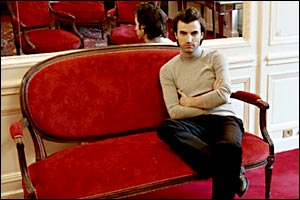
The worlds of art, design, and fashion are about to acquire a new meeting place—a juncture where the three come together and, on a good day, ignite. It’s down the block from the Dia Center for the Arts in Chelsea, at 542 West 22nd Street, and it opens, appropriately enough (as much as any commercial enterprise can be, it has been conceived as a love letter to its location), on Valentine’s Day. It is the Balenciaga store, an intriguing collaboration between the label’s designer, Nicolas Ghesquière, and the French artist Dominique Gonzalez-Foerster. The 5,000-square-foot space—a former garage—will house a grotto, the beginnings of a contemporary-art collection, chairs by Verner Panton and the Memphis Group designer Ettore Sottsass, and fitting rooms based on garden pergolas. There will be a massive skylight, sounds that change as you move around the floor, and a lighting scheme, created by the French designer Benoit Lalloz, that modulates to fill the store with anything from simulated sunshine to the feeling of a rainy day. And on top of all these delights, there will be, of course, Ghesquière’s clothing. The new Balenciaga boutique aims, in short, to be a store that is entirely of its time, like Mary Quant’s Carnaby Store and Biba, those two famous London boutiques, were in the sixties and seventies, respectively, or like L.A.’s Maxfield was in the eighties.
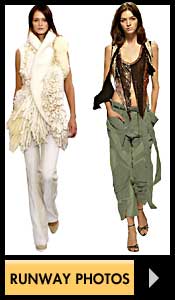
And how surprising that such a twenty-first-century venture should be from Balenciaga—the atelier that, of all ateliers, seemed crystallized in its glorious heyday, so much so that when the great couturier Cristobal Balenciaga (“the greatest dressmaker who ever lived,” according to Diana Vreeland) retired in 1968, the famed hostess Mona Bismarck, the story goes, locked herself away in her villa on Capri for three days of mourning. The house was, apparently, dead. Only now it is not only alive but perhaps at its peak. Ask any fashion editor in town. The one show they would not miss this season, and haven’t missed any season since 1997, is Balenciaga, and the reason is simple: Nicolas Ghesquière.
Ghesquière is young—31—and impossibly gifted. He grew up in Loudun, a small town in central France, the son of a Belgian golf-course-manager father and a French mother, loved fashion from an early age, and by 14 had gotten an internship at Agnès B. Four years later, he was working for Jean Paul Gaultier, which is also when he first came to New York and fell in love with the city—as well he might. He stayed with a friend in a loft on Lafayette. They went to Indochine and to Beige and, to celebrate New Year’s Eve, to a party at Francesco Clemente’s Greenwich Village studio.
“Ah,” Ghesquière says, his eyes twinkling with pleasure, “I remember it so well. Truffaut’s daughter was there. It just seemed the most amazing thing, to be at Clemente’s studio with Ewa Truffaut. New York was a big discovery for me then.” Back then, of course, Ghesquière was just another beautiful fashion boy who didn’t speak all that much English. Now he is the beautiful boy of fashion—and his English is fluent. Last year, Anna Wintour threw the most talked-about party of Fashion Week for him. In October 2000, he was named avant-garde designer of the year at the VHI/Vogue Fashion Awards, and a year later, he was named Womenswear Designer of the Year by the CFDA. He is, according to Suzy Menkes of The International Herald Tribune, “the most intriguing and original designer of his generation,” and his fans include Chloë Sevigny (“I worship Balenciaga”), Kate Moss (“I’ve got so much Balenciaga, but it’s never enough”), Nicole Kidman, Charlotte Gainsbourg, and Madonna.
And he effected this transformation simply by working his way up and by producing startling and—mostly—original work. After toiling as a design assistant at Gaultier for two years and doing a stint as a freelance knitwear designer, Ghesquière joined the house of Balenciaga in 1995. He paid his dues working on the Asian market, designing mostly women’s golf and mourning clothes. At that time, Balenciaga was owned by Groupe Jacques Bogart, and its head designer was the Belgian Josephus Thimister—until Thimister was fired after his audience walked out on a show that was accompanied by punishingly loud live music by the band Add N to (X). Ghesquière asked for and was given the top job. “I had no idea of a plan,” Ghesquière says when asked what it was like, at the age of 26, to be suddenly at center stage, designing Balenciaga’s ready-to-wear Le Dix collection. “I wanted to express myself and my designs, yes, but it wasn’t like I felt it was my turn. I just wanted a job, actually.” He flashes a modest smile.
All the same, for someone who had no plan, Ghesquière seems to have managed his career in a startlingly methodical manner. He has offered a bit of something for everyone: producing, over the years, pencil-thin pants, eighties-style blouson jackets, overalls cut into mini-dresses, pastel-colored combat pants, and skin-toned tops festooned with tassels, yarns, fake-fur tails, and torn ruffles. His friendly and unassuming demeanor is legendary: He is modest and thoughtful, without a single hard or defensive edge. When asked about the furor that ensued last year after one of his designs, a Gladiator-style patchwork vest, was exposed as being a close copy of a vest designed in 1973 by the little-known California designer Kaisik Wong, who died of aids in 1990, he says simply, “Yes, I made a mistake. Now my team and I laugh about it, but at the time I was hurt by some of the things people wrote. But yes, absolutely I made a mistake. It was my fault.” And about the not-much-liked dress Jennifer Connelly wore to pick up her Best Supporting Actress Oscar last year, he says: “She loved it, but I had no idea about the rules of Hollywood glamour.” He lets out an enormous laugh. “We were making something much more arts-and-crafts.”
But while he is as nice as he is reputed to be, perhaps even nicer, this does not mean that he isn’t ambitious, or that his vision is only about certain seasonal silhouettes. When the Gucci Group bought Balenciaga in 2001, it was not a case of Domenico De Sole and Tom Ford swooping in and gobbling up the label. They wanted Ghesquière, and because Ghesquière wanted to stay with and expand Balenciaga, they bought him the whole house. “It is a happy relationship,” Ghesquière says. “It has worked because they wanted me to explain what I wanted to do with Balenciaga, not the other way around.” It makes sense. Ghesquière’s collections are ineffably cool and cutting-edge, but they have also had a huge commercial impact—not so much in terms of what he sells (his is a rarefied, high-end designer product) but in terms of his influence on other designers. He’s someone the industry watches to see where fashion might go next, and there are very few of those now.
First, he asked to show in New York rather than Paris. “It is true that the collections in New York are not as experimental as they are in London and Paris, but in America, you can touch a lot of people with a message that is clean and direct,” he explains. “I was fascinated with the idea of coming to New York and trying to catch this collective attention. It is not that I want to be an American star, but it is just that as a French designer, that was something I wanted to try to tap into. And besides,” he continues, “the way we show at Balenciaga suits New York. It is fast and to the point. People are concerned with the clothes here rather than with the theatrical aspect of a show.” Still, Ghesquière is very much concerned with presentation. Last spring, he not only decided to show his first New York collection at an art gallery—an obvious target for designers looking to get out of the tents—but set his sights on one of the few commercial spaces that doesn’t need any favors from fashion to heighten its profile: the Gagosian gallery.
“I went there to see an art show a long time ago, and I thought what an amazing space it was, but when I asked, they said, ‘Oh, no, we don’t do fashion shows here,’ ” he says. “But someone made a connection, and when Larry Gagosian was in Paris, he rang me and said, ‘Voilà, come to the Ritz and have a drink.’ I was very nervous—suddenly having to explain myself and Balenciaga to this very … strong man, non?”
But of course, Gagosian—there are no flies on him—understood, and opened his doors. “Oh, I was so happy,” continues Ghesquière. “I asked if we could do it there again this year, but the gallery has a show on then, and the Dia Center is just perfect, so we are doing it there. And after the show, we will show people the shop. There won’t be a party or anything, just that people can cross the road in the afternoon and see the store.”
It’s clear the store is Ghesquière’s reigning passion. “I think that the concept of having the same store in different parts of the world is boring now,” he explains. “I think architecture should be specific to its city. So for New York, I had this fantasy—it is a cliché, of course—of a New York garage. And so we have tried to change as little as possible about the space. We have the same brick walls and red window frames, and there is no sign above the shop, just a label on the door, but at the same time, we have added things. There are sculptural pieces in the store and big rocks from Connecticut by the entrance, so it is both playful and yet earnest and conceptual. I hope we have achieved a harmony between what is sold and where we are selling.”
Ghesquière takes a breath. He is tiny and fine-boned, and he looks like a boy, but his enthusiasm is infectious. He makes you think that every shop should look like a garage. “The space is about the meeting between clothes and art,” he says, and he manages to sound neither silly nor pretentious. Plus, it’s true: The store has been conceived and designed not by an architect and a marketer but by a designer and an artist. Dominique Gonzalez-Foerster uses video and film, and she had made many an installation, but she describes her work as using “environments.” At last year’s Documenta, she created a park that combined various elements from places she has visited: rose bushes and boulders from Mexico, a telephone booth from Rio de Janeiro.
“I knew Nicolas’s clothes before I met him,” Gonzalez-Foerster says, “and so I was excited at his idea that we should work together. We met and clicked immediately. There has been this fashion lately for stores to reference a gallery and to create a white cube. It is a very elegant system, but we wanted to go beyond that. We both thought there must be something else.”
Certainly, Gonzalez-Foerster and Ghesquière’s Balenciaga store prove that there is a good deal else. Not least the clothes: The spring collection is full of tiny minidresses, scuba-inspired tops, and the jersey pants and cycle shorts that insiders have been trying to get their hands on since October.
When asked what he has up his sleeve for his latest collection, Ghesquière—on this day in Paris, three weeks before the New York shows—only smiles. Of course, he can’t talk about the collection before it is unveiled or, more to the point, finished. But he is too willing to please to remain unresponsive. “It is very much more experimental than last summer’s collection,” he says. “There is one outfit for each girl, so we will have 30 or 35 girls, and just one vision of each.” He pauses. “For the first time, I am using more of the Balenciaga tradition. In the past, I purposefully distanced myself from that. I was transgressive and like, Oh, I don’t care, and I was just trying to be very ready-to-wear. Of course I am not a couture person. I like ready-to-wear, but I am using more of this”—he gestures around the bustling Balenciaga atelier. “I wish I could say more,” he says, “but I can’t.”
So if part of him is embracing the tradition of Balenciaga, is another part of him reaching away? Having saved one label, does he want to create his own, with his own name? He widens his eyes and smiles. “Perhaps I have saved the house of Balenciaga,” he says quickly, “but it has also saved me. Yes, of course I would like to do something under my own name at some point, but right now, I am very happy. Balenciaga is a perfect screen for me, for both showing my work and protecting it.”
Nicolas Ghesquière’s New York
Favorite New Yorker: My boyfriend, James Kaliardos, is from Michigan, but he’s been a New Yorker for years. We’ve been together for three years.
In the city: I love going to Harlem and to Long Island City, but I have an Upper West Side fantasy. I love downtown New York, but I adore uptown. I love the New York of Woody Allen’s movies, and of Rosemary’s Baby; I love the Dakota, Central Park, and the Natural History museum and going to the zoo.
Staying overnight: The Carlyle, without question. Whenever I can, I stay at the Carlyle.
Eating out: Without a doubt, Mr. Chow. If I had an apartment here, I would want it to be like Mr. Chow, with a black piano in it—the whole thing. Also, it’s not a big scoop, I know, but I love to eat Japanese food in New York: Honmura An on Mercer Street, Omen, and Blue Ribbon Sushi. It’s very French to think like that—to come to New York and to make a tour of Japanese restaurants, but there we are. And they are worth it.
Tea and pastries: I love to sit outside the Magnolia Bakery and eat chocolate cake. It is so old-fashioned, and all the girls there are so cute. And Tea and Sympathy! Ah, j’adore Tea and Sympathy.
For a drink: Balthazar, or you know where else I like? Lucky Strike… . They have really got it right.
After hours: Where is that place that Chloë [Sevigny] took me to? Oh, I know, the Bulgarian discothèque [Mehanata 416 B.C.]. I love it there. I also go to Joe’s Pub to hear bands and music.
Going shopping: I stopped going to vintage stores after what happened with the vest! No, in fact I still go to Resurrection, because they have such a good eye and they know their history so well. I love the flea market. I love going to the Upper West Side vintage store Allan and Suzi. They have everything there from old Thierry Mugler pieces to entire drag-queen outfits. Barneys, of course, that’s where I get Margiela stuff. And I always go to Kirna Zabête.
Art fix: I love the galleries in Chelsea: I always stop at the Dia Center, Matthew Marks, Andrea Rosen, and the Gagosian Gallery. My favorite part of the Met is the Egyptian hall. After which you go to E.A.T. to have a little something to revive yourself, or, if you want a glass of champagne, to Cipriani. I love the Brooklyn Museum for fashion; there is a Charles James dress in taffeta there—oh, wow.
Best New York moment: The VH1/Vogue Fashion Awards in 2000: I went with Chloë. All the photographers on the red carpet were shouting, “Chloë, Chloë, Chloë!” They asked me to get out of the way so they could take photographs of her alone. Moby was there, and the Spice Girls and Galliano and Marisa Berenson, and I sat next to J.Lo, but Chloë and Matt Damhave (formerly of Imitation of Christ) only cared about seeing Beyoncé from Destiny’s Child. They were obsessed with her!