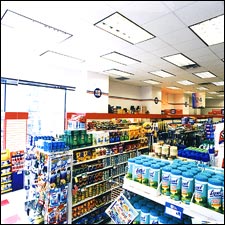
Inside the Duane Reade on the corner of Delancey and Ludlow on the Lower East Side, a thick white guy in dusty construction boots ruminates on a display of Ben-Gay and its generic counterparts. “Didn’t know how much they cost,” he mutters as he puts one down and picks up another. “You gotta be kidding me!” he says finally, and stalks out past the dozen other shoppers reading product labels with the quiet deliberation of people considering books from an unknown author. The store looks disheveled and lived-in, as if it had grown organically through years of trial and error, not through anything as prosaic as a retail “planogram.” In the front window display, food is haphazardly stacked next to diapers and window cleaner, and, in a fit of absurdity, only one item has its price tagged: Johnson & Johnson baby powder, $2.99.
Duane Reade ought not to be successful. The prices aren’t particularly low and the staff isn’t particularly helpful. And the often cramped and disorganized stores offend the boutique sensibilities of New Yorkers. “I just happened to be in a Duane Reade, and the entire time I contemplated how poorly planned the shops are,” says Karim Rashid, the industrial designer whose clients range from Acme supermarkets to Armani. “How bromide and miserable and vacuous the place is, how completely unaesthetic. What a poor experience.”
Yet over the past decade, Duane Reade has completed a voracious expansion campaign and achieved a ubiquity once limited to cabs and pigeons. How did a chain that’s neither the cheapest (a gallon of milk goes for $3.39 at Duane Reade and $3.19 at CVS) nor the nicest become New York shorthand for drugstore?
The company understands two important things: New Yorkers are uniquely harried shoppers, and the whole ball game comes down to real estate. Duane Reade has used its skill at that quintessential New York blood sport to cut rents by shoehorning its stores into bizarre locations other chains wouldn’t touch. And it’s kept New Yorkers coming back by knowing us better than we’d like to think: For all our bluster about good design, organic foods, and attentive service, we’ll take our Band-Aids and trash bags where we can get them.
Founded in 1960 by the brothers Abraham, Eli, and Jack Cohen, Duane Reade started as a three-store health-and-beauty chain that took the name of the two streets that bounded its lower-Broadway warehouse. The company grew in fits and starts over the next three decades. But it didn’t really begin to take off until 1996, when then-owner Bain Capital brought in the president of Pathmark, Anthony Cuti, as CEO.
A Rome-born, Manhattan–raised 59-year-old with a swoosh of gray hair and the air of someone used to getting his way, Cuti gave the chain an ambitious new energy. In 1998, the company raised $102 million by going public and used the cash to buy stores from Rock Bottom, Love’s, and Value Drug and open plenty of its own. Since Cuti took over, Duane Reade has grown from 59 to 249 stores, the most of any drugstore chain in the city.
The massive expansion hasn’t always been friendly. An estranged union of Duane Reade employees runs DwayneGreed.com, and a string of steamrolled residents has called the company a bad neighbor. In one dispute, Cuti refused to compromise on a huge store-top billboard that irritated neighbors in Rockaway, and even sued an artist who took out a negative ad in the local paper. “It seems like he had a bit too much testosterone for his own good,” says Congressman (and mayoral candidate) Anthony Weiner of the hard-charging CEO, who eventually had to modify the sign and lost the suit. “It ended up the way it would have if he hadn’t been a dick.”
Cuti’s aggressive style has served him better in the real-estate game. The central conundrum of New York retail is that you pay gobs of money for space but you can mark up a bottle of soda only so much. To compete against 5,000-store giants in an unsentimental real-estate market where the highest bidder, not the local kid, gets the lease, Cuti has to be smart enough to pick the right locations but flexible enough to use whatever spaces he can get.
Satisfying the first part of that formula is easy in theory. According to Cory Zelnik of Winick Realty Group, Duane Reade’s real-estate broker, it means staying on the avenues and major crosstown streets (like 14th and 23rd) and opening stores near mass-transit stops. Generally, a store needs 25,000 people who will use it as their primary source of pharmacy and beauty products, Cuti says. Entities like Equifax and the city comptroller’s office provide population-density maps, which help to some degree, but because so much of New York is vertical—meaning that placing a store on the right or wrong side of an apartment tower can make or break it—and so much is office space, picking spots means spending a lot of time counting pedestrians. When the company considers a location, the marketing department sets up electronic beams or hand counters to tally the number of people who pass by at various times and in different weather conditions.
Of course, that a store on a busy corner next to a subway exit is likely to get good foot traffic isn’t exactly a secret. That’s why these locations tend to fetch premium lease prices. Finding affordable spaces in these prime areas requires Cuti to be a bit more creative. While most pharmacy chains run in fear from multi-floor, non-box layouts, he embraces them. Forty-nine of his stores have two floors, and they come as small as a studio apartment (under 500 square feet) and as large as a suburban supermarket (a 17,200-square-foot box in Flatlands, Brooklyn). Odder spaces include a store at 62nd Street and Broadway with a basement described as “kind of a triangle with a leg on it,” and an old theater on East 86th Street with 1,300 square feet on the ground floor and 12,000 upstairs.
The payoff for flexibility is significantly lower rent. Take 4 Times Square, where in mid-2000 Duane Reade signed a lease for 3,000 square feet on the street and 9,000 below. With a subterranean location, less-than-hot neighborhood (the jury was still out on Times Square), and a lease shorter than the usual fifteen years, it was the kind of ugly duckling only Cuti could love. At the time, Times Square real estate was going for about $250 a square foot on street level, but a mere third of that—about $85 a square foot—in the basement, says Tom Bow, senior vice-president for the Durst Organization, which leased the space. “Most tenants wouldn’t be able to take that space, but they could,” says Bow. “They understood that Times Square was a 24/7 location. They just knew the local market.”
Defying retailing guru Paco Underhill’s fatwa on “butt-brush,” Duane Reade found thatNew Yorkersdon’t mind being bumped from behind.
One of Duane Reade’s newest finds is a dilapidated two-story building a few blocks west of Rockefeller Center. Walking through the gutted husk, Udo Steudtner, Duane Reade’s director of construction, is pleased. “This is probably one of the premier corners in New York,” he beams. It doesn’t look like much. On the first floor are the cracked red tiles of a former fast-food restaurant, and in the basement—a dank box that lets out into a subway station—bathroom graffiti memorializes a commuter dive bar that gave up the ghost. It’s the classic Duane Reade gambit: Take an odd, unlovable, but well-located hole that would repel other chains and adapt it into successful—and cheap—retail space. If the marketing team has calculated correctly that the store is on the commuting route of some 25,000 office workers, it won’t matter that the surroundings are less than pristine. New Yorkers will shop there anyway.
If you’ve ever run into a Duane Reade to pick up some basic supplies—say, soda and toilet paper—only to find yourself wandering aimlessly in the apparently random aisles, it will come as some surprise to learn that someone actually designs the stores. As senior vice-president of sales and marketing, Gary Charboneau has been choosing locations and designing Duane Reades since 1993.
In a store near his office, as a rainy weekday lunch crowd swirls around us and Hall and Oates’s “Out of Touch” segues into Phil Collins’s “Sussudio” on the Muzak, Charboneau explains how he has split the basic Duane Reade layout into four blocks that can be moved around like the colors on a Rubik’s Cube. The first block is the chain’s bread and butter: beauty and cosmetics, which is most often on the first level near the door. “We try to keep those categories next to each other so that the shopper, usually a female shopper, is in close proximity to that stuff,” he says. Next is the pharmacy, which is always in the least accessible part of the store, because people don’t browse for prescriptions. The last two sections, seasonal (cards and candy) and household and grocery, can be split and moved to fit the space. Most stores carry between 18,000 and 20,000 different items.
With 300,000 people making a purchase at Duane Reade every weekday, a study of exactly what the stores sell gives a pointillist portrait of the New York consumer. Unlike most drugstores, where prescriptions make up the majority of sales, half of Duane Reade’s sales come from food, cosmetics, and the like. That runs from insoles and corn pads—because New Yorkers walk so much, Duane Reade sells twice the industry average—to foods for the society-X-ray palate. “We have four-foot-long sections of rice cakes. Put those in a suburban store and they all go stale,” says Charboneau. “And we have these soy crisps, which are not the best-tasting things. But they fly off the shelf.”
Selling makeup—a huge business for drugstores—proves a challenge to convention: New Yorkers come in darker shades than most Americans. “Cover Girl cosmetics, the No. 1 line in the U.S., is nowhere near No. 1 in Duane Reade. Why?” asks Charboneau. “They think their customer is blonde-haired and blue-eyed. And there ain’t that many true blonde-haired, blue-eyed people in New York.” So in 2002, Charboneau and Duane Reade’s recently retired head of cosmetics, Karen Durham, created a Duane Reade offering, apt. 5 (“The Color for the City”). Even its name evokes city life: Apartment for obvious reasons and 5 because it has what Charboneau calls a “prestigious” association, Fifth Avenue. Not to mention the reference to Chanel No. 5. The line is now the chain’s top beauty seller—industry analysts say annual sales approach $2 million.
When New Yorkers make their way to the pharmacy counter, their selections are heavy on sex and therapy and ambivalent about kids. The top-selling sedative, ranked nineteenth nationally, is one of the top five drugs sold at Duane Reade. Also popular here is Viagra, and a couple of anti-AIDS drugs are in the top twenty. But what New Yorkers really specialize in is birth control: Three contraceptives rank in the top 25 of Duane Reade sellers, while no contraceptive breaks the top 50 nationally. “There is no birth-control pill that’s No. 1 in any market except here,” Cuti explains. “It’s the nature of the city. It’s where the action is.”
Duane Reade also takes advantage of its intimate knowledge of New Yorkers to cram the stores with as much product as possible. Charboneau’s designs typically use four-foot-wide aisles instead of the five-foot highways in the ’burbs. “New York is one of the only places you’ll ever shop where people are tolerant of being bumped from behind,” he says, defying retailing guru Paco Underhill’s fatwa on “butt-brush.” The other thing we don’t seem worried about, according to Charboneau, is cleanliness: “New Yorkers are less sensitive to it.”
The one thing we are sensitive to is long lines, so Duane Reade doesn’t starve its stores of employees. To keep rushed shoppers moving, most stores have six cashiers at the front, compared with three at suburban stores, and between 10 and 30 employees working at one time. (The company offsets its heavy staffing with paltry pay: Duane Reade’s largely foreign-born employees start at minimum wage, and the company fights for every penny.) “When I’m catching somebody out of Penn Station moving 100 miles per hour, they want service and they want it quick,” says Cuti. “It’s, ‘I’m carrying my bag, I’m ten minutes late, the dumb train was late, I got to get the Tylenol and my bottle of water as quickly as I can.’ ”
Neil Stern, a drugstore analyst at retail-consulting firm McMillan Doolittle, describes the Duane Reade model as blunt sales: “It’s how much more can you sell out of the space, not how clean you were or whether all your products were marked.” This attitude helped the stores move $816 per square foot in 2004, according to McMillan Doolittle, compared with the industry average of $575. Still, in 2004, the company’s profit margin hovered around 1 percent, about a third of what national chains take home. “It falls into the ‘only in New York’ category,” says Stern. “You shake your head and marvel, but you don’t exactly rush to copy it.”
When you operate with such a small margin, events that don’t break in your favor can wreak havoc on the bottom line. The 9/11 attacks destroyed Duane Reade’s most profitable store, a local recession compounded its problems, and a battle with its largest union forced it to set aside about $17 million for a possible payout. And while its sales grew from $1.17 billion in 2001 to $1.47 billion in 2003, its profits plummeted 80 percent. So the company has hit the brakes, opening only 17 stores in 2003 and 16 in 2004, down from more than 30 each year in 2001 and 2002.
Besieged by an army of larger and richer suburban rivals—there are now 100 CVS stores in the five boroughs and two Home Depots in Manhattan (not to mention the specter of Wal-Mart’s looking for a way into the New York market)—Cuti decided to take the company private. In July 2004, he coordinated a sale to Oak Hill Capital Partners, an investment firm run by Texas oil billionaire Robert Bass, for $748 million. Though the deal was opposed by some shareholders, Cuti believes it will allow him to concentrate on a long-term reimagining of Duane Reade. Unable to continue his expansion model because of a runaway real-estate market, Cuti plans to search for more sales inside each store. He hopes to transform Duane Reade from a convenience store where New Yorkers pick up essentials to a “full-service” store where New Yorkers shop for everything. And that means making Duane Reade a little more … chichi.
The store at 34th Street and Eighth Avenue gives an idea of the Duane Reade of the future. There’s a high-end European SkinFitness Centre staffed by “skin-care advisors” near the front door, and the company’s first Chock full o’ Nuts kiosk is selling ten-ounce coffees for 99 cents in a bid to undercut Starbucks’ $1.49 cups. The chain has also just opened thirty Moviebank machines, ATM-like gadgets that rent DVDs for $2.49 a day (about $2 less than Blockbuster). Next, Cuti is looking into prescription-eyeglass kiosks and teeth-whitening booths.
Whether New Yorkers will actually go to Duane Reade for their skin-care and teeth-whitening needs remains to be seen. But what the company does in its stores may be beside the point. In the end, it really does come down to real estate, and the blazing commercial market may be a boon to the savvy Cuti after all. With banks bidding up prime spaces by 50 percent or more, Duane Reade’s cheap leases have become the jewel of the company. Some 200 of them are locked in past 2008, taking the rents progressively below-market with each passing day. Jeffrey Roseman, a Newmark commercial-real-estate agent who’s leased spaces to Duane Reade, says that the company doesn’t really have to sell another toothbrush. “If the drugstore business were to collapse today,” he says, “they’d probably have one of the more successful real-estate businesses subleasing their stores.”