
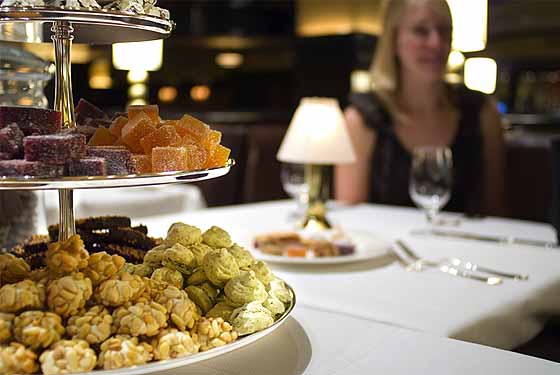
As dinner unfolds at Del Posto, the new addition to the Mario Batali–Bastianich-family fine-dining empire, it’s hard to know whether you’ve entered restaurant nirvana or some strange, slightly comical pastiche of what an opulent five-star restaurant should be. First there is the bread, which comes with butter plus an offering of Batali’s trademark “house-cured lardo,” known in less lofty circles as pork fat. As you spread this lardo, Nutella style, on your house-baked focaccia, you can admire the plush, darkly glowing room, with its towering columns and tall curtained windows like those you’d find in the lobby of a grand Roosevelt-era New York hotel. You can peruse the menu, stuffed with $60 dishes of lobster risotto for two, and old Batali favorites like bollito misto, a medley of rustic Italian offal products that are carved, with elaborate ceremony, tableside. Like at Alain Ducasse’s famously effete restaurant uptown, footstools are provided for ladies’ handbags. And instead of the rock tunes that are piped into Batali’s flagship restaurant, Babbo, you can enjoy live piano lounge music at Del Posto while sipping your $24 cup of “cave-aged” Chinese tea.
For grizzled Batali veterans (like me), this is all a little strange and unsettling, like watching a troop of lumberjacks tiptoe their way through a ballet. The great chef made his reputation peddling the opposite kind of dining experience, after all. At raucous, unpretentious restaurants like Babbo and Lupa, Batali and the Bastianich family created an intense, almost tribal enthusiasm for their particular brand of rustic Italian cooking. But at Del Posto they seem to have something else in mind. This is their Vegas enterprise, a splashy combination of canny marketing and aggressive haute-cuisine extravagance. It’s located, naturally enough, on the westerly edge of the meatpacking district, the New York dining world’s version of the Vegas Strip. With its valet parking and baronial balcony seating, the restaurant seems to have been designed, like a giant gill net, to catch the great schools of revelers and high rollers who troll the city at night. Food plays a part in this calculation, but in the end, Del Posto isn’t really about food. It’s about spectacle and entertainment.
With Mark Ladner (formerly of Lupa) in the kitchen, and Batali focusing all his attention on the restaurant’s opening, the cooking is generally superb. But if you’ve managed to fight your way into Babbo over the last few years, none of it is exactly revelatory. Among the antipasti dishes, robust old favorites like lamb’s-tongue vinaigrette and tripe alla parmigiana have been replaced by smaller, more refined offerings like funghi misti, indistinct little pots of cuttlefish and octopus cooked with tomatoes and chickpeas, and slices of the garlicky Italian sausage cotechino, served over lentils. My friend the sweetbread maniac greatly enjoyed his $16 sweetbreads piccata but complained that there was only one sweetbread on his plate. I liked my grilled radicchio (with a cream sauce made with Fontina cheese), and the lightly crisp vegetable fritto misto was very nice, too, but if you’re not on an expense account (and maybe if you are), my advice is to ignore the antipasti and move on to the predictably excellent pasta.
Among other things, Del Posto represents Batali’s conspicuous, somewhat strained attempt to put Italian cooking on the same level as high French cuisine. As a result, even the simplest peasant noodle dish is served with multiple rows of silver, on fine bone china, in the most exacting, Michelin-approved style. The first one I sampled (this being Batali, there are fifteen, plus four risottos) was a chewy tangle of pici (a Tuscan country pasta, mixed here with coxcombs and black truffles), which was very good but not good enough to merit its $30 price tag. The risottos (try the pumpkin with lardo) are similarly pricey but also good, especially if you enjoy having your risotto reverently served from a silver chafing dish. For $23 you can order little pork-stuffed agnolotti designed to be eaten with your fingers, and $27 buys an ingenious spaghetti dish tossed with fresh crab, scallions, and the slightest kick of jalapeño. Best of all, though, are little cigar-shaped chestnut ravioli ($25), which are stacked over a bed of sweet onions and pieces of roasted pigeon flavored inventively with myrtle.
If you think roasted pigeon and myrtle sound lofty by Batali’s standards, you’re right. At the same time, however, a vague disconnect develops, as the entrées roll around, between the restaurant’s exaggerated surroundings and the type of Everyman gourmet cooking chef Batali is famous for. I enjoy my bollito misto as much as the next fat guy, but do we really need to see the parade of great stuffed pig’s feet and bulbous sausages being hoisted from their steam cart, then sliced at the table? The offal of choice at Del Posto is calf’s liver, stirred in a white-wine reduction, with a delicate combination of polenta and frizzled leeks, but the roast rabbit I sampled was bland, and the mostly unadorned serving of lamb’s kidneys looked sad and overwhelmed on its exquisite china plate. The seafood dishes are better, particularly the orata, steamed in parchment and flavored with grapefruit zest and lemon, and so are old standbys like lamb (served three ways—a chop, a shoulder, and a mini breaded meatball) and duck (stuffed with duck sausage). Nothing I tried, however, tasted quite as good as the squab breast, which was deboned, broiled to a light crunchiness on the outside, and tinged with vinegar.
This food is accompanied by all sorts of pageantry and largesse, which, I’ll admit, is easy to get used to. At the bar you can get Bellinis flavored with persimmon, and wines from 40 regions of Italy. There are intricate tasting menus available, and nine types of beef, fish, and fowl, carved for two or four at a serving station as big as the bridge of a battleship. For dessert, I recommend a superior, Italian version of baked Alaska called an apricot cassata di gelati, consisting of apricot sorbet and almond cake, encased in a decadent meringue top. There’s a nice rich slice of gianduja flecked with gold leaf, and a tasting of chocolates you can wash down with a selection of esoteric rums. There’s also a classic zabaglione, whisked up on the night I ordered it by Lidia Bastianich herself. The first lady of Italian cuisine beats the eggs, sugar, and Marsala over a low flame, then pours the mixture into little pink Venetian glasses. The result is creamy and faintly boozy, and, of course, delicious. But somehow, in that grand, cavernous space with its tall columns and endlessly tinkling piano music, a little of the essential flavor is lost.
Del Posto
Address: 85 Tenth Ave., nr. 16th St.; 212-497-8090
Hours: Tuesday through Thursday, 5:30 to 10:30 p.m.; Friday and Saturday, 5:30 to 11.
Prices: Antipasti: $13 to $17. Pastas: $12 to $30. Entrées: $27 to $35.
Ideal Meal: Grilled radicchio, chestnut ravioli with pigeon, squab or calf’s liver, apricot cassata.
Note: If you have the cash, try the veal rack for two ($95) and the pork loin for four ($140).
Scratchpad
We subtract one star for the stagy atmosphere and another for the lack of what, for a better word, we’ll call “Bataliness.” The food’s very good, but it’s not Babbo in its prime.