Do Tariffs Mean the End of Free Shipping?

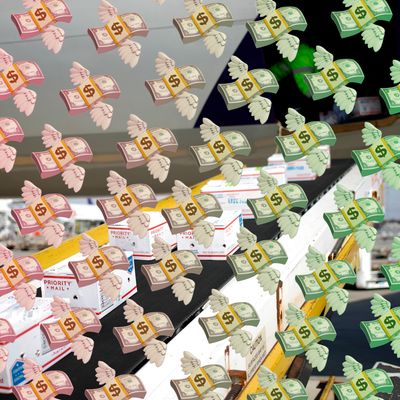
Chaos has reigned since the Trump administration’s tariffs went into effect (and then were paused for all countries except China) last week with both luxury items and smaller everyday products already becoming more expensive. There has been particular confusion across the board about how tariffs will affect shipping prices and customs duties; online retailers like Cou Cou and FarFetch have already added reassuring banners to their websites declaring that “duties and taxes” are covered on all purchases. I spoke with several shipping-and-logistics experts to figure out what we can expect in coming months.
Do customers now have to pay duties and taxes on items made overseas?
In short, no. “Duties and taxes” are actually unaffected by tariffs, which aren’t paid directly by consumers, although they do lead to general price increases. But around the same time that the tariffs were first announced, the Trump administration also closed the de minimis loophole between the United States and China. That will end duty-free imports of goods valued at or under $800 starting on May 2. This theoretically means that you could end up paying duties on items from online retailers like Temu and Shein that are shipped directly from China, but we don’t yet know how this will actually work.
“Chinese exporters are going to get hit with these fees,” says Cathy Morrow Roberson, founder and director of the supply-chain research firm Logistics Trends & Insights. “And the decision is, do they pass them on to their customers here in the U.S., or do they just eat them?”
What we do know is that Temu and Shein (as well as smaller Chinese exporters who operate via Amazon storefronts and Strategist-favorite affordable-luxury brand Quince) have been expecting the end of de minimisfor some time (it’s actually a Biden-era initiative), and they’ve started building out U.S.-based supply chains to cushion the blow.
Will shipping still get more expensive?
As retailers struggle to find ways to absorb tariffs while remaining profitable, it does seem likely that shipping costs will go up. “Tariffs are tightening margins across the board, and retailers will be forced to make tough choices,” says supply-chain consultancy firm enVista’s director of transportation, Britain Pavlic. That means they’ll either “either absorb the added cost or pass it on to consumers.”
If this doesn’t take the form of shipping fees, expect price increases or extra “tariff surcharges,” adds Morrow Roberson.
Does that mean they’ll get rid of free shipping?
Tariffs could lead to the rolling back of free shipping, especially for items with tighter margins. That’s especially because shipping has already become much more expensive in recent years with the USPS, UPS, and FedEx all “jacking up their rates and surcharges,” says Morrow Roberson.
Smaller clothing stores will be most affected, says Pavlic: “Electronics retailers may find ways to adapt without charging more, but others, particularly in apparel, might not have that flexibility.” It’s possible that more retailers will start offering Amazon Prime–style free shipping subscriptions to entice customers and spread out costs, Morrow Roberson adds.
It seems likely that minimum spends to qualify for free shipping will go up in some cases, but it won’t happen immediately. Catherine Newell-Hanson of kids’-clothing brand Milk Teeth says that her store will continue to offer U.S. customers free shipping on orders of more than $150 for now, but that “like every business, we’re monitoring the ever-changing situation, and trying not to make any reactive decisions yet.”
Are we about to experience COVID-style shipping delays and supply-chain issues?
There are reports of retailers pausing new imports into the United States as they wait and see how tariff negotiations shake out. So as supplies of products stored in U.S. warehouses gradually dwindle, shipping delays and supply issues are very possible, although hopefully not on the scale we experienced during the pandemic.
The main issue, Morrow Roberson says, is that if many retailers pause and then restart imports at once, in a few months “there’s going to be some congestion at the ports, to put it mildly.” But don’t panic and rush out to buy toilet paper just yet — we actually manufacture quite a lot of it here in the U.S.
More On Tariffs
- How Tariffs Will Affect Holiday Shopping This Year
- What Does the End of De Minimis Mean for Online Shopping?
- Our Top-Pick Anker Charger Is Already Up $10
- Silk Is About to Get Harder to Find. Here’s What to Get Now.
The Strategist is designed to surface useful, expert recommendations for things to buy across the vast e-commerce landscape. Every product is independently selected by our team of editors, whom you can read about here. We update links when possible, but note that deals can expire and all prices are subject to change.