The Best Leaf Blowers, According to Landscaping Professionals
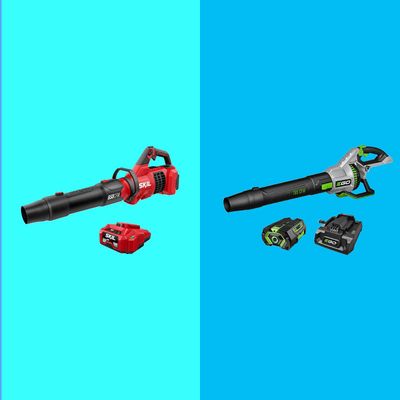
It’s fall again, and whether you’re clearing a few leaves from a walkway or tackling a whole yard full of deciduous trees, the best battery-powered blowers can make fall cleanup easier without the noise, fumes, or maintenance of a gas model. If you roll your eyes at the thought of using a battery to clear mounds of foliage, think again: Today’s cordless models are powerful enough to do the job of gas models, simpler to maintain, and they’re a lot quieter, which makes them much more pleasant to use (and a lot more palatable for your neighbors). They cost more up front, but you’ll never need to buy fuel or filters, and you can share batteries with your other tools.
In this article
Even professional landscapers have started making the switch to battery-powered equipment, often because of noise bans or restrictions in cities like Washington, D.C.; Ann Arbor, Michigan; and Winter Park, Florida. “I made the transition during COVID,” says Mike Bellows of E-Scapes Electric Lawn Care in Acworth, Georgia, who has three crews each doing ten yards a day with handheld battery-powered blowers. Jacob Romkee — of Vintage Lawn Service in San Jose, California, and a member of Thumbtack’s Pro Advisory Board — says his crew uses heavy-duty battery backpack blowers. “For our business, we mostly use a backpack blower that is 36 volts, and it works phenomenally for providing service for ten or more residential homes in a day,” he says.
Is it time for you to make the switch to battery power? We asked landscapers, experts, and homeowners who’ve logged long hours with these tools which battery-powered leaf blower they recommend for your yard.
New! You can now save this product for later.
Powerful, dependable, and part of our favorite overall outdoor tool system.
New! You can now save this product for later.
A versatile blower that gets you into the broadest range of tools out there.
New! You can now save this product for later.
A less-expensive blower that can handle most tasks in a suburban yard.
What to look for in a battery-powered leaf blower
Battery voltage
Our experts recommended models using batteries ranging from 18 to 80 volts. The higher the voltage, generally, the more power a unit has. For light-duty clearing on patios and walkways, an 18-volt or 20-volt model may be enough, and can often share batteries with tools such as drills and circular saws, depending on the brand. But for bigger yards or jobs (if you have two or more mature, leaf-dropping trees or your neighbor does) and want to replace a gas blower, look for a model with at least a 36-volt battery.
Eric Goranson of DIY podcast and YouTube channel Around the House tries to use blowers that work with the 18- and 20-volt batteries he already has. The exception? If you’re starting to build up a wall of new outdoor gear in your garage or shed. “If you’re buying outdoor power equipment on its own and not tying into an existing tool battery, I’d go higher voltage mixed with high amp-hour batteries,” he says.
Supplied battery capacity and runtime
While voltage indicates a battery’s power, amp hours (Ah) indicates its capacity — how much fuel it has in the tank, and thus its runtime. If you’re buying a blower in a kit with a battery (you’ll see tools packaged with batteries from two to 12 Ah), you’ll want to look for the biggest capacity battery for the money, keeping in mind that bigger batteries are heavier — important in a handheld tool. A bigger battery will also take more time to recharge, especially with the charger supplied with your tool (typically you can buy a fast charger from the manufacturer; you can also keep an eye out for kits that include a faster unit).
Power: CFM and MPH
You’ll see two specs listed for leaf blowers: cubic feet per minute and miles per hour.
CFM is a measure of the amount of air a blower can move — and this impacts the amount of leaf litter or other debris the blower can move in a pass. Have a big yard full of mature trees and a yardful of dry leaves that you don’t want to spend all day on? You’ll want a blower that moves a lot of air, so a high-CFM model is what you’ll want.
MPH (as you might expect) is the speed the air is moving. This translates roughly into hour much force the blower can apply. Need to get a coating of wet leaves off of your driveway? You’ll need a blower that can move air quickly, so look at that MPH specification.
Battery platform
Before buying a leaf blower (or any other battery-powered tool), consider what else the battery can power. If you already own some tools, look at the blowers your favorite brand has available. If you’re picking up your first tool, check to see what other tools that manufacturer offers, because leaf cleanup likely isn’t the only chore on your list. Some brands (like Ego, Stihl, and Husqvarna) focus on outdoor tools, while others like Ryobi let you share its 18-volt batteries among a range of shop and outdoor tools.
Handheld or backpack?
A backpack blower isn’t automatically more powerful than a handheld, but it can run longer if it holds more batteries. Handhelds are lighter and easier to maneuver, making them a better choice for most homeowners (and easier to use for jobs like clearing gutters or blowing out a dryer lint trap indoors). Backpacks shift the weight to your shoulders and hips (they can weigh upward of 20 pounds loaded with batteries) and can be more comfortable during longer cleanup sessions when you expect to be running the blower for 45 minutes or more — great if you have a large property to take care of.
Cruise control
You’ll want a blower that has a cruise-control feature that locks in your desired speed without requiring you to hold down the trigger. This can reduce hand fatigue and is useful when you need both hands for another task — for example, setting the blower down to dry small hand tools or cleaning out a utility vacuum filter in front of the airflow. Luckily most of the available blowers have this feature; you’ll want to steer clear of models that don’t.
Boost, turbo, or max modes
Every leaf blower has a variable-speed trigger, but not all have a boost mode. Usually controlled by a button within easy reach of your thumb, boost maximizes the blower’s air volume and speed. Manufacturers typically base their claimed CFM and MPH specs on measurements taken with the blower set to boost mode. Boost drains the battery faster, but it can be necessary for lifting wet, matted leaves when simply moving closer to the target while at regular high speed isn’t enough.
Balance, handling, and versatility
As you climb the battery-voltage and capacity scale, the battery pack gets larger and heavier, and its position on the back of the blower can throw off the tool’s balance. Ideally, a blower should sit level in your hand at rest or have the tube pitched slightly downward toward the ground. If the blower is out of balance or the battery pulls the tube upward, you’ll have to constantly rotate your wrist to keep the nozzle pointed down, which can cause strain.
Leaf blowers aren’t just for lawn care. Car detailers have started using them to dry vehicles to a spot-free finish, and they’re just as useful if you’re washing your car in your driveway. Many manufacturers offer short “stubby” nozzle extensions that concentrate the airflow in a compact area, making it useful for navigating around a car or getting into tight spaces such as garage and shed corners. Many models include one even if the manufacturer doesn’t specifically call attention to it, and features like auxiliary handles can make blowers even easier to use in tight spots or at odd angles.
Best leaf blower overall
New! You can now save this product for later.
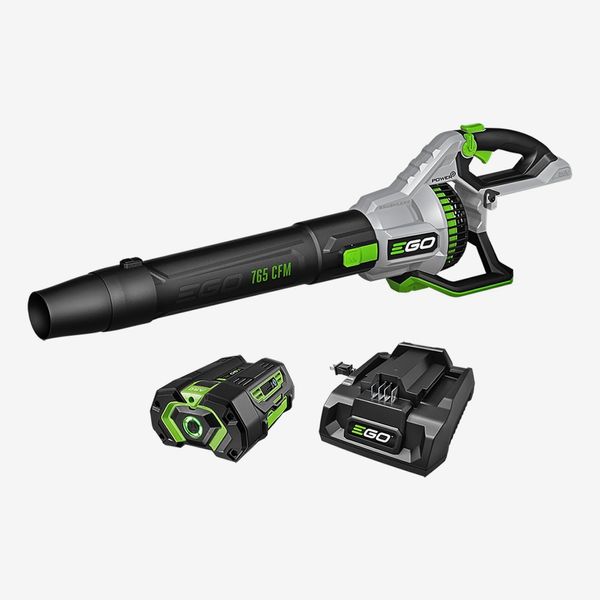
Ego Power+ 765 CFM Blower
Volts: 56 | Amp-hours: 5 | Runtime with included battery: Up to 90 minutes | Recharge time: About 70 minutes | CFM: 765 | MPH: 200
Leaf blowers are year-round tools for landscaping crews. In spring and summer, they clear grass clippings and other debris after mowing, before becoming a workhorse in the fall, so when a crew finds one with the runtime and durability to withstand daily use, it should have no trouble handling a homeowner’s workload. “When I started with battery-powered tools, it was just trimmers because the blowers had not gotten there yet,” Bellows says. “Then I noticed that the blowers were more powerful and I tried all the others but have yet to find one that works as well as Ego.”
Bellows and his crews use a couple of Ego models, but rely on the 765 CFM model for most tasks. The Ego moves plenty of air and moves it quickly, giving you enough runtime and power to handle everything from clearing patio debris to blowing snow off the car and pushing leaves into a pile. With a five-amp-hour battery, it can run for up to 90 minutes at its lowest 260 CFM setting, while the variable-speed trigger lets you ratchet up the power as needed. Its balanced design and naturally downward-pitched tube make it comfortable to hold, so you only have to focus on a sweeping, side-to-side motion. A simple cruise-control dial makes it easy to maintain the right amount of power — too much can make a mess of things — while the wide-head nozzle helps direct air across hard surfaces. The 56-volt battery also works with Ego’s core piece of equipment, from mowers to pole saws, and a growing lineup of lifestyle tools, like power stations and utility vacuums.
Jon Graham of Element Plumbing, Heating, Air & Electrical in St. George, Utah, was skeptical of battery-powered lawn equipment at first. “Over the past two seasons I’ve tried three different brands with success and failures,” he says. “Some brands have exceeded my expectations while others have fallen well short.” The workhorse in his garage today is the smaller Ego Power+ 650 CFM blower. “It’s gotten me through entire fall leaf cleanups with no noticeable difference in performance from a full battery to a drained one.”
Best less-expensive leaf blower
New! You can now save this product for later.
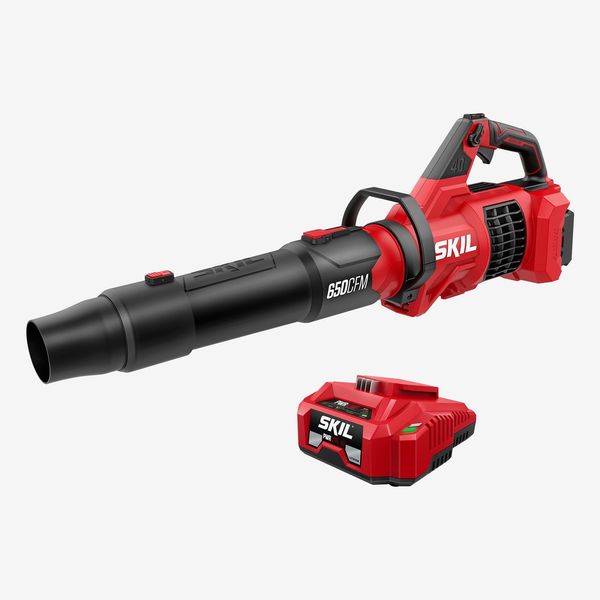
Volts: 40 | Amp-hours: 4 | Runtime with included battery: up to 54 minutes | Recharge time: About 60 minutes | CFM: 650 | MPH: 170
For yards with fewer mature trees, the Skil PwrCore 40 BL0650C may not have the raw oomph of the Ego, it moves plenty of air and with a top speed of 170 MPH it can still free wet, matted leaves from all but the thickest piles. Its variable-speed trigger lets you ease off around flower beds — where it can be easy to rip the blooms off plants and demulch the ground — or open it up for larger cleanup jobs. It’s one of the few blowers with an auxiliary handle, which gives you more control when you need to hold the tool at an awkward angle, like pointing it across the roof of the car to clear snow or water, or across a run of gutters.
The chunky, quick-release spring lets you pop off the blower tube and expose a stubby nozzle underneath, which is useful for drying a car, or cleaning in tight spaces, like blowing debris out of the back of an SUV or under the tool bench. The tool comes with one battery that charges in about an hour, but purchasing a second one can keep you going through a long Saturday of cleanup.
The Skil is a dependable, high-quality tools (Skil is owned by Chervon, Ego’s parent company) but if you’re just beginning to purchase outdoor power equipment, keep in mind that Skil doesn’t offer as broad a selection of outdoor tools as the competition. The lineup does include standouts like a single-stage snow blower capable of clearing a 20-inch-wide path through about 10.5 inches of powder.
Best light-duty leaf blower
New! You can now save this product for later.
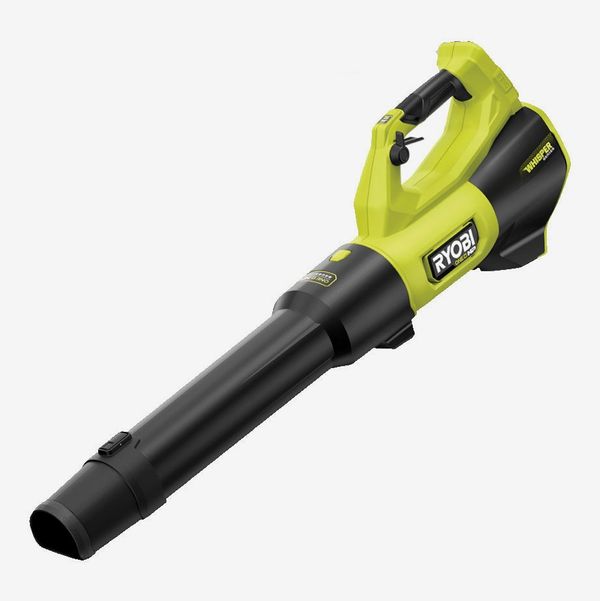
Volts: 18 | Amp-hours: 6 | Runtime with included battery: Up to 60 minutes | Recharge time: About 3 hours | CFM: 510 | MPH: 130
Some homeowners need to pay landscapers to handle fall cleanup, but if you have a small yard (or only need to dry off a car or blow debris out of the garage), a heavy-duty wind cannon is overkill. If you want to handle light cleanup yourself without adding another battery platform to the garage, the Ryobi PBLLB01B makes a lot of sense. It runs on the company’s ubiquitous 18-volt batteries, which power more than 300 tools, so anyone already invested in the system can use a power pack they may own for other tools. And like many blowers, you have the option to buy this one as a bare tool if you already have other Ryobi gear, which saves about a quarter of the price.
And at about seven pounds with the included six-amp-hour battery, it’s considerably lighter than many higher-voltage blowers while still delivering a class-leading 510 CFM and 130 MPH. That’s not as much power as our overall recommendation, but the combination of enough power and a light, easy-to-handle package makes the Ryobi particularly useful for homeowners who don’t need a heavy-duty blower for hours of leaf cleanup. The variable-speed trigger and cruise control make it easy to dial back the power for delicate work or settle into a comfortable setting for longer jobs, while high and low modes let you trade airflow for runtime.
Best leaf blower to build your tool collection around
New! You can now save this product for later.
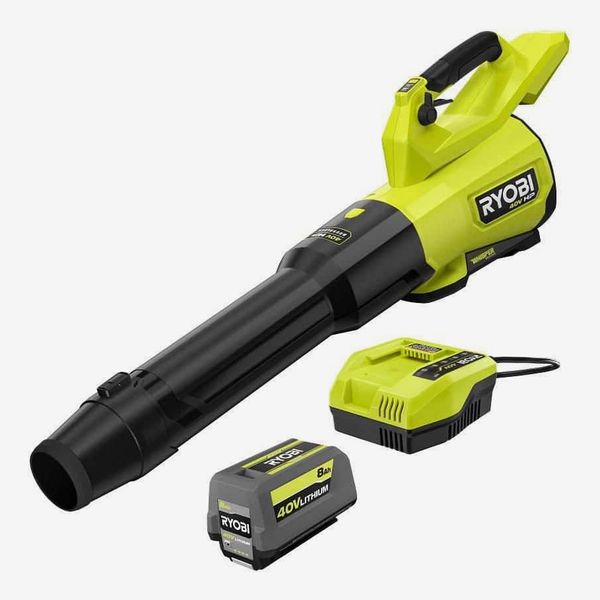
Ryobi 40V HP Brushless Whisper Series 180 MPH 800 CFM Cordless Battery Leaf Blower
Volts: 40 | Amp-hours: 8 | Runtime with included battery: Up to 85 minutes | Recharge time: About 120 minutes | CFM: 800 | MPH: 180
For new homeowners, outdoor-power-equipment beginners, or anyone who wants the simplicity of a single-battery platform for every seasonal outdoor task, the Ryobi 40-volt blower is a great choice. Why? Because it gets you into Ryobi’s 40-volt system, which includes roughly 131 tools across 23 categories — covering everything from walk-behind mowers to pressure washers and snow blowers.
On this model, Ryobi keeps the controls straightforward: One setting locks the unit in maximum power (functioning like a continuous boost button), while another dials back output to conserve battery life. While these two shortcuts manage most clearing jobs, you also get a variable-speed trigger and a cruise-control lever for finer adjustment.
Quiet yet powerful, the blower tops out at about 75 decibels on high — roughly the volume of a household vacuum, but moves 800 CFM at up to 180 MPH, plenty of power to get most jobs done. And you’ve got plenty of time to work, courtesy of the chunky eight-amp-hour battery included in the kit, a versatile size that can also drive larger tools like snow blowers and log splitters. Because Ryobi offers an expansive battery lineup ranging from 2.0Ah to 12.0Ah, you can easily match battery size to the task as your tool collection expands — opting for a lightweight battery during quick cleanup jobs or a higher-capacity pack for lawn mowing.
Best backpack blower
New! You can now save this product for later.
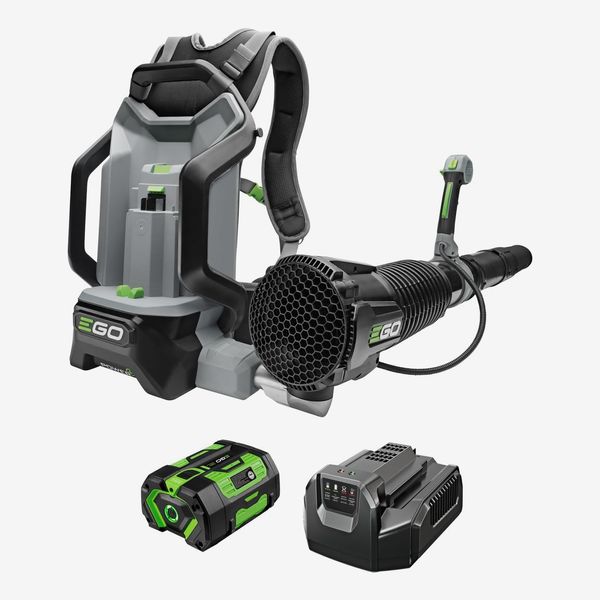
Volts: 56 | Amp-hours: 7.5 | Runtime with included battery: Up to 180 minutes | Recharge time: About 150 minutes | CFM: 600 | MPH: 145
For big yards, a backpack blower can give you more power or longer runtime, and it’s easier to carry than a handheld blower with equivalent oomph. The Ego LB6003’s 600 CFM and 145 MPH mean it’s about as powerful as middle-of-the-road handhelds, but the included 7.5-amp-hour battery (which is about the weight of a bowling ball), gives you up to several hours of runtime, enough to clear a large yard, while the weight rides on your back instead of hanging from your arm. The adjustable harness and belt distribute that load across your body, making the blower more comfortable to use than a handheld, and you avoid the fuss of a gas-powered model.
The controls — like those on most backpack blowers — favor right-handed users, but the setup is familiar, with a boost button and rotating cruise-control dial, and the tube adjusts between two positions to accommodate different jobs or user heights. One quibble: You can’t see the battery while you’re working, and the system is missing an onboard battery gauge so you don’t get a warning when you’re running out of power.
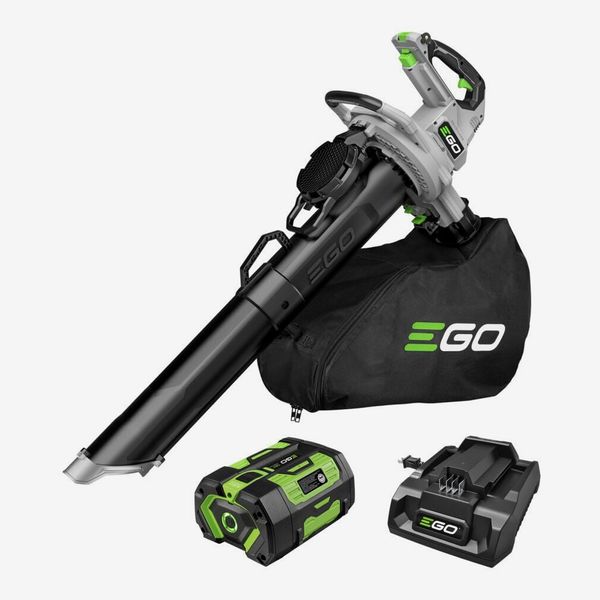
Best combination leaf blower–leaf vacuum
New! You can now save this product for later.
Volts: 56 | Amp-hours: 6 | Runtime with included battery: Up to 90 minutes | Recharge time: About 80 minutes | CFM: 500 | MPH: 210 | Mulching ratio: 16:1
The suburban holy grail: one tool that can blow leaves, mulch them, and suck them up and bag them, all powered by a quiet electric motor. The auxiliary handle and shoulder strap help keep the tool, and its hefty six-amp-hour battery, manageable as you work over a pile of leaves or clean up where the curb meets the street.
Ego added metal where it counts, including around the edge of the vacuum tube to protect the plastic from cracking and a six-tooth blade inside that helps deliver an impressive 16:1 mulching ratio. The hefty collection bag also earns points for its wide opening and easy-to-use zipper, which makes emptying it less of a chore. The downside is that in blower mode, the layout puts the considerable weight of the battery directly below your hand, which can make extended blowing more tiring. Still, the ability to switch between vacuuming and blowing without changing tools makes the LV5005 useful for homeowners who want one machine for most leaf cleanup.
Best leaf blower for customer support and warranty coverage
New! You can now save this product for later.
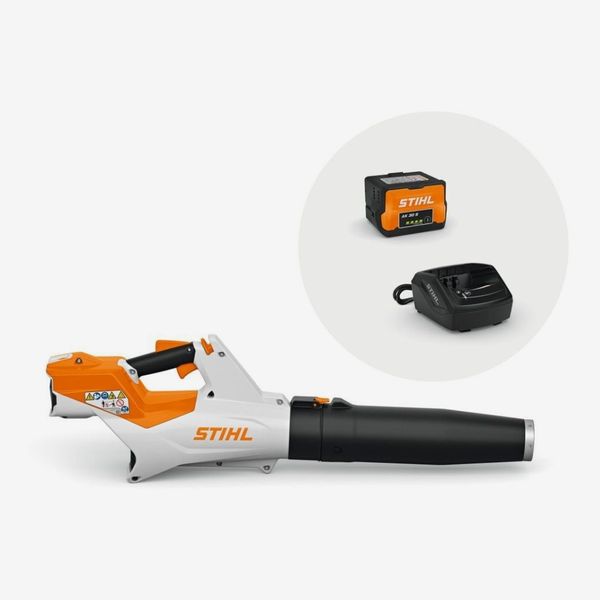
Stihl BGA 60 Battery Powered Blower
Volts: 40 AK battery | Amp-hours: 5 | Runtime with included battery: 16 | Recharge time: About 205 minutes | CFM: 459 | MPH: 154
The Stihl BGA 60 is a capable performer, plus it gives you peace of mind with a five-year battery warranty out of the box, the longest we’ve seen (Ego covers its tools for five years, but the battery only for three). That coverage (even though the commercial warranty is shorter, at three years) is part of the reason landscapers trust the brand. “One part of working with Stihl is their warranties on their products,” says Romkee. “If anything breaks, they quickly handle repairs and cover the costs. I have tried multiple brands of blowers, and this one is a higher cost for a reason.” The BGA 60 also has several thoughtful features, including centrally positioned controls that don’t favor right-handed users, a telescoping nozzle with about six inches of travel that helps with storage and can put the blower’s tip closer to debris, and a durable metal ring around the nozzle for scraping up stubborn leaves.
The 40-volt “AK” battery that powers the blower also runs a good, albeit pricey, mix of core chore tools, including mowers and chainsaws, along with a growing range of equipment like pressure washers and utility vacuums. The limitation is that the system tops out at a five-amp-hour battery, so runtime can be a challenge, particularly for longer jobs, unless you buy extra batteries (Recharge times can also be lengthy with the supplied charger, so you may want to upgrade to a more capable charger in that case). Keep in mind that Stihl has multiple 40-volt battery models and this blower uses the company’s consumer-oriented AK type, so you can’t mix and match with Stihl’s higher-end ALLPRO or AP batteries.
Curtis Atkinson, of Sunshine Landscapes in Bluffdale, Utah, also uses Stihl, and recommends the slightly less expensive BGA 50 for DIYers with smaller yards. “The Stihl is a good choice for homeowners with smaller yards who aren’t planning on doing heavy-duty leaf blowing,” he says. The BGA 50, which weighs about the same as its larger counterpart at roughly 7.5 pounds, keeps roughly the same CFM, but has a bit less velocity at 123 mph.
Our experts
- Mike Bellows, owner of E-Scapes Electric Lawn Care
- Jacob Romkee, co-founder of Vintage Lawn Service
- Eric Goranson, of DIY podcast and YouTube channel Around the House
- Curtis Atkinson, CEO of Sunshine Landscapes
- Jon Graham, CEO of Element Plumbing, Heating, Air & Electrical
The Strategist is designed to surface the most useful, expert recommendations for things to buy across the vast e-commerce landscape. Some of our latest conquests include the best acne treatments, rolling luggage, pillows for side sleepers, natural anxiety remedies, and bath towels. We update links when possible, but note that deals can expire and all prices are subject to change.
Every editorial product is independently selected. If you buy something through our links, New York may earn an affiliate commission.