I Designed the Rudy Jude Jeans
Julie O’Rourke on Maine, momfluencers, and MAHA.
Welcome to Jeans Month on the Strategist, where we’re obsessively vetting denim — from trying on every pair at the Gap to asking dozens of stylish people about their favorite fits. For more, head to our Jeans Month hub.
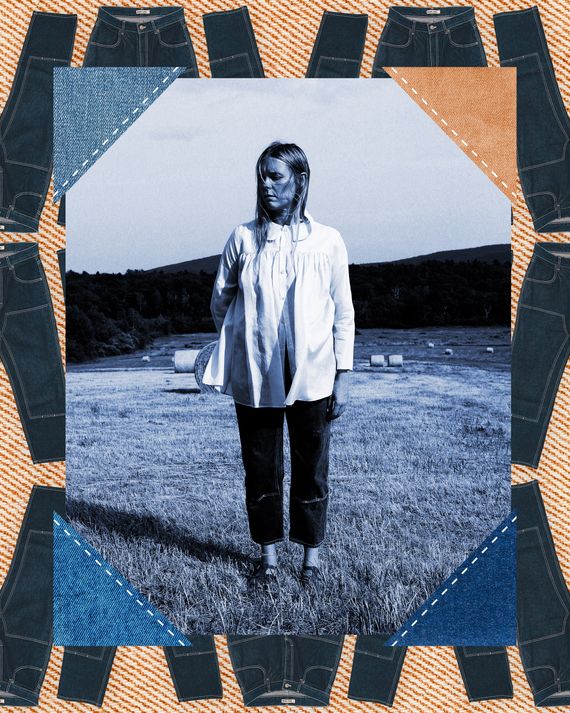
From her studio window in Maine, Julie O’Rourke, the 40-year-old founder and designer behind the clothing brand Rudy Jude, can sometimes spot a fellow Mainer wearing her wildly popular and hard-to-get Utility Jeans. It’s been nearly ten years since the label sold its first piece of clothing, a kids’ thermal set, following O’Rourke’s mission to make practical clothes out of high-quality fabrics that outlast the people who wear them. And over that time, after a few setbacks, it’s grown into a bi-coastal slow-fashion brand that sells out of nearly every plant-dyed dress, pair of jeans, and oversize jacket they make.
The Utility Jeans in particular are so in-demand that many shoppers will happily pay close to full price, and sometimes more, for a used pair on eBay, Poshmark, or through the vibrant Rudy Jude Buy Sell Trade group on Facebook. Part of the appeal is that the jeans fit really well (I own multiple pairs myself) and come in an inclusive range of sizes.Wearing them feels like an entry into a club of unfussy yet stylish people looking to buy less by buying better, who nod in acknowledgment upon spotting one another on the street. (It’s also a club that counts Washington State representative Marie Gluesenkamp Perez and comedian Abby Elliott among its members.)
Today, O’Rourke, who has a degree in textile design form RISD, remains Rudy’s Jude’s sole designer and the face of every product launch. She is also a one-woman marketing department, modeling each new piece and often taking photos alone, with her camera and tripod balanced on a rocky bit of coastline. This — along with a personal Instagram feed full of ambitious craft, garden, and cooking projects, plus outfit inspiration that pairs well with messy hair and muck boots — has earned her a very specific level of celebrity among sustainable-fashion enthusiasts and moms who love to imagine themselves making beautiful things and living off the grid.
O’Rourke lives with her partner, Anthony, and their three kids (ages 9, 6, and almost 2) in a house they’ve spent the last few years building by hand. To her followers and customers, O’Rourke represents a creative life well-lived, one that also happens to be surrounded by the rugged beauty of an island in Maine. As Kathryn Jezer-Morton wrote in her Substack newsletter, Mothers Under the Influence, in 2022, “To mess around for fun while also making money: Is there a higher calling?”
But in the last few months, a subset of the Rudy Jude fandom has begun to speculate and obsess over possible overlap between O’Rourke’s homesteader-ish lifestyle and that of content creators who self-identify as MAHA. The resulting feelings of distrust have sparked a wellspring of social media gossip and think pieces about how O’Rourke can simultaneously appeal to both progressives and anti-vaxxers.
In honor of Jeans Month, I spoke to O’Rourke about designing Rudy Jude’s signature Utility Jeans, being associated with trad wives (“I’m not even married”), and trying to keep up with jeans demand.
This conversation has been edited and condensed for length and clarity.
How did you start Rudy Jude?
I had just had my first son and in the boldness of being a new mom, I was like, “I have to do this and I have to do it now.” I wanted to make a plant-dyed kids’ line and there was nowhere to plant-dye on the East Coast. So I said to myself, “I’m just going to go to L.A. and see what happens.” We drove out in our Prius with our dog and our baby, and I started walking into factories cold with a baby in a carrier and my samples. And I was really freaked out by what I saw; a lot of the stuff that I was seeing was junky T-shirts, bad fabrics, synthetics, bad colors. It all of a sudden took the romance out of creating clothing. I found manufacturing with a company in Hollywood that sewed all the tops of the initial kids’ thermal set first, so we ran out of fabric before we could get the bottoms done. I was devastated. Then, this sounds really made up, but we were at Cookbook Market in Echo Park and I met someone whose fiancé was a natural dyer on the west coast. He had his own clothing line and a factory that completely aligned with my vision. Now we’re business partners.
Where did the name come from?
Jude was a nickname of mine, then when I started on Instagram I tried to get RudeJude but it was taken so RudyJude stuck. Then when I started the brand it felt like the right thing to call it, personal and easy to remember.
Were the first jeans just for kids? Did you always plan to expand into adult clothing?
The cost of making kids’ clothes is very similar to the cost of making adult clothes, but charging the adult price for kids’ clothes feels hard. So adult clothing was always on the back burner. But I needed to have the confidence to do it. When the kids’ line took off it felt like a natural progression to get into adult clothing.
The first pair of jeans we made were not Utility Jeans, they were toddler jeans made with seconds denim, which is cast-off denim from factories that is also very beautiful, but less expensive because there is less consistency and potentially less volume available. Now all of our denim is natural indigo selvedge denim from Japan that is made with organic cotton. When you weave denim on a narrow loom, you’re getting this really beautiful tension and really beautiful rigidity to the fabric that you don’t get when you’re weaving on a wider loom. So it ages super well. I think when you have a clothing brand, you have to take this responsibility of, I’m creating a new product and I’m putting it out into the world, and to make sure that you’re doing that with the most care that you possibly can; it took some time to be able to invest in that. I patterned the first adult jeans when I was pregnant with my second son, and we have since made some adjustments. So our first round of adult jeans was a little bit different from what we are doing now.
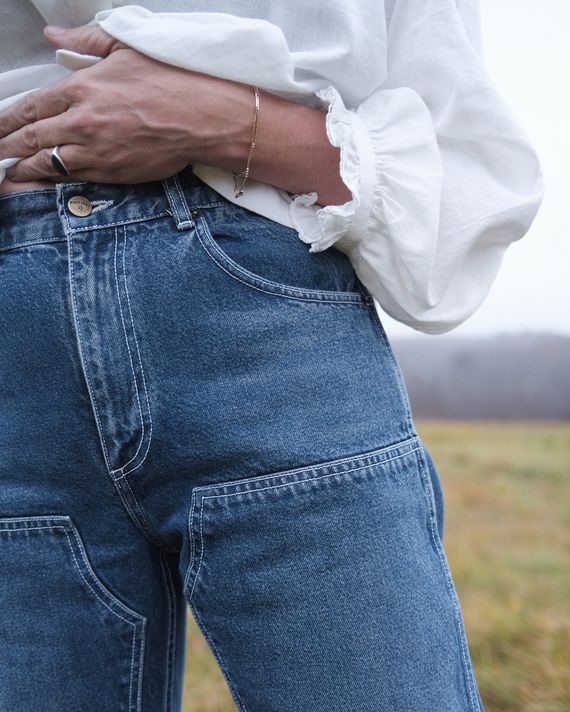
The Utility Jeans are high-waisted with a reinforced knee that’s reminiscent of early Carhartt jeans. Did you base the design off of a particular vintage pair?
I had a pair of double-knee carpenter pants when I was a kid that made a very big impact on me and my awareness of personal style. A lot of the things I make are a reference to something I loved or yearned for as a kid. When I was a teenager, we moved out of rural Blue Hill, Maine, and I went to a larger high school in southern Maine. There were a lot of really rich kids or kids that would dress rich and had fancy cars, and I felt really shocked by that. I was so mortified that I made my own clothes and would pray that nobody would ask me about it. I just wanted to look like I got it at Abercrombie. Then I got into theater, and I would go and sew on Sundays for the costume department with a lot of older ladies. I learned a lot of sewing skills that way.
How did you achieve the fit of the Utility Jeans, which don’t have any stretch, but are basically unisex and fit many different body sizes and shapes?
I never looked the way I wanted to look in jeans, especially vintage jeans. So it was my challenge to see how I could adapt that kind of pattern to make it fit me in a way that feels more comfortable. If you lay out any jeans and look at the way that they’re shaped, the legs kind of splay out, which will give you a lot of fabric gathering in the crotch when you close your legs. I wanted to make sure our jeans didn’t do that but also didn’t give you a front wedgie. What I realized is they needed to have a really flat hook, which is the front seam that runs up the crotch zone. Our jeans come in nine sizes that go up to a 40-inch waist, which I think ends up being close to a standard size 22. It feels exciting to have a pair of jeans that works for such a huge spectrum of body shapes.
How much of the way you do small drops is based on sustainability, and how much is based on economics?
It’s both things, we’ve tried it several ways. We used to do small batches and then they would sell out really fast. So we switched to doing some premade and some pre-order just to be able to gauge how many people want the product. It also means we don’t end up with waste and we don’t end up with a warehouse full of stuff that we can’t sell. We recently added eight inseam lengths on top of the nine sizes that we do. If we weren’t using the pre-order model, we would have to store all of those jeans and it would be impossible.
You will sometimes say in your Instagram Stories that people can call the store in Venice and order things over the phone that are otherwise sold out online. How does that work? You just call the store?
Yes. Recently, a friend wanted to buy something for his wife and wanted to get it for her birthday. So we were like, call the store and they’ll work with you. They’re amazing salespeople and there is a stylist aspect to calling the store. Oftentimes, we make more than the pre-order so we can fill the store with things to sell and if you look on the brand Instagram you can usually see what we have in the store. I think people don’t know that you can call in, but you definitely can. But don’t clear us out.
On Instagram you are often making a rug one day and then waking up and doing some embroidery, and then your 6-year-old son, Rui, is making a cake from scratch by himself, or the whole family is going to dig for clams. I think a lot of people are suspicious as to how it’s all possible. To so many of your followers, that kind of lifestyle doesn’t feel real. Do you have people helping out on the sidelines?
Every once in a while I’ll get an Instagram message that somebody has accidentally sent to me, but they meant to send it to someone else. Last summer, somebody wrote, “I wonder how much they pay their garden manager.” And I thought, If I had a garden manager, my garden would be so much nicer. There is not as much help on the sidelines as I would like. Anthony and I work together as much as we can. We have our youngest son, Sal, at home with us during the day and we split who is with him and who is doing their work, which feels insane sometimes. But I think that since he’s our third, there’s a feeling of, “This is such a precious time, and it goes by so fast.” I happen to love just doing a lot of little things, and I find time to do those things because it’s important to me and it makes me feel good. I think that people don’t realize that I am just living my life and posting it online. I’ve always been somebody who loves to work with my hands and understand fabric and pattern-making and all of those things.
How much are you on your phone? Do you have feelings about phone use and social media and your kids and those kinds of things?
I go through phases. Sometimes I’m not on my phone at all because it doesn’t inspire me. And sometimes I am on it more than I want to be, and then I’m like, “Ugh, go do something else.” I wouldn’t say that my kids are shielded from it. They know what we’re doing on our phones and I try not to do anything on my phone that I don’t want them to connect with too. My oldest is 9, and he knows about followers, he knows about people watching our lives. But he’s never been like, “Oh, I want to do TikTok dances” or something. I don’t know if it’s just by luck but that is just not something that’s entered our vocabulary yet or our world.
I remember a time when you were talking about watching The Bachelor, which I thought was surprising because it felt a little discordant, in a compelling way, to all the other stuff on your Instagram.
I’m a big Bachelor fan. I love watching TV. I feel like in the narratives that people build upon me, there’s things that they ignore. We’re not Little House on the Prairie, and we exist in a contemporary world, and we do contemporary things. I am perfectly happy in the world of trash TV, and I think it surprises people. Anthony is too, we’ll be glazing a window by candlelight and watching Love Is Blind. I don’t think I’m that different from other people, but I think a lot of people spin a narrative of who I am and why I’m doing the things that I’m doing.
On that note — the terms “momfluencer” and “trad wife” are thrown around a lot. Do you identify with any of those sorts of labels?
I certainly didn’t choose those labels nor were they why I entered this space. I think it’s funny to be kind of aligned in this trad-wife thing where in my mind I’m like, I am not even married. I’m somebody who is skeptical of everything and everyone, and every movement and everything that anybody says. I don’t want to be in the married club. I exist outside of that thing.
The people who follow you and buy your clothing clearly appreciate your aesthetic, your approach to art and making things, the way you are raising your children, the way you make time for the things that are important to you. They find all of that aspirational, while in some cases being very skeptical of the way your lifestyle seems to also resonate with people who believe very different things, politically, than they do. In some ways the popularity of your jeans and the appeal of what you share online puts you at the center of a complicated Venn diagram. Are you concerned that online speculation about your politics — and specifically, whether you consider yourself MAHA — could alienate customers?
I cannot control what people feel when they look at me or my lifestyle or the clothes that I make. To think that those sorts of qualities that feel so innate to me are seen as some kind of a trend or political movement, like, “She’s giving us a message that she is into this thing,” it has nothing to do with that. I’m experiencing the world in the way that feels the most authentic to me. I’m grateful that many people find the little windows of my life that I share aspirational and I would only hope that that brings positivity and joy to their life.
It seems to me that no matter what I do, say, or don’t say, speculation will abound. I do not identify as MAHA. I’m not a political movement. The thing that I want people to get from us is seeing an alternative way to live, but that doesn’t have to do with my beliefs, or your beliefs don’t have to be the same.
Speaking as the brand, since the inception of Rudy Jude, our aim has always been to have as little impact on the environment while building something that is intentional, considered, and artful. This has not changed. Our goal is to make functional, beautiful garments that fold into the lives of anyone who values them. We would never try to control who buys or wears our clothes based on their personal beliefs. If this feels alienating, if this creates complicated feelings for the wearer in any way that causes harm to them emotionally, I don’t think this brand is for them.
More From The Strategist
- Hark, the Advent Calendars Arrived (Very) Early This Year
- The Best Things Strategist Editors Have Bought This Year (So Far)
- 63 Things You Should Never Buy Full Price
- The Strategist Fall 100
The Strategist is designed to surface useful, expert recommendations for things to buy across the vast e-commerce landscape. Every product is independently selected by our team of editors, whom you can read about here. We update links when possible, but note that deals can expire and all prices are subject to change.