My Hunt for the Best Tofu Press

Save this article to read it later.
Find this story in your account’s ‘Saved for Later’ section.
Despite being a lifelong tofu lover and considering myself a very capable and curious chef, I’ve only recently begun cooking the stuff by following actual recipes. (My 4-year-old is not a fan of my improvised stir-fries.) New dishes aside, the most significant takeaway from this has been the practice of tofu pressing. Forcing the excess water out of even an extra-firm brick of tofu gives it a more solid, meatlike texture that’s easier to work with when raw, and comes out crispier and tastier no matter how you cook it. If you’re working with any kind of sauce or marinade, pressing out the excesswater also means there’s room for those other liquids to soak in. It makes even unseasoned, uncooked tofu (which I do eat) taste better, and I haven’t not pressed a block since I started doing it.
At first, I pressed my tofu bywrapping it in a dishcloth and topping it with a cast-iron skillet or a full teakettle. That works and definitely feels like a pro move, but it can be cumbersome and messy. Then I discovered the elegance that is a dedicated tofu press. These relatively compact and tidy containers apply constant pressure to a block of tofu to squeeze out any excess liquid. They sound simple, but there’s a huge variety available. You can spend less than $20 or over $100. You can get a compact stainless-steel set or a boxy plastic model. You can get a three-piece press that includes a self-contained drainage tray or a six-part press that requires a bowl or plate to catch spillover. Picking the perfect one comes down not only to price and size, but how much time and effort (including cleanup) you’re willing to put in for your desired end result.
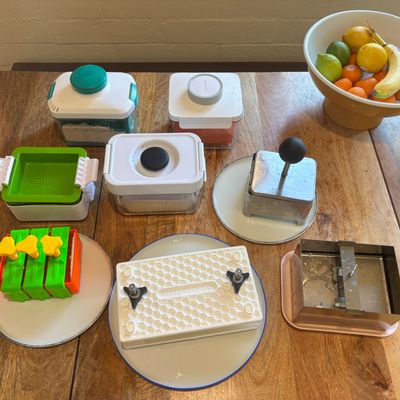
I tested eight different models, all the same way: I put the tofu in, compressed it, and walked away for about a half-hour. This is admittedly longer than the average suggested pressing time, and it ignores the optimized pressing techniques that some of the models specified, but it’s how I roll. My method worked to varying degrees with every press, but my favorite presses resulted in a super-flat and uniform block of tofu, are small in size, and have as few parts as possible, even if that means sacrificing features like a drainage tray.But your preferences may differ, so I’ve included reviews of all the options below.
My top tofu press picks
New! You can now save this product for later.
My favorite non-plastic pick. It’s made of stainless steel and is just two parts.
New! You can now save this product for later.
And my favorite inexpensive press. It’s compact, has three parts, and is made of BPA-free plastic.
New! You can now save this product for later.
My runner-up. It’s almost as good as the Tofuture, but a little bigger and has four parts.
The ones that didn’t work for me
The fewest parts, but too big
New! You can now save this product for later.
EZ Tofu Press
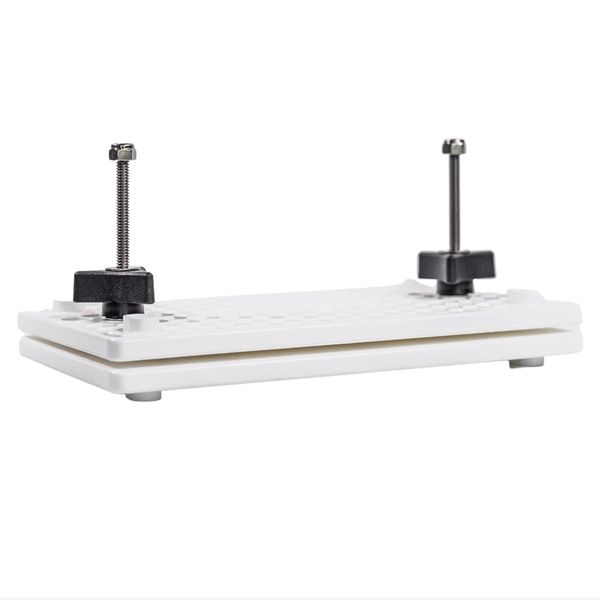
The EZ Tofu Press is literally a vice — two thick plastic plates threaded through on each end with a pair of bolts and tightened with tension knobs. Put the tofu between the plates and tighten the knobs to push the plates toward each other and compress the tofu. For optimal drainage, the instructions recommend turning the press on its side and further tightening at regular intervals, but you can also just make it as tight as possible at the start and let it sit for a while, which is what I did (I believe tofu pressing should be a set-it-and-forget-it process), and it worked just fine.
The EZ Tofu Press is the only one I tried that doesn’t separate into multiple pieces, which is a huge selling point.However, it has the biggest footprint of any press I tried, and yet despite that, the placement of the bolts doesn’t leave much room for more than your average size block of tofu, which does nothing for its performance and just means it takes up excess space. Having to tighten each side separatelyalso made it hard to get an evenly pressed block, which is annoying.And because there’s no drainage tray, you’ll need something underneath to catch the liquid, which isn’t a total deal-breaker but an extra step nonetheless.
Nice-looking, but too many pieces
New! You can now save this product for later.
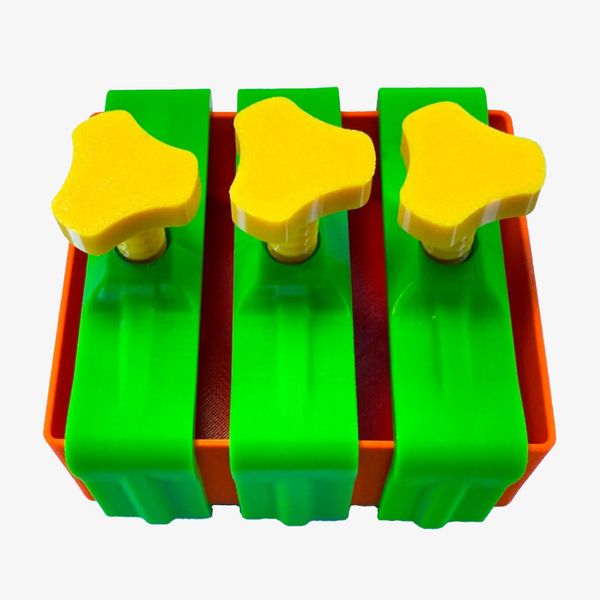
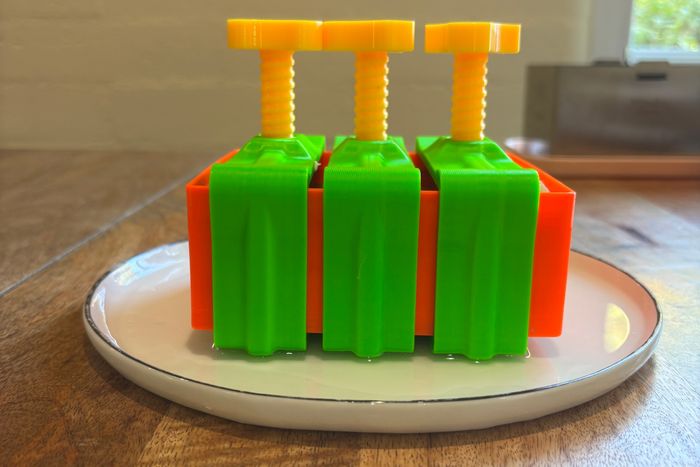
Thisvicelike press is eight separate pieces — a main compartment with drainage holes on the bottom, a pressing tray, and three sets of clamps and screws that fit around the compartment and press down on the tray. All of the parts are made of thick, brightly colored 3-D-printed plastic that feels more like a throwback
Fisher-Price toy than a kitchen gadget, so it’s the most fun press to look at. (Per the manufacturer, the plastic is virgin, food-grade PETG filament that is both nontoxic and BPA-free.)
If you’re just an occasional tofu presser and want something affordable and small, this one’s a great pick. It’s the cheapest I tried. But as a regular presser, I have to pass. You basically have to assemble and disassemble the entire thing before and after use, which I simply don’t have the patience for. It alsodrains slower than most of the other presses I tried, possibly because the drainage holes are partially blocked by the clamps. And like the EZ press above, there’s no drainage tray.
[Editor’s note: The FilamentWorx press is currently unavailable, but we’re working to find out when it will be restocked and will provide an update once we know more.]
Plastic-free, but difficult to use
New! You can now save this product for later.
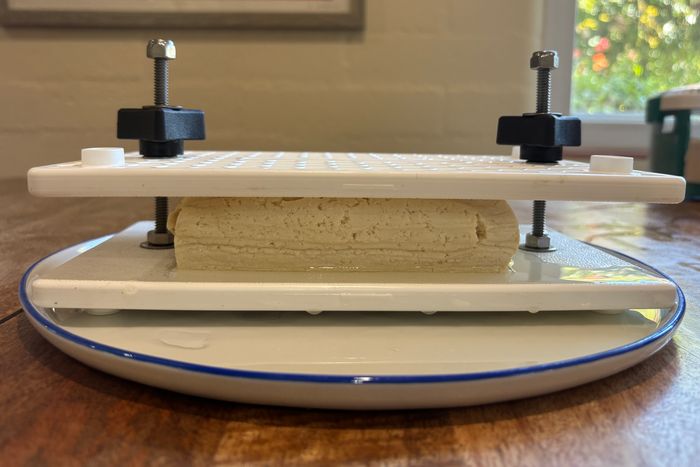
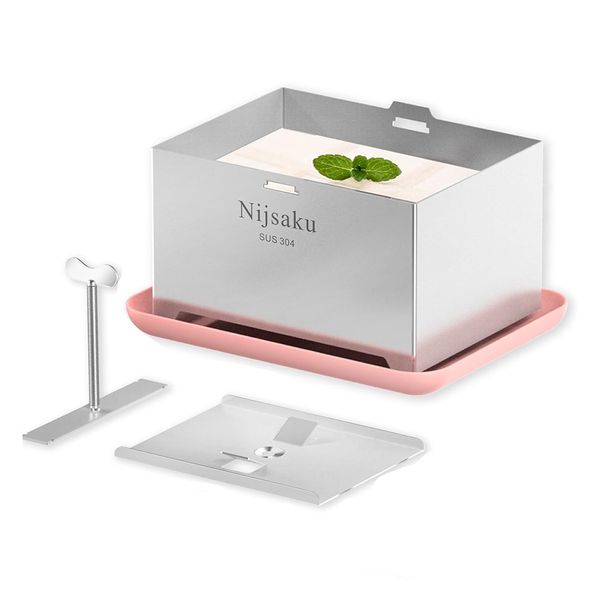
The mutlipart, multipurpose stainless-steel Nijsaku press is the most involved: Drop the vented base plate into the main container, center the tofu on top, cover it with the pressing plate, install the tension rod, and twist the screw until it’s tightened to your liking. (As with the EZ press, the manufacturer recommends further tightening at regular intervals, which I once againdidn’t do and was still happy with my results.) It also comes with a cheese cloth that you can wrap around a solid block of tofu for enhanced drainage (helpful, but I didn’t find it necessary).
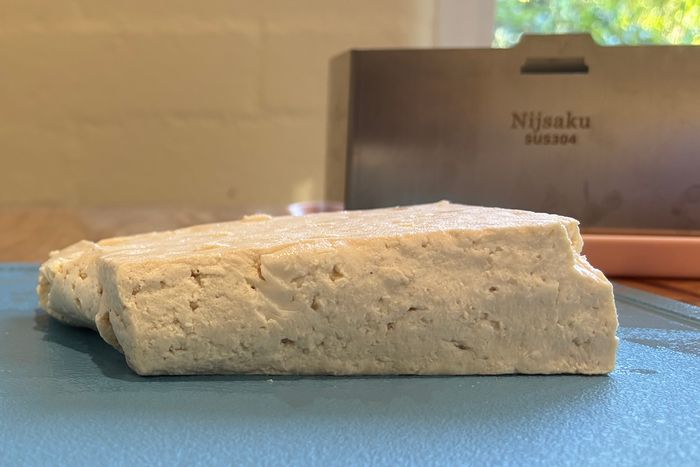
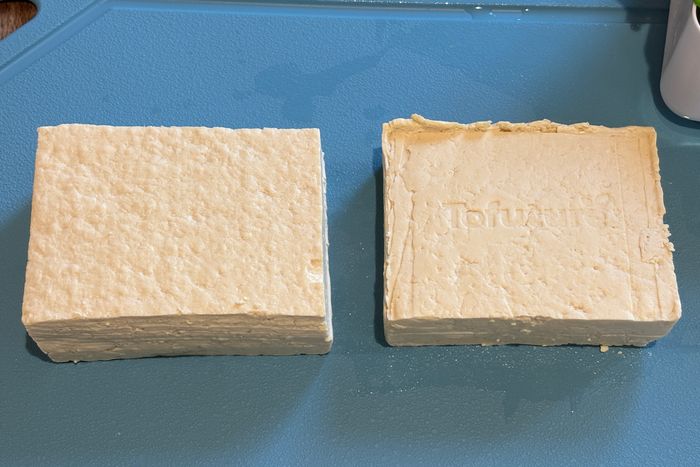
I liked that this one is entirelystainless steel, comes with a drainage tray (which is plastic, but doesn’t touch the tofu itself), and presses really well, even without the cheese cloth. You can also use the cheese cloth to make your own tofu or soft cheese. Still, it’s not the press for me, mainly because it’s made of five separate pieces (not counting the drainage tray), including small and easily misplaced ones like the tension rod and screw, and is rendered unusable if you lose even one of them. And if you don’t perfectly center your tofu on the base place, you can also end up with an exceptionally sloppy-looking block (see photo proof below). I ended up passing this one to a friend who’s also a professional pastry chef and was eager to try her hand at homemade paneer.
Works great, but too big and requires a bit of elbow grease
New! You can now save this product for later.
OXO Good Grips Tofu Press
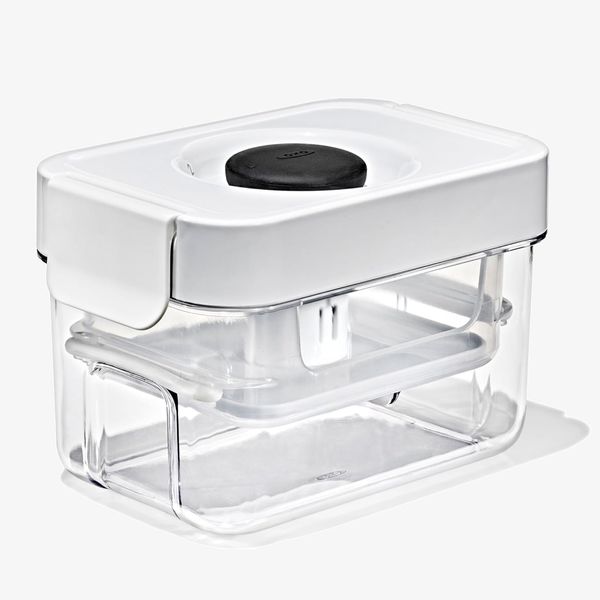
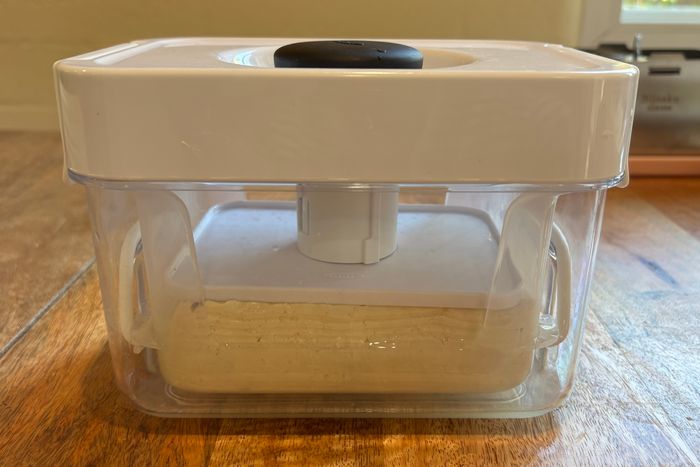
There are seven total parts to this press, but you can get away with not disassembling a few of them after every use, so it’s basically just three: (1) A tension rod that threads through the snap-on lid and attaches to the pressing plate, (2) an inner drainage tray with removable silicone tension bands, and (3) a main container to catch the drained liquid or marinate your tofu. There are two pressing strengths, which you control by turning the black knob on top. Both press tofu thoroughly, quickly, and evenly. Releasing the tension bands when you’re done brings the tofu to the top, so it’s easy to lift out. And this press is made by OXO, which is known for simple, functional, and durable kitchen gadgets.
In short, the OXO press is reliable, easy to use, and a worthy buy, but it loses points when compared to some of the others I tried. Even if you don’t take the whole thing apart after every use, seven separate parts is a lot. And while it’s not huge, it’s also the second-largest press I tested. There are a few presses that do just as much with less, and easier is always better as far as I’m concerned.
The one I almost kept
A near-perfect press, but I found something even smaller
New! You can now save this product for later.
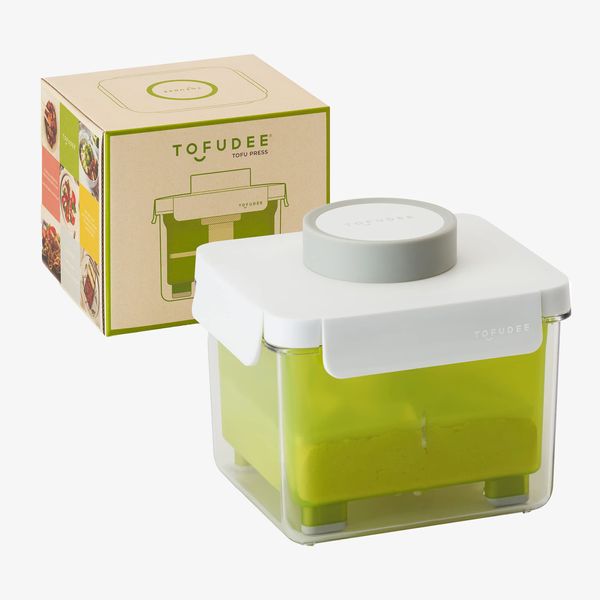
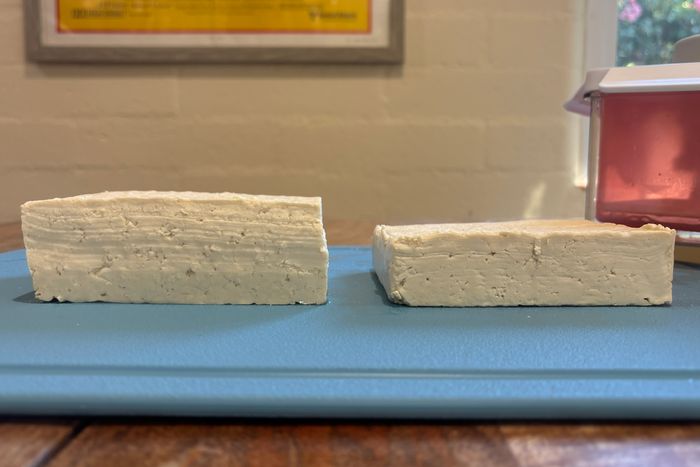
The Tofudee is similar to the OXO press above — there’s a lid with a tension rod (except this one doesn’t come apart), a detachable pressing tray (that you don’t need to detach every time), an interior drainage tray, and a main container for drained liquid or marinade — but it’s more compact and less complicated to use overall. All the parts make it taller than an average tofu block but not much wider. There are four pieces, and you simply twist the tension rod to lower it (you need to simultaneously push and turn the knob on the OXO, which requires a bit of elbow grease). It also drains just as fast and as thoroughly as the plastic Tofuture press I ultimately went with (see below). The only reason I didn’t keep this one is because the Tofuture is smaller and has fewer pieces to worry about, and because I’m already keeping two presses and can’t justify taking up space with a third.
The two I’m keeping
Plastic-free and just two parts
New! You can now save this product for later.
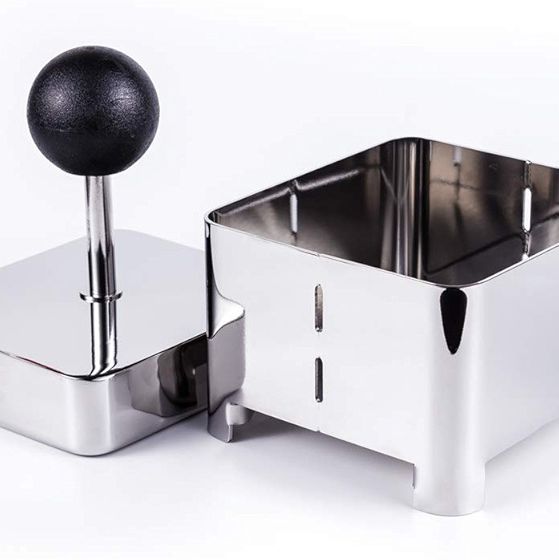
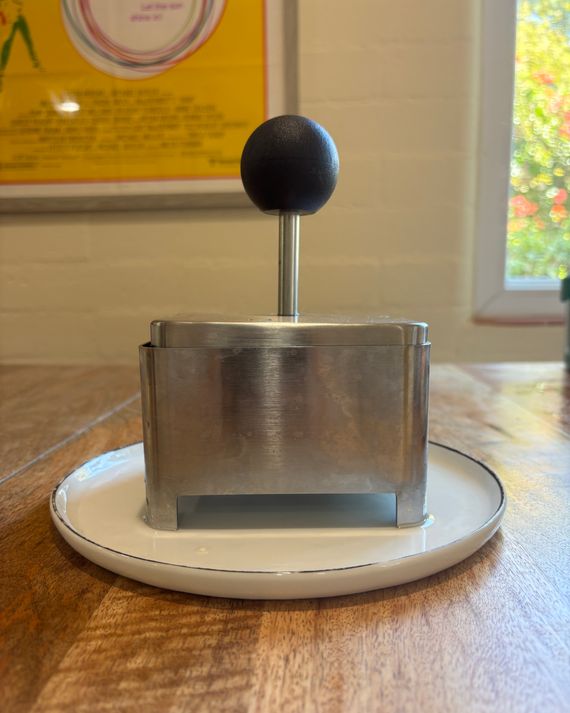
The Tofu Ninja presses with weight rather than tension: It’s a raised stainless-steel container with a removable stainless-steel plate and six-pound stainless-steel brick on top. Plop the tofu inside, top it with the brick, and let the water drain out of openings on the bottom and sides. It’s the most self-explanatory and low-lift press I tested, and it’s attractively sleek, to boot. And while it doesn’t come with a drainage tray, it’s also barely larger than the tofu itself, so finding a suitable makeshift one is easy.
Yes, it’s very expensive, and comparatively very heavy, but it’s also easily the most low-lift press I tested, and it’s attractively sleek. The drainage process takes a bit longer, but I tend to start pressing my tofu well ahead of time, so that’s not an issue for me. And even my husband, who had no problem with the makeshift dish-towel-and-cast-iron method and has never splurged on anything cooking related, didn’t want to part with this one.
Inexpensive and compact
New! You can now save this product for later.
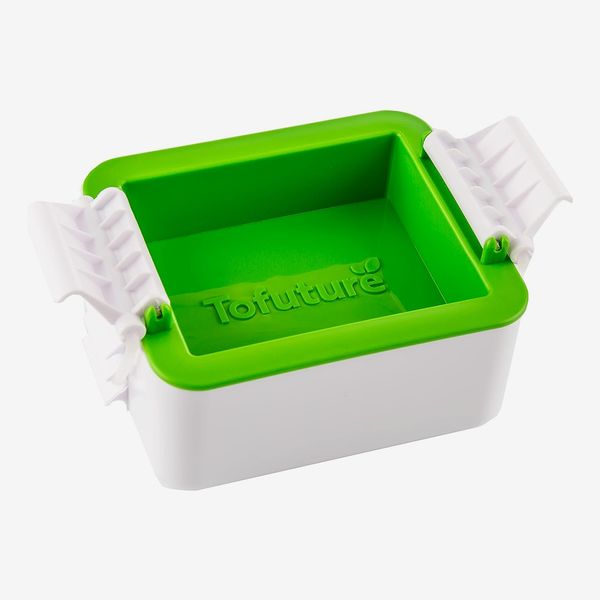
The Tofuture is compact and incredibly easy to use. The tofu goes inside the vented inner tub, the inner tub goes inside the main container, and the pressing lid sits on top. Hook the lid’s silicone bands onto either side of the main container, flip the latches down for an even tighter squeeze, and walk away — the liquid drains into the main container, no tray necessary. The three separate parts are easy to both keep track of and clean, and the whole thing barely takes up more space than the tofu itself. Like other plastic options on this list, it’s BPA-free, which may not be so bad as long as you don’t put anything hot in it but is something to be aware of. I’ve also read a few reviewer complaints about the latches breaking, but it’s held up quite well for me, and you can always buy replacement lids (latches included) and bands on the Tofuture site if need be. Still, despite its tiny size, it delivered one of the best and most thoroughly pressed tofus in the shortest amount of time (a very close second to the runner-up, Tofudee), and it costs less than nearly all the other presses I tried, so it’s a keeper.
More From The Strategist
- Hark, the Advent Calendars Arrived (Very) Early This Year
- The Best Things Strategist Editors Have Bought This Year (So Far)
- 63 Things You Should Never Buy Full Price
- The Strategist Fall 100
The Strategist is designed to surface useful, expert recommendations for things to buy across the vast e-commerce landscape. Every product is independently selected by our team of editors, whom you can read about here. We update links when possible, but note that deals can expire and all prices are subject to change.