The Best Robotic Pool Cleaners, According to Pool Professionals
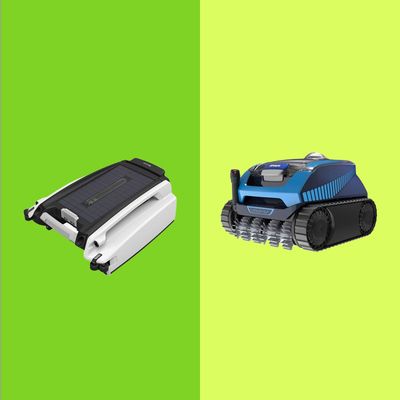
Whatever kind of pool you own, the best robotic pool cleaners can save you hours of skimming, vacuuming, and scrubbing while keeping the water cleaner between cannonball sessions. Today’s models are a far cry from older cleaners — suction-side skimmers that ran off of your pool’s skimmer or pressure-side cleaners powered by a pump — that wandered the pool in a random pattern, collecting debris but often unable to deal with dirt and buildup.
In this article
Modern cordless pool robots are smarter and easier to use. They systematically clean the floor, climb walls, scrub the waterline, and some even skim the surface, collecting everything from bugs to leaves with little effort. “I’ve been selling robotic pool cleaners for close to 30 years, and they’re superior in almost every way,” says Matt Giovanisci of SwimUniversity, when comparing modern robots to older-style cleaners.
“We see noticeably better debris removal with these units, especially fine dirt, sand, and that stubborn waterline buildup that used to require manual scrubbing,” says Nathan White, central operations manager of Poolie. “The premium models handle cleaning with almost no homeowner involvement, which is a big shift from where things were even five years ago.”
We asked pool professionals which models they recommend (and did some testing of our own) to find the best robotic pool cleaner for your pool.
Our top picks
New! You can now save this product for later.
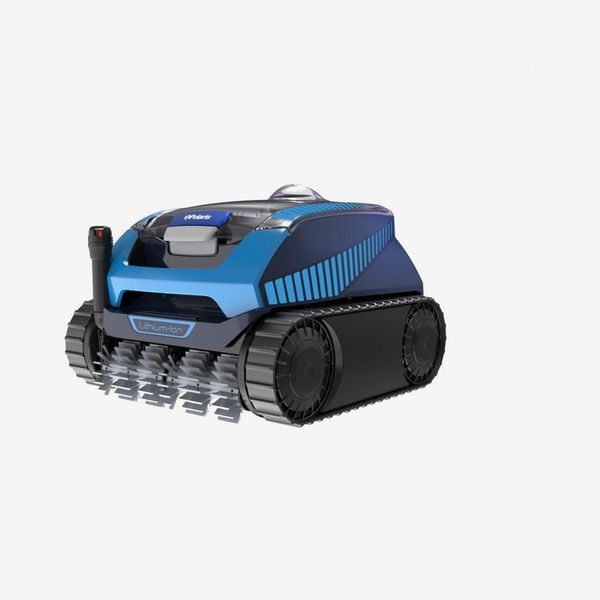
Cleans pool floors, walls, and waterline — and you can steer it underwater.
New! You can now save this product for later.
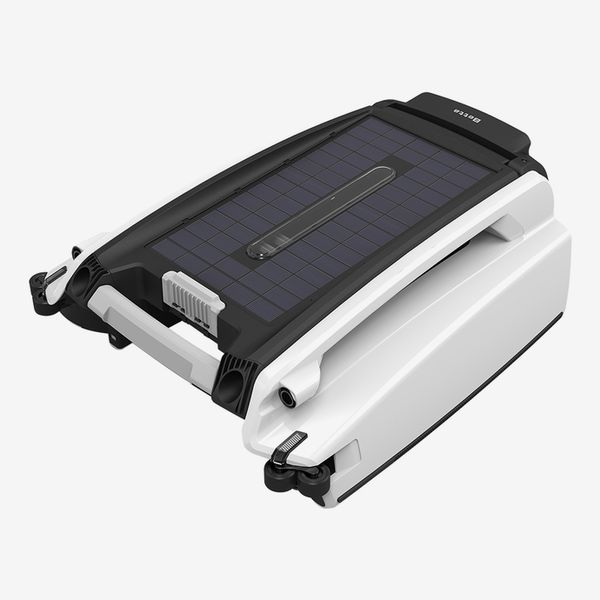
Skims surface debris to keep your pool tidy before the floor and sides get dirty.
New! You can now save this product for later.
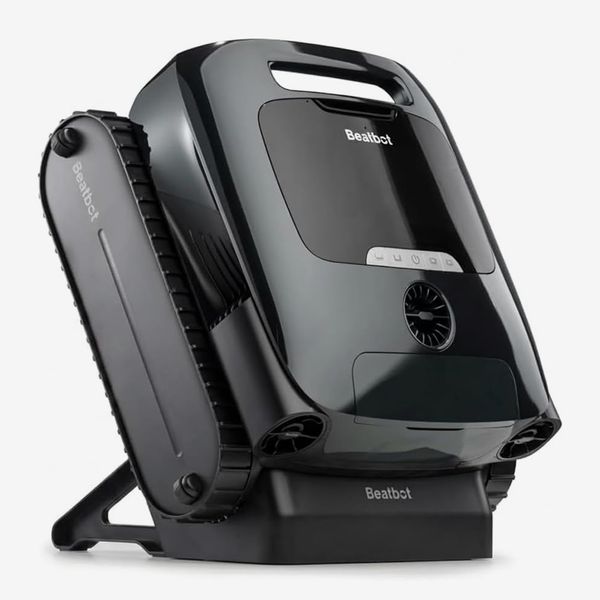
A robot that does it all: It cleans the pool floor and walls and skims the surface.
What we’re looking for
Wall and floor cleaner, surface skimmer, or all-in-one?
Most modern robotic pool cleaners clean the pool’s floor, climb walls, and scrub the waterline, where sunscreen and grime tend to collect — they do much more than older pool cleaners, which focused almost exclusively on floors.
Removing floating leaves, bugs, and pollen is a separate task, handled by a dedicated robotic skimmer. These robots, typically cheaper than their floor-scrubbing counterparts, aim to remove floating debris before it has a chance to get the floor and walls dirty. (Surface cleaning is less essential because removing leaves and bugs with a net is simple, and even the best robots struggle to collect debris trapped in corners or above shallow steps.)
For aboveground pools, where the walls and floor are easier to clean manually, a surface skimmer may be the only robot you need. For deeper in-ground pools, however, a surface skimmer will likely need to be paired with a second robot, or can be added to assist an older-style pressure or suction-side cleaner that handles the floor and walls. Some manufacturers sell robot pairs: one that cleans the floor, walls, and waterline, and another dedicated to surface skimming.
The latest cleaning innovation? The latests premium all-in-one models can clean the floor, walls, waterline, and surface, though you’ll pay more for that convenience, and it may be faster to use a pair of robots, since they can take care of both jobs simultaneously.
Corded or cordless?
You’ll find both corded and cordless pool robots, and the choice comes down to convenience, runtime, and budget.
Corded models can run as long as needed, making them a good choice for large pools or especially dirty water, as you might have under a leaf-dropping tree. They typically cost less than comparable cordless models with built-in rechargeable batteries. Most also include an external controller, often mounted on a storage caddy outside the pool, that handles power and basic controls. Additional settings are usually accessed through a companion app, and because the robot remains tethered, many corded models can be steered, using the app to a specific area for spot cleaning while they’re underwater. The tradeoff is the floating cable, which can tangle during cleaning, and can limit the size of the pool in which you can use the robot.
Cordless robots eliminate the cable, making them quick to deploy and easier to remove from the pool, although you’ll often need to retrieve them with a hook attached to a telescoping pole. Most run for about two to five hours per charge depending on the cleaning mode, which is enough to clean many residential pools, then might require three or more hours to recharge. Unlike robotic vacuums or robot lawn mowers, the vast majority of pool robots can’t return to a charging dock on their own. Once the cleaning cycle is finished, they typically have to be lifted out of the water and placed back on their charging base by hand. If you’re set on a pool robot with automatic parking and charging, you will want to look at something like the Wybot S2.
Cordless models are limited by battery runtime, so you want a robot that can complete a cleaning cycle before the battery dies. For smaller pools, a model with about two hours of runtime is typically sufficient. Larger pools with a longest run of 40 feet or more may exceed the capability of many cordless robots, making a corded model a better choice.
The robots we recommend do offer onboard controls and a companion app for scheduling and settings, but most can’t be manually steered or adjusted once they’re underwater (Bluetooth and Wi-Fi signals don’t work underwater), so once it starts the cleaning cycle, you’ll have to catch it and fish it out if you want it to stop early.
A robot that fits your pool size
Whether you’re looking for a corded or cordless model, manufacturers typically describe a pool robot’s capacity by the pool’s maximum length or total square footage.
With corded models, the cable length determines how far the robot can travel. A 50-foot cable is usually enough for smaller pools with a longest run of about 33 feet, while larger pools require longer cables. Generally, the longer the pool, the more the robot benefits from some sort of anti-tangle swivel built into the cord.
Filtration
Most filter baskets hold three to four quarts of debris, while larger models hold five quarts or more, an advantage if your pool is surrounded by trees. Filter efficiency is measured in microns (μm). For perspective, a human hair is about 70 microns wide, fine beach sand measures 90 to 100 microns, and dead algae can be as small as two to 30 microns. The finer the filter, the smaller the particles it captures, though finer filters also clog more quickly and reduce water flow, which saps the robot’s performance.
Many pool robots use interchangeable filters for different cleaning jobs, and the ones that don’t come with two often offer a finer filter as an accessory. Coarse 100- to 200-micron filters are best for spring openings and large debris — sticks, leaves, and bugs — because they maintain strong water flow. Finer ten- to 50-micron filters excel at capturing dust, pollen, sand, and dead algae during routine cleaning. Plastic mesh is the most common filter material, though some manufacturers use pleated, fabriclike filters for finer filtration. In either case, the filters are removable, washable, and designed to be reused.
Navigation
While you can still find pool robots that clean in a random pattern, this less-than-efficient navigation method is mostly limited to entry-level models. “The biggest jump I’ve seen is in navigation and mapping,” says White. “The smarter units cover the pool far more thoroughly than earlier generations, which used to miss spots or double back inefficiently.”
Mid-priced robots use gyroscopes and inertial measurement units, which track the robot’s position and orientation so it can cover more ground in less time. Higher-end models add sonar and acoustic sensors that bounce sound waves off walls, like a bat, to map the pool, improving navigation in complex shapes and reducing overlap. The latest models use LiDAR laser scanning, found in robot lawn mowers and high end robot vacuum cleaners, along with cameras to create detailed maps, identify debris, and reroute the bot to focus on dirtier areas instead of treating every part of the pool the same. These systems clean more efficiently, often finishing a cycle while using less battery power.
While today’s robots use smart navigation to get at more dirt and debris than older, simpler models, you may find yourself needing to take care of some things yourself. Robots can climb and clean steps and shallow sun shelves, but in my experience, those areas (which accumulate dirt — plant your foot on a step or shelf, and you’ll notice grit immediately, which isn’t the case on the floor in the deep end) don’t get cleaned as thoroughly as the flat pool floor. Pool steps can be difficult because they’re often narrower than the robot itself, making it hard to maintain traction and stability. Textured step surfaces can trap sand in the low spots where the brushes and suction struggle to reach. Shallow sun shelves may not provide enough water above them to allow robots that are designed to operate fully submerged to navigate effectively.
Retrieval and care
Fishing out a corded pool robot is pretty straightforward. You simply pull it to the pool’s edge using the power cable (as with any device, you’ll want to take care while doing this), and lift it out by grabbing the handle. Most mid-priced cordless models automatically park on the pool floor near a wall when their cleaning cycle ends. Then you use a pool pole with a hook attachment to snag the robot’s handle and pull it to the surface.
Depending on the model, it can briefly feel like you’re hoisting 35 to 40 pounds while the trapped water drains back into the pool. A step up in convenience is waterline parking, where the robot climbs the wall at the end of its cycle and clings to the tile line for ten to 15 minutes, giving you time to grab it by hand before it slips back to the bottom. The most premium models go a step further with surface parking, rising to the top of the pool like a submarine and floating until you’re ready to retrieve them.
You’ll want to make sure to take care of your robot by removing it from the water when it’s done and paying attention to its maintenance instructions — especially if you’re used to just leaving an older suction cleaner out there all season. “The materials of suction cleaners are typically plastic, which stands up to the pool-water chemistry much better,” says Austin Gardiner, CEO of GL Pools. “A robotic cleaner has a controller, motherboard, or computer of some kind within it, as well as a motor built in, and these parts are much more expensive, and in a busy backyard with kids, dogs, guests, the risks of damage through poor handling can incur costs.”
The best robotic pool cleaner overall
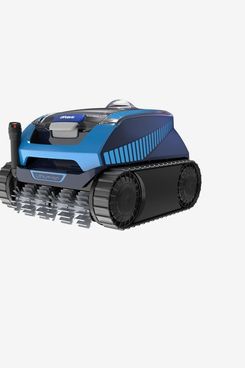
New! You can now save this product for later.
Pool size: Up to 50 feet long | Run time: Up to 2.5 hours | Recharge time: Up to 5 hours | Filter basket size: 4 liters | Corded or cordless: Cordless
The Freedom Plus cleans the floor, walls, and waterline using a pair of motors and a double-helix brush that loosens debris and funnels it toward the filter. Unlike many cordless robots that lose communication once they’re underwater, the Polaris includes a remote so you can steer it during a cleaning cycle, which is especially useful for targeting problem areas like steps. “The filtration handles large debris and fine stuff well, and the app controls are intuitive too,” says White. “But what really sets Polaris apart is the long-term parts availability and dealer service, and that’s not a small thing.”
The app includes a waterline-only cleaning mode, letting you freshen up the most visible part of the pool (and one that accumulates buildup) before guests arrive. Since Bluetooth and Wi-Fi don’t work underwater, the remote, which you have to partially submerge in the water to use, relies on Li-Fi (“Light Fidelity”), an optical communications method that uses rapid pulses of light through the water for real-time communication with the robot. You can start or stop the robot, steer it, or recall it to the wall for easy retrieval instead of waiting for the cleaning cycle to finish. It also has a dedicated lift button that brings the robot to the waterline, making it easier to pull out of the pool.
The best robotic pool surface skimmer
New! You can now save this product for later.
Betta SE Solar-Powered Robotic Pool Skimmer
Pool size: Up to 60 feet long | Run time: Up to 30 hours | Recharge time: Up to 6 hours | Filter basket size: 3.5 liters | Corded or cordless: Cordless
Think of skimming the water’s surface as the first line of defense: Everything floating there eventually sinks to the bottom of the pool. Keep the surface clear, and you’ll prevent debris from becoming a bigger job later. “We do like the Betta SE for larger pools with heavy debris,” Gardiner says. “This is a very effective and simple robotic style cleaner that does have good return on investment. They are not nearly as complicated or expensive as the submersible-style robotics, and without cords or batteries, there is also little to no time spent managing or operating them.”
The Betta SE uses a pair of motors to automatically skim leaves, pollen, dust, insects, and pet hair from the pool surface for more than a day on a single charge. Rather than relying on mapping, it freely roams the water’s surface, using its solar-powered, cordless design to keep cleaning with as little as five to six hours of direct sunlight. A wireless remote, a 200-micron fine-mesh debris basket with a top handle, and adjustable bumper rods simplify operation and maintenance.
The best robotic pool cleaner for small pools
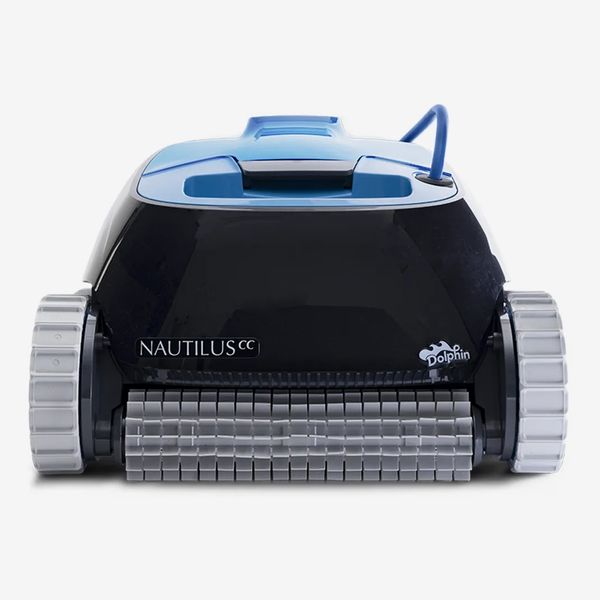
New! You can now save this product for later.
Pool size: up to 33 feet long | Run time: Two-hour default cycle | Filter basket size: 3.5 liters | Corded or cordless: Corded
“Maytronics and its Dolphin line have been my go-to,” says Giovanisci, citing the company’s network of dealers for repairs as an important reason. The Nautilus CC keeps things simple: Plug the controller into an outlet, lower the robot into the pool, and press the power button. Weighing less than 15 pounds, it’s easy to lift in and out of the water, while its top-loading filter basket makes maintenance quick. Just pull it out, empty it, rinse it clean, and slide it back into place without having to touch the collected debris.
The robot cleans the pool floor and wall but does not cover the waterline like more full-featured models. The 100-micron filter strikes a good balance between capturing larger debris and finer material, such as hair, without sacrificing cleaning performance. If your pool collects a lot of fine sand or silt, you’ll want to upgrade to a finer filter. Combined with gyroscope-assisted navigation and an energy-efficient two-hour cleaning cycle, it keeps the pool clean with minimal effort.
The best robotic pool cleaner for aboveground pools
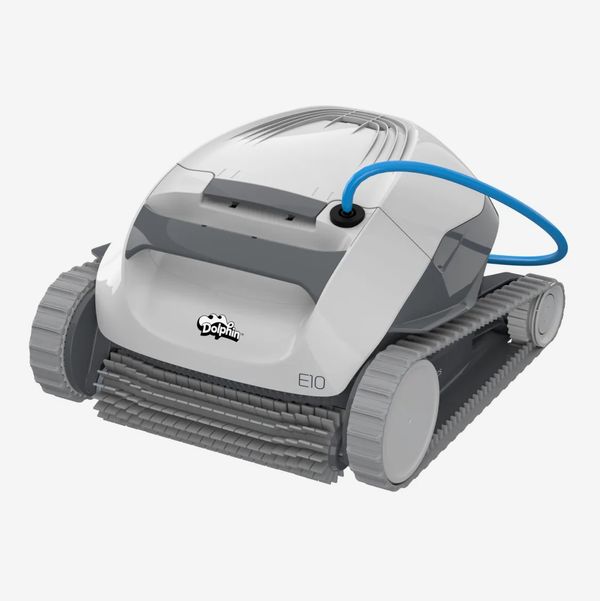
New! You can now save this product for later.
Pool size: up to 30 feet long | Run time: Up to 1.5 hour default cycle | Filter basket size: 3.5 liters | Corded or cordless: Corded
The Dolphin E10 is a simple corded pool vacuum meant for aboveground or shallow in-ground pools where floor cleaning is the priority. Its 39-foot cable provides plenty of reach for pools up to about 26 feet long, while avoiding the added cost and complexity of wall climbing, which is difficult on the flexible walls of most aboveground pools.
There’s no app, remote, or scheduling to fuss with. Just plug it in, drop it in the pool, and let it run its 1.5-hour cleaning cycle (you can run it consecutively, but you’ll want to empty the basket first, then cycle the power on and off). A rotating scrubbing brush removes dirt and algae from the floor and the cove where the floor meets the walls. “The E10 is a reasonable budget pick,” White says. “Parts are technically available, but repairs on it usually aren’t worth the cost, so it’s more of a seasonal unit.”
The best all-in-one robotic pool cleaner
New! You can now save this product for later.
Pool size: Up to 97 feet long | Run time: Up to 11 hours when skimming only; up to 5 hours when cleaning walls, floors, waterline, and skimming | Filter basket size: 3.7 liters | Corded or cordless: Cordless
While until recently most robotic pool cleaners have been able to clean the pool’s walls and floor or skim the surface, the Beatbot does it all. It belongs to a new era of robotic pool cleaners designed to handle every pool surface: the floor, the walls and waterline, and the surface.
I’ve been testing a first-generation AquaSense Pro in my own pool, where it has climbed and cleaned walls reliably and does an admirable job skimming the surface. The dual-filtration basket, which captures both larger debris and smaller particles, significantly reduces how often I needed to manually corral leaves with a net. The current-generation AquaSense 2 Pro has a larger battery that provides slightly longer runtime, up to 11 hours when used for surface skimming alone. The AI navigation, which was already good at plotting an efficient cleaning path, has also been improved.
The Beatbot app handles basics like scheduling and is where you’ll typically select the cleaning mode. You can program it to scrub all surfaces throughout the week, then switch it to surface skimming before a pool party to remove leaves and debris. Retrieval is also easier than with many robotic cleaners: when the cycle is complete, the Beatbot floats to the surface and waits for you to pull it from the pool.
The AquaSense 2 is expensive — it costs as much as a top-of-the-line wall cleaning robot and surface skimmer — but you get the convenience of a single device.
The downside is that Beatbot is primarily a direct-to-consumer brand, so support for parts and repairs is still more limited than with models from legacy pool-equipment makers, whch can often be serviced by local pool shops. In the event of a problem, you’ll need to ship the unit to them for evaluation, and the company will repair or replace it if needed.
Our experts
• Matt Giovanisci, owner of SwimUniversity
• Nathan White, central operations manager of Poolie
• Austin Gardiner, CEO of GL Pools
More From The Strategist
- Hark, the Advent Calendars Arrived (Very) Early This Year
- The Best Things Strategist Editors Have Bought This Year (So Far)
- 63 Things You Should Never Buy Full Price
- The Strategist Fall 100
The Strategist is designed to surface useful, expert recommendations for things to buy across the vast e-commerce landscape. Every product is independently selected by our team of editors, whom you can read about here. We update links when possible, but note that deals can expire and all prices are subject to change.