This Predictive Thermometer Takes (Most of) the Guesswork Out of Cooking
Save this article to read it later.
Find this story in your account’s ‘Saved for Later’ section.
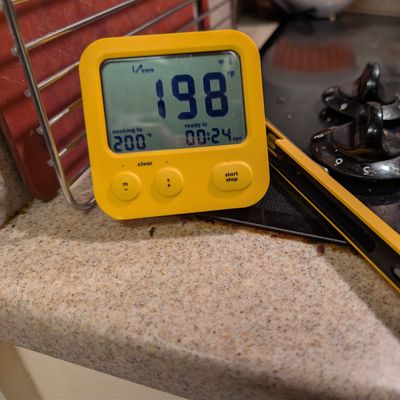
I wouldn’t say that I’m a naturally talented home cook. I love to cook, but while some seem to have a preternatural ability to see inside their protein of choice or give it a poke and pull it off the heat at exactly the right moment, I’ve been way over (or under) more times than I’d like to admit. Getting a wired probe thermometer was a big step in the right direction, but if I didn’t get the tip of the probe right in the center, I could still screw it up.
For that reason, I’ve been curious about predictive thermometers. They’re wireless, and beyond telling you the current temperature, they use multiple sensors to measure how quickly heat is transferring and predict when the center will reach your desired temperature. I’d been seeing ads for chef-scientist Chris Young’s Combustion Predictive Thermometer, and once I saw it start to show up in J. Kenji López-Alt’s YouTube videos, I decided it was time to try it.
New! You can now save this product for later.
The thermometer is well designed
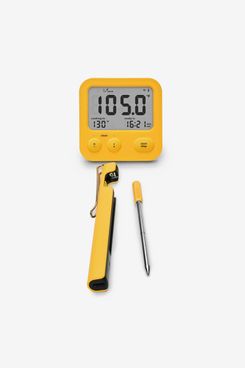
I’ve been using the second-generation Combustion probe thermometer, which improves on the first by being hermetically sealed and having a higher maximum temperature. The bundle mine came with includes a little battery-powered charging sleeve that doubles as the probe’s bridge to a Wi-Fi network and a black-and-white LCD display that also boosts the Wi-Fi signal (both are USB-C rechargeable). You can get just the probe for $150 or the probe plus the Wi-Fi booster for $190.
The thermometer is a slick feat of engineering. It’s just under four inches long and noticeably thinner than other wireless probes on the market, which is nice for not putting such a gaping hole in your food. It needs to be inserted in food to a depth of about two inches, which is notably less than others (including the longer, wider Typhur Sync Gold), allowing you to use it with smaller or thinner foods.
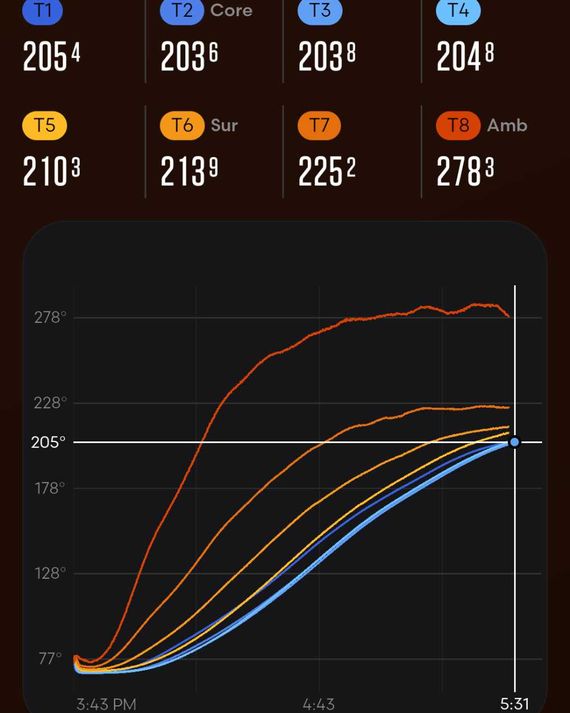
Despite the slim profile, it packs in eight temperature sensors: four that find and monitor the lowest internal temperatures, three that track cooking temps toward and at the surface of your food, and one that attempts to gauge the air temperature surrounding your food. The battery promises 40 days of standby time or 90-plus hours of cook time, and it takes only 25 minutes for a full recharge or just five minutes of charging to cover you for a 24-hour cook, which is extremely fast. Because the latest version of the Combustion is hermetically sealed and rated IP69K (meaning it’s completely sealed against dust and can withstand high-pressure, high-temperature water jets sprayed at it), it can be used for cooking sous-vide. It should also be able to withstand temperatures up to 900 degrees Fahrenheit. Unlike other wireless probes, it can handle freezing temperatures, down to minus-5 degrees F.
Setting it up took a little trial and error
Setup was not entirely smooth. The directions were a bit sparse, but with some button mashing and a few attempts, I got the probe to pair with the Combustion app on my phone (a Google Pixel 10 Pro). It updated the firmware, and then I could pair the probe with the display and get them all on my home Wi-Fi network. This took a few attempts, but once it was done, I never had to worry about it again, and the probe would instantly pair to everything within seconds of pulling it out of the sleeve.
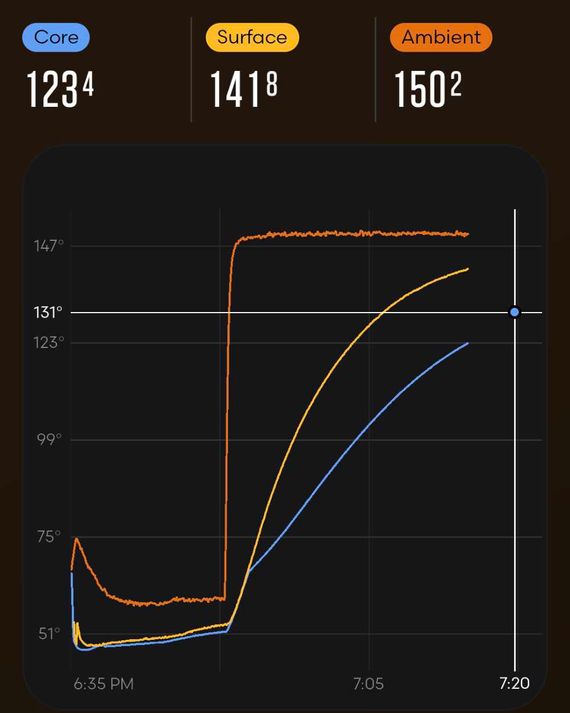
To cook, you set the desired core temperature in the app or the display. Then you put the probe into the food, ensuring that it at least passes through the thickest part of the cut. Most probe thermometers have only one temperature sensor at the tip, so it’s critical that you get that point right in the center, but with the Combustion, it doesn’t matter if you overshoot the middle. Because the probe has eight temperature sensors, it will automatically find the coldest spot and designate it as the true center. Once the software sees how quickly things are heating up at different points, it will tell you the current percentage of doneness that the food is cooked to and will estimate how much time is left to reach the set temperature.
By default, the app shows you the core, surface, and ambient temperatures, and it displays a graph so you can see each one’s progress, but you can also view measurements from all eight sensors at once. The Wi-Fi display shows all this, too, and because it instantly reconnects with the probe and Wi-Fi booster, once you’ve done that initial setup, you don’t need to use the app at all. Either way, once your food’s core reaches the predetermined temperature, an alarm will sound. The display’s alarm tone is plenty loud, but I’d like to hear some more attention-grabbing tones from the phone app.
With the Wi-Fi accessories, you can monitor the cooking from anywhere
When cooking, I would leave the booster sleeve as close to the probe as possible. The probe sends data via Bluetooth to the booster, which then either broadcasts over its own Wi-Fi network (if you’re grilling by remote campfire somewhere) or, more ideally, connects to your home Wi-Fi network. Using the latter method, you can take the display farther away from the probe or even leave your house altogether and keep track of your food’s progress in real time from the mobile app.
Without the Wi-Fi boosters, I still got a fairly decent range with the Bluetooth connecting directly to my phone. Its Bluetooth range pales in comparison to the Typhur Sync Gold’s, which uses a longer-range 915 MHz radio frequency. If you have the sleeve or display, though, your range is effectively unlimited. If you’re trying to save some money and want to buy just the probe, you can still get it onto your home Wi-Fi network: All you need is an old phone or tablet, which you can effectively use as a Wi-Fi display that you leave by the probe. The probe also works with a handful of other cooking devices from Combustion (like grill fans) and some high-end cooktops from companies like Fisher & Paykel, as well as with a handful of apps, including the excellent Crouton recipe app for iOS.
It takes all the guesswork out of cooking
As far as cooking, the Combustion noticeably improved the quality of my food while decreasing my stress. The first test I ran was my mom’s famous turkey-meatloaf recipe, and it came out baked all the way through with a glossy glaze on the outside and moist and soft on the inside — like one of my mom’s best. Another key test was broiling salmon — I once destroyed a leave-in wired ThermoWorks probe doing this, but the Combustion probe had no issues with this and also held up over high heat on a gas grill.
In general, I was extremely impressed with the accuracy of the prediction timer. When it first gives you a time until it’s done, it’s pretty spot-on, but it does adjust as needed. For even more precise cooking, you can set alarms for surface temp and ambient temp, which may keep you from burning the outside of your meat while you’re waiting for the core to get up to temperature. (You can also set an alarm for each of the eight temperature sensors, though I don’t know why anybody would want to do that.) It’s worth noting that between the radiant temps coming off your meat as well as evaporative cooling, the ambient measurement is just never going to read as high as the true temperature in an oven, but it’s still useful to have.
To test the hermetic seal, I did two sous-vide tests: For the first, I put the probe into a steak and then vacuum-sealed the whole thing, and for the second, I stuck the probe in through foam tape on an already sealed chicken breast (leaving the outer bit exposed in the hot water). Both worked flawlessly (the Wi-Fi connection, too). It’s worth noting that using a leave-in thermometer while doing a sous-vide allows you to do something called “delta cooking,” where you use a somewhat higher-temperature water bath than you want your final core temperature to be, which allows you to sous-vide a whole lot faster.
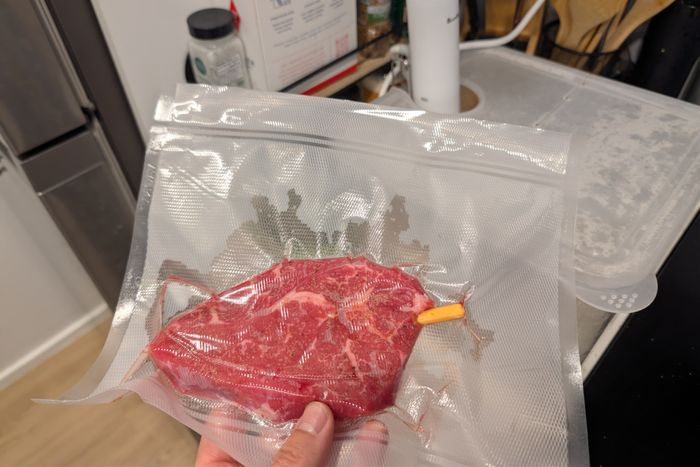
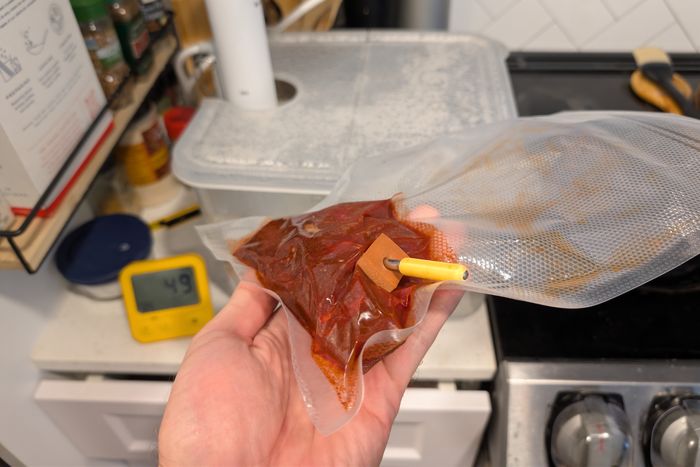
I tested the probe with a lot of veggies, too, including whole sweet potatoes in a ceramic casserole dish, artichokes in a steamer basket, and a three-inch-deep glass baking dish of mixed veg. They all came out perfectly, with restaurant-quality texture. My sourdough breads were spot-on, too, and the probe had no trouble transmitting through the thick walls of my cast-iron Dutch oven.
Carryover cooking is still an unsolved problem, though
One of the features I was most eager to try is called SafeCook. While we’ve all heard that you must cook chicken breast to 165 degrees F to kill all the harmful bacteria, 165 degrees is actually just the temperature where everything instantly dies. If you bring it to 150 degrees and hold it there for just 30 seconds, you get the same total die-off, and your chicken will be way more tender and juicy. (That’s one of the things that makes sous-vide cooking safe.) The USDA and FDA have a whole time/temperature table on this, but the idea with SafeCook is that it automates all that data, so when it’s turned on, you just tell it what type of protein you’re cooking, and it will let you know when 99.99999 percent of bacteria are dead.
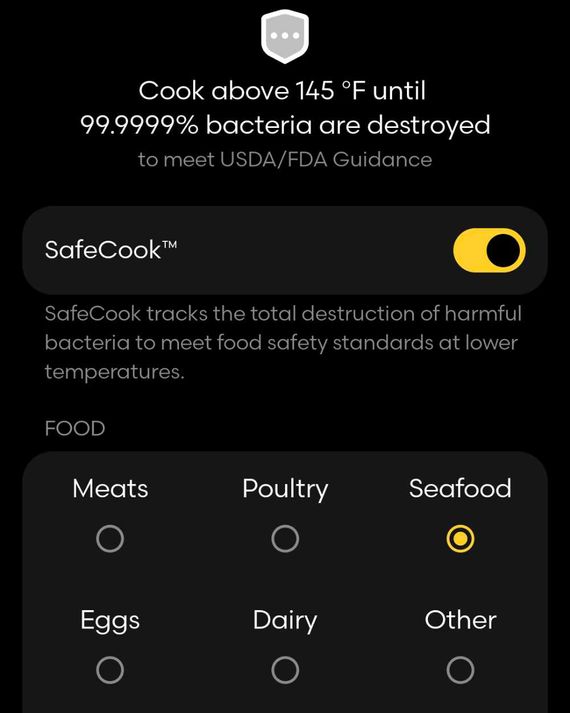
I tested the feature by roasting a whole chicken. I put the probe in the deepest spot in the breast I could find, turned on SafeCook for poultry (it also has settings for meats, seafood, eggs, and other foods), set the desired temperature to 150 degrees, and then popped it in a 400-degree oven. Once the core hits 130 degrees, SafeCook shows up with a percentage for how done it is. The alarm for 150 degrees went off first, but SafeCook hadn’t quite gotten to 100 percent yet — that came about 30 seconds later. When I pulled it out, the breast meat was indeed super tender and juicy, but the legs (which were closer to the heating element on top) were significantly overcooked (likely due to my too-hot oven and my ignoring the surface temps).
I probably could have pulled it out a lot sooner (or set it for a lower target temperature), because while the bird rested on the counter, the thermometer reached 164 degrees via carryover cooking. This was a bit of a disappointment, as I really wanted to try 150-degree breast meat. This happened a few times, so I asked Young about carryover cooking via email.
“Carryover is probably the most challenging physics problem I’ve worked on, and we’ve been working on improving it for years,” Young wrote. “Right now, our best models can predict it to about +- 2.5C of the final carry over temperature … It means that we can be off by up to 5C, which is the difference between medium-rare and medium.” He went on to explain that carryover is influenced by many things — like how frequently a steak is flipped, how thick it is, the average surface temperature the steak experienced — and all of those combined can be the difference between 5 degrees or 20 degrees of carryover. He’s hoping to solve the carryover problem with the applied math team as part of their next version of the thermometer’s firmware and plans to push a big update to the prediction engine later this year.
The display has some drawbacks
While the display is great for the most basic functions, it’s harder to get into the nitty-gritty if you want to. It will show you the “ready in” time and the core, surface, and ambient temperatures, but not the other sensors, and it doesn’t display any SafeCook data. If you happen to have two or more probes, you can pair them with the same display, but the data you can display is even more limited. It’s a long way from Typhur’s display, and Typhur comes with two probes rather than just the one (which is nice if you’re grilling different types of proteins or you want one probe in the light meat and one in the dark for your Thanksgiving turkey), so you arguably get more bang for your buck.
The Combustion’s smarts just make my food so much better
Ultimately, I liked this thing so much more than I thought I would. I still find myself reaching for it several times a week to use as both a leave-in probe and an instant-read thermometer (it’s a little slower on that front than my ThermoWorks, but it’s fast enough for my needs). The Combustion is unsurpassed as far as accuracy, and its prediction smarts are fantastic. I’m very excited to see how the above-mentioned big update adds to the functionality — in addition to carryover prediction, I’d love to see a dedicated sous-vide mode and a delta-cooking mode — but as it stands now, it’s become an indispensable tool in my kitchen and around the grill.
Other kitchen tools that can make you a better cook
More From The Strategist
- Hark, the Advent Calendars Arrived (Very) Early This Year
- The Best Things Strategist Editors Have Bought This Year (So Far)
- 63 Things You Should Never Buy Full Price
- The Strategist Fall 100
The Strategist is designed to surface useful, expert recommendations for things to buy across the vast e-commerce landscape. Every product is independently selected by our team of editors, whom you can read about here. We update links when possible, but note that deals can expire and all prices are subject to change.