I’d Replace My Protein Powders With the Cheaper Ones From Quince

Over the past year, I’ve been on the Quince beat: I reported on Quince’s work bags in June, I tried 15 of the retailer’s sundresses in July, and in the meantime, I’ve tested its cashmere sweaters, trench coats, and fanny packs for our clothing-basics stories. I’ve become very familiar with just how broadQuince’s product categories are (Caviar? Gold bars?) and was especially intrigued to see that it recently entered the wellness and supplements space. Now, Quince is offering everythingfrom electrolytes packets and plant-based protein to grass-fed collagen, daily greens powder, and more. And so I set out to test the range, comparing the products to some of the supplements I normally use and seeing how they fit into my daily routines and training sessions. While I was skeptical at first, I discovered that a few of these supplements might be worth keeping in my pantry, while others I’ll have to skip next time.
Just note: Many of the supplements below are currently available, but I’ve noticed they sell out quickly. I was unable to test a few formulas — including the certified organic mushroom coffee and the magnesium glycinate plus — as they were out of stock on Quince’s site.
Update on July 6, 2026
Quince now offers a subscription option for its Daily Superfood Greens, allowing you to save 5 percent on recurring deliveries.
The protein powder that I’ll keep purchasing
New! You can now save this product for later.
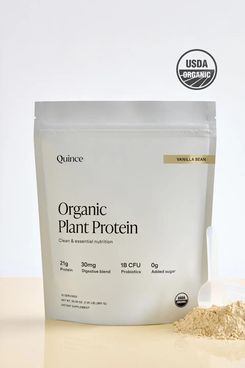
This plant-based protein powder was one of my favorites in Quince’s supplements line. For my testing, I added the vanilla flavor to my shaker bottle with water and ice, and I was pleasantly surprised by how easily it dissolved and how smooth it tasted as I drank it. There was virtually no chalkiness, and because the powder is sweetened with monk-fruit extract, it’s free from added sugar, stevia, and sugar alcohols.
The ingredients list counts 21 grams of protein, which come from a combination of organic pea-protein isolate, organic brown-rice protein concentrate, organic chia-seed protein, and organic pumpkin protein. This protein profile is actually quite similar to our best overall plant-based protein powder from Orgain Simple; however, the Quince differs here in that it does not contain protein from peanuts or tree nuts such as almonds (which may make it a better option for those with allergies). Because the protein source of the Quince powder is diverse — it comes from a blend of legumes, seeds, and rice — it also means you’re getting a wide variety of essential amino acids, making it a well-rounded vegan protein powder. At $1.34 per serving, it’s also much cheaper than Orgain Simple’s $2.14 per serving.
The collagen peptides that reminded me of Vital Proteins’ (but for less)
New! You can now save this product for later.
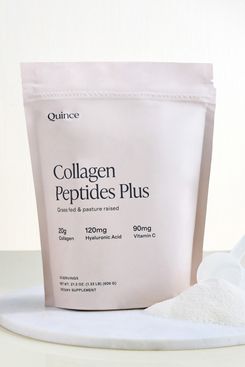
If you’ve tried a collagen powder, it might have been Vital Proteins Collagen Peptides Powder, which has been recommended by many celebrities on our site and is our pick for the best collagen-protein powder. The Vital Proteins powder has 20 grams of collagen peptides, which is the same amount as Quince’s 20 grams of grass-fed pasture-raised collagen peptides. The Quince collagen also includes 120 mg of hyaluronic acid (from sodium hyaluronate) and 90 mg of vitamin C (as ascorbic acid). Each pouch has 30 servings.
Quince’s Collagen Peptides Plus is unflavored, so I didn’t taste it when I added it in my regular morning coffee. It dissolves easily in hot beverages, although it needs a bit more emulsification to reduce clumping in cold beverages like iced coffee or smoothies. At $30 for 30 servings, you’re getting a great deal of $1 per serving (versus the very similar Collagen Peptides Advanced from Vital Proteins, at $1.79 per serving). Plus, the straightforward label of just three ingredients makes this a nice option for someone who has wanted to try a “beginner” collagen powder.
A rather grassy greens powder
New! You can now save this product for later.
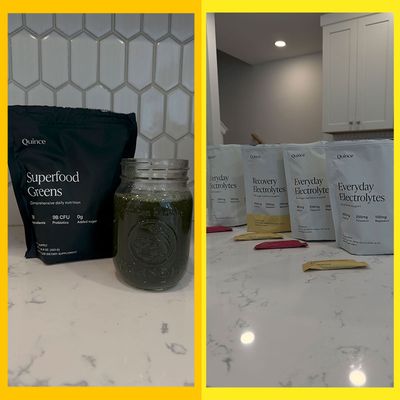
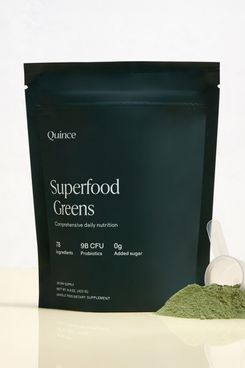
I had relatively high hopes for the Daily Superfood Greens since I’ve been an on-and-off AG1 user for the last few years. My boyfriend takes AG1 practically every morning, so we almost always have some of it on hand. A benefit of AG1 is that it’s NSF-certified, meaning that it’s been thoroughly tested for contaminants and banned substances. The Quince Superfood Greens are not NSF-certified, although the website does say that they are“rigorously third-party tested for contaminants to guarantee the highest quality and safety standards” and “produced in an NSF cGMP compliant and FDA registered facility.” This may be fine for the average person adding it to their smoothie, but for Division 1 athletes or professional athletes — who follow closer regulations regarding supplements — it’s something to keep in mind.
When comparing the ingredients of Quince and AG1, I noticed some similarities. Both Quince’s Superfood Greens and AG1 have dairy-free probiotic blends, plus vitamin D3. AG1 includes the vitamin D3 via a dropper, which combines it with vitamin K2 in MCT oil to enhance absorption. I’ve tested it out and found remembering to use the dropper to be a nuisance when you’re running out the door, and I preferred that Quince’s is already incorporated in the powder. The Quince also contains iron, and while the Quince uses monk-fruit extract and Reb M (more on the latter below) as the sweeteners, AG1’s “original” flavor uses stevia (Stevia rebaudiana) leaf extract. Be warned that Quince’s Superfood Greens are rather earthy or grassy in flavor, which I personally was not a fan of. I don’t really like to gag down my supplements and believe there needs to be some level of enjoyment, which I didn’t find with this one.
For a few bucks cheaper, Quince now offers a subscription option like most other popular green-juice-powder makers do, including AG1 and Huel. But even without the subscription, Quince’s powder is still more affordable than its competitors’ at $1.34 per serving compared to AG1’s $3.30 per serving and Huel’s $1.88 per serving (calculated using each brand’s onetime-purchase pricing).
One electrolyte powder is great for everyday use, the other for travel
New! You can now save this product for later.
New! You can now save this product for later.
New! You can now save this product for later.
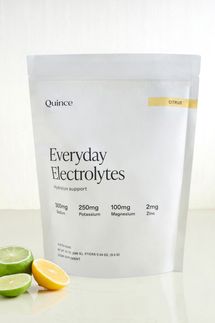
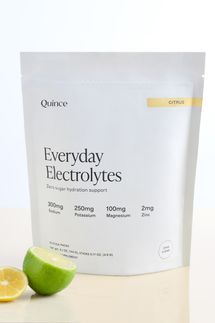
That all brings me to my favorite category: the electrolytes. I liked all three formulas, but the Everyday Hydration electrolytes were my top pick. Compared to our best overall DripDrop Hydration, Quince’s Everyday Hydration contains less sugar (5 grams versus 7 grams) and carbohydrates (5 grams versus 9 grams). It counts 300 milligrams of sodium, which is on par with many other daily electrolyte mixes on the market (DripDrop’s includes 330 milligrams). These minor supplement facts matter to me as someone who works out five to six times per week. I also appreciate that this has 250 milligrams of potassium, 100 milligrams of magnesium, and 2 milligrams of zinc per serving to support hydration and cell function. I never found the citrus or raspberry flavors to be artificial-tasting, and you can mix them into 8 to 16 ounces of water, which will determine if the flavor is more intense or subdued.
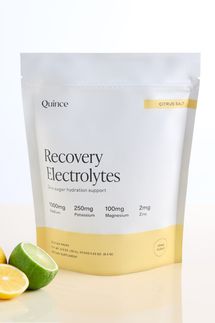
I was surprised to see that the Recovery Zero Sugar Hydration contains zero grams of carbohydrates per serving; most supplements that mention “recovery” in their product name contain both hydrating electrolytes and some carbs to restock depleted glycogen stores. For example, Momentous Fuel has 300 milligrams of sodium and 28 grams of carbohydrates per serving. The Recovery Sport Drink Mix from Skratch, which is perhaps an even more effective post-workout supplement, has a four-to-one ratio of carbs to protein, plus electrolytes including sodium, potassium, calcium, and magnesium. When I tested Quince’s Recovery Zero Sugar Hydration, I felt that it wasn’t comprehensive enough for refueling immediately after a long run (I also needed to drink a protein shake and eat a banana); however, that’s why it might be better suited to more everyday purposes, like if you’ve had a long travel day or if you’re fighting off a cold.Also, the Recovery Hydration is truly not much different from the Everyday Hydration (the both sugar-inclusive and zero-sugar kinds). The main thing you’re getting is 1,000 milligrams of sodium compared to Everyday Hydration’s 300 milligrams.
All three formulas — Everyday Hydration, Everyday Zero Sugar Hydration, and Recovery Zero Sugar Hydration — contain Reb M, or Rebaudioside M, a no-calorie sweetener naturally found in the stevia plant and in sugarcane (but in low concentrations for the latter). To be honest, I’d never heard of Reb M until I began working on this piece, but in Quince’s case, its Reb M comes from a fermentation process using sugarcane, which gives it a sugarlike taste. Just note: The Everyday Hydration contains regular cane sugar, too. Also, the packaging for each formula shows a graphic that says “Free from stevia or sugar alcohols” and “Free from artificial flavors or sweeteners.” It’s really a matter of rhetoric here, since in my eyes, Reb M is just another sugar substitute, even if it’s naturally occurring.
More From The Strategist
- Hark, the Advent Calendars Arrived (Very) Early This Year
- The Best Things Strategist Editors Have Bought This Year (So Far)
- 63 Things You Should Never Buy Full Price
- The Strategist Fall 100
The Strategist is designed to surface useful, expert recommendations for things to buy across the vast e-commerce landscape. Every product is independently selected by our team of editors, whom you can read about here. We update links when possible, but note that deals can expire and all prices are subject to change.