Mattress Jargon, Demystified


If I did not write about sleep for a living, shopping for a mattress would majorly stress me out. It can be totally overwhelming to research the sheer number of options — especially for something so expensive — while trying to understand the different mattress types, terms, and materials. And jargon-filled marketing claims only make things worse.
So in an effort to make buying a mattress feel less utterly confusing, I’ve compiled a glossary of all the mattress terminology I see on a daily basis, organized alphabetically, as a way to help decode it all. Whenever possible, I’ve also included links to more in-depth explainers we’ve written on some of these topics, if you want to be a bit of a specs nerd.
All-foam mattress
A mattress constructed entirely of polyurethane foam, meaning it doesn’t contain any springs. Often used interchangeably with the term “memory-foam mattress,” though not all all-foam mattresses are made with memory foam. Most are made with some kind of polyurethane foam (of which memory foam is one type) and often incorporate multiple types of polyurethane foams. You may see latex-foam mattresses categorized under this umbrella term, too, but they are generally categorized separately from polyurethane-foam mattresses.
Bed-in-a-box
A mattress that has been compressed and rolled into a box for easy shipping. Bed-in-a-box mattresses are commonly sold by online, direct-to-consumer retailers, but are increasingly common in big-box stores like Target and Walmart. All-foam mattresses,latex mattresses, and hybrid mattresses can all be compressed as bed-in-a-box mattresses.
Bonnell coils
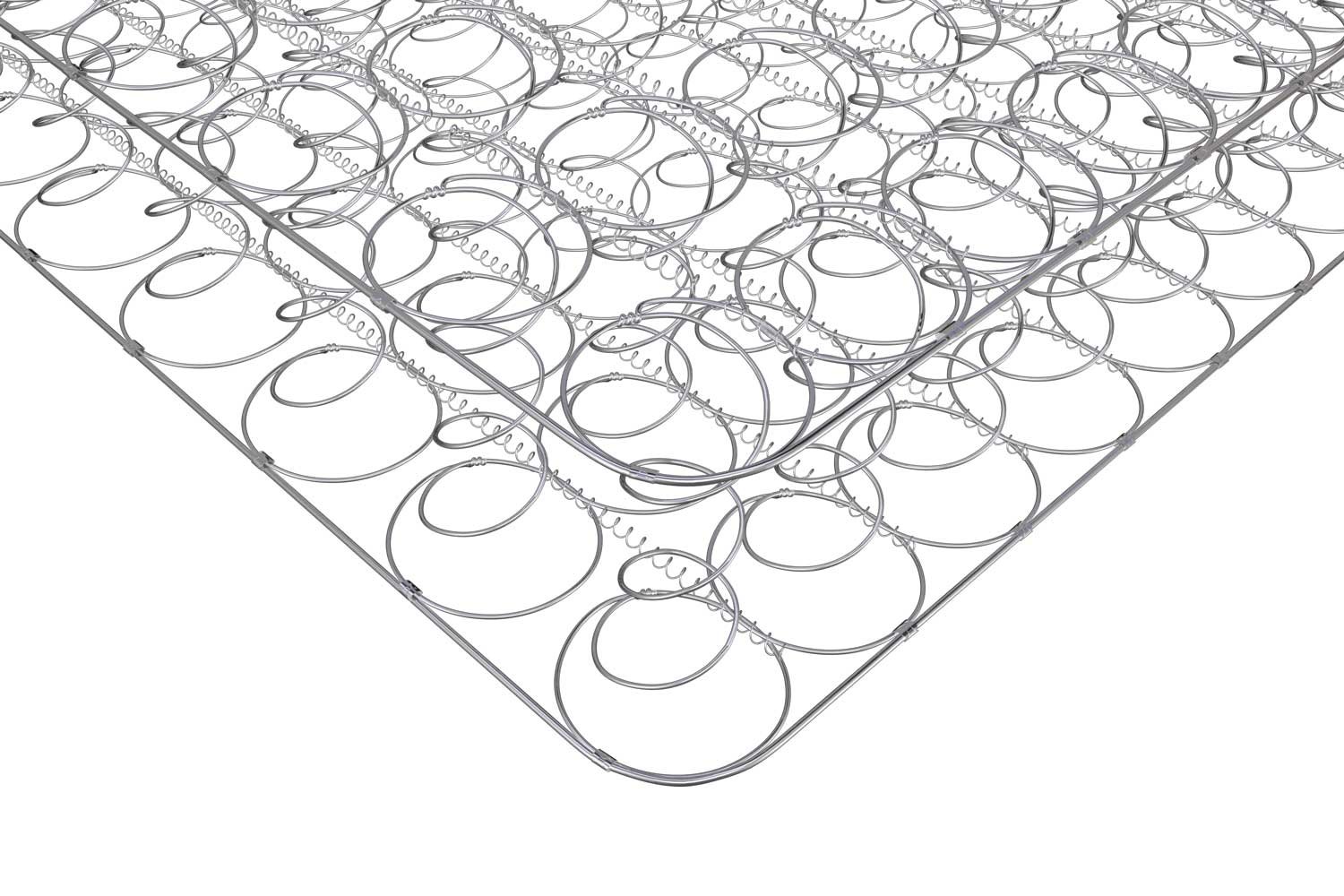
A style of hourglass-shaped steel-wire coils that are laced together to form a single coil unit. These are most commonly used in innerspring mattresses; while they used to be extremely popular, pocketed coils have largely overtaken these interlocking coils in the mattress industry at large.
CertiPUR-US certified
A certification that is specific to polyurethane foam and covers the foam’s content, durability, and emissions. The CertiPUR-US organization is mainly run by people who’ve worked in the foam industry; it was established by the industry itself to create safety criteria for foam sold in the United States, as the foam industry went global. Because there are hazardous materials that could be used in foam production, looking for the CertiPUR-US certification is an easy way to make sure the foam in the mattress you’re buying was made with safe materials only. Most brands brag about their certification, but you can cross-check their participation in the CertiPUR-US directory.
Comfort layer
The topmost layer of a mattress that sits directly underneath the cover. This layer can be made of a variety of materials, but will most commonly be either polyurethane or latex foam. The comfort layer plays a huge role in how firm or soft your mattress feels, and how much you sink into it.
Edge support
How well the outer edges of your mattress bear weight. If rolling too close to the edge of your bed makes you feel like you’re going to fall out of it, or if sitting on the edge makes you feel like you’re sliding off toward the floor, that would be considered poor edge support. A mattress with good edge support should feel as sturdy around the perimeter as it does in the center; manufacturers will often add a reinforced edge made from foam, or additional coils, to improve edge support.
Euro top
A style of pillow top that is stitched flush with the rest of the mattress. See our pillow-top mattress explainer for more.
Firmness
How soft or hard the mattress feels. Firmness is obviously subjective but can usually be ascribed to one of five “levels”: soft, medium-soft, medium, medium-firm, or firm. Many brands use a one-to-ten scale to describe the firmness of their mattresses, but these are always brand-specific; there is no established standard that will tell you how a mattress from one brand compares, firmness-wise, to a mattress from another brand.
Gel infusion
A phase-change materialadditive common in polyurethane foams that helps to counteract the heat-trapping nature of foam. Gel infusions act like a heat sink: When your body compresses the foam, gel beads within it are squished together and absorb your body heat, which dissipates as it transfers from one bead to another and away from the surface of the mattress.
Global Organic Latex Standards (GOLS)
A latex-specific certification designating that a latex product is both natural, as in non-synthetic, and produced from the sap of organic rubber trees as opposed to non-organic rubber trees. This certification is issued by the Control Union. While being organic doesn’t necessarily improve a product’s overall safety or sustainability, the GOLS certification does also enforce social and environmental regulations on producers, as well as establishing a clear and traceable supply chain.
Global Organic Textile Standard (GOTS)
A textiles-only certification that, in the context of mattresses, typically applies only to the fabric a mattress cover is made from, and/or interior batting fibers, usually wool or cotton. Issued by the Global Organic Textile Standard, the GOTS certification proves that a textile product is made from organic materials and that its production meets sustainability and ethical criteria. It doesn’t have anything to do with foam, coils, or other common mattress components, which may be covered by different certifications like CertiPUR-US, GOLS, or Greenguard Gold.
Greenguard Gold
A certification that covers a variety of construction materials, including polyurethane foams. The Greenguard Gold certification has strict standards about volatile organic compound (VOC) emissions and indoor air pollution in particular. Greenguard Gold–certified products must also meet testing requirements set by the California Department of Public Health for VOC emissions, because the state’s more-stringent-than-average legal requirements are considered the industry standard for emissions testing, according to UL Solutions, the issuer of all Greenguard certifications.
Hybrid mattress
Essentially the opposite of an all-foam mattressor an innerspring mattress, a hybrid mattress contains layers of different materials, typically springs and some sort of foam, whether it is polyurethane foam or latex foam. Hybrid mattresses are increasingly popular — many mattresses with coils are hybrids — as they are designed to provide the “best of both worlds” between sturdy support and cushiony comfort.See our hybrid mattress explainer for more.
Innerspring mattress
A mattress that is primarily constructed of Bonnell coils or pocketed coils. These are often thought of as “traditional” mattresses, especially among most American adults. Invented in the late 19th century, innerspring mattresses dominated the American mattress market until relatively recently, accounting for 92 percent of mattress sales in the 1970s and 1980s. True innerspring mattresses will have only a minimal amount of padding on top of the springs; what most sets them apart from hybrid mattresses is that they lack the thicker foam comfort layers typical of a hybrid. Instead, innersprings usually have just a quilted cover with some batting in it. Because you’re sleeping much closer to the springs, innerspring mattresses will feel more firm and bouncy than most other mattress types.
Latex foam
Latex is type of rubber used as a mattress material, either for the entire mattress or as a comfort layer. Latex is typically derived from the sap of rubber trees and processed into foam, using one of two processing methods: Dunlop or Talalay. These methods describe how the sap is made into foam; though the type of latex that is in a mattress is not always specified,Dunlop latex tends to be firmer and denser, and Talalay latex tends to be softer and springier.If you see the term “natural latex,” regardless of whether it’s natural Dunlop latex or natural Talalay latex, that means the latex began as rubber-tree sap and is eligible for GOLS certificationif harvested from organically farmed trees. However, there arealso synthetic forms of latex as well as blended natural and synthetic versions.
Memory foam
The common name for viscoelastic foam, a type of polyurethane foam that is slow to change its shape but can return to its original shape once pressure is removed. (Remember: All memory foam is polyurethane foam, but not all polyurethane foam is memory foam.)Memory foam is commonly used as a comfort layer, because of its pressure-relieving, body-contouring characteristics. See our memory foam explainer for more.
Motion isolation or motion transfer
These terms are two sides of the same coin: Motion isolation describes how well a mattress prevents motion transfer. If you’ve ever seen a mattress commercial where someone drops a bowling ball onto a mattress just inches away from a glass of red wine, you’ve witnessed a claim about motion isolation — basically, the ability to stop a sleeper’s movement from being felt all over the whole mattress. Motion isolation is most pertinent for people who share a bed, and thanks to pocketed coilsand energy-absorbing foams, most modern mattresses are pretty decent at it.Foam generally stops motion transfer better than springs, but performance can vary depending on the entire mattress construction. Generally, pocketed coils are better for motion isolation because they flex individually rather than as an entire unit. If you are shopping for an innerspring mattress,be prepared to feel more motion transfer and bounce if it contains interlocking Bonnell coils.
Phase-change material (PCM)
A substance that releases or absorbs latent heat when changing state, say, between a liquid and a solid. Phase-change materials (PCMs) have been commercially developed as cooling fabrics and gel infusions for use in mattresses, bedding, and even clothing. Typically they start out solid and turn to liquid as they absorb your body heat and draw it away from your body (they’ll ultimately release it once you get up, as they change phase and solidify again). PCMs are generally encapsulated in fiber or gel so they can act like a heat sink; they won’t suddenly make your bed feel wet as they absorb your body heat.They work more by preventing you from overheating rather than actively “cooling” you. But PCMs, particularly in fabric, can have a slightly cool-to-the-touch feeling when you first come in contact with them.
Pillow top
A pillow top is an additional comfort layer sewn directly onto the top of a mattress, essentially a permanently attached mattress topper. See our pillow-top mattress explainer for more.
Pocketed coil
A type of steel spring commonly used in hybrid mattresses, where each spring is individually wrapped in fabric, rather than the springs being physically interlocked with one another. Pocketed coils are also known as Marshall coils. Pocketed coils move individually, so they increase motion isolation and conform around the body more than the interlocking Bonnell coils commonly used in innerspring mattresses.
Polyurethane foam
A type of plastic-based foam that is the basis for most all-foam mattressesand all memory-foam mattresses. (All memory foam is polyurethane foam, but not all polyurethane foam is memory foam.)It’s the product of a chemical reaction and, depending on the particular ratios of the ingredient mix, additives, and how its produced, can vary in firmness and density. Polyurethane foam can be certified as nontoxic by both the CertiPUR-US certificationand the GreenGuard certification.See our memory foam explainer for more information.
Pressure relief
A mattress with good pressure reliefwill cushion your body so that you don’t start to feel pain on the parts of your body where the mattress is supporting your weight. Pressure relief is particularly important for side sleepers, who are resting their entire body weight on their side and especially on their hip and shoulder joints. Memory foamis a go-to material for pressure relief, but latex foam and other polyurethane foamscan also do the trick.
Reinforced edge
A construction feature used to give a mattress more edge support. A reinforced edge can be an additional section of coils around the perimeter or a border of high-density foam wrapped around the support layer.
Zoned support
A style of mattress construction in which horizontal sections of the mattress are designed to provide varying levels of pressure relief and/or support to address specific concerns like back pain. The most common style of zoned support is to make the middle of the bed firmer, to provide hip support, while making the upper third of the bed softer for pressure relief around the shoulders — one good example is the Saatva Memory Foam Hybrid mattress. Some zoned mattresses will also feature extra cushioning around the middle of the bed to provide specific relief to the lower back; or pick for the best mattress overall, the Saatva Classic, uses this approach.
The Strategist is designed to surface useful, expert recommendations for things to buy across the vast e-commerce landscape. Every product is independently selected by our team of editors, whom you can read about here. We update links when possible, but note that deals can expire and all prices are subject to change.