At Last, a Breakthrough for Plastic-Free Nonstick Pans

Save this article to read it later.
Find this story in your account’s ‘Saved for Later’ section.

I always say that every kitchen should have three styles of skillets: stainless steel, cast iron, and nonstick. With these, you can cook anything.
Still, as the Strategist’s kitchen and dining writer, I find myself inundated with brands telling me how they’ve innovated in the cookware space — and a lot of the time, it’s with some sort of hybrid pan that’s supposed to be better than any of those on their own. This is especially the case when it comes to nonstick skillets, which raise concerns about “forever chemicals” or, in the case of their ceramic-coated alternatives, not being particularly slick or having durable coatings.
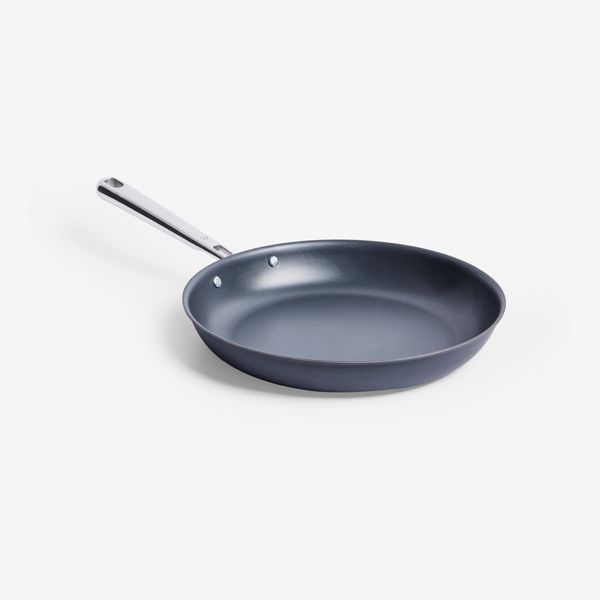
However, I’ve never found an alternative I love — until now. Misen’s new carbon nonstick skillet is what it sounds like: a mix between carbon steel, which is basically a lighter-weight cousin of cast iron, and nonstick. I was skeptical at first, but given that we love the brand’s regular carbon-steel pan (Strategist senior editor Winnie Yang wrote about it, and it’s one of the picks in my colleague Micheal Zhao’s roundup of the best carbon-steel pans), I decided to try it out. So far, I’ve been exceedingly impressed.
New! You can now save this product for later.
The pan has an aluminum core, which is the case with most stainless-steel skillets, too. And though the brand didn’t incorporate that into the name, it could have. Aluminum is a lightweight and heat-responsive material — two crucial features of this skillet. The core is surrounded by carbon steel that has been “super-heated” in a nitrogen-rich environment to create an “extra-hard, extra-smooth, and extra-durable” surface, as Misen describes it.
The results? You get the best of all worlds.
As with nonstick pans, the Misen’s surface releases food easily without needing to be seasoned (fat in the pan will help maintain this attribute over time, but it doesn’t require the care and maintenance of carbon steel or cast iron). And, similarly, “it seems to be much easier to keep clean than the regular carbon,” says Zhao, who has been testing the pan as well. “There are no bits of char permanently stuck to it after months of use.” Yang, who has also been cooking with the Misen, says she has a tiny bit of char on hers — but that it hasn’t affected the nonstick performance. And she reports that there are no scratches on it from the metal utensils she’s been using with it — which is absolutely verboten with regular nonstick. One disclaimer: Though it’s not as finicky as stainless steel can be, preheating still helps the nonstickiness, and don’t expect that you can get away with not using oil or butter (which to me is a nonnegotiable for good cooking anyway).
I myself have made crispy-skinned fish and chicken cutlets that slide right out. But the ultimate nonstick test, I think, is all forms of eggs. Fried eggs come right off. A frittata releases easily. Even scrambled eggs turn out pretty well. (I will say: For this last preparation, which I make nearly every day, I’ll likely still turn to a proper nonstick because nothing else gets them quite as soft and fluffy.)
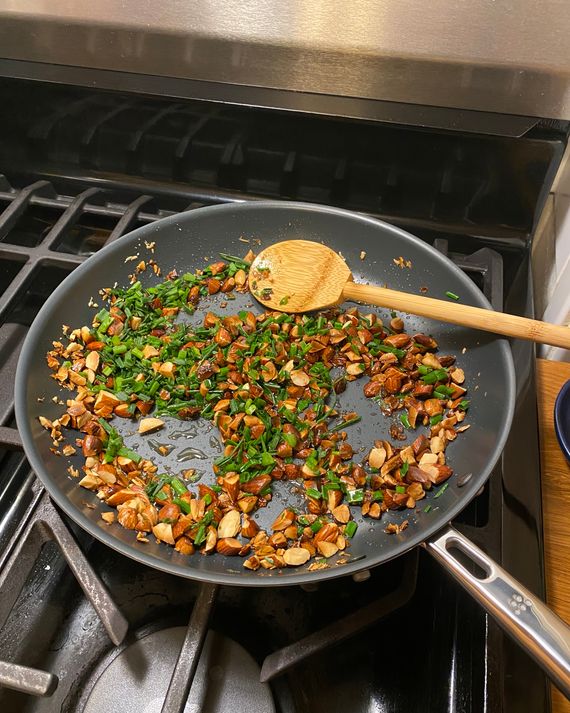
Even as it maintains its slickness, the Misen pan still gets way hotter than a nonstick. “I stuck it in a pizza oven to cook shishitos, and it had no problems with 800-degree heat,” Zhao says. But as I mentioned above, it’s also heat responsive and ace at distributing said heat evenly — so playing with the flame of your stove will yield more exacting results than with cast iron, which holds onto high temperatures like nobody’s business. Because of this, I have turned out golden-brown toasted nuts, perfectly cooked skin-on chicken thighs, and charred green beans that don’t get overly soft and floppy in the process.
It’s lightweight: 2.48 pounds, compared to the 3.2 pounds of Misen’s original carbon-steel pan. This makes me more inclined to pull it out on a regular basis. The stainless-steel handle — which Zhao, Yang, and I all pointed out as a big selling point — is much more comfortable to hold and easier to clean than the silicone-covered handle of the original.
And the final big appeal: Misen says you can cook with acid in this skillet, which is the biggest no-no of regular carbon steel. Zhao, Yang, and I have all done so with various lemon-, tomato-, and white-wine-based sauces and found that it hasn’t stripped or stained the surface or affected the overall performance. Basically, nothing can screw it up. “I would unquestionably tell anyone to buy this,” Zhao says, “and even leave it with roommates who don’t really cook” — a ringing endorsement if there ever was one.
A few more pans we love

More From The Strategist
- Hark, the Advent Calendars Arrived (Very) Early This Year
- The Best Things Strategist Editors Have Bought This Year (So Far)
- 63 Things You Should Never Buy Full Price
- The Strategist Fall 100
The Strategist is designed to surface useful, expert recommendations for things to buy across the vast e-commerce landscape. Every product is independently selected by our team of editors, whom you can read about here. We update links when possible, but note that deals can expire and all prices are subject to change.