Artist Eric Haze’s ‘Magic Trick’ for Removing Stubborn Things From Almost Any Surface
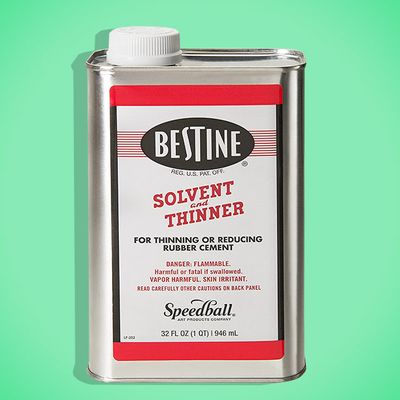
In a world of constant change and perpetual technological upgrades, I am a big fan of anything that remains a constant — things that function the same way today as they did decades ago and haven’t undergone any unnecessary changes. As an art director and a designer, I can tell you that if a product still has the same logo it was born with after many decades, it’s another telling sign that it’s doing something right. Products like this, as the saying goes, are a wheel that does not warrant reinvention. Their time-tested familiarity breeds confidence, and I can confidently say that, after 40 years of being a staple in my studio and my garage, Bestine solvent is worth whatever modest price you may pay to add a can to your DIY tool kit.
As a graphic designer in the ’80s, I was originally introduced to Bestine for a specific reason. Before computers made graphic design a largely digital process, artwork was traditionally prepared for a printer in a series of black-and-white overlays that required laying everything out to scale on what are known as “blue line” mechanical boards. We pasted everything to the boards using spray-on mount adhesive or hot wax. Bestine was the product — or magic trick — we used when we needed to unstick and reposition anything or wipe away any excess gunk that would attract dirt and fingerprints. With a little squirt onto a rag and a quick wipe, it melted away any stickiness. Because the solution isn’t water based and evaporates very fast, it typically never compromises a range of water-based inks, paints, and other permanent markings.
As any super-dependable product tends to do, Bestine found its way from my studio into my home. Over time, I learned it could perform the same magic trick for all sorts of minor household projects because it removes just about any gummy, sticky residue from lots of surfaces. The registration document stuck to the corner of your car windshield? A dab of Bestine will loosen it and leave the glass as clean as a whistle, no razor blade required. That tag on a rare vinyl album you found at a garage sale? A wipe of Bestine will free it (and remove any residue) without destroying the packaging. That sticker your friend — or maybe your kid — placed in a hard-to-reach spot on a wall? Wet its face with a rag doused in a little Bestine, let it sit for a minute, and peel.
New! You can now save this product for later.
Now it is worth noting that, as effective as Bestine can be, I have discovered (sometimes the hard way) that it works better on some surfaces than others. It’s absolutely foolproof on glass, paper, cardboard, powder-coated metal, and most other nonporous materials. But it can leave a haze on plastic, plexiglass, and anything else with a high-gloss finish that it may dull on contact. If you intend to use it on anything fragile or valuable, I suggest you find a small spot or similar material to try it on first. Although it evaporates very quickly and, in my experience, is nowhere near as harsh on the skin as traditional paint thinners, Bestine is a chemical solvent and should be applied with care, much as you would use bleach or any strong household cleaner. It should be kept out of the reach of children and foolish adults; wearing basic rubber gloves is also never a bad idea if you have sensitive skin. One last rule of thumb: If I really want to be sure no latent Bestine residue remains or compromises a surface over time, I just wipe whatever I apply it to with a little soapy water afterward.
The Strategist is designed to surface the most useful, expert recommendations for things to buy across the vast e-commerce landscape. Some of our latest conquests include the best acne treatments, rolling luggage, pillows for side sleepers, natural anxiety remedies, and bath towels. We update links when possible, but note that deals can expire and all prices are subject to change.