The True Origin Story of ‘The Elf on the Shelf’
“I can play with all these other toys, but that elf has a job to do.”

Save this article to read it later.
Find this story in your account’s ‘Saved for Later’ section.
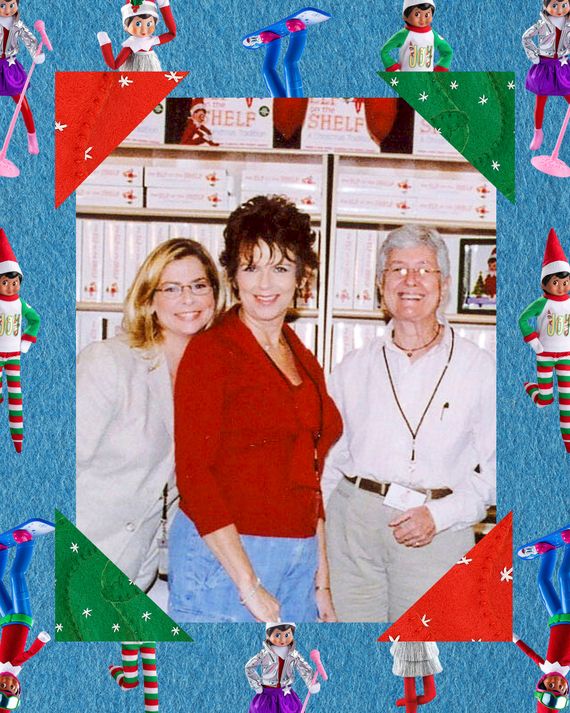
Until about 20 years ago, the Christmas character canon included the usual suspects: Frosty, Rudolph, the Grinch, and of course, Santa Claus himself. In the weeks leading up to December 25, children would pay their respects, revisiting beloved tales about the Island of Misfit Toys and Whoville, and writing letters destined for the North Pole. In the suburbs of Atlanta, however, two young girls anticipated a little elf named Fisbee most of all.
Throughout their childhood, Chanda A. Bell and Christa Pitts regarded Fisbee, a small vintage elf doll dressed in red and white, as a sort of scout to the Man in Red. According to their mother, Fisbee would fly back and forth between their house and the North Pole each night so he could report their wishes and behavior — both good and bad — to Santa. Upon the elf’s return each morning, he would choose a new hiding spot for the girls to discover when they woke up. “We anticipated the elf as much, if not more, as we did Santa’s own arrival,” Pitts recalls. “It was basically like Christmas morning every single day leading up to the actual day of Christmas.”
As the little girls became adults and started their own families, Fisbee remained perched in their parents’ house. Then, one day, he sparked an idea in Bell’s head: She and their mom, Carol Aebersold, should write a story about him and their cherished family tradition. They eventually shared their plans with Pitts, who joined them to imagine how an accompanying elf doll just like their Fisbee could fit into the picture.
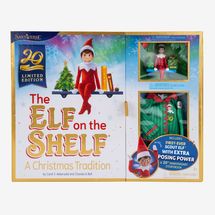
So goes the origin story of the Elf on the Shelf, who has since been featured as a balloon in the Macy’s Thanksgiving Day Parade and encrusted in Swarovski crystals in a limited-edition 20th-anniversary set. But in the early 2000s, when the family first envisioned the character, they had nothing to go off except their childhood memories and the 1950s pixie elf that Aebersold had inherited from her own mother. To understand how the Elf on the Shelf went from an outsider at holiday fairs to a Christmas tradition that young millennials and Gen-Zers are now passing on to their own children, I asked the sisters all about their little elf.
This conversation has been edited and condensed for length and clarity.
How long has this elf tradition been part of your family?
Christa Pitts: Our mother had an elf that became our elf. Our grandmother would say, “You guys, cut it out. That elf works for Santa.” So pieces of what people know today as the Elf on the Shelf were part of our family history.
How did the elf go from Fisbee to the Elf on the Shelf?
Chanda A. Bell: It started when I was working for my dad two days a week in his engineering and fabrication firm. His office was about two hours from where I lived, and I was a new mom staying at home, trying to make a little extra money. So I would go over, and I would spend the night with my parents and bring my son with me. It was during that time that I looked up and saw the elf that I grew up with sitting on a shelf, and I said, Hey, Mom, we should write a story about our elf. We spent the next several months writing when I would stay with them.
From the very beginning, we knew we were going to make a book and that it would come with an elf doll because the story was written as a how-to versus a traditional story. I brought the viewpoint of a child experiencing it, and my mom was able to bring the viewpoint of an adult, so we wrote the story together. And then it was like, Well, we’re going to have to get someone to illustrate this. What do we do next? And that’s when the real work began — not only figuring out how to put an elf from Santa Claus in this boxed set with a book, but also starting to form a business, raising money, and all of the things that go with that.
How did you get started?
Bell: We had no experience and no money, but we did buy a book that told us what to do. So we wrote a proposal and we sent it off. We got a phone call from an agent, and that agent took it to all the publishing houses, and they all passed on our project. I think adults, certainly, until they experienced it themselves didn’t get it. It’s the biggest joke in our family, but my own brother-in-law was like, That’s about the dumbest thing I’ve ever heard.
The publishing houses all had opinions; we were told it was destined for the damaged-goods bin. They also said, Maybe you want to let someone else write this for you. Those were the experts, and I was just a former schoolteacher — what did I know? But I remember a very specific moment when I dug in, and I was like, If this story is not going to be written the way that God gave it to us, then it’s just not going to be written. It was either this story or no story. So our agent ended up mentioning the idea of self-publishing. We had no idea what that meant, but we thought we had a really good idea, and we were passionate about what it could be and about sharing it with other families.
We realized that we needed a printer and, in our case, a doll manufacturer. Given that the combination of the two products was different from anything else on the market at the time, eventually we had to step into that role of being a publisher, finding a printer, and getting the boxed set made. Everything in the United States was far too expensive. At first, we met someone who offered to make a prototype for us with a $10,000 price tag we couldn’t afford. They might as well have asked for a million dollars. Then we found a connection who actually worked with a broker overseas, and she offered to develop the complete boxed set we originally envisioned.
How did the design of the actual Elf on the Shelf doll come about?
Bell: It was very important to us that the doll had a retro feel, that it felt special and traditional, that we were creating something that felt as nostalgic as our memories. But we didn’t really have any background; we didn’t know what we were doing. We weren’t working with any industrial designers or engineers back then.
So you designed the elf yourself?
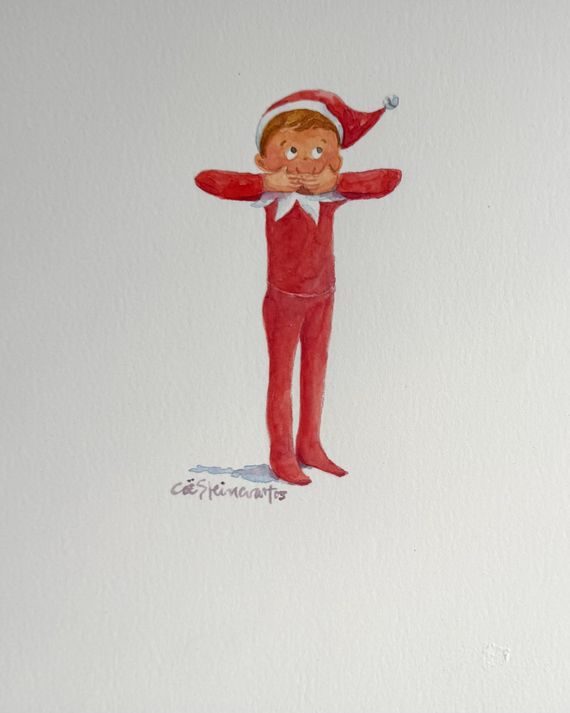
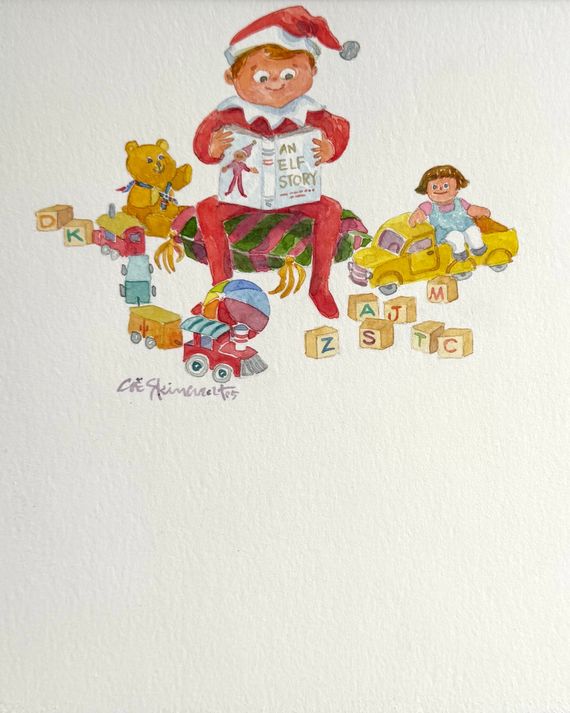
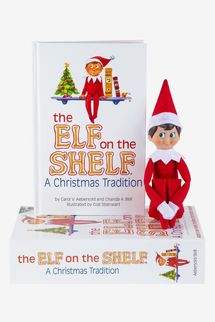
Bell: We worked with illustrator Coe Steinwart, who created drawings and watercolor art for both the book and the boxed set. To help with inspiration, we shared photos of my son, who had a small, little elflike face, and photos of the elf we had growing up to ensure the final art and elf provided a timeless, nostalgic feel and was different enough from earlierpixieelves. I ended up creating the packaging concept while on the phone with our sourcing firm based on a stationery set that was in front of me. The envelope sat on one side, while the stationery sat on the other, enclosed by a bow. This concept helped us share the fun of both the elf and his story — always together, never separate.
What elements did you pull from Fisbee for the original Elf on the Shelf?
Bell: Those sort of iconic pixie elves from the ’50s and ’60s are similar in look and feel. Our elf also wears a felt suit, which has been traditional with pixie elves. But the face is unique to our elf.
What did that first Christmas look like, when you introduced the Elf on the Shelf to the world?
Bell: The very first event was in September of 2005. We hosted a small book signing, and all of our friends and family were invited, and they came and they bought books, and then it was like, Now what? We’d managed to make 5,000 of these boxed sets. We had put it on personal credit cards. Christa sold her house.
How did you pitch it to potential customers?
Pitts: There was no social media, so we had to find another way to get the word out. We put together a website, and we started going to small Junior League markets and holiday fairs and selling these one by one out of our trunks and explaining to people what it was.
We would stop every single person that walked by, and we would give them our elevator speech, which was about 45 seconds long, and it explained how the Elf on the Shelf works: You give your elf a name. That’s how it gets its magic. It’s adopted into the family. It flies back and forth every night between Thanksgiving, sometimes December 1, and Christmas morning. And then on Christmas, the elf helps Santa deliver his presents and flies back with him to the North Pole until he comes back the following year. We had it down. Then we would show you the back page of the book, where you could officially adopt your scout elf.
Chanda and I did have an advantage in that we had experienced it as children, so we didn’t have any of that adult jadedness. We knew if parents got this into their home and they started using it, their kids would love it and believe in it just as much as we did.
How has the Elf on the Shelf changed over the years?
Pitts: I think, with many things in the Santaverse realm, they evolve over time. We had a lot of people reaching out to us and asking us various questions, and some were about the other elves at the North Pole: What did they look like? Are there girls? Are there boys? What is the story there? And so our world just evolved from that very first 2005 Christmas season.
Bell: Our target audience for a really long time was roughly 7 years old. It’s our sweet spot because kids really love, love, love their elf at that age. But we started realizing the age of adoption is actually much younger, when families — especially people who grew up with the Elf on the Shelf — are eager to bring it to their children. So people are adopting elves as early as 2. This year, we’re launching a YouTube show for those younger kids, which will be a new foray for us.
But since the beginning,we’ve stayed really consistent with the overall look: the solid red suit that the Elf on the Shelf wears, the white collar, the white mittens, the eyes to the side, the white rim on its little red hat. We knew we wanted to create a sense of nostalgia, and the combination of red and white is a visual connection point that reminds people of the holidays, Santa Claus, and joyful memories. Even when we introduced the female elf, it was really just with a skirt, and she’s got her earrings and her cute red lipstick on. But for the most part, the solid-red outfit really has become iconic with the character.
What is the inspiration behind that rule that you cannot touch the elf?
Pitts: We did have that rule growing up — and I think any busy parent, aunt, grandmother will understand this — because if kids touch things, particularly when they’re young, they lose them, drool on them, tear them apart, forget where they put them, right? It was a way of protecting the elf from the unknowns of the house. Also, not being able to touch it really helped it stay magical. It kept up this window of, I can play with all these other toys, but that elf has a job to do.
Do you have any tips for families who are just getting started with their Elf?
Bell: Reading the book is key because instead of just assuming it’s whatever you see online — and that might be what first attracted you to it — the story itself is a very simple premise. It can be a very simple tradition, or as complicated or as over the top as people want to make it.
New! You can now save this product for later.
What are your favorite ways that you’ve seen families do this?
Pitts: There’s a lot of stuff that happens in the kitchen: snow angels in either sugar or flour, sometimes baked treats or breakfasts that the elf helped out with a little bit, so you’ll see a little flour on the nose or on the hands. And then, of course, there are elaborate scenes where the elf will come back from the North Pole and is hanging upside down in your living room like he’s Spider-Man.
Bell: Some of the best stories we see are around complete meltdown moments from kids. The Rock has a very famous Instagram video where he accidentally touched the elf and the kids are going crazy. We have a book called Elftastrophe about how you can bring the elf’s magic back if someone touches it. You can either sprinkle cinnamon near the elf, you can sing a Christmas carol together, or you can write a letter of apology. Again, it’s just more time together.
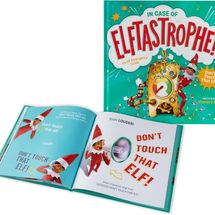
New! You can now save this product for later.
What characters from the Santaverse do you have in your homes today?
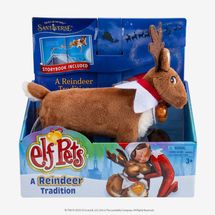
Pitts: My elf’s name is Belvedere. And then I have the pets: I’ve got my fox named Bailey, and my Saint Bernard is Scotch, and then I also have my reindeer, Soda.
Bell: My elves are Chimney and Snowflake. My kids are now 19 and 24, and on Thanksgiving, they’re like, Mom, where’s the elf? I’m like, Oh, he must have been caught in a snowstorm. I think that’s the fun of it — it’s a tradition you can never grow out of.
New! You can now save this product for later.
New! You can now save this product for later.
New! You can now save this product for later.
More From The Strategist
- Hark, the Advent Calendars Arrived (Very) Early This Year
- The Best Things Strategist Editors Have Bought This Year (So Far)
- 63 Things You Should Never Buy Full Price
- The Strategist Fall 100
The Strategist is designed to surface useful, expert recommendations for things to buy across the vast e-commerce landscape. Every product is independently selected by our team of editors, whom you can read about here. We update links when possible, but note that deals can expire and all prices are subject to change.