The 5 Very Best Dehumidifiers
Dry out your basement, ventless bathroom, or damp bedroom.
Save this article to read it later.
Find this story in your account’s‘Saved for Later’section.
Comment
In this article
Part of ensuring healthy indoor air quality is managing humidity. By itself, high humidity is a problem for the mold potential, but all that moisture in the air can increase the concentration of pollutants. “Humid air can contribute to the growth of mold, a common allergen, and dust mites also thrive in humid conditions,” says Melanie Carver, chief mission officer for theAsthma and Allergy Foundation of America.
But it can be tricky to manage humidity — after all, it’s not as ubiquitously tracked as temperature, and you can’t really see it the way you can dust or smoke. The EPA suggests keeping the level inside a house at 30 to 50 percent relative humidity. “Lowering the humidity to 30 percent can inhibit mold, pollen, mites, and those are triggers for allergy in some people with asthma or a sensitivity,” says Dr. Clifford Bassett, an allergist and immunologist atSchweiger Dermatology Group.
While long showers add some moisture to the air, if your home has consistently high relative humidity, the bathroom isn’t the likeliest source. Jay Lanzy, owner ofFresh Air Technologies, sees humidity wreak havoc on homes around Charlotte, North Carolina, where he addresses crawl spaces that can send that humidity into the house through air conditioning ductwork. “If you see peeling paint in the corners of a basement or efflorescence on the concrete or brick, it is a good indication of consistent high humidity,” he says. While a central air-conditioning system will also dehumidify, many homeowners don’t include the basement, which is usually cooler than the main living area, as part of that conditioned space.
Smell is also a good indication that you have a problem. “This is something that annoys me when people are dismissive about musty odors and basements,” says Mike Leggett, general manager ofBrickKicker, a home inspection service. “They say, ‘it’s just an old house with a musty odor,’ well that musty odor is a chemical produced by an actively growing mold.” Basements are the likeliest source of high humidity in a home.
In addition to speaking with four experts about the importance of dehumidifiers, I also tested six models, focusing on those made by reputable brands (Frigidaire, GE, Midea, TCL). After getting the relative humidity up to 60 percent in a small bathroom where I sealed the exhaust vent and air-conditioning supply, I ran each dehumidifier with the fan on high and timed how long it took to drop the humidity by ten points. We measured noise levels and tested performance with floor drains and pumps for models that had them. If a unit had a companion app, we tested connectivity and ease of use alongside the physical control panel.
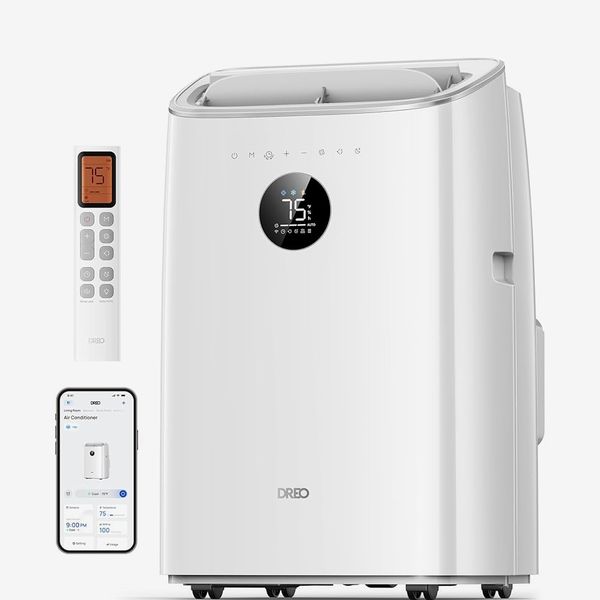
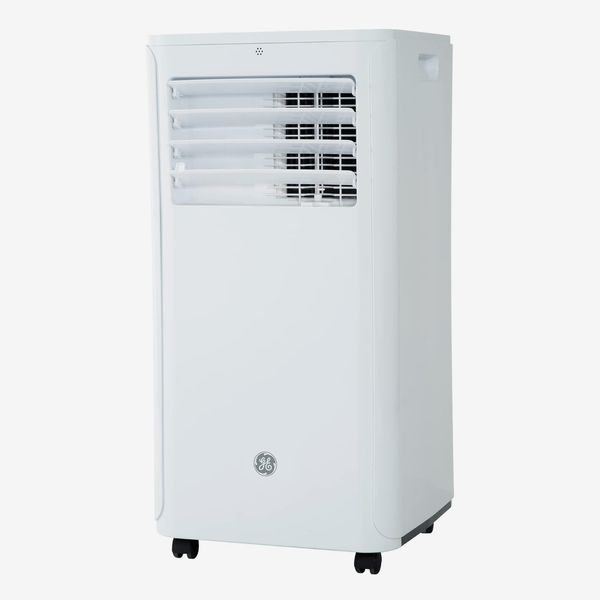
Whether you need to dry out your basement, ventless bathroom, or damp bedroom, I found the best dehumidifiers to do the job. (And if that space needs cooling as well, we found thatportable air conditionersare also very effective dehumidifiers.)
Updated on August 18, 2026
We still stand by all of our dehumidifier favorites, which have been updated with the latest availability and pricing.
Ourtoppicks
Whatwe’relookingfor
Capacity
Choose one that can, at minimum, handle the square footage of the space you want to dry. Manufacturers usually list square footage alongside the number of pints of moisture the unit removes per day. While there’s no strict industry standard for sizing, smaller models typically remove less than 30 pints per day and work well in spaces of up to 600 square feet. Medium-size units remove 30 to 40 pints daily and suit rooms up to 800 square feet. The largest models — those often used in basements — pull 40, 50, or more pints per day and treat areas 1,200 square feet or larger.
Don’t hesitate to size up if you have the space. Unlike an oversize air conditioner, which may cool a room too quickly without removing enough moisture, a larger dehumidifier dries the space faster — though it will use more energy to do so.
Energy efficiency
As with most major appliances, it’s smart to choose an Energy Star–rated dehumidifier. These models include a secondary efficiency value called Integrated Energy Factor (IEF), which replaced the older Energy Factor (EF) metric in 2019. EF measured how many liters of water were removed per kilowatt hour, but IEF offers a more accurate picture of annual energy use by also accounting for power consumed when the compressor is off but the fan is still running. Generally, the higher the IEF, the more efficient the unit. Energy Star–certified models list their IEF on the label or in online specs, while non-certified models may not disclose it.
Before June 2019, the Department of Energy tested dehumidifiers in 80-degree conditions at 60 percent relative humidity, resulting in the popularity of appliances with capacities of 50 to 70 pints. The updated test runs at 65 degrees to better reflect typical basement conditions, where cooler air holds less moisture, leading to more options for medium-size machines rated to remove 20 to 50 pints per day. To qualify for Energy Star labeling, dehumidifiers removing up to 25 pints per day must meet an IEF of at least 1.70; 25- to 50-pint units must hit 2.01 or better, and those over 50 pints must reach a minimum of 3.30.
Drainage
Many medium to large dehumidifiers offer continuous drainage via a hose — either 1/4-inch tubing (often included) or a threaded fitting for a 3/4- or 3/8-inch garden hose you provide. While both drain water from the unit automatically, saving you from remembering to empty a bucket, they differ in utility.
Models without a pump rely on gravity, so the hose must slope downhill to a floor drain. If the hose rises above the drain port, it may not empty properly. Pump-equipped models can push water up to 16 vertical feet, making them ideal for draining from the dehumidifier on the floor up and into a laundry sink or washing machine discharge. If the drain opening is narrow, as it might be if a washing machine ties into the home’s main drain, a pump model using 1/4-inch tubing may also fit better than dehumidifiers requiring a bulkier garden hose.
Defrost
If you’re dehumidifying a space where the temperature regularly dips below 65 degrees, it’s important to choose a model designed to operate efficiently in cooler conditions. When the air gets too cold, frost can build up on the unit’s coils, which can interfere with performance. This may cause the compressor to turn on and off frequently without actually removing moisture. Some models include a built-in anti-frost sensor that automatically shuts the unit off when temperatures drop too low.
Size
A dehumidifier’s size usually matches its power and the number of pints it can remove per day. Larger units are about the size of a domestic carry-on bag; medium ones tend to skew smaller, like an international carry-on. The room’s square footage tends to dictate what style, and therefore size, dehumidifier you should get. But checking both the machine’s size and its required clearance can help you figure out if it will fit in your room. Most units need 12 to 18 inches of space away from walls and about 24 inches above.
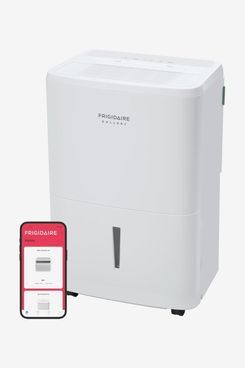
Best dehumidifier overall (for large spaces without a pump)
New! You can now save this product for later.
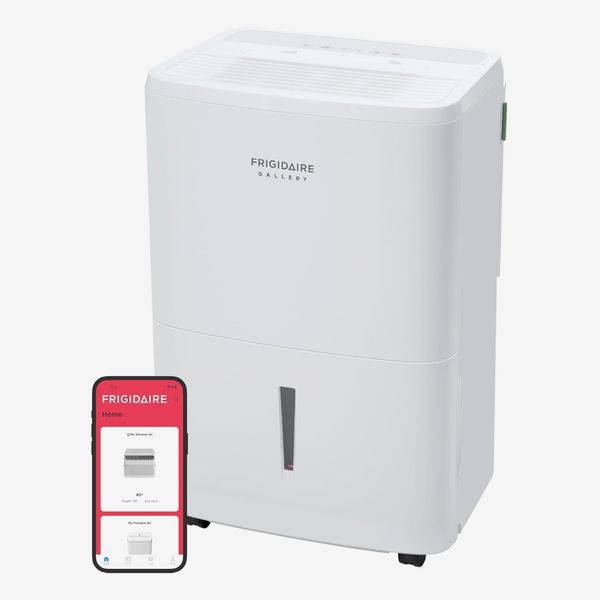
Capacity:50 pints; up to 4,500 square feet| Energy rating:1.8 IEF, Energy Star-certified| Drainage:Gravity| Defrost:Yes| Size:24 11/16” x 16” x 12 3/16”
If your basement has a floor drain, or you don’t mind emptying the bucket in a main-floor living space, the Frigidaire Gallery is a fast, powerful unit with an easy-to-use app. Its wheels glide smoothly on hard floors, and the center-mounted luggage-style handle makes the 42-pound unit easy to move. In testing, it dropped humidity by ten points in just six minutes, using about $0.06 worth of electricity per hour. The fan hit 61.8 decibels on high — about the level of normal conversation. That may be fine for a basement, but it’d be a bit distracting if you plan to use it in a shared living space.
Frigidaire’s app is well-designed, letting you remotely power the unit, adjust between four modes and three fan speeds, and set your target humidity. The dashboard shows real-time humidity, temperature, and a basic air quality rating based on particles 2.5 micrometers or smaller. The unit pulls air from the back and pushes it out the top — a common setup. Frigidaire recommends placing it at least 12 inches from walls, with 24 inches of clearance above. A 72-inch cord gives you flexible placement options. The unit also works with Alexa and Google Assistant for voice control. A red float indicator shows the bucket level, though it’s a bit hard to see in the dark.
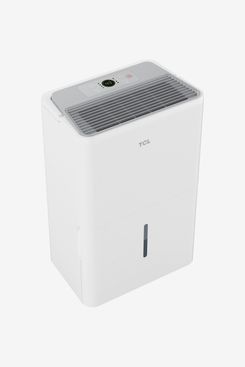
Best less-expensive dehumidifier (for large spaces with a pump)
New! You can now save this product for later.
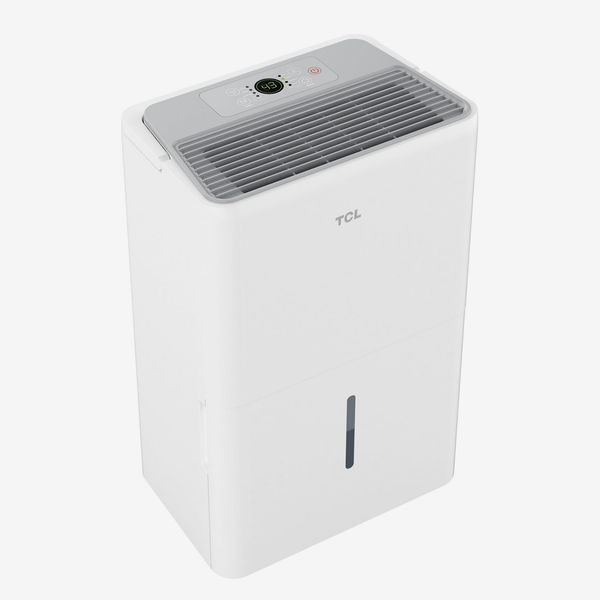
Capacity:50 pints; up to 4,500 square feet| Energy rating:2.01 IEF, Energy Star-certified| Drainage:Pump| Defrost:Yes| Size:15 3/8” x 24” x 12 15/16”
For basements without a floor drain, the TCL can pump water just over 16 feet vertically, which means it should easily handle draining into a laundry sink or wherever the washing machine discharges. The pump uses a narrower drain tube (included) that’s about 1/4-inch wide, but if you have a floor drain, you can thread on a wider garden hose and let gravity do the work.
During testing, the TCL took about twice as long as the Frigidaire Gallery — 11 minutes total — to drop the room’s humidity by 10 percentage points. It cost about $0.06 per hour to run, though it remained relatively quiet at around 65 decibels. The app is clean and straightforward, with remote shutoff. While it allows you to turn the pump feature on and off, we didn’t encounter many practical scenarios where that was useful.
For such a large machine — at 44 pounds empty, it was the heaviest in our test — it glides easily over smooth floors and rugs. It also has a fold-down handle that disappears when not in use. You can control the device through Alexa and Google Assistant, which is helpful if you don’t want to bother with the app. The dashboard is straightforward too.
We have a love-hate relationship with TCL’s bucket. It was the easiest to pour from, with a top that pops off easily, so you can wash out any mildew that might develop. But we wish the bottom was flat — if you set it down while it’s full of water, it tends to tip.
If you plan to place this in a living space, the design is clean and likely won’t stick out. However, for some reason, TCL placed a large silver sticker with model info and the Energy Star logo on the side instead of the back — not something you may want to look at. It also lacks a float that shows the current water level.
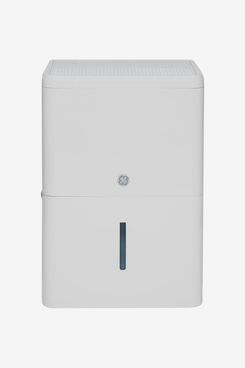
Best dehumidifier for medium spaces (without a pump)
New! You can now save this product for later.
Capacity:35 pints; up to 3,00 square feet| Energy rating:1.6 IEF| Drainage:Gravity| Defrost:Yes| Size:19 3/8” x 13 3/16” x 9 7/8”
The GE dehumidifier is about the size of a rolling carry-on bag, but it works fast — dropping humidity by 10 points in just six minutes during testing, which was tied for the second quickest of all the models. It’s not Energy Star-certified, which became clear when we discovered it consumed about $0.05 per hour to run, which was the second most expensive in our testing. That efficiency, plus the noise — it averaged 77 decibels on high from close range, which is similar to a vacuum cleaner — gives this unit old-school muscle car vibes. Still, the unit is compact, has a clean, modern, squared-off design that would likely fit unobtrusively in most living spaces, with four easy-gliding caster wheels that made it easy to move.
The Smart Dry mode, which adjusts fan speed to maintain your target humidity, ran noticeably quieter at lower speeds and was easier to live with. The rear mesh filter pops off easily for cleaning, though connecting the garden hose can be tricky if you have larger hands (use a wrench and take your time to avoid marring the plastic threads). While the unit doesn’t have Wi-Fi, the dashboard is simple and intuitive. One thing it lacks, though, is a float or clear indicator for water level — unless you’re close enough to spot the small green LED light, there’s really no way to tell it’s time to empty the bucket.
We also tested and likedFrigidaire’s 22-pint dehumidifier, which had a lot of the same features as our favorite 50-pint model, but it’s about the same size as the GE and holds less water, and it’s designed to treat 1,500 square feet. If you don’t need the GE’s capacity, and Wi-Fi control is important in a small-to-medium size model, the Frigidaire is easy to control, energy efficient, and very quiet, but it’s a bit slower to get the job done.
Best dehumidifier for medium spaces (with a pump)
New! You can now save this product for later.
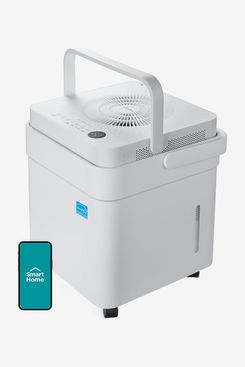
Capacity:35 pints; up to 3,500 square feet| Energy rating:1.9 IEF, Energy Star-certified| Drainage:Pump| Defrost:Yes| Size:14 1/2” x 14 1/2” x 14 3/4” nested (25 1/2” extended)
For all its quirks — and there are a few — the Midea is fast, quiet, and paired with a fantastic app that makes it easy to leave in the basement and monitor remotely from your phone. In our tests, it completed the dehumidifying task in just five minutes — the fastest in our test — using about $0.04 worth of electricity per hour. It was also the second-quietest model we tested, measuring under 60 decibels on high — slightly louder than a refrigerator. The app lets you power the unit on or off, view current humidity, adjust modes and fan speeds, and even check both the current water level. Midea includes an estimate of when the bucket will fill — helpful if you’re away from home. It was also the easiest unit to hook up to a garden hose, thanks to well-placed threads that were not recessed.
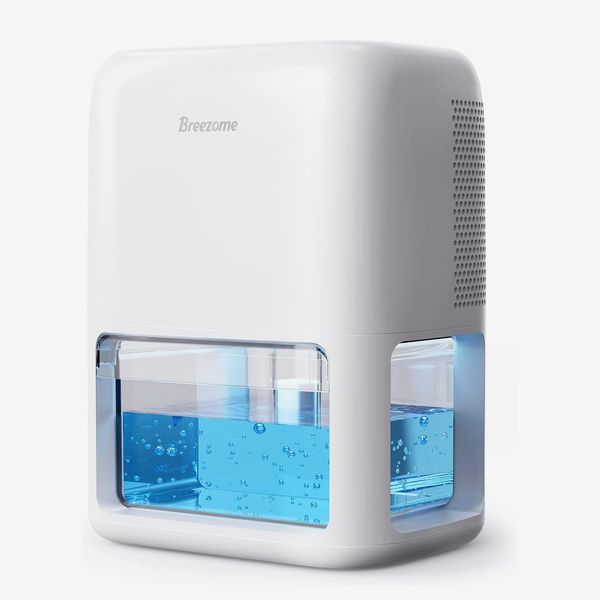
Best dehumidifier for a bathroom
New! You can now save this product for later.
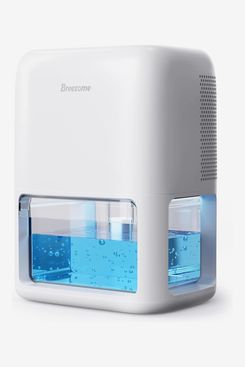
Capacity:60 ounces; up to 500 square feet| Energy rating:unknown IEF| Defrost:Yes| Size:6 1/4” x 8 5/8” x 11 15/16”
For bathrooms without a vent or window, the Breezome operates at a noise level comparable to a refrigerator. But in a small bedroom, the unit’s sleep mode drops the noise down to a soothing, fan-like white noise. During testing, the Breezome took about an hour to dry the room while consuming roughly $0.01 per hour in electricity. The unit features a timer on the dashboard so you can flick it on to run for 12 to 48 hours, making it convenient to work into a routine after you step out of the shower and leave for the day.
While every model tested can be turned on or off using a smart plug — which is a straightforward way to add remote convenience to units that don’t connect to Wi-Fi — the Breezome is an exception. A smart plug powers it on, but you must press the power button on the device to start it running. The Breezome’s LEDs cycle through seven different colors, including a blueish white. You can double-tap to select a color, which provides a nice, soft night-light-like glow, or turn the light off completely. Unlike some other dehumidifiers, the Breezome does not have a sensor to detect if the bucket is installed, so the unit will operate even if the bucket is not properly aligned.
Somemoredehumidifyingoptions
Ourexperts
• Melanie Carver, chief mission officer for theAsthma and Allergy Foundation of America
• Dr. Clifford Bassett, allergist and immunologist atSchweiger Dermatology Group
• Jay Lanzy, owner ofFresh Air Technologies, a home remediator
• Mike Leggett, general manager ofBrickKicker, a home-inspection service.
The Strategistis designed to surface the most useful, expert recommendations for things to buy across the vast e-commerce landscape. Some of our latest conquests include the bestacne treatments,rolling luggage,pillows for side sleepers,natural anxiety remedies, andbath towels. We update links when possible, but note that deals can expire and all prices are subject to change.
Every editorial product is independently selected. If you buy something through our links,New Yorkmay earn an affiliate commission.