The 6 Very Best Trekking Poles


Trekking poles provide extra stability and balance for hikers and trail runners, especially those traversing steep terrain. They can help reduce fatigue and minimize your risk of injury, and can even support ultralight tents that reduce pack weight in the backcountry. To find the best pairs of trekking poles for you, Strategist associate editor Jeremy Rellosa and I spoke to frequent thru-hikers and outdoor experts to get their recommendations for the poles they’d most recommend, then tested them out for ourselves. Below, you’ll find ultralight collapsible carbon poles that can be stashed in a daypack, sturdy aluminum poles that will save your knees without breaking the bank, and everything in between.
What we’re looking for
Material and weight
“Most trekking poles are gonna be aluminum or composite, which is partially or completely made of carbon,” explains Katie Gerber, a Colorado-based wilderness guide and author of Adventure Ready: A Hiker’s Guide to Planning, Training, and Resiliency. Gerber has hiked thousands of miles of trails in the United States. She explains that the primary difference between the two shaft materials is weight: “Generally, carbon poles are going to be lighter and help reduce the vibration in your hands.” Unfortunately, they’re also generally more expensive.
So is weight important? “For some people, weight might not matter at all, but as a long-distance backpacker, I care about the difference in ounces — it’s gonna be in my hands or on my back for hundreds, if not thousands, of miles on a trip,” Gerber says. Most poles that are best for long-distance backpacking weigh 16 ounces or less per pair, whereas models meant for hiking may weigh between 17 and 20 ounces per pair.
Adjustability
The shaft of nearly every pole on this list can be adjusted to fit your height and your preferred length for different terrain (some ultralight models are available in fixed lengths). “If you’re going uphill, you can shorten the pole a little bit. If you’re going downhill, you can lengthen the pole to break up your momentum from walking and give your joints a break,” Gerber says. “Whether you get an adjustable or a fixed-length pole, make sure that it’s able to be sized to you. If you’re walking on flat ground or rolling terrain, your elbows should be at a 90-degree angle while you grip the trekking pole.”
So that they can be stashed away easily when not in use, trekking poles are usually either telescoping or collapse into sections connected by an internal cable (usually one of these sections — most commonly the one closest to the grip — has a telescoping feature while the other sections don’t). Collapsible poles will take up less space in a backpack, but they tend to be more expensive than simpler telescoping ones and offer slightly less height adjustability.
Grip and tip
Trekking-pole grips are generally made from foam, cork, or rubber, says Gerber: “They’re different in how they resist moisture and vibration. They have different softness. If you have super-sweaty hands or something, maybe you want a foam grip that’s going to prevent water from getting in it. Some people really like the feel of cork and how it sort of molds to your hand over time.” Trekking poles will also have either round shock-absorbing rubber tips or pointy and precise metal tips. Pointy tips are more durable and, because they literally stab into the ground with each step, provide additional stability on uneven and icy terrain. For many trails, these pointy tips are overkill — it’s also worth noting that they will tear a hole in your backpack if you’re not careful. Most trekking brands therefore sell rubber tips that slip over the top of your pointy ones, and these are worth investing in both to protect your bag and if you’re hiking on gentler trails some of the time.
Baskets
The umbrellalike protective discs above your trekking pole tips are called baskets. Generally removable and replaceable, these help prevent mud and dirt from splashing up onto your hiking pants, and on very soft terrain they’ll stop your hiking poles from sinking in too deep. Some brands offer optional wider baskets designed explicitly for trekking in snow.
Best overall trekking poles
New! You can now save this product for later.
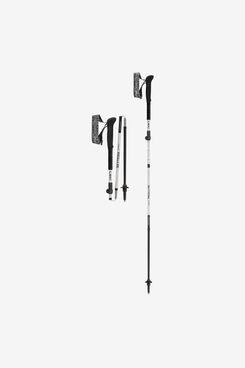
Material and weight: Carbon, 6.3 oz per pole | Adjustability and collapsibility: 43”-51”, collapsible into four 15” segments | Grip and tip: Foam grip, carbide tip | Baskets: Interchangeable, sold separately
I recently completed the 100-mile Tour du Mont Blanc using these ultralight collapsible Leki poles, which also come recommended by Gerber and Strategist senior editor Winnie Yang. Quite simply, I couldn’t have done so without them. Even though they’re made from carbon and held together by a tension wire, they are far sturdier than aluminum telescoping poles that I’ve used in the past. I was able to rely on them completely during steep and rocky ascents and descents; they saved me from falling more than once and generally gave me a confidence boost on tougher sections of the trail. Weighing almost nothing, they were comfortable to grip and never made my arms feel tired for even a second.
The main draw of these poles, though, is how little space they take up when fully collapsed. (A process that isn’t actually so intuitive the first time you do it — watching a video helps.) This was particularly useful for me when undertaking a long international trip where I was packing for both a hiking trail and beach vacation afterward. They’d have fitted easily into a small carry-on bag, but TSA agents tend to take issues with sharp-tipped hiking poles, and I decided against taking that risk. (Although many travelers now say that rubber-tipped ones should be okay thanks to a recent rule change.)
Best less-expensive trekking poles
New! You can now save this product for later.
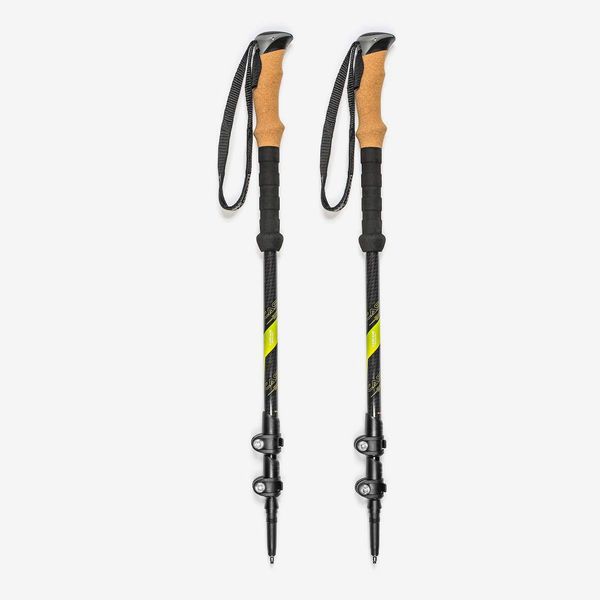
Material and weight: Carbon, 5.6 oz per pole | Adjustability: 30”-52” telescoping length | Grip and tip: Foam or cork grip, carbide and rubber tips included | Baskets: Interchangeable, snow and mud included
Cascade Mountain, says Gerber, makes “a good carbon pole, and it’s pretty lightweight.” She recommends the brand to any casual or budget hikers looking for stability on the trail. While these telescoping poles don’t collapse into segments like the Lekis above, each still retracts to around 30 inches, which is decent enough for attaching to the outside of a backpack. The brand also provides incredible value for the money by including a set of interchangeable snow baskets, mud baskets, and rubber protection tips with each set, rather than making customers purchase them separately.
Best telescoping trekking poles
New! You can now save this product for later.
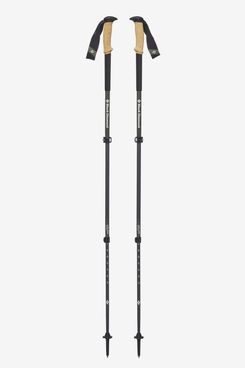
Material and weight: Carbon, 8.5 oz per pole | Adjustability: 24”-51” telescoping length | Grip and tip: Cork grip, carbide tips | Baskets: Interchangeable, sold separately
Collapsible trekking poles are expensive as well as a little fussy to assemble. Just want a pair of sturdy poles that don’t weigh too much, pack up fairly small, and don’t cost more than $200? These are the ones. “I’ve tested a lot of poles and some are just more complicated than they need to be. I like Black Diamond’s Alpine Carbon because they have a straightforward design that everyone can understand,” says Graham Averill, a freelance writer and outdoor-gear expert. “The cork handles are comfy and it’s easy to choke up on them when you’re climbing something steep.” The Black Diamond Alpine Carbon Cork is one of Gerber’s top recommendations as well. “It’s very good and very highly rated by a lot of our guides,” she says. The simple, three-part telescoping shaft is secured by two sturdy flick locks on each pole that are easy to use.
Best aluminum trekking poles
New! You can now save this product for later.
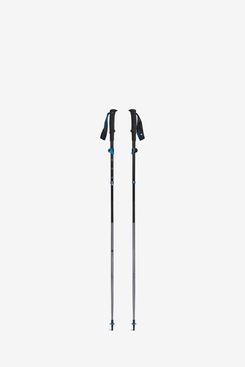
Material and weight: Aluminum, 5.2 oz per pole | Adjustability: Four fixed lengths, collapsible into three segments | Grip and tip: Foam grip, carbide and rubber tips included | Baskets: Interchangeable
This pair of aluminum Black Diamond poles comes recommended to us by outdoor-gear expert and writer Ebony Roberts, who uses them as her main pair: “They’re lightweight yet sturdy and have a foldable shaft that makes stashing them in or on a backpack easy,” she says. Other than the relatively lighter weight compared to other aluminum (and even carbon) poles, she likes that the foam grips are comfortable and “don’t make my hands sweaty if I’m out in the hot sun all day.” She adds that the poles lock firmly in place and are reliable on slippery descents, “and especially useful when wearing a kid carrier.” Strategist associate editor Jeremy Rellosa adds that the fixed shaft length (he opts for the 120-cm. option) means these poles have fewer moving parts to break compared to more adjustable poles.
Best trekking poles with extra shock absorption
New! You can now save this product for later.
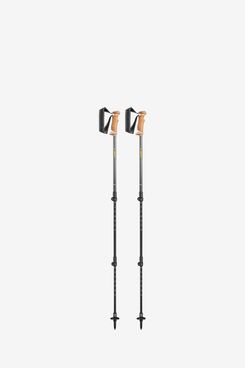
Material and weight: Aluminum, 5.5 oz per pole | Adjustability: Shaft adjusts 39”-53”, telescopes to 27” | Grip and tip: Cork grip, elastomer tips | Baskets: Interchangeable
This pair of Lekis has a light anti-shock (that’s what the AS stands for) system toward the tip of the pole that works like a cushion that flexes upon impact. It’s a solid pair that comes recommended by outdoor writer and gear tester Miyo McGinn. “They’re good quality, and if you want all the bells and whistles, these deliver. Interchangeable powder baskets and teeny trekking baskets let me use them year-round for ski touring as well as hiking; the little levers for retracting and expanding are micro-adjustable, really sturdy, and can maintain a lot of pressure. If I screw them on really tight, they don’t retract when I put my full body weight on them. Friends with adjustable poles will comment on how their poles get shorter over the course of the day — mine never do,” she says. “The one feature I wish I had was longer grip. It’s only one hand-sized, but a hand-and-a-half or double-hand-length grip lets you find more angles/lengths without adjusting the length of the pole.”
Best trekking poles for ultralight backpacking
New! You can now save this product for later.
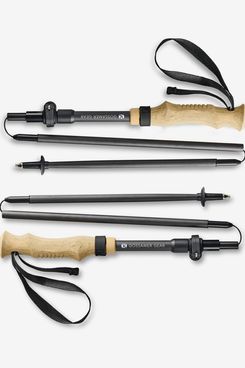
Material and weight: Carbon, 6.2 oz per pole | Adjustability: Shaft adjusts 45”-51”, collapsible into three 15” segments | Grip and tip: Foam grip, carbide and rubber tips included | Baskets: Interchangeable
These days many thru hikers are saving on pack weight by carrying their tent poles in their hands. By this I mean they’re using trekking pole-supported ultralight tents that can be pitched using pretty much any adjustable-length trekking poles out there, rather than separate tent poles. For beginners, I recommend matching your tent and pole brand for optimum compatibility, and Gossamer Gear makes that process easy. Its one-person and two-person backpacking tents (straightforwardly named the One and Two) work well with these matching collapsible carbon poles. You simply adjust the shaft to the length marked by a tent icon, then proceed from there. Easy tent pitching aside, these are comfy and grippy poles that weigh almost nothing, and their collapsible sections make them easy to pack for any adventure.
Our experts
• Graham Averill, freelance journalist and outdoor-gear reviewer
• Katie Gerber, Colorado-based wilderness guide and author of Adventure Ready: A Hiker’s Guide to Planning, Training, and Resiliency
• Miyo McGinn, freelance journalist and outdoor-gear reviewer
• Ebony Roberts, freelance journalist and outdoor-gear reviewer
• Winnie Yang, Strategist senior editor
Additional reporting by Jeremy Rellosa.
The Strategist is designed to surface the most useful, expert recommendations for things to buy across the vast e-commerce landscape. Some of our latest conquests include the best acne treatments, rolling luggage, pillows for side sleepers, natural anxiety remedies, and bath towels. We update links when possible, but note that deals can expire and all prices are subject to change.