The 7 Very Best Portable Chargers

In this article
Whether you’re trying to get through one more Zoom meeting from the park or trying to hail an Uber at 2 a.m., you want to make sure your phone and laptop is charged — and that’s where a capable, reliable portable power bank comes in.
The best portable charger for your needs has plenty of capacity to keep your devices charged (or even charge them multiple times), the ability to do that quickly, and enough ports to handle everything you need to keep alive. High-capacity power banks can power a laptop and charge your device several times, but they are big and expensive, while ultracompact chargers fit into a pocket with just enough capacity to top up a phone.
One thing that’s certain about choosing a portable charger is that you want to know where it comes from so you don’t fry your phone. You can find tons of battery packs from unknown brands on Amazon, but I would recommend choosing a brand that has a yearslong reputation for building reliable products that last. (This is a category in which it matters — you don’t want to risk a no-name device that may overheat or worse.) Anker is one of the best-known brands, but companies like Belkin, Mophie, BioLite, EcoFlow, Nitecore, and Moft also make good chargers.
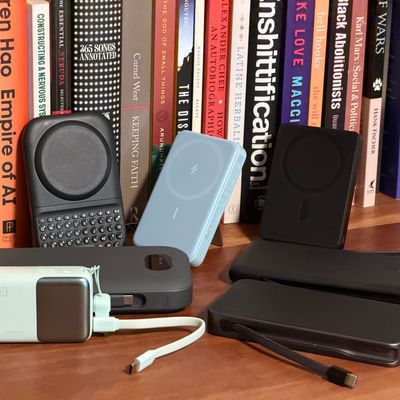
To find the best options, I tested more than 30 power banks and portable chargers while going about my days.
Updated on September 18, 2026
Mophie’s Powerstation Plus 10K (Signature Series) is our new best portable charger overall. I’ve also added Belkin’s BooseCharge Plus 10K as the best less-expensive portable charger, Iniu’s Pocket Rocket as the best compact portable charger, Anker’s 633 as the best wireless charger, Belkin’s UltraCharge Pro as the best portable charger for laptops, and the Clicks Power Keyboard as the best portable charger with a built-in keyboard. Finally, I’ve added a couple alternative picks for wireless chargers, and ensured that all our other picks are in stock and the prices are up to date.
What we’re looking for
Ports and wireless charging
A portable charger should have at least one USB-C port to plug a cable into, but we looked for chargers with extra ports, built-in cables, or wireless charging via Qi 2 and MagSafe. Those additions typically impact the shape of the charger. A device that prioritizes wireless charging will have to be compact enough to fit on the back of a phone, and one with built-in cables needs enough room to store the cables when they are not in use. Keep in mind that wireless charging is slower and less efficient than hooking up a cable, and it can overheat your phone if left attached for too long. For compatibility with older cables and gear you’ll want to look for portable chargers with USB-A ports (though most companies have abandoned them in favor of USB-C ports, which are more modern and allow for a slimmer design).
Capacity
Many power banks have a capacity of at least 5,000 milliamp hours (mAh). That’s barely enough to charge an iPhone 17 Pro Max (which has a capacity of 5,088 mAh) one time. If you want one that’ll charge your phone more than once, a portable charger with 10,000 mAh is a better choice. Some power banks can even recharge a laptop, though you’ll have to double check your laptop’s battery capacity (an M1 MacBook Pro has roughly 5,152 mAh) as well as its wattage requirements (see below) to make sure it can give you a full recharge.
Charging speed
Charging speed is determined not only by the charger output, but also by the charging rate the device (and charging cable) can accept. For a phone, a power bank that delivers 18W or more is considered fast-charging, meaning you can get your smart phone from 0 to 50 percent in about half an hour (though this may not be true in very hot or very cold environments). Laptops require 60 to 80W for charging, so be sure to look out for chargers with faster speeds if your laptop frequently needs recharging.
I also considered the method by which you actually charge the power bank; every one I recommend can be charged using a USB-C cable, but most will require you to carry a power brick with you to recharge it. Some chargers, however, have built-in A/C plugs so you can plug it directly into the wall like a regular charging brick and refuel while your phone is charging — and usually at a higher speed to boot.
Weight
A heavy portable charger isn’t truly portable, so for chargers meant for phones and other mobile devices, I only considered options that weighed around half a pound or less. For higher-capacity laptop chargers, I considered ones that weigh just over a pound, but only if they could charge a laptop at least twice.
Passthrough charging
Power banks with pass-through charging are able to charge other devices while being charged themselves.This is particularly handy when traveling. You can charge both your power bank and phone overnight using a single outlet (and if you get one with multiple outlets, you don’t have to pack a power strip and charger for work trips).
Best portable charger overall
New! You can now save this product for later.
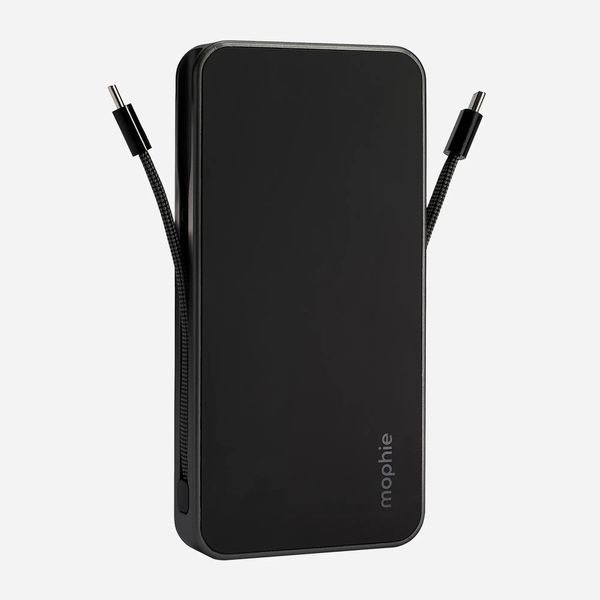
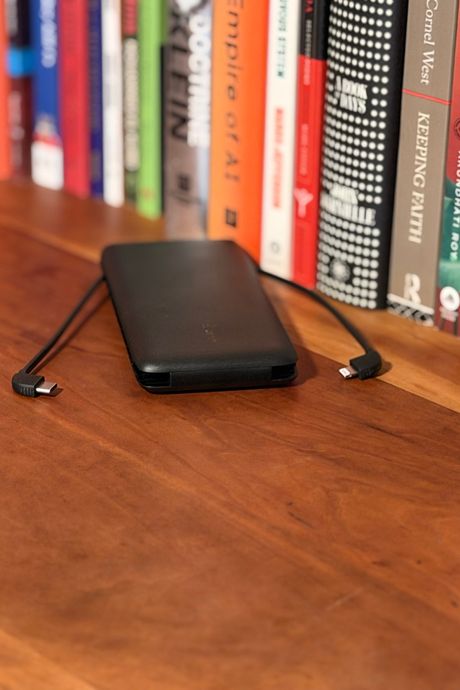
Ports and wireless charging: USB-C port (1); built-in USB-C cable (2) | Capacity: 10,000 mAh | Charging speed: 30W | Weight: 0.55 pounds | Passthrough charging: Yes
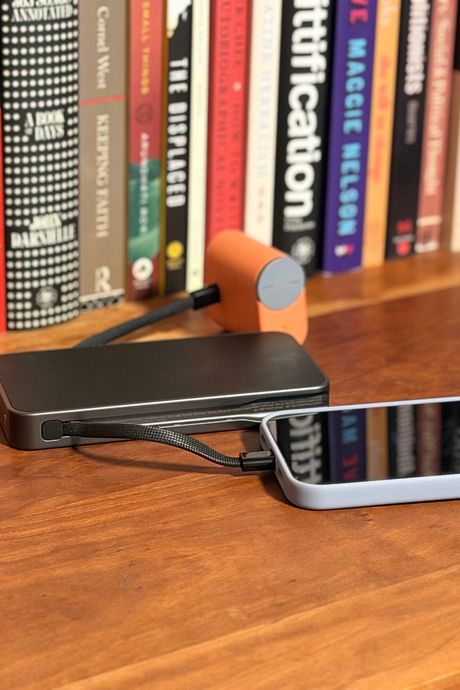
While many brands use labels like “Signature Series” to charge a premium for devices with negligible benefits over the regular model, Mophie’s fancy line of chargers features genuine improvements with an attention to detail you’d expect of a flagship product. The body of the Powerstation Plus 10k is made of soft-touch plastic that’s quite pleasant and secure to handle compared with the cheaper-feeling plastic of the BoostCharge Plus, with borders that give the charger a refined metallic look. I’ve dropped it a couple times, and it still looks new.
The Powerstation has a single USB-C port that supports fast charging up to 30 watts, but there are also two built-in cables that save you the trouble of carrying extra charging cables. They’re made from a braided fabric that’s tougher and more elegant than the Belkin’s rubber-coated cables. When not in use, the cables are held in place by magnets on the connectors, which provide a satisfying click that’s both secure and makes the device a worthy fidget toy. Handy as they are, the cables are quite short, so you can’t keep this in your back pocket and charge your phone unless you use an additional cable. If you’re on the go, you’ll want to keep your phone charging in a jacket pocket or bag.
With a 10,000 mAh capacity, the Powerstation can charge an iPhone 17 Pro twice with a bit of juice to spare. If you need to charge multiple devices at once, you can use both built-in cables and the USB-C port to charge up to three devices simultaneously.
My only complaint: The Powerstation’s soft-touch finish is an absolute fingerprint magnet. If you have oily fingers, you’ll likely need to wipe this charger down after you’re done using it. Even so, the overall premium feel of the Mophie’s materials makes up for that inconvenience. It isn’t enough to detract from how nice it looks.
Best (less expensive) portable charger
New! You can now save this product for later.
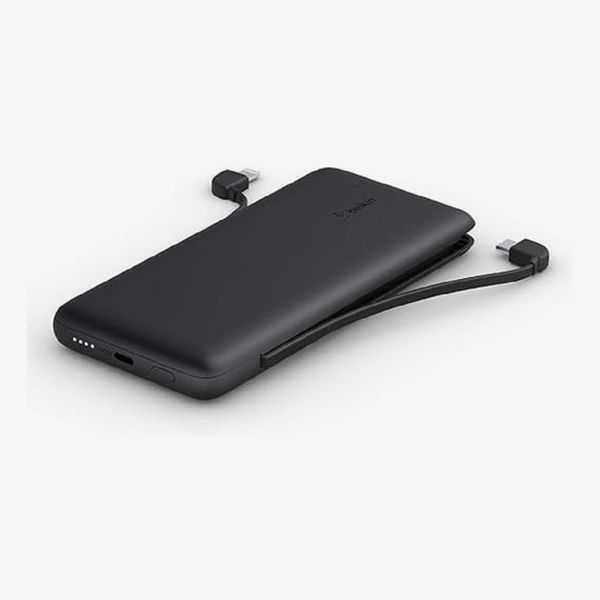
Ports and wireless charging: USB-C port (1); built-in USB-C cable (1); built-in Lightning cable (1) | Capacity: 10,000 mAh | Charging speed: 23W | Weight: 0.66 pounds | Passthrough charging: Yes
If you have an old iPhone with a Lightning connector that’s always in need of a boost or just want to spend a little less, Belkin’s Boostcharge Plus 10k offers nearly all the same core features as the Powerstation Plus — with just a bit less polish. It’s slightly taller and a tad thinner than the Mophie, but its textured plastic shell isn’t as nice to touch.
Like the Mophie, this charger has two built-in cables: one USB-C and an antiquated (backward-compatible) Lightning cable for older Apple devices. Both are coated in a rubbery material that lacks the elegance of the Mophie’s braided cables. Additionally, they require more guidance to be placed back into their slots when not in use. You have to drag your finger down the cable to get each piece in place, whereas the Mophie’s cables just snap right back.
Best compact portable charger
New! You can now save this product for later.
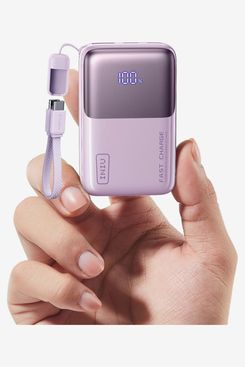
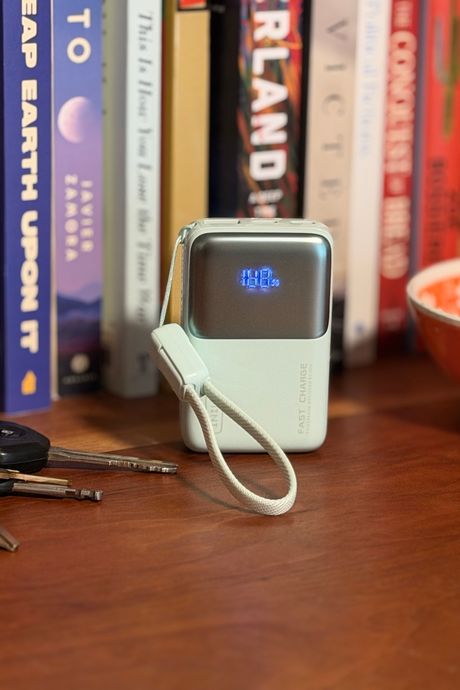
Ports and wireless charging: USB-C port (2); USB-A port (1); detachable USB-C cable (1) | Capacity: 10,000 mAh | Charging speed: 45W | Weight: 0.35 pounds | Passthrough charging: Yes
INIU’s Pocket Rocket is as practical as it is charming. Its footprint is smaller than a credit card’s — though it’s about as thick as a deck of playing cards — and it can easily fit in a small pocket. There are three ports: two USB-C ports and one USB-A. Unlike the Powerstation or Boostcharge, it doesn’t technically have a built-in cable, but it does come with a detachable USB-C to USB-C one that acts as a loop you can hook onto a carabiner or keychain when not in use.
While the Mophie and Belkin both use four-dot indicators to give a rough estimate of how much power they have, the Pocket Rocket has an alphanumeric display that shows an accurate percentage. That makes it a bit easier to determine whether you can give your device a full boost, and the screen’s frosted finish is nicer to look at.
The Pocket Rocket comes in an assortment of fun colors, including black, white, light green, light blue, light pink, and light purple.
Best wireless portable charger
New! You can now save this product for later.
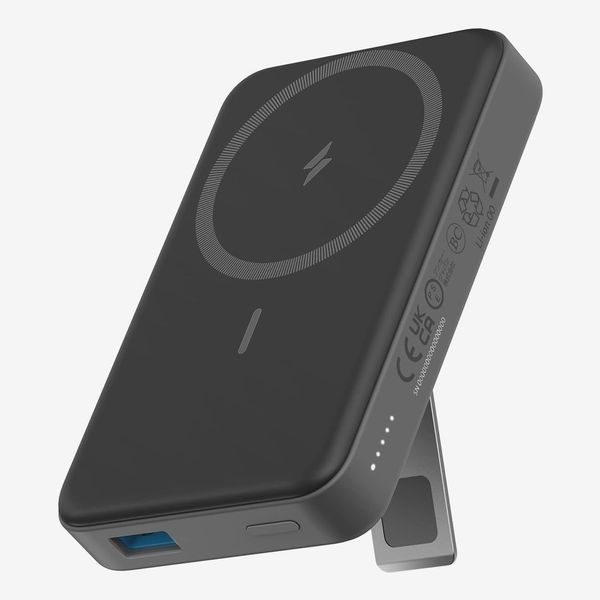
Ports and wireless charging: USB-C (1); USB-A (1); MagSafe and Qi 2 | Capacity: 10,000 mAh | Charging speed: 7.5W (wireless), 20W (wired)| Weight: 0.48 pounds | Passthrough charging: Yes
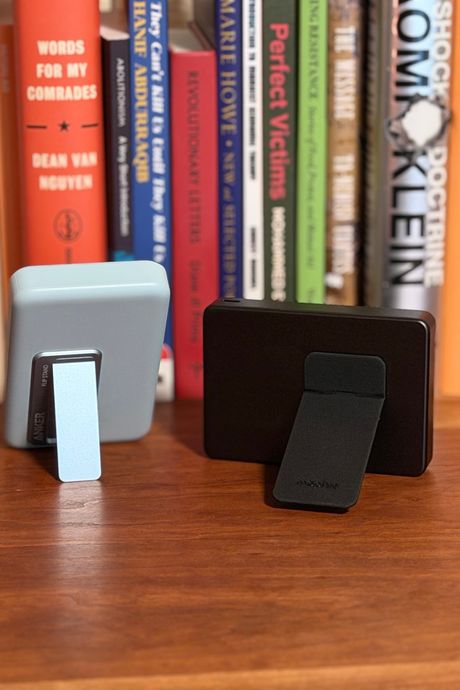
For charging my phone on the go without a cable, I like Anker’s 633 magnetic charger. It has the polish of Mophie’s Powerstation (without the built-in cables) and has a kickstand to hold your phone up for hands-free viewing. In addition to wireless charging, the 633 has one USB-C port and one USB-A port in case you’re clinging to some old cables. Using all three allows you to charge three devices simultaneously. The wattage does vary, however, for each method. The USB-A port maxes out at 18 watts, the USB-C port can charge up to 20 watts, while the wireless charging pad is limited to just 7.5 watts. That means it’s not as fast as some other wireless chargers (such as the Mophie Powerstation), but it’s quick enough to give your phone a boost in times of need. The magnets are quite strong, so it’ll stay attached to your phone.
It’s a nice addition, but I wish the Anker’s kickstand were as sturdy and adjustable as the Mophie’s Powerstation Wireless Stand. The 633’s kickstand folds out vertically (just like the Mophie’s) and can be positioned at nearly any angle, but it’s made from a thinner metal that doesn’t stay as firmly in place. The stand itself isn’t too wobbly, but I’m more worried about its longevity than the Mophie’s. And for the nitpickers, it’s worth noting that when attached to the back of my iPhone 17 Pro without a case, the 633 hung just below my iPhone’s lip. You won’t notice this unless you use your phone while it’s charging, but once you see it, you can’t unsee it, and if you’re picky — but not picky enough to have your phone in a case — you may find it unseemly.
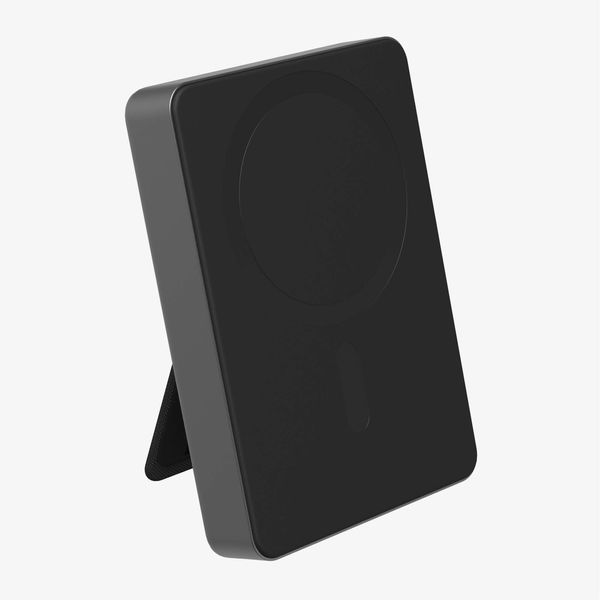
New! You can now save this product for later.
Like our overall best portable charger, Mophie’s more expensive Powerstation Wireless Stand has a polished look and feel, and it feels a lot fancier than Anker’s 633. It’s made of an anodized aluminum rather than the Anker’s soft-touch plastic, and its kickstand is both nicer to use and more functional. The stand can be propped up at any angle just like the 633’s, but this one can also rotate to four different positions (think of a cross), so you can use it horizontally or vertically. I also like that it features a fabric finish, and that Mophie cleverly hid all the ugly logos and technical jargon on the back of the stand so you never see it.

New! You can now save this product for later.
Handy as wireless chargers are, they’re often quite bulky. Not so with Anker’s incredibly thin Nano Power Bank, which is only 0.34-inches thick. It has half the capacity of the Anker 633 —enough to charge an iPhone 17 Pro Max from 0 back to 100, but it also won’t be as noticeable in your pocket. If all you need is something to make sure your phone makes it to 2 a.m. when you need to call a Lyft, you’ll be grateful for the Nano’s portability.
Best portable charger with a built-in A/C plug
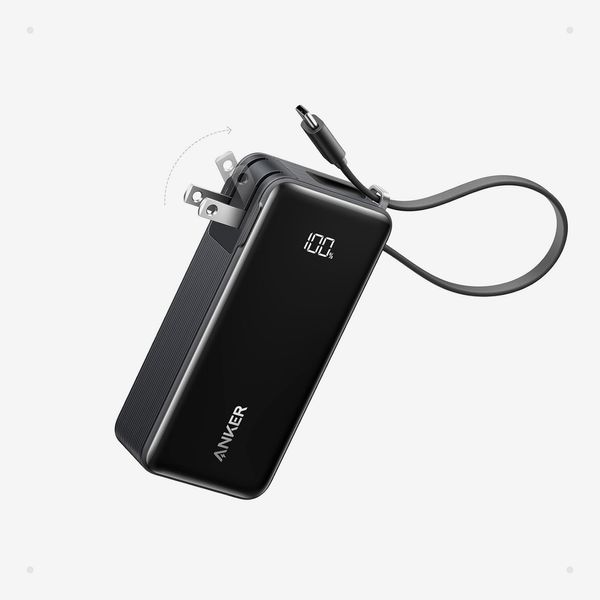
New! You can now save this product for later.
Ports and wireless charging: USB-C (2) | Capacity: 10,000 mAh | Charging speed: 30W (unplugged) | Weight: 0.31 pounds | Passthrough charging: No
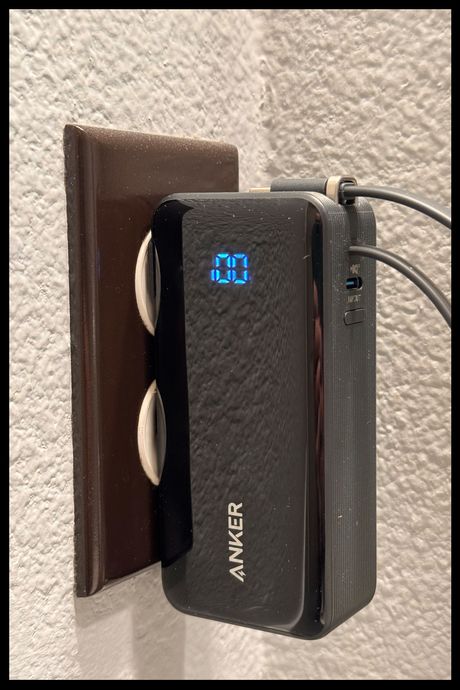
If you want something with a built-in A/C plug so you don’t have to carry a separate power brick, get the Nano 3-in-1, which has a fold-out A/C plug so it can go directly into an outlet. The on-device USB-C cable is longer than the Belkin’s, so it’s easier to use your device while it’s plugged in. There’s also one USB-C port that you can use to plug in another cable and charge two devices at once.
At the top of the charger is a small metal loop that holds the tip of the cable in place when you’re not using it, and while it’s clever, I do wish there was some sort of built-in wrap or other management system so the cable doesn’t just dangle when it’s not plugged in, as that leaves it more vulnerable to damage. And since the cable isn’t replaceable, you’ll have to get a whole new charger if it ever breaks.
Best portable charger for laptops
New! You can now save this product for later.
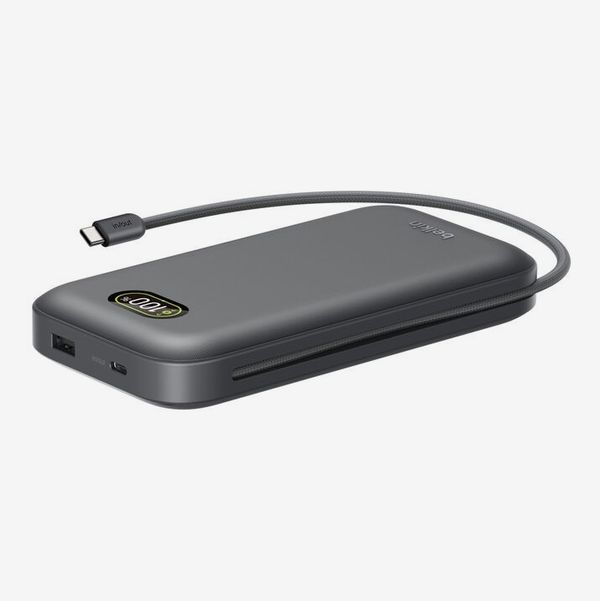
Ports and wireless charging: USB-C (1), USB-A (1), Built-in USB-C cable (1) | Capacity: 27,000 mAh | Charging speed: 140W | Weight: 1.3 pounds | Passthrough charging: Yes
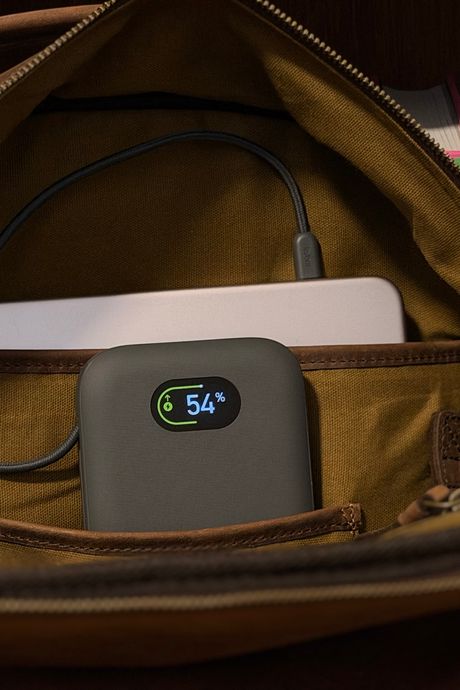
For those who need to work or play on the go and frequently run their laptops down to zero percent without an outlet nearby, Belkin’s UltraCharge Pro has enough power to bring it back to 100. Because its capacity is nearly triple that of chargers like the Mophie Powerstation, it’s noticeably larger and heavier, but it won’t weigh your bag down too much. Its plastic shell feels like somewhere between the Boostcharge and the Powerstation; it doesn’t feel cheap, but it’s not particularly fancy either. Like our best portable charger overall, this one has a built-in cable that’s coated in a durable braided material. It’s longer than that of the Mophie, so you can plug it into your laptop while it’s in a backpack and it should reach — I tested it with five backpacks and it worked with each one.
With a capacity of 27,000 mAh, it has enough juice to recharge a MacBook Air or Neo multiple times. And just to be sure, there’s a display on the front to tell you how much charge is left on the battery pack itself. There’s even a fun animation that fills the edge of the screen with a green line to coincide with the percentage — if it’s at 50 percent, the line will cover half of the screen’s edge.
New! You can now save this product for later.
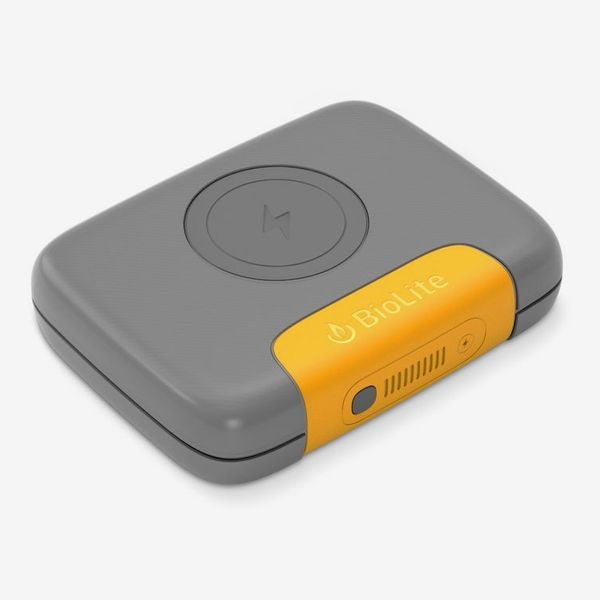
Although it has a slightly lower capacity than the UltraCharge, and it doesn’t have a built-in cable, the BioLite Charge 100 Max can charge a total of five devices at a time. That’s more than any other charger we’ve recommended, and it is perfectly suited for scenarios where multiple people need a boost, like a party or camping trip (its outdoorsy aesthetic certainly doesn’t hurt). It has three USB-C ports, one USB-A port, and a Qi 2 charging pad, though they can’t all charge at the same speed. Two of the USB-C ports cap out at 100W for laptops and tablets, while the third only goes up to 15W, as do the USB-A port and wireless charging pad, meaning those are best reserved for phones and other smaller devices.
Best portable charger that’s also a keyboard
New! You can now save this product for later.
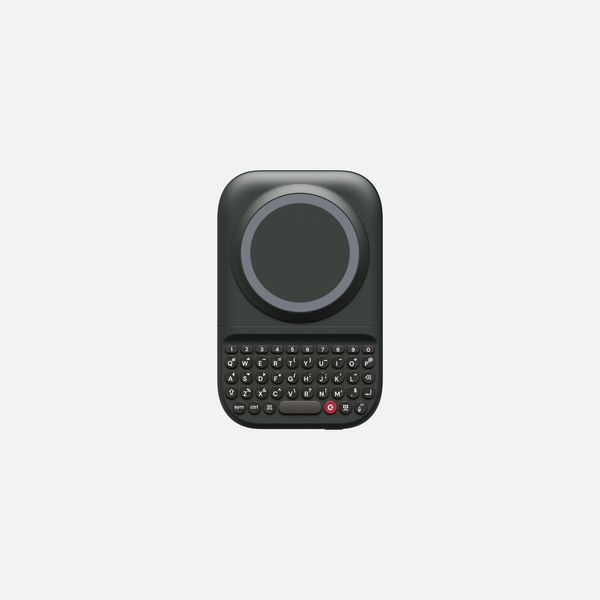
Ports and wireless charging: USB-C (1); Qi 2/MagSafe | Capacity: 2,300 mAh | Charging speed: 5W | Charging input: USB-C | Weight: 0.39 pounds | Passthrough charging: Yes
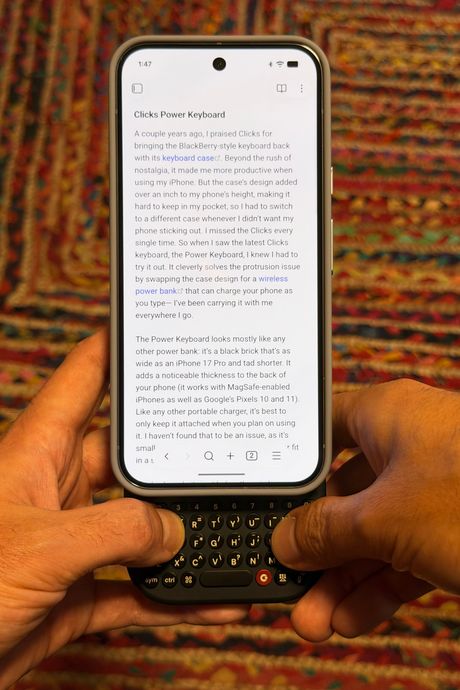
While this shouldn’t be your primary charger if your phone regularly sits at 15 percent, the Clicks Power Keyboard has a retro charm that’s hard to resist. It also makes you more productive when you use your phone. Unlike most portable chargers, which serve the single purpose of bringing your phone’s battery back to an acceptable percentage, the Clicks has a slide-out hardware keyboard that turns your phone into a faux Blackberry. The keys are clicky without being stiff — crucial for long typing sessions — and the customizable shortcuts allow you to do things like open a specific note in your Notes app with just a few keystrokes.
Since it has a capacity of just 2,300 mAh, it’s best not to rely on this one to regularly keep your phone alive (that’s less than the capacity of an iPhone 17 or 18’s battery), but it’s enough to get your phone through a long day. And while it’s not as slim or light as the Nano, it’s light enough to fit in a jean pocket when not in use, so you’ll always have a keyboard handy.
The Strategist is designed to surface the most useful, expert recommendations for things to buy across the vast e-commerce landscape. Some of our latest conquests include the best women’s jeans, rolling luggage, pillows for side sleepers, ultra-flattering pants, and bath towels. We update links when possible, but note that deals can expire and all prices are subject to change.
Every editorial product is independently selected. If you buy something through our links, New York may earn an affiliate commission.