15 of the Very Best Chef’s Knives
Finding one you feel comfortable using for all your meals is vital to your efficiency and success as a cook.

In this article
My chef’s-knife collection is substantial. I’ve owned some since I moved out of my parents’ house a decade ago, I’ve received others as gifts, and I’ve tested quite a few for this story. And after so much time with so many blades that I’ve used to slice, chop, cut, and carve my way through many meals, I know that finding one you feel comfortable holding and using is vital to your efficiency and success as a cook. Beyond considering price, of course, chef’s knives are made of different materials, are different sizes, have different-feeling handles, and are different weights — and in none of those categories is there an absolute correct way to go. Also, it’s worth saying, more expensive doesn’t necessarily mean better. It’s like a white T-shirt: What’s the ultimate one to somebody else may not be the ultimate one to you. Here, I drew on my own expertise and spoke to 20 experts to determine some outstanding options — and then did my best to categorize and describe them to help you find yours. If you’re in the market for more than just a chef’s knife, I’ve dug deep into the best knife sets, too, and you can also check out our guide to serrated knives.
Updated on October 14, 2026
We made sure all of our favorite chef’s knives are still in stock and correctly priced.
Our top picks
What we’re looking for
Blade length
Chef’s knives have blades that are most commonly eight inches long, sometimes seven, sometimes six. Though you don’t see it very often, they can go up to ten or 12 and down to five. What length you want comes down to personal preference. How large are your hands? How practiced are you in knife control? I’d also argue that it’s helpful to have different sizes for different tasks. I use my eight-inch blades for specific heavier-duty and larger-volume tasks like cutting through a squash or chopping up a huge amount of herbs, but I use my six-and-a-half-inch blade (which feels like a Goldilocks size for my hands) for most everything else. To keep things consistent, I’ve listed the eight-inch blade when available, and also when an expert didn’t specifically mention a different size. But if you know you have smaller or larger hands, or want to add some variety to your collection, certain blades are available in various sizes (which you can see when you click into the links to buy).
European- or Japanese-style
Not every chef’s knife falls distinctly into one of these categories (some don’t fall into either). But the terms are commonly used and the distinctions are notable enough that it’s good to have a sense of the main characteristics of each. European-style knives (which include German style, French style, and western style) tend to be heavier with a thicker, more curved blade — the shape of which assists in rocking back and forth with the tip down on your cutting board. Japanese-style knives are usually lighter with a thinner blade and straighter edge, ideal when you’re after extreme precision. To make the landscape more complicated, some Japanese companies make European-style knives, and some European and American companies make Japanese-style knives. Here I’ve denoted the style of each to the best of my ability, then gone into more detail in the descriptions.
Weight
I just mentioned that, in general, European-style knives tend to be heavier and Japanese-style knives lighter, but that’s not always the case. That’s why knowing the exact weight can be a helpful determiner of which you’ll personally find most comfortable.
Best chef’s knife overall
New! You can now save this product for later.
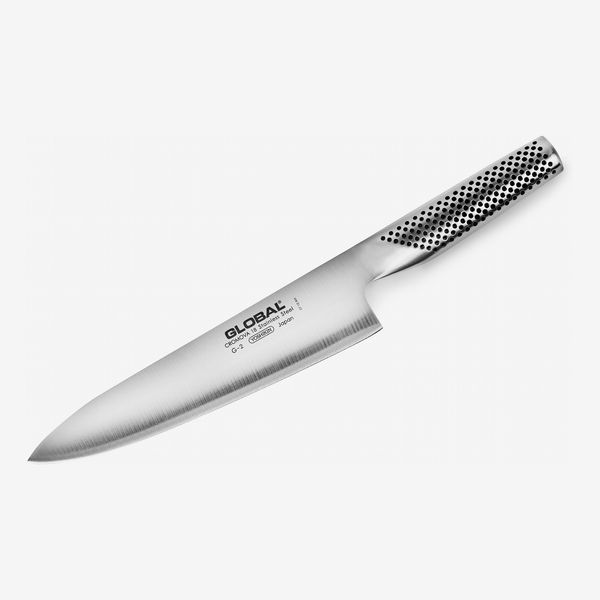
Blade length: 8 inches | Style: Combination | Weight: 5.5 ounces
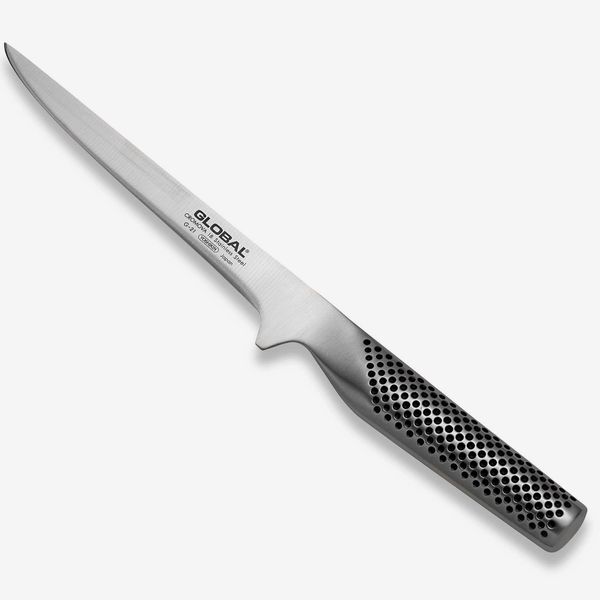
I first became interested in Global’s chef’s knife when I read Strategist contributor Nick Marino call it “the only knife you really need” in a heavily researched and vetted guide he wrote back in 2018. So I called it in to test it out for myself.
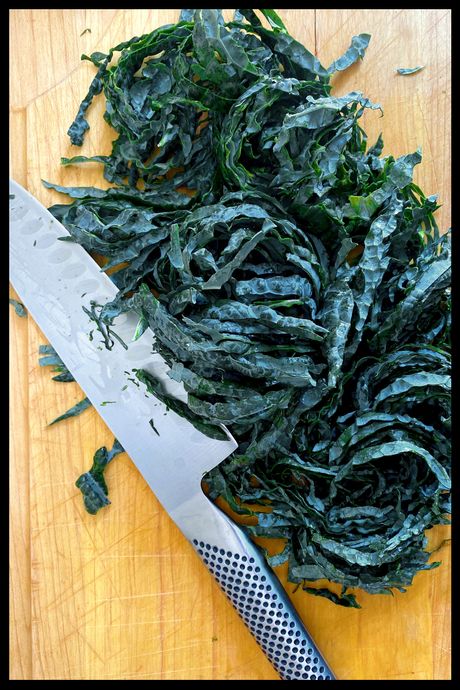
Now, a couple of years later, I instinctively reach for this knife more than any other (and like I said up top, I have many to choose from). I find its weight — on the lighter side for an eight-inch — to be perfect. I can perform more delicate tasks, like making florets out of a head of broccoli or slicing through a tomato, without it becoming unwieldy. Still, it’s hefty. I use the blade to carve chickens, pushing through small bones, as well as to cut hard-as-can-be squash into pieces for roasting. The handle is on the shorter side, which adds to that feeling of control: My relatively small hands can get a very good grip and maneuver with ease. The curve is subtle, but helpful, allowing me to get into a rhythm with repetitive tasks (like dicing onions) quickly and efficiently.
Though it’s due for a professional sharpening soon, the blade has stayed exceedingly (even shockingly) sharp in the time I’ve been using it regularly with little maintenance. Smitten Kitchen’s Deb Perelman told Marino how well it holds an edge, too, and confirmed the same to me all these years later. Jeff Strauss, chef of Oy Bar in Los Angeles, is another fan. “It has a blade that is Japanese in design,” he explains, “but influenced by the French-style knives. It has a bit more curve to the blade, a little more lift to the tip, and it can kind of work in both ways.”
Best Japanese-style chef’s knife
New! You can now save this product for later.
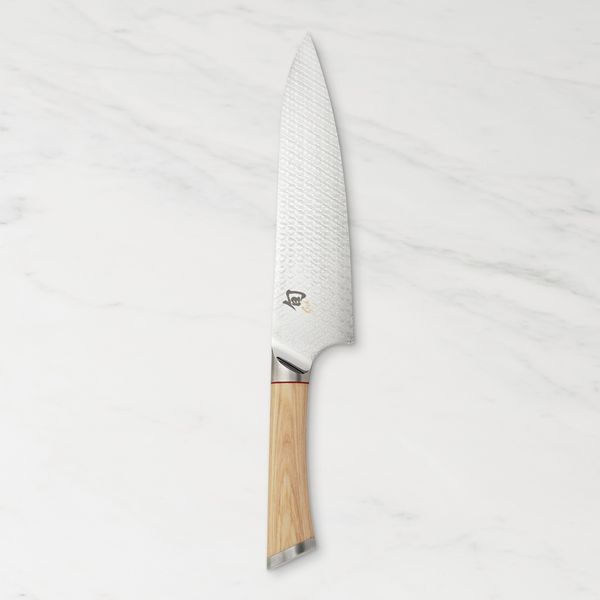
Shun Hikari Chef’s Knife - 8"
Blade length: 8 inches | Style: Japanese | Weight: 7.7 ounces
The Shun Hikari chef’s knife was the first nice knife I ever bought myself. I got it more than six years ago, and it’s still one of my most used because of the extremely sharp blade. It’s a couple of ounces heavier than my Global — though, I’ll note, still lighter than several of the European designs below) and the edge is a bit more curved (which both allows for an even steadier rocking motion across my cutting board and creates even more of a distinct tip). Overall it feels balanced. And I’d be remiss not to mention how much I love the design: The wood handle, which swoops in slightly at the center, is gorgeous and nice to hold.
Recipe developer and cookbook author Samah Dada owns one, too, and calls it “the best knife I’ve ever used.” She says she “can be very dexterous with it, but it doesn’t feel unwieldy,” and also points out the acute edge. In fact, she says the blades are designed at such an angle and with such high-quality steel that you’re not even supposed to get them sharpened more than a couple of times a year because it’s unnecessary. I have had mine professionally sharpened a handful of times (with my own maintenance between sessions), and it always comes back as perfect as the day I got it, with an edge that lasts for many months before I notice any dulling.
Best less-expensive Japanese-style chef’s knife
New! You can now save this product for later.
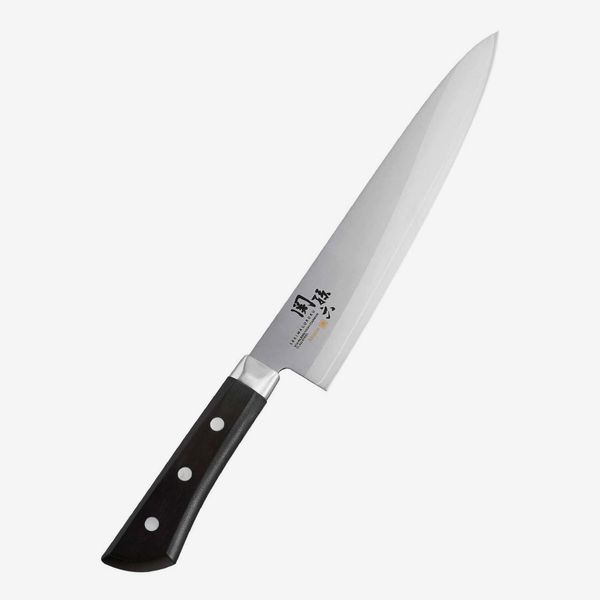
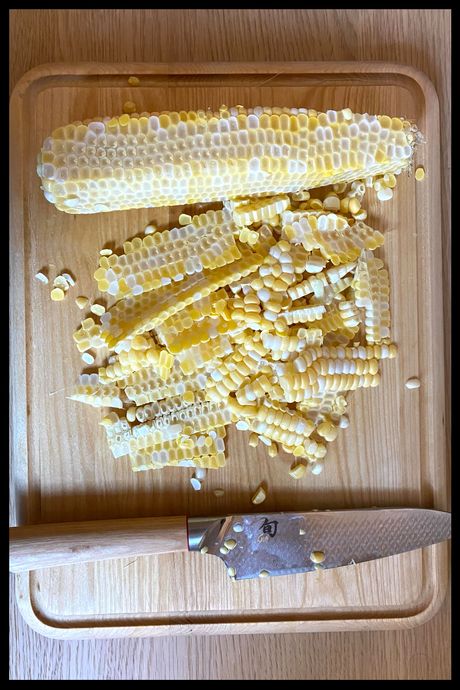
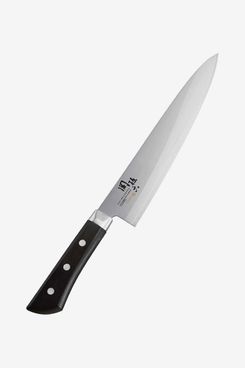
Blade length: 8 inches | Style: Japanese | Weight: 5 ounces
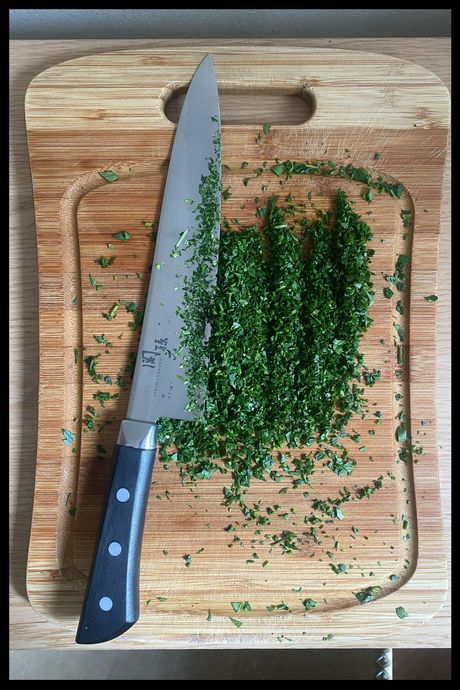
This knife was first introduced to me by the writer, cookbook author, and editor Matt Rodbard, who found it when digging through Tokyu Hands in Shibuya. I was skeptical at first that such an inexpensive blade would be good, but it is. (We’ve featured this one for several years now, both in this article and multiple gift guides and tentpole sales events, and I’ve never seen it go above $32.) Price can certainly be a useful indicator of the quality of a chef’s knife, but this is an exception.
It’s extremely lightweight — the most lightweight on this list besides the much smaller five-inch Wüsthof and the kids’ Opinel knives. Still, it doesn’t feel flimsy in my hands. “A heavy handle helps balance for sure,” Rodbard says, “but I really like the feel of this one. It feels like a high-quality knife for the price.” The plastic handle is rounded and comfortable to grip, and it’s sharp as can be out of the box. Rodbard notes that its blade is on the softer side, which means it won’t hold its super-acute edge for ages, but it’s also much easier to sharpen when it dulls down, especially since a home cook is more likely to use a sharpening gadget than a stone that takes a lot of finesse and practice.
Best European-style chef’s knife
New! You can now save this product for later.
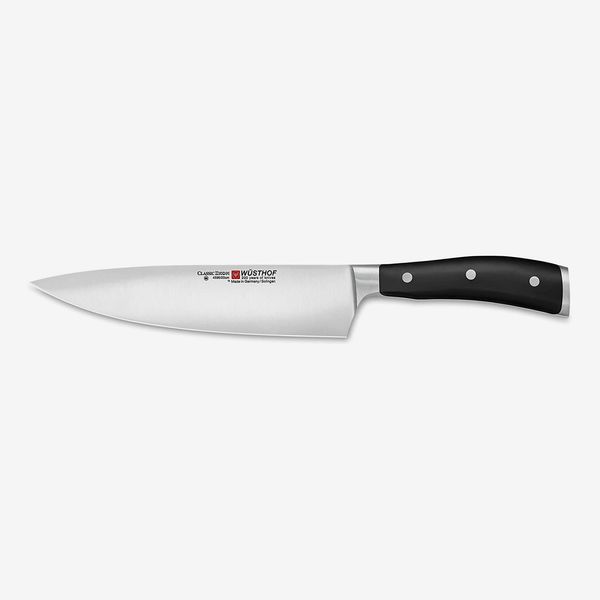
Blade length: 8 inches | Style: European | Weight: 9 ounces
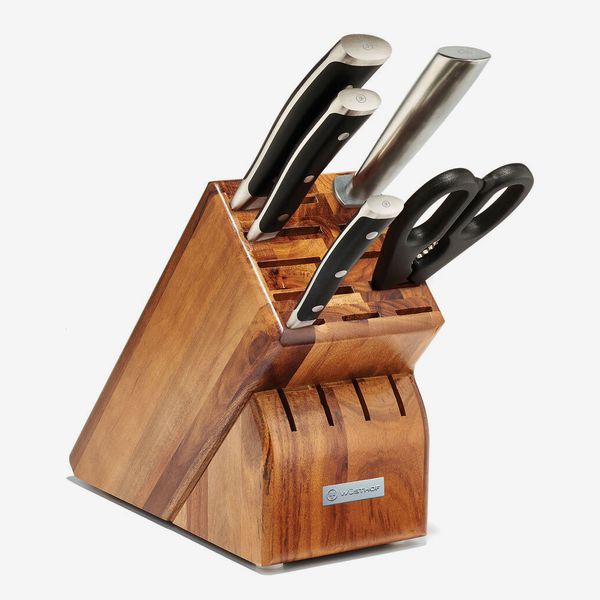
If you want a classic European-style knife (heavier than those I’ve detailed so far), try Wüsthof. We named their knife set the best overall, and with good reason — it’s the brand preferred by some celebrity chefs, including Ina Garten and Gordon Ramsay. Cook and Top Chef Canada host Eden Grinshpan was told to buy the “super-high quality” blades when she was in culinary school, and cookbook author Erin Gleeson registered for them when she got married a decade ago. Both still use them to this day because of how durable they are. Gleeson even notes that though she uses the chef’s knife for “everything,” including taking it with her when she travels somewhere with a rental kitchen, because it “rarely needs sharpening.” Joy Wilson, creator of Joy the Baker, is another fan. She likes the weight of it because “the metal runs all the way through the handle, which makes it feel even throughout the knife,” she explains. It’s heavier than both the Global and the Seki Magoroku, lending to a particularly controlled feel. “Also, the area where the handle meets the bottom base of the blade is so comfortable,” she says.
Best less-expensive European-style chef’s knife
New! You can now save this product for later.
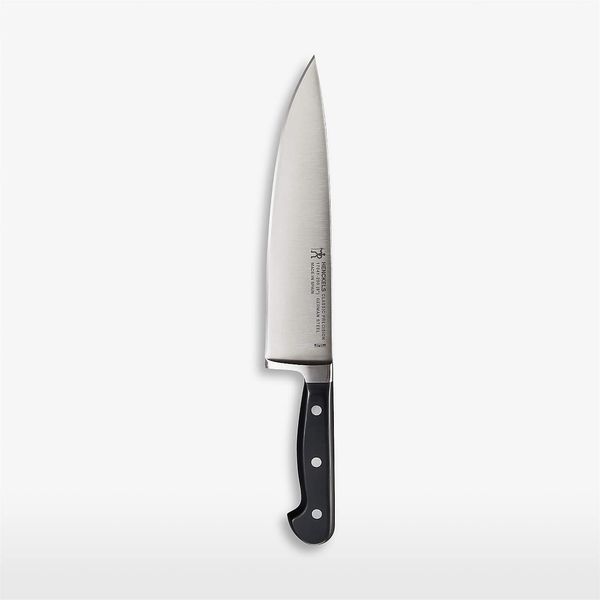
Blade length: 8 inches | Style: European | Weight: 9.8 ounces
For an even heavier — and cheaper — option, consider this blade from Henckels.James Peisker, co-founder of Porter Road in Nashville, got itas a gift from his mom when he was 16 years old and still uses it to this day (he even has a tattoo of it on his wrist). Not only is it durable enough to last for decades, but Peisker says it doesn’t require very much upkeep and holds its edge for much longer than Japanese knives. He says he hones the blade after each use to realign the layers (as opposed to taking some of the steel off to create a new edge), so he only has to sharpen it about every seven months. As for its feel, Peisker says “it’s definitely heavy” but comfortable in the hand, thanks to the substantial heel or the wider steel part that sits against the end of the blade and the handle(a part most Japanese knives don’t have). He rests his index finger over it and “that positioning gives me such good control,” he says.
Most stylish European-style chef’s knife
New! You can now save this product for later.
Blade length: 8 inches | Style: European | Weight: 6.4 ounces
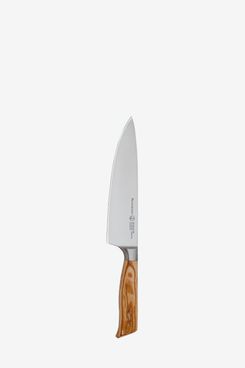
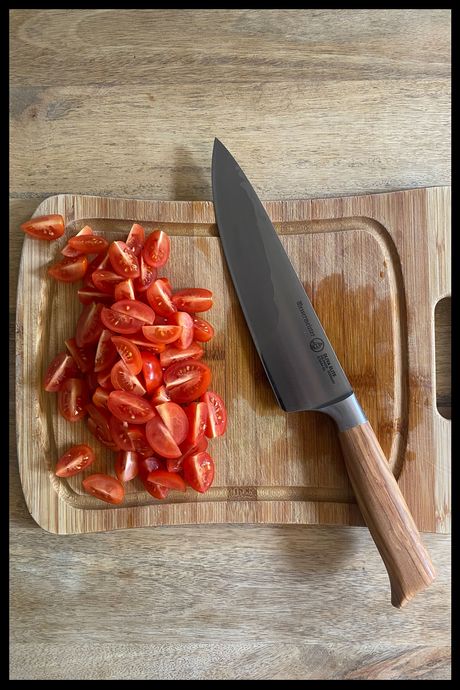
I added this Messermeister knife to my collection about six months ago, and it has quickly become one of my favorites. It’s on the lighter side overall, just about an ounce more than the Global. Out of the box, the blade was one of the sharpest I’ve ever used, and that razor-fine edge has held up incredibly well. It slices through tough vegetables like squash and delicate ones like tomatoes with ease. It’s also really nice-looking. I love the warmth a wood handle brings to a knife, and this one is made from especially pretty multitoned Mediterranean olive wood. The rounded, indented shape makes it very comfortable to grip.
Chris Carter, Porter Road’s other founder, also loves this knife. He says while people are generally drawn to the look of Japanese knives because they tend to be particularly beautiful — this European model is just as striking. And it’s his preference because of the hardier blade construction. It delivers great versatility, durability, balance, and precision, he says, thanks to the strong German steel tang (which means the blade runs all the way through the handle instead of being forged together where the two parts meet).
Best chef’s knife for beginners
New! You can now save this product for later.
Blade length: 8 inches | Style: Combination | Weight: 8 ounces
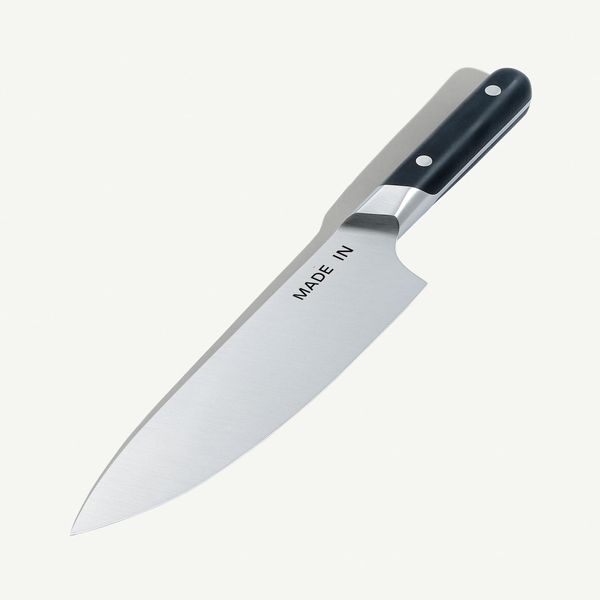
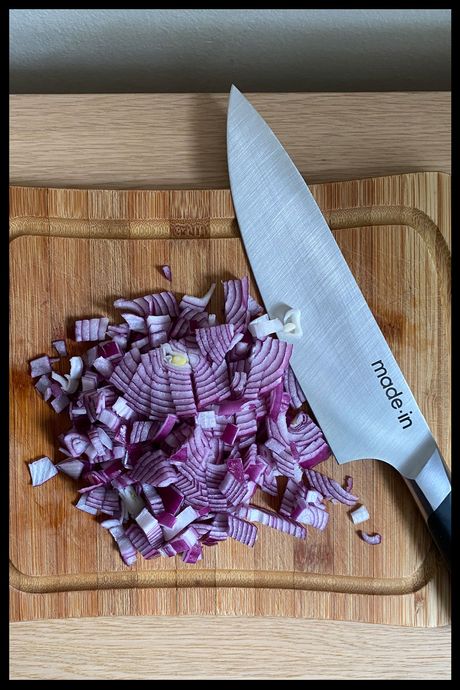
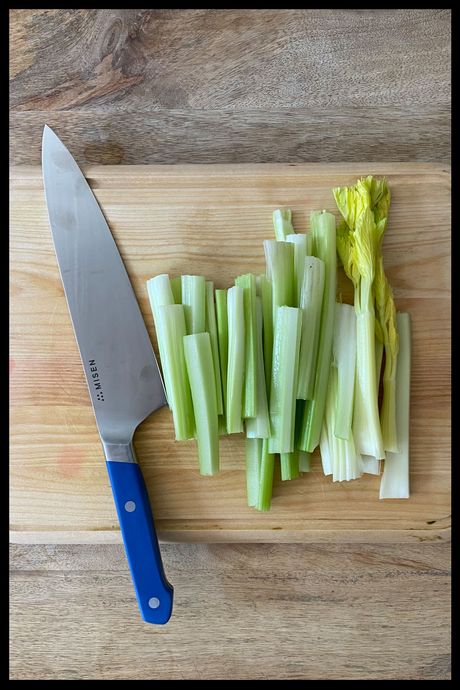
Learning to wield a lighter knife with precision can take a bit of practice, so those newer to cooking might prefer to start with Made In’s eight-ounce model. (It’s a few ounces more than the Global, a difference you can feel.) In my own testing, I found it to be particularly sturdy when dicing vegetables, helping my hand stay firm and straight as I rocked the super-sharp blade through onions, carrots, and celery. It feels solid and strong in the hand, and the rounded handle is nice to grip, too. Culinary producer Kiano Moju, who owns multiple (and Made In’s other knives, too), appreciates the full-tang construction, just like the Messermeister above. “It’s never wobbly,” she says, “and it balances nicely.”
Best less-expensive chef’s knife for beginners
New! You can now save this product for later.
Blade length: 8 inches | Style: Combination | Weight: 8.3 ounces
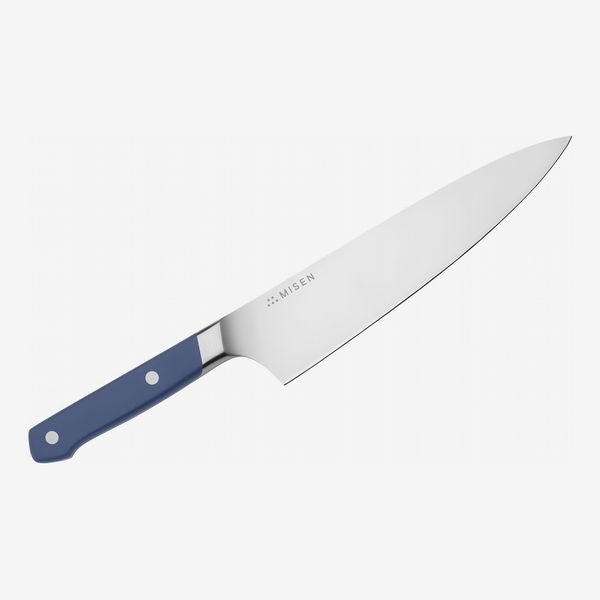
Misen’s knife is even less expensive than Made In’s, the price pretty much as good as it gets for someone who wants to upgrade from whatever generic big-box-store blade they’ve been using. It comes supersharp out of the box, and mine has maintained its edge over six months so far (it gets used a few times a week) with no need for sharpening yet. The edge has a bit more of a slope to it than Made In’s, which makes rocking it back and forth quickly and efficiently feel like second nature. My only knock is that the handle is boxier than any others I’ve tried (including Made In’s). It’s not terribly uncomfortable, just a small detail worth noting, especially if you’re sensitive to how your tools feel in your hand.
Strauss was the first person to recommend Misen’s knives to me and explains why they’re not only a great value but great quality, too: “One of the things knife nerds talk about is steel hardness,” he says. “This is on the hard end of bendy, which means it sharpens really well but isn’t so rigid that if you move it funky you can feel it, and even break it.” That level of firmness is, in his mind, a perfect sweet spot. Not only are they fit for beginners, but “I know a bunch of pro chefs who use them,” he says. “You don’t have to be overly precious with them, but they’re still well made. I own six.”
Best balanced chef’s knife
New! You can now save this product for later.
Blade length: 8 inches | Style: Combination | Weight: 6.5 ounces
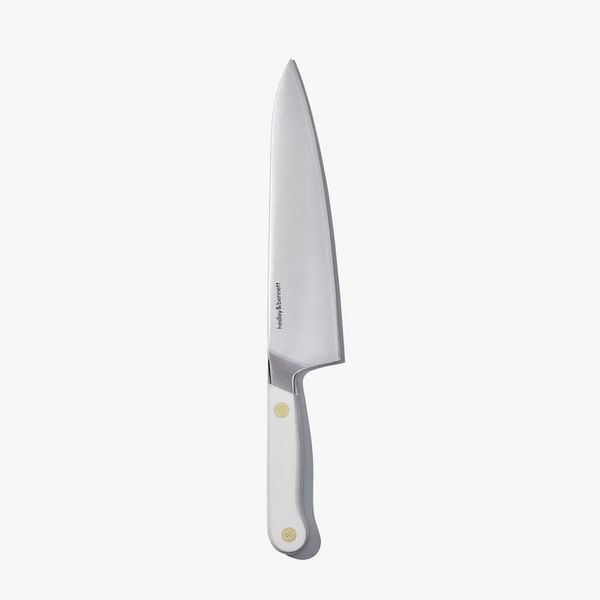
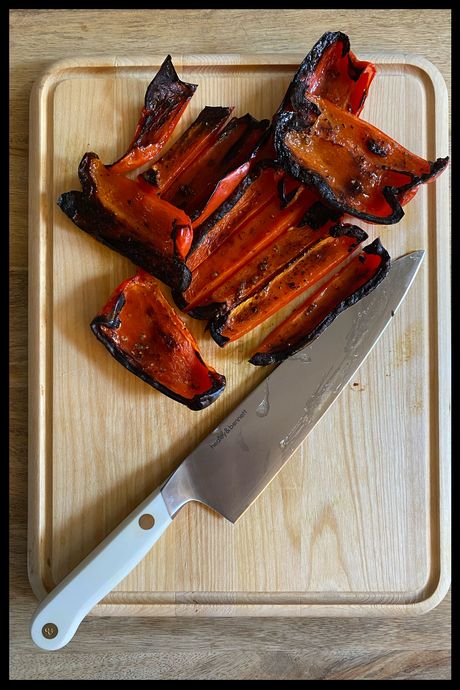
Hedley & Bennett is known for their aprons, but they recently started making knives, their first foray into actual kitchen tools. The chef’s knife was designed with input and testing from professional chefs — and in my own testing, I can tell that level of thoughtfulness went into it. While the knife weighs an ounce more than my Global, it’s not enough to really notice a difference. Plus, the weight is evenly distributed from handle to blade so it doesn’t feel cumbersome to hold. And as someone who has her knives out in the open, I also appreciate the aesthetic details, like the barely noticeable logo and brass rivets. Both chef Melissa King and Zoya Roya, the founder of Fysh Foods, call it “well-balanced,” with Roya adding, “It’s not too heavy to handle, but heavy enough that it still glides through whatever you’re cutting with ease.”
Best less-expensive balanced chef’s knife
New! You can now save this product for later.
Blade length: 8 inches | Style: Japanese | Weight: 9 ounces
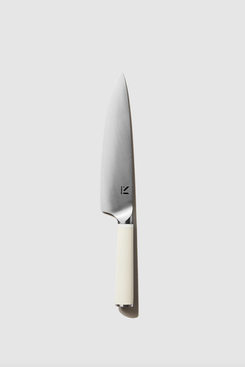
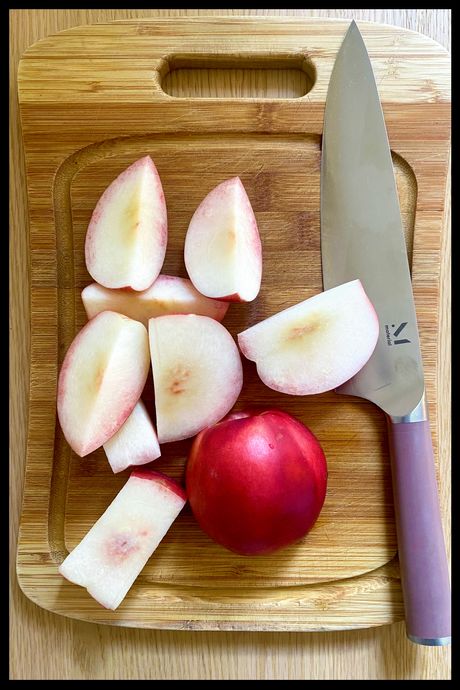
I’ve been using Material Kitchen’s chef’s knife (along with the other two blades in its set)for many months now and have found it a worthy addition to my collection. The handle is rounded and smooth, which makes it comfortable to grip.It’s a few ounces heavier than my Global (which, as you can probably tell, is the point of reference I often use since that’s my most-reached-for knife). Unlike the Hedley & Bennett above, you can, just ever so slightly, feel the weight difference here — but that can be helpful when cutting firm ingredients like squash and potatoesand even forhaving greater control when it comes to tasks like dicing onions evenly.Still, it’s full tang, so evenly weighted from tip to end.
Writer and recipe developer Rebecca Firkser has been using hers practically every day for fiveyears. “I love everything about it,” she says. “I got it in the neutral color, which is just plain pleasing to me in a sea of black-handled knives. Straight from the package (and when regularly maintained — I sharpen mine at home every couple months), the blade can easily handle thin tomato slices,” she says, “which is my benchmark for a ‘good’ chef’s knife.”
Best super-small chef’s knife
New! You can now save this product for later.
Blade length: 5 inches | Style: Japanese | Weight: 3.8 ounces
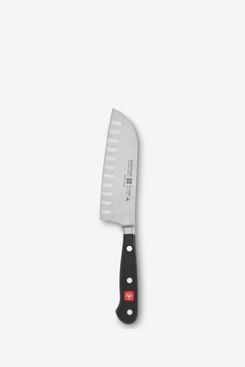
Even though Wüsthof is a German company that specializes in German knives, it also makes a Japanese-style santoku knife. It’s the choice pick from Amanda Cohen, chef of New York City’s Dirt Candy. In general, Wüsthof is a much-beloved brand (I found it to be the best overall pick if you’re investing in a knife set) — and this small-but-mighty blade fits right in. “I’m a serial monogamist when it comes to knives, and right now I’m in a long-term relationship with this one,” Cohen told me. “A shorter knife gives you more control so I’m through with six-inch knives for the moment. This one holds its edge for a ridiculously long time. It’s also really light,” she says (the lightest on this list) which means she can use it for hours “switching between really precise knife work and hacking away at tougher vegetables.”
Best chef’s knife for utility
New! You can now save this product for later.
Blade length: 10 inches | Style: European | Weight: 5.6 ounces
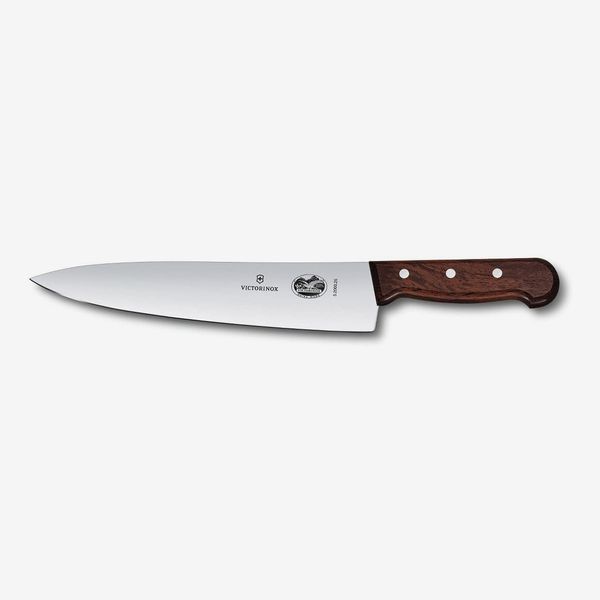
For those who anticipate doing a lot of heavy-duty tasks with their chef’s knife, a super-sharp and durable — but still affordable — one is key. You want to be able to use it without worry that you’ll quickly run down the edge, bend the tip, or damage a softer blade. Cara Nicoletti, a fourth-generation butcher and founder of the sausage company Seemore Meats & Veggie, wrote a piece for the Strategist grew up around her grandpa and his father and brother using the most utilitarian knives around (like, ones that would break down countless carcasses before they would need to sharpen the blade again). Then she found herself in New York City kitchens where professional chefs revered their knives, treating them with a care and pride previously unfamiliar to Nicoletti. Now, she says, “the knives I use most at home land squarely in between those beloved by my butcher relatives and those worshiped by my chef colleagues” — and chief among them are her Vicorinox knives.
“They tend to last the longest and keep a sharp edge, even when being used daily on heavy projects,” she says. “The blades are stainless steel, which make them easy to maintain, and I love the rosewood handle for grip comfort. You may not be breaking down full beef carcasses in your home kitchen (or maybe you are? What do I know!), but you still want knives that don’t need to be sharpened every time you break a chicken.” Nicoletti’s size of choice is ten inches, but that’s definitely on the larger end for most people. Victorinox makes the same knife in eight inches, too.
New! You can now save this product for later.
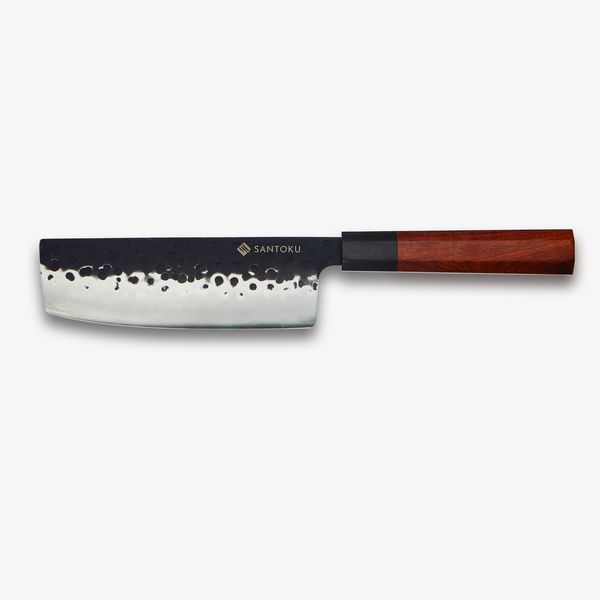
Blade length: 7 inches | Style: Japanese | Weight: 8.9 ounces
With a straight blade shaped a bit like a small cleaver, a nakiri knife is designed to be particularly good at breaking down large vegetables such as cauliflower and cabbage, as well as slicing, dicing, and chopping onions, peppers, all manner of root vegetables, and more. But according to Emily Fiffer, co-owner of Botanica in Los Angeles, it’s just as versatile as a chef’s knife and can be used for very similar tasks. It’s her own go-to blade even for delicate tasks like chopping herbs for salsa verde or cutting up a piece of fish. “The only thing I wouldn’t do with it is slice bread,” she says.
Best high-end chef’s knife
New! You can now save this product for later.
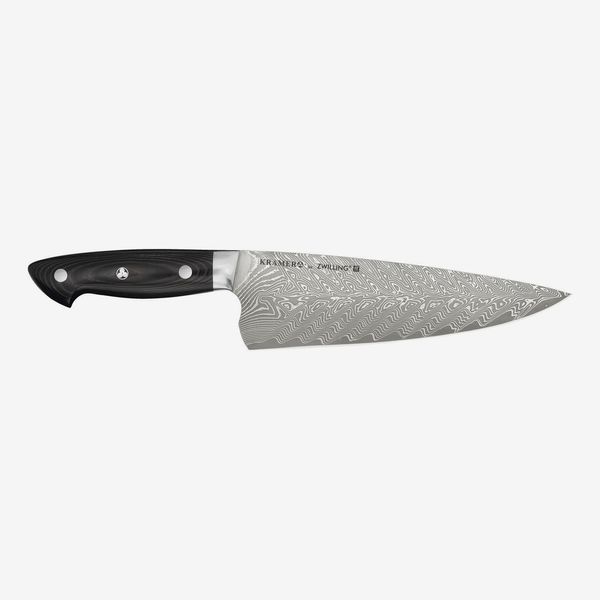
Blade length: 8 inches | Style: European | Weight: 9.5 ounces
This blade is expensive. Bob Kramer, a real artist and artisan, crafts handmade knives that he auctions off to eager fans and serious professionals. They regularly go for tens of thousands of dollars (or even, in the case of the one he made special for Anthony Bourdain, a quarter of a million dollars). This particular knife, however, is not a one-off, and comes from a collaboration with tried-and-true kitchen company Zwilling, which makes well-known knives of their own. It’s still very pricey, yes, but a much more accessible model of Kramer’s work, relatively speaking. I actually own one, (a prize I won at my old job at Bon Appétit for guessing closest to the correct number of pie weights in a jar — a silly but true story). It’s a real prize on my knife rack — always sharp with such a comfortable handle and Kramer’s signature damascus steel design on the flat surface of the blade (he combines two different types of steel to create the effect). It’s the heaviest one I own, so I tend to pull it out for big jobs, like slicing large hunks of meat and cutting through particularly firm squash.
Rodbard has one, too, gifted by a dear friend of his. “Would I ever buy myself a $400 knife?,” he says. “No. Was I afraid to use it for over three years? Yes. Have I now fallen so hard for it that a day doesn’t pass that I don’t pull it out just to feel the grip in my hand? Absolutely.”
Best chef’s knife for kids
New! You can now save this product for later.
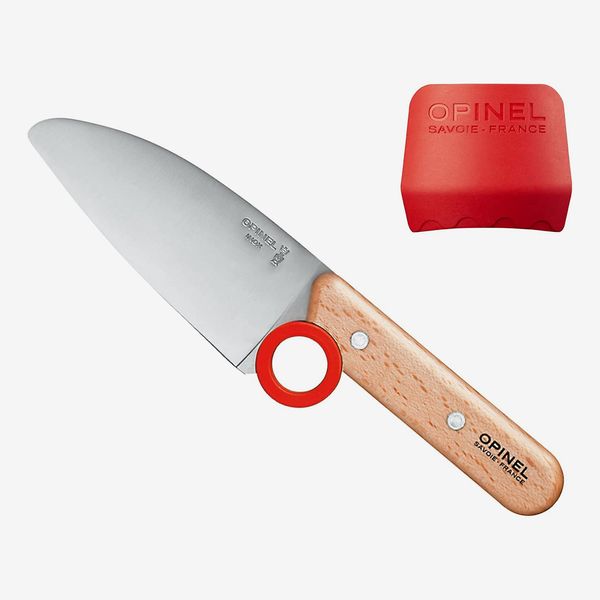
Blade length: 4 inches | Style: European | Weight 5.3 ounces
Handing over a chef’s knife to your kid can feel daunting — but the best way for them to learn is to use a real metal blade. For this reason, Sara Kate Gillingham, co-founder of Kitchn and The Dynamite Shop, a cooking school for kids, endorses the Wüsthof above, noting the smaller size makes the practice very manageable. That said, for particularly young ones — about ages 5 to 8 — she says the Opinel knife is the only kid-branded kitchen tool she’s really into. “There’s no product that should replace a parent overseeing safety,” she explains, “but the finger guard and grip hole work to teach proper positioning. It’s like training wheels.” While she warns it’s not good for kids to become too dependent on said training wheels, she says she appreciates the fact that it’s not a gimmicky product: “It’s like a real knife but with some added protection.”
Some more knives (of all types) that we’ve written about
Our experts
• Chris Carter, co-founder of Porter Road
• Amanda Cohen, chef of Dirt Candy
• Samah Dada, recipe developer and cookbook author
• Rebecca Firkser, writer and recipe developer
• Sara Kate Gillingham, co-founder of Kitchn and The Dynamite Shop
• Erin Gleeson, cookbook author
• Eden Grinshpan, cook and Top Chef Canada host
• Melissa King, chef
• Nick Marino, Strategist contributor
• Kiano Moju, culinary producer
• Cara Nicoletti, founder of Seemore Meats & Veggie
• James Peisker, co-founder of Porter Road
• Deb Perelman, founder and writer of Smitten Kitchen
• Matt Rodbard, food writer, editor, and cookbook author
• Zoya Roya, founder of Fysh Foods
• Jeff Strauss, owner and chef of Jeff’s Table
• Joy Wilson, creator of Joy the Baker
The Strategist is designed to surface the most useful, expert recommendations for things to buy across the vast e-commerce landscape. Some of our latest conquests include the best acne treatments, rolling luggage, pillows for side sleepers, natural anxiety remedies, and bath towels. We update links when possible, but note that deals can expire and all prices are subject to change.