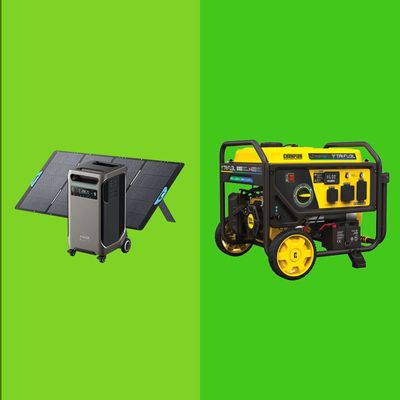
The Very Best Portable Generators
In this article
A portable generator is one of those things you don’t much appreciate until you need it, whether that’s during a blackout following a storm or when your devices die on a camping trip. Fortunately, with many great portable generators on the market today, all you need is a bit of planning (and a few dollars) to never be without power again, whether you’re at home in the dark or out in the field.
The picks below are based on expert recommendations and our own testing (done at campsites, at our homes, and even during a multiday blackout). Generators can be powered a few different ways: with gasoline, by burning both gas and propane, or even with the sun when you use solar power for a battery inverter generator — a newer option that’s a great choice if you’re looking to run a generator indoors.
“Gas-powered generators create exhaust fumes, limiting the use to the outdoors,” says Corey Dandy, a manager with the hardware chain Aubuchon Company. “Battery generators are completely safe indoors or even in-tent.”
What we’re looking for
Total capacity
The first thing to consider when shopping for a generator is just how much power it can store — and put out when you need it. A generator’s capacity is given in watt hours, a measure of energy that determines how much power a device can deliver, for how long. Essentially, it’s the amount of work a generator can do — for example, a generator rated at 100 watt hours could power a 100-watt lightbulb for one hour. (That would be a very small, weak generator!) Watt hours are given as a measurement of total capacity — a 4,000-watt-hour generator can deliver that amount of work starting from a full tank of gas or a full charge in its batteries.
To figure out how big a generator you actually need, add up the watt hours required to run all your essential devices in an outage (or for an outing). Most manufacturers don’t list a device’s watt-hour consumption, so you’ll have to do some math: Multiply each product’s wattage (you can often find this on the appliance itself or online) by the number of hours you expect it to run. Some critical appliances, like a refrigerator, would need to run 24 hours, but you might only run a CPAP machine for eight hours. Not great at math? Kevin Feak, an engineer with Fire Protection and Safety Services, likes the simple generator calculators on sites like Lowe’s.
But before you buy a generator that produces at least that number, you have to factor in surge. This is the temporary spike in electricity that appliances — especially those with compressors like refrigerators and window air conditioners — draw when they first start up before settling into a lower running wattage. “Surge numbers are really important to factor in when you’re sizing a generator,” says Feak. If two appliances with high surge-wattage demands attempt to turn on at the same time, it could overpower a weaker generator. Feak went on to say to ensure you factor in the surge demands for critical devices like medical equipment, sump pumps, and well pumps.
Number and type of outlets
Many of the battery-power stations out there these days have myriad different outlets, from AC outlets, which are the same as those in the wall of your home, to USB and USB-C ports, for devices ranging from computers to phones, to direct current (DC) ports, which are often used to recharge a battery generator via a vehicle or solar panel. (You may recognize DC ports if you’ve driven a car with a cigarette lighter.) If you need a portable generator to keep multiple large home appliances running during a blackout, or even to charge an electric vehicle in a pinch, you’ll want a generator with several 120/240-volt AC outlets; if you just want to keep phones and lanterns charged, a much smaller unit with a few USB ports and an AC outlet or two is fine.
If you regularly experience seasonal power outages but don’t have the budget for a larger whole-home standby generator, some of the bigger units we looked at (Feak advises looking for models with 240-volt output) can dish out enough power to run a whole house — but this requires the installation of a device called a transfer switch near your home’s main electrical panel. You’ll need to hire an electrician to install the switch itself (professional installation typically starts at around $500). Once installed, the transfer switch allows you to redirect power from the grid to the generator for the specific circuits you’ve selected by manually switching it over at the panel. Installing a transfer switch can be a worthwhile investment.
Weight
Just because a generator isn’t permanently fixed in place doesn’t mean it’s necessarily portable. For this review, we’ve considered units that can reasonably be moved from place to place thanks to their lightweight or built-in wheels and handles, because the mobility of the hardware is of paramount importance here.
Keep in mind that batteries are heavy, and for a comparable amount of power output, gas-powered generators — even when filled with fuel — are often lighter than battery-powered portable power stations. This is worth keeping in mind if you plan to charge with solar panels: Most panels include cables that are only about ten feet long, so unless you buy an extension cable, you may need to move the unit closer to wherever the panels can get maximum sunlight exposure. With some power stations weighing well over 100 pounds, that can mean hauling them up or down stairs and wheeling or carrying them across the yard.
Best portable solar-powered generator overall
New! You can now save this product for later.
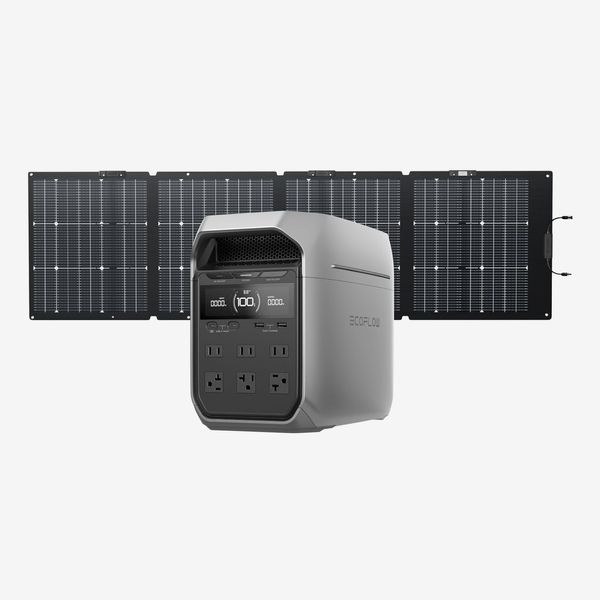
EcoFlow Portable Power Station DELTA 3 Plus - With 220W Solar Panel
Capacity: 1024 watt hours / Outlets: 6 AC, 2 USB-A, 2 USB-C, 3 DC / Weight: 27.6 pounds (power station only; 64 pounds with 4 panels)
EcoFlow’s Delta series has been a popular option since its launch in the roughly 1,000-watt-hour category, a segment that has since expanded to include models that now quadruple that capacity. The Delta 3 Plus is a Goldilocks pick, with the best combination of capability and ease of use we found in our testing. It’s capable enough out of the box to run critical appliances, light enough for one person to carry, has a very fast recharge time, has a user-friendly app, and can charge from multiple solar panels for extended use during outages.
The Delta 3 Plus has a surge capacity of 3,600 watts, meaning it has an easier time starting demanding appliances, and it can recharge fully from a standard wall outlet in under an hour. In practical terms, that means in an emergency, charging the Delta 3 Plus for an hour at a friend’s house or a café can provide enough power to keep a standard refrigerator humming for about ten hours. If you want even more capacity, like many midsize power stations we tested, the EcoFlow can use additional batteries (they don’t have their own screens or ports) that stack on top, extending your storage and run time without the cost of another full Delta 3 Plus.
The Delta 3 Plus’s real advantage is solar capability. While many units in this size class can handle around 500 watts of solar input, the Delta 3 Plus can accept up to 1,000 watts through two 500-watt inputs, meaning you can utilize more panels. That kind of solar capacity means that for a little more money, you can get closer to the kind of extended run time you’d expect from a gas or propane generator, but without the fumes, engine noise, or maintenance. EcoFlow offers both permanent rooftop panels and portable folding panels designed to store in a garage or basement and deploy in a yard during an outage. The portable versions avoid the need for professional installation (and let you take the whole system with you on the road).
The Delta 3 Plus uses a standard XT60i connector, so you are not locked into EcoFlow-branded solar panels (though manufacturers often discount when you buy panels at the same time as the power station). A single 220-watt panel can recharge the 3 Plus in about seven or eight hours, though the unit does support pass-through charging, so it can still power appliances while it is recharging. Fully outfitted with four of EcoFlow’s 220-watt panels wired together in series, the unit can recharge in three to four hours under partly cloudy conditions, or in as little as two hours under sunny skies. EcoFlow’s bifacial panels collect energy from both sides and they perform best over reflective surfaces like snow, sand, or light-colored concrete rather than grass (slipping a mirror over the surface, under the panels, can boost efficiency).
Each 220-watt panel weighs about 16 pounds and folds into a compact two-by-two-foot package roughly two inches thick, though unfurled it stretches into a strip that is seven feet long. Setup is straightforward, with built-in stands that help angle the panels between 30 and 60 degrees and simple plug-and-play connectors that make daisy-chaining panels together painless. Using four panels at once might make it look like a small solar farm spread across the yard, but even unfolded, the panels are manageable enough to store out of they way against a garage wall when they aren’t in active use.
There are a few negatives: The included solar cable is only about eight feet long, however, which may make it difficult to keep the power station indoors while the panels sit outside in full sun. EcoFlow sells additional extension cables, but that’s another added expense. The real downside is cost: Building out a fast-charging solar setup adds up quickly, with each portable panel costing roughly $300, meaning a fully loaded array can add well over $1,000 to the overall system price, so choose a kit for the best deal.
Looking for an even better deal? EcoFlow tells us that our former top pick, the Delta 2, should be available through this summer. It’s still a very capable unit and can save you a little money if you don’t need the extra outlets and flexibility of the Delta 3 Plus.
Best less-expensive solar powered generator

New! You can now save this product for later.
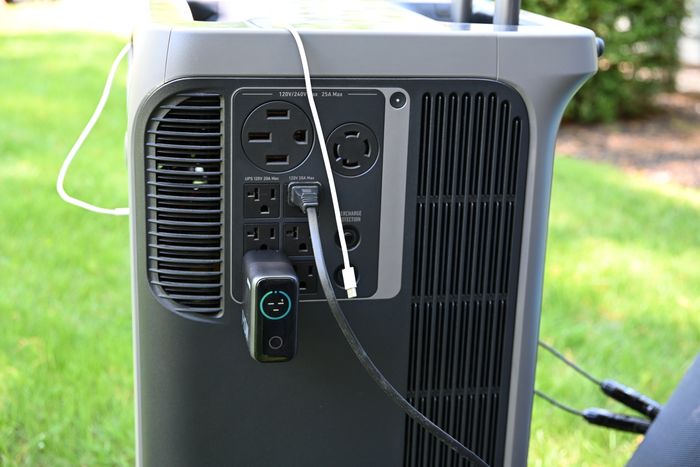
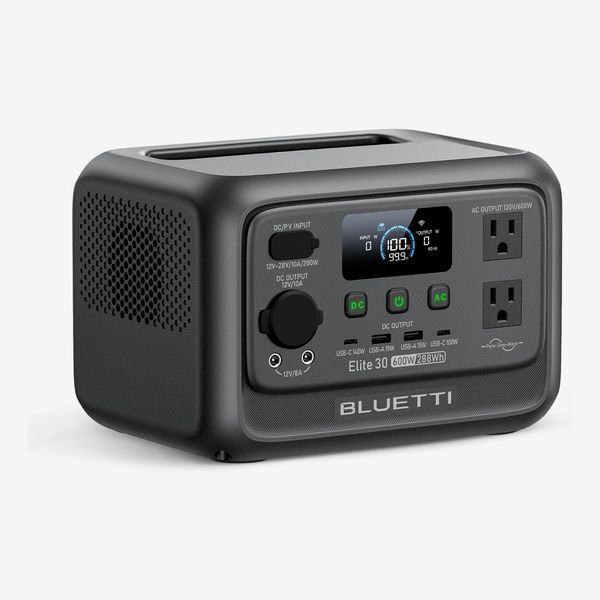
Bluetti Elite 30 V2 Portable Power Station
Capacity: 288 watt hours / Outlets: 2 AC, 2 USB-C (140W + 100W), 2 USB-A (both 15W), 3 DC / Weight: 9.5 pounds
Weighing just under ten pounds with a flip-up handle, the Elite 30 V2 is a toaster-size power station built not just for emergency backup but for the road — great for camping, RVing, or heading to the beach. Lunch-box-size portable power stations like the Bluetti offer plenty of power, plus a combination of AC outlets and at least one USB-C Power Delivery (PD) port, letting you run laptops and other devices that don’t use a traditional wall plug alongside household appliances.
With 288 watt hours of capacity, the Elite 30 V2 can run a full-size refrigerator for roughly three hours. At just 30 decibels — about as quiet as a library — it’s ideal for powering medical devices in a bedroom, where excess fan noise can be disruptive. Plugged into a wall outlet, the Bluetti recharges in about 70 minutes, can be charged using Bluetti’s 100W and 200W solar panels, and like many modern portable power stations, it can be monitored over Wi-Fi or Bluetooth so you can keep tabs on remaining power from your phone.
Best large-capacity solar-powered generator for household outages
New! You can now save this product for later.
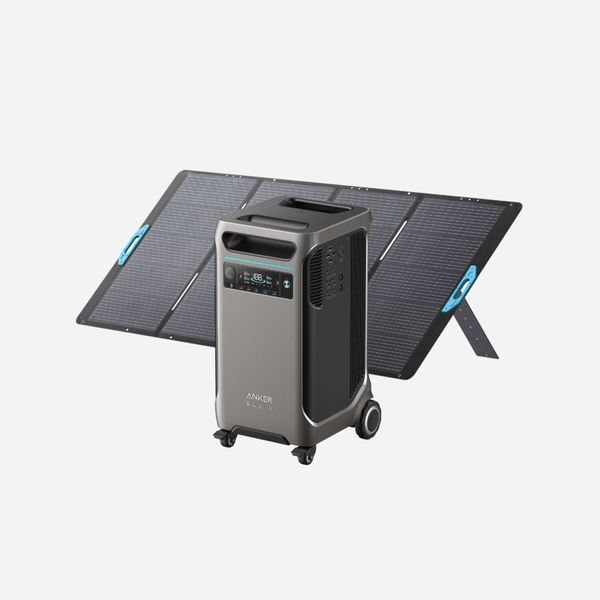
Capacity: 3,840 watt hours / Outlets: 6 AC, 2 USB-A, 3 USB-C, 2 240V / Weight: 133 pounds
For those who want more out-of-the-box power than the EcoFlow Delta 3 Plus can deliver and don’t mind the added weight, the Anker Solix F3800 can run kitchen appliances for hours with little effort. It also includes 240-volt outlets for high-demand draws, like an electric dryer. At nearly 4,000 watt hours, the power the Solix produces is closer to midsize portable gas generators. The chunky, 133-pound Solix is about the size of a standard carry-on suitcase, though taller, with a similar telescoping handle that makes it easier to move around. Front casters help it glide smoothly across hard surfaces like patios, hardwood, and carpet, but carrying it up or down stairs is a two-person job. In terms of output, the F3800 has enough capacity to keep a typical refrigerator running for roughly three days. The 240 volt port means you can connect the Solix to a wired transfer switch, or even charge your electric vehicle in a pinch.
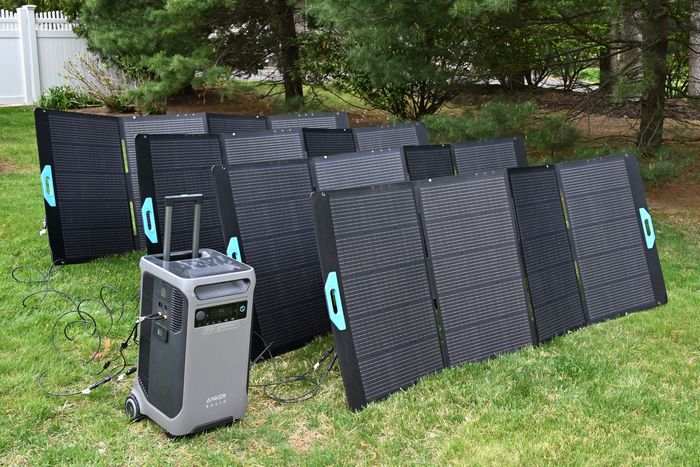
Anker’s 400-watt solar panels feature four adjustable angles that let you fine-tune their position throughout the day, so you can optimize how they face the sun: keeping them more upright in the morning and late afternoon, and flatter around midday when the sun is highest. Like EcoFlow’s panels, they’re weatherproof, so occasional rain isn’t a concern and, in a backyard with good southern or western exposure and few overhead trees, you could keep these out overnight. Deployed, the panels are enormous — more than eight feet long and about 40 inches tall. Folded for storage, they shrink to roughly 40-by-27 inches and about two inches thick, weighing just over 35 pounds each. With four panels generating a combined 1,600 watts of solar input, the Anker recharged in about 10 hours under partly cloudy conditions, though it can take from 3 up to about 15 hours, based on how strong the sun is. The panels feel substantial and well built, though their weight makes them somewhat cumbersome to move around. Solar input tops out at 2,400 watts — you can pair the F3800 with up to six of Anker’s 400-watt solar panels through the XT-60 connection, but at $600 per panel, maximizing your recharge time would add more than $3,500 to the purchase price of the F3800.
Pass-through charging allows you to run appliances while simultaneously recharging the unit through solar. Plugged into a standard wall outlet, the F3800 recharges in about three hours. With extra adapter cables, you can position the solar panels as far as 33 feet away from the power station, which means you can probably leave the unit inside while the panels are cooking outside. Like most of the modern power stations, the F3800 relays its charge status, both what’s left and how it is recharging, on a clear display and through an app that works through Wi-Fi or, when the internet is down, Bluetooth.
Like the EcoFlow, the Anker can use expansion batteries, letting you scale up the system to nearly 54,000 watt hours — enough to power an entire home for a couple of days in an outage. In this setup, a (technically) portable battery-powered system is as powerful as a gas-powered standby generator, which can produce anywhere from 10 to over 50 watt hours. That said, if you have those kinds of needs, you might want to look at a more permanent setup, since a system like that based on the F3800 — though more environmentally friendly — would come at a considerable cost.
Best compact gas generator
New! You can now save this product for later.
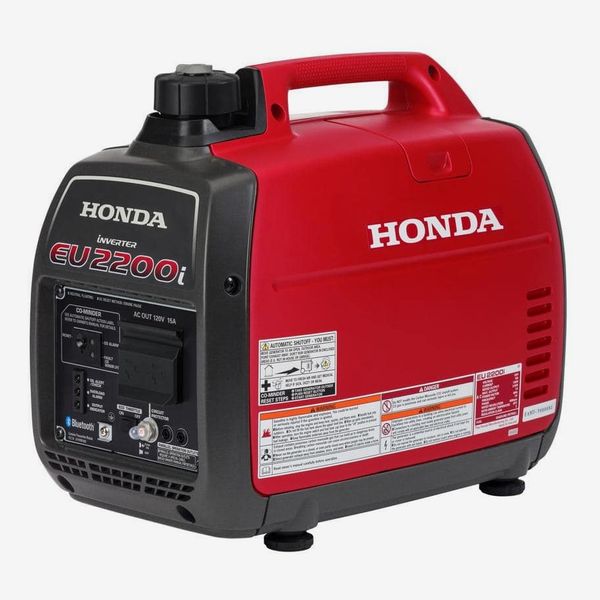
Capacity: 2200 watt hours / Outlets: 2 AC / Weight: 46 pounds
If you’re looking for a compact, quiet, and reliable generator for powering a few appliances during a storm, running a few tools at a worksite, or keeping smaller devices running at a campsite or tailgating party, this is the generator for you. With a full tank of gas, the EU2200i can run for more than eight hours, and during that time it provides steady power via two 120-volt outlets. Of the noise, Generator Bible’s Paul Melville says that it’s quiet, operating at 57 decibels, which is comparable to the volume of a normal conversation. Any reasonably able-bodied adult should be able to move this generator about with ease, as it weighs less than 50 pounds, and anyone will be able to operate it, too. It uses an easy pull-start ignition system and can be powered off by an onboard switch or remotely via app as this is a Bluetooth-enabled generator. It’s too small to tie into a home AC system or run any other larger power users that call for 240 volts (such as an oven, washer, or dryer), but for most people and most applications, it’s a great choice. Need more power? Consider purchasing another one; per the Aubuchon Company’s Dandy, “the EU2200i has a unique feature that allows the user to link a companion generator,” which effectively doubles the output power.
Best tri-fuel generator
New! You can now save this product for later.
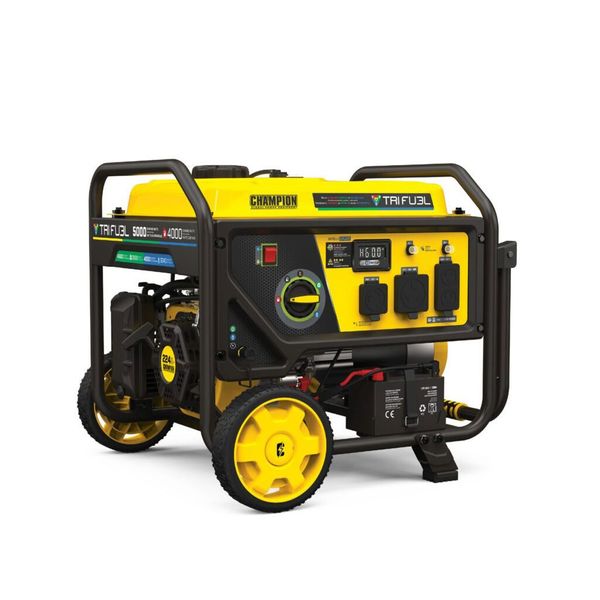
Capacity: 4000 watt hours / Outlets: 4 AC / Weight: 135 pounds
A common complaint about traditional gas-powered generators is that fuel can go stale during long stretches between uses, making the engine harder to start in an emergency. Dual-fuel generators, which can run on either gasoline or the liquid propane in your gas grill’s tank, help sidestep that issue, and tri-fuel models like this Champion can also run on natural gas if you choose to have a plumber connect it permanently. “One benefit to doing a dual-fuel generator is that propane will store much longer than gasoline,” says Feak. “So it will not lose its combustibility, so you can have it sit in a shed for five years and it’ll be just as combustible as when you bought it.” The ability to run on propane may also help you avoid long lines at gas stations during major outages.
The Champion’s power output varies depending on the fuel source. On gasoline, it produces 5,000 starting watts and 4,000 running watts, while propane delivers 4,500 starting watts and 3,600 running watts. This model includes several features that make owning a gas engine easier, including a switch-activated electric start powered by an included battery, which is a major advantage for anyone uncomfortable with pull-starting a generator. It’s also engineered for easier cold-weather starts, a critical feature since winter storms are a common cause of power outages. While it doesn’t offer smartphone connectivity, a built-in display shows useful information at a glance, including power output and run-time data to help track maintenance intervals.
Gas generators are never quiet, but the Champion registers around 68 decibels from 23 feet away, roughly comparable to the sound of an electric toothbrush held at arm’s length. More important, it includes built-in carbon monoxide detection that can automatically shut the generator down if CO levels become dangerous. “A CO monitor that will automatically shut off the generator if it detects too high a concentration of carbon monoxide is a feature everyone should consider, considering how deadly CO can be and how people sometimes don’t think about the placement and have these units too close to a basement window or an open garage door,” says Feak. With a full five-gallon tank of gasoline, the 224cc engine can run for up to 14 hours at half load, while a standard 20-pound propane tank delivers about 10.5 hours at the same load.
Best heavy-duty gas generator
New! You can now save this product for later.
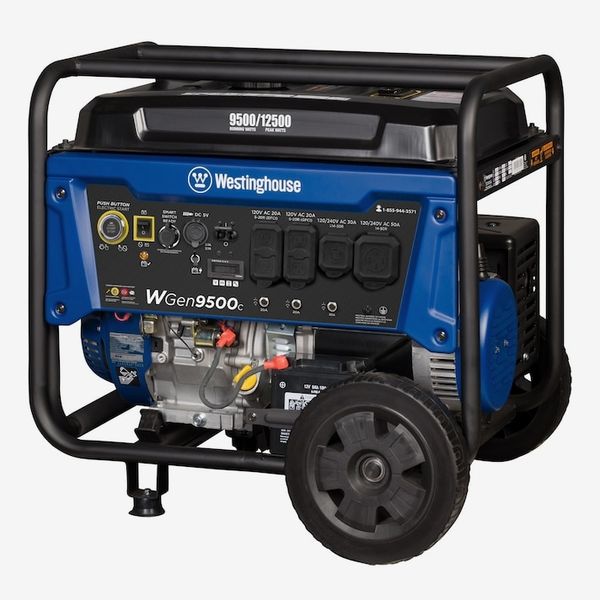
Capacity: 9500 watt hours / Outlets: 4 AC / Weight: 209 pounds
If you need to keep your entire home running like the power never went out or you need to supply electricity to a bustling job site, a television shoot, or multiple campsites at once, this burly generator is the one for you. Generator Bible’s Melville trusts the Westinghouse brand following years of positive experiences with its generators. The company is “really efficient when it comes to product support and warranty support,” he says. Not that you’re likely to need help on that latter front, as the WGen9500c is a remarkably reliable machine. The generator can run for up to 12 hours when under a modest load — say, running a fridge, a TV, and a fan — and can perform for eight hours at half-load, which could still mean powering multiple tools and/or appliances at once. Start-up is done via switch or remote control and is 100 percent electric — no need for pulling a cord. The generator self-monitors while running, shutting down if the oil runs low or if it detects carbon monoxide buildup. Heavy but well balanced, the generator is easy to move about on relatively flat, even ground thanks to its wheels, so you can get power wherever you need it. It may seem like more power than many people need, but Aubuchon Company’s Dandy advises, “I always said overkill in this case is not a bad thing.”
Our experts
• Corey Dandy, a manager with the hardware chain Aubuchon Company
• Kevin Feak, an engineer with Fire Protection and Safety Services
• Paul Melville, Generator Bible
The Strategist is designed to surface the most useful, expert recommendations for things to buy across the vast e-commerce landscape. Some of our latest conquests include the best acne treatments, rolling luggage, pillows for side sleepers, natural anxiety remedies, and bath towels. We update links when possible, but note that deals can expire and all prices are subject to change.
Every editorial product is independently selected. If you buy something through our links, New York may earn an affiliate commission.